M.Sc Natural Resource Management is a graduate-level program offered by the Graduate School of Science and Technology at Mid-West University in Birendranagar, Surkhet, Nepal. The program focuses on natural resources, biodiversity, water resource management, climate change, energy resources, land use, environmental assessment, policy, governance, and research-based study.
The course runs for 2 years through 4 semesters and carries 68 total credit hours. It follows the semester system and includes theory courses, practical components, seminars, project work, elective courses, entrepreneur development, and a master’s thesis.
| Field | Details |
|---|---|
| Course | M.Sc Natural Resource Management |
| Short form | M.Sc NRM |
| Institution | Mid-West University School of Science and Technology |
| Academic unit | Graduate School of Science and Technology |
| University | Mid-West University |
| Location | Birendranagar, Surkhet, Nepal |
| Level | Graduate |
| Duration | 2 years |
| System | Semester system |
| Number of semesters | 4 |
| Total credit hours | 68 |
| Eligibility | B.Sc. Agriculture/ Botany/Biotechnology/ Microbiology/ Environmental Science/ Environmental Management/ Food Technology/ Forestry/Natural Resource Management/ Statistics/ Zoology, other B.Sc. program, or BE Agriculture/ Architecture/ Civil/Environmental Engineering, or relevant discipline from any recognized university with an aggregate of 50% or 2.00 GPA out of 4.00 |
| Entrance exam duration | 2 hours |
| Entrance exam format | 100 questions, 1 mark each |
| Website | mugsst.edu.np |
M.Sc Natural Resource Management at Mid-West University School of Science and Technology is structured for students who want graduate-level study in natural resource systems and their management. The program covers ecological, economic, policy, technical, and environmental aspects of resource management.
Students study subjects such as Introduction of Natural Resources, Ecological Principles for Resource Management, Natural Resource Economics, Natural Resource Policy and Governance, Forest and Biodiversity Management, Integrated Water Resource Management, Climate Change and Natural Resource Management, Sustainable Energy and Resources, Land Use and Land Degradation, and Environmental Assessment and Auditing.
The program also includes field-related and research-oriented components through geospatial technologies, seminars, project work, elective courses, entrepreneur development, and a master’s thesis.
Applicants must have completed one of the following academic backgrounds from any recognized university:
B.Sc. Agriculture
B.Sc. Botany
B.Sc. Biotechnology
B.Sc. Microbiology
B.Sc. Environmental Science
B.Sc. Environmental Management
B.Sc. Food Technology
B.Sc. Forestry
B.Sc. Natural Resource Management
B.Sc. Statistics
B.Sc. Zoology
Other B.Sc. program
BE Agriculture
BE Architecture
BE Civil
BE Environmental Engineering
Relevant discipline
Applicants must have an aggregate of 50% or 2.00 GPA out of 4.00.
Applicants need the following documents for the entrance application:
A copy of citizenship
Bachelor-level marksheets for M.Sc. application
Other certificates, including character and provisional certificates
Two copies of passport-size photos
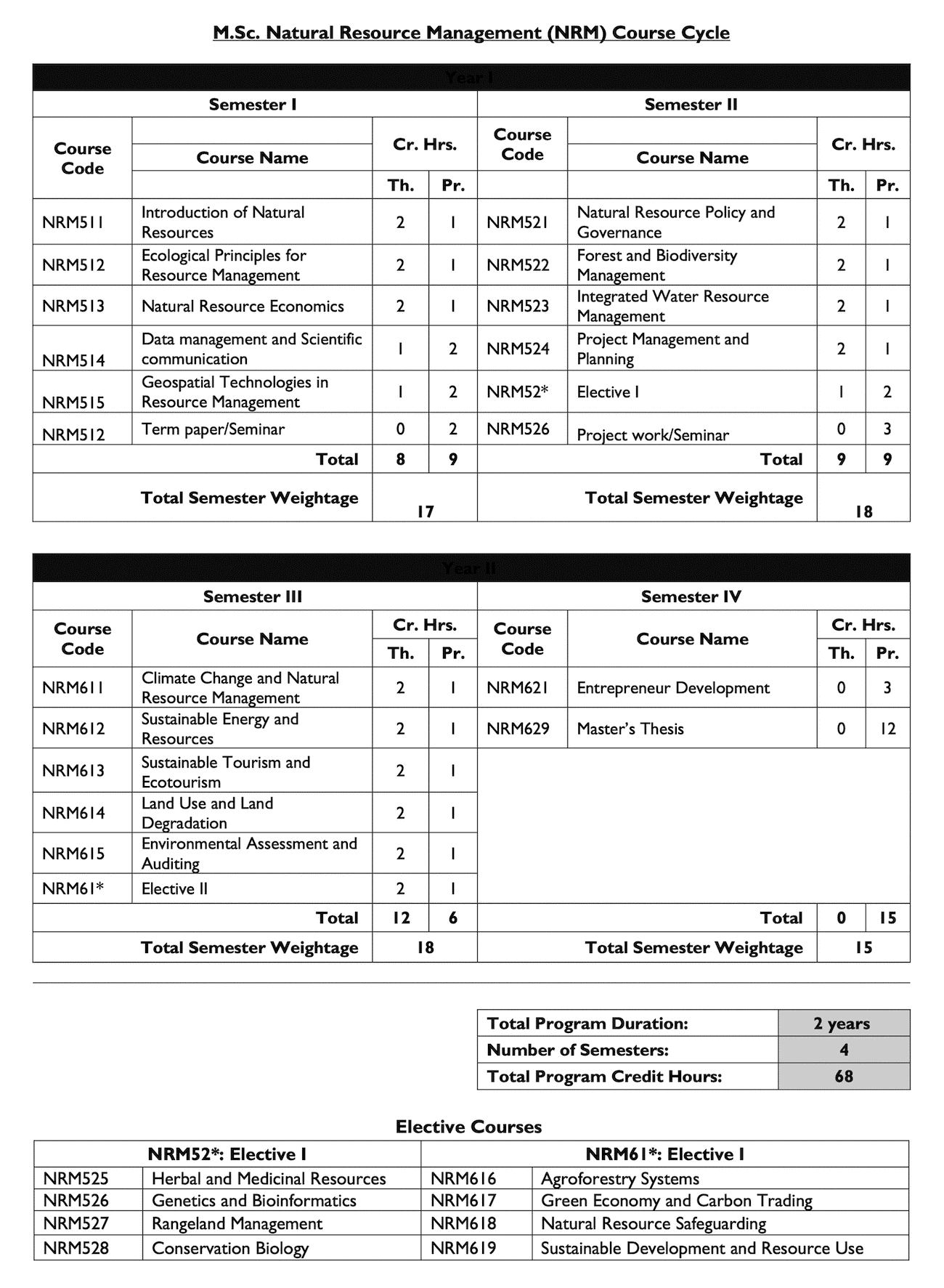
The program runs for 2 years through 4 semesters. It carries 68 total credit hours.
| Semester | Theory Credit Hours | Practical Credit Hours | Total Semester Weightage |
|---|---|---|---|
| Semester I | 8 | 9 | 17 |
| Semester II | 9 | 9 | 18 |
| Semester III | 12 | 6 | 18 |
| Semester IV | 0 | 15 | 15 |
| Total | 29 | 39 | 68 |
| Course Code | Course Name | Theory | Practical |
|---|---|---|---|
| NRM511 | Introduction of Natural Resources | 2 | 1 |
| NRM512 | Ecological Principles for Resource Management | 2 | 1 |
| NRM513 | Natural Resource Economics | 2 | 1 |
| NRM514 | Data Management and Scientific Communication | 1 | 2 |
| NRM515 | Geospatial Technologies in Resource Management | 1 | 2 |
| Term Paper/Seminar | 0 | 2 |
| Course Code | Course Name | Theory | Practical |
|---|---|---|---|
| NRM521 | Natural Resource Policy and Governance | 2 | 1 |
| NRM522 | Forest and Biodiversity Management | 2 | 1 |
| NRM523 | Integrated Water Resource Management | 2 | 1 |
| NRM524 | Project Management and Planning | 2 | 1 |
| NRM52* | Elective I | 1 | 2 |
| NRM526 | Project Work/Seminar | 0 | 3 |
| Course Code | Course Name | Theory | Practical |
|---|---|---|---|
| NRM611 | Climate Change and Natural Resource Management | 2 | 1 |
| NRM612 | Sustainable Energy and Resources | 2 | 1 |
| NRM613 | Sustainable Tourism and Ecotourism | 2 | 1 |
| NRM614 | Land Use and Land Degradation | 2 | 1 |
| NRM615 | Environmental Assessment and Auditing | 2 | 1 |
| NRM61* | Elective II | 2 | 1 |
| Course Code | Course Name | Theory | Practical |
|---|---|---|---|
| NRM621 | Entrepreneur Development | 0 | 3 |
| NRM629 | Master’s Thesis | 0 | 12 |
| Course Code | Course Name |
|---|---|
| NRM525 | Herbal and Medicinal Resources |
| NRM526 | Genetics and Bioinformatics |
| NRM527 | Rangeland Management |
| NRM528 | Conservation Biology |
| Course Code | Course Name |
|---|---|
| NRM616 | Agroforestry Systems |
| NRM617 | Green Economy and Carbon Trading |
| NRM618 | Natural Resource Safeguarding |
| NRM619 | Sustainable Development and Resource Use |
The entrance examination for M.Sc Natural Resource Management has a duration of 2 hours. It includes 100 questions, with 1 mark for each question.
| Subject Area | Number of Questions |
|---|---|
| General Knowledge | 10 |
| English | 10 |
| Computer Science | 10 |
| Biology | 20 |
| Chemistry | 20 |
| Physics | 20 |
| Mathematics | 10 |
| Total | 100 |
The General Knowledge section covers biodiversity and conservation, IUCN Red List, protected areas, endangered species, ecological systems, ecological succession, environmental degradation, global environmental issues, SDGs, and international environmental agreements such as the Kyoto Protocol, Paris Agreement, and Convention on Biological Diversity.
It also includes major ecosystems, landforms, rivers, watersheds, climate zones, global circulation patterns, global distribution of natural resources, international environmental policies, environmental conferences, renewable energy, resource management, environmental disasters, green technologies, sustainability practices, national environmental policy, Environmental Protection Act, NGOs, environmental economics, carbon credits, green taxes, and subsidies.
The English section includes vocabulary, synonyms and antonyms, homonyms, homophones, word building, suffixes and prefixes, contextual meaning, idioms and phrases, grammar, reading comprehension, writing, punctuation, cohesive devices, coherence, discourse markers, phonemes, phonemic symbols, word stress, and intonation.
The Computer Science section covers computer hardware and functions, CPU, RAM, storage devices, input and output devices, operating system basics, Windows file and folder handling, user interface basics, word processors, spreadsheets, presentation tools, internet basics, web browsers, email, cyber security, safe browsing, phishing, malware, password security, data privacy, ethical data sharing, computer networks, LAN, WAN, HTTP, TCP/IP, cloud computing, and environmental data management.
The Biology section includes cell biology, eukaryotic and prokaryotic cells, cellular respiration, photosynthesis, mitosis, meiosis, ecology, ecosystem dynamics, energy flow, food webs, trophic levels, biomes, human impact on ecosystems, conservation biology, ecological restoration, genetics, evolution, biodiversity, genetic conservation, environmental pollution and human health, microorganisms in ecosystems and health, plant physiology, carbon cycle, animal behavior, and ecological roles in food webs.
The Chemistry section covers atomic structure, periodic table, chemical bonding, chemical reactions, water chemistry, soil chemistry, air chemistry, industrial processes and environmental impact, organic chemistry, hydrocarbons, organic pollutants, biodegradation, environmental cleanup, physical chemistry, chemical equilibrium, thermochemistry, kinetics of environmental processes, renewable resources, biodegradable polymers, waste minimization, and recycling in the chemical industry.
The Physics section includes mechanics and motion, Newton’s laws of motion, work, energy, power, conservation of energy and momentum, simple machines, thermodynamics, heat transfer, heat engines, refrigeration, heat pumps, environmental applications of thermodynamics, electromagnetism, electric fields, potential, current, magnetic fields, electromagnetic waves, optics, solar energy, photovoltaic cells, remote sensing, GIS, renewable energy sources, greenhouse effect, global warming, radiation, and effects on ecosystems.
The Mathematics section covers algebra, linear equations, polynomials, quadratic equations, matrices, determinants, vectors, calculus, limits, differentiation, integration, applications of derivatives and integration, statistics, probability, central tendency, probability distributions, regression analysis, correlation, hypothesis testing, vector operations, geometry, GIS and remote sensing applications, population growth models, resource depletion, sustainability models, and differential equations in environmental modeling.
The program gives students a structured foundation in natural resource systems, environmental issues, and resource governance. It connects ecological study with economics, policy, water resources, biodiversity, climate change, energy, land use, environmental assessment, and research.
The course also gives space to technical and applied study through geospatial technologies, scientific communication, project planning, seminars, and thesis work.
The course is offered within the Graduate School of Science and Technology at Mid-West University. The school’s academic setting includes undergraduate and graduate programs in science, technology, environmental studies, information technology, and natural resource management.
Students study in an academic environment that supports classroom learning, laboratory practice, research preparation, field-based exposure, seminars, workshops, and academic activities related to science and technology.
Students at Mid-West University School of Science and Technology have access to academic resources that support subject learning and research preparation.
The school has laboratories in physics, chemistry, zoology, botany, and computer science. These laboratories support practical learning and academic work across science and technology programs.
The library includes textbooks, reference materials, and national and international journals for academic reading and research preparation.
Field visits are arranged according to the nature of the course. These visits help students connect classroom learning with practical observation.
Student counseling is part of the school’s student support system and helps students with academic and professional direction.
Admission includes application screening through the concerned academic office or campus. Eligible candidates appear in an entrance test. Admitted candidates are required to submit necessary documents within the given admission period.
Students can contact the Graduate School of Science and Technology for current admission dates, application requirements, fee structure, available seats, and document details.
M.Sc Natural Resource Management is offered at Mid-West University School of Science and Technology in Birendranagar, Surkhet, Nepal.
Contact: Graduate School of Science and Technology, Dean’s Office
Phone: +977-083-520176
Email: info@mugsst.edu.np
Website: mugsst.edu.np
Contact: GSST Central Departments
Phone: +977-083-524275
Location: Birendranagar 08, Surkhet
M.Sc Natural Resource Management runs for 2 years.
The program has 4 semesters.
The program has 68 total credit hours.
Applicants need B.Sc. Agriculture, Botany, Biotechnology, Microbiology, Environmental Science, Environmental Management, Food Technology, Forestry, Natural Resource Management, Statistics, Zoology, another B.Sc. program, or BE Agriculture, Architecture, Civil, Environmental Engineering, or a relevant discipline from any recognized university with an aggregate of 50% or 2.00 GPA out of 4.00.
The entrance exam is 2 hours long and has 100 questions. Each question carries 1 mark.
The entrance examination includes General Knowledge, English, Computer Science, Biology, Chemistry, Physics, and Mathematics.
Yes. Semester IV includes Master’s Thesis with 12 practical credit hours.
The course is offered at Mid-West University School of Science and Technology, Graduate School of Science and Technology, Birendranagar, Surkhet, Nepal.