Bachelor of Business Studies (BBS) at Quest Model College (QMC), Ratnanagar-8, Chitwan is a Tribhuvan University (TU) affiliated bachelor’s program delivered in a four-year annual examination system. The program builds a foundation in business communication, quantitative methods, economics, law, accounting, marketing, finance, and organizational behavior, then moves into a concentration area in the final year. Students complete a final project that includes fieldwork and a formal report and presentation process. On campus, BBS students study in a technology-integrated learning environment supported by laboratories, a library, counseling services, and academic support in selected subjects.
| Item | Details |
|---|---|
| Course Name | Bachelor of Business Studies (BBS) |
| College | Quest Model College (QMC) |
| Location | Ratnanagar-8, Chitwan, Nepal |
| Affiliation | Tribhuvan University (TU), Faculty of Management (FOM) |
| Duration | 4 years |
| Exam System | Annual examination system |
| Graduation Requirement | Completion of required courses (total 1950 marks) and a final project report (50 marks), with passing grades in all components |
| Eligibility | 10+2 in business/commerce or equivalent recognized by TU; additional criteria may apply as set by the Faculty Board or campus |
| Attendance Requirement | Minimum 70% attendance to qualify for annual examinations |
| Specialization | Three concentration courses in one functional area (Accounting/Finance/Marketing/Management) |
| Learning Support at QMC | Counseling; academic support in English, Mathematics, and Accountancy |
| Key Facilities | Library, science lab, computer lab, multimedia, conference hall, cafeteria, transportation, CCTV |
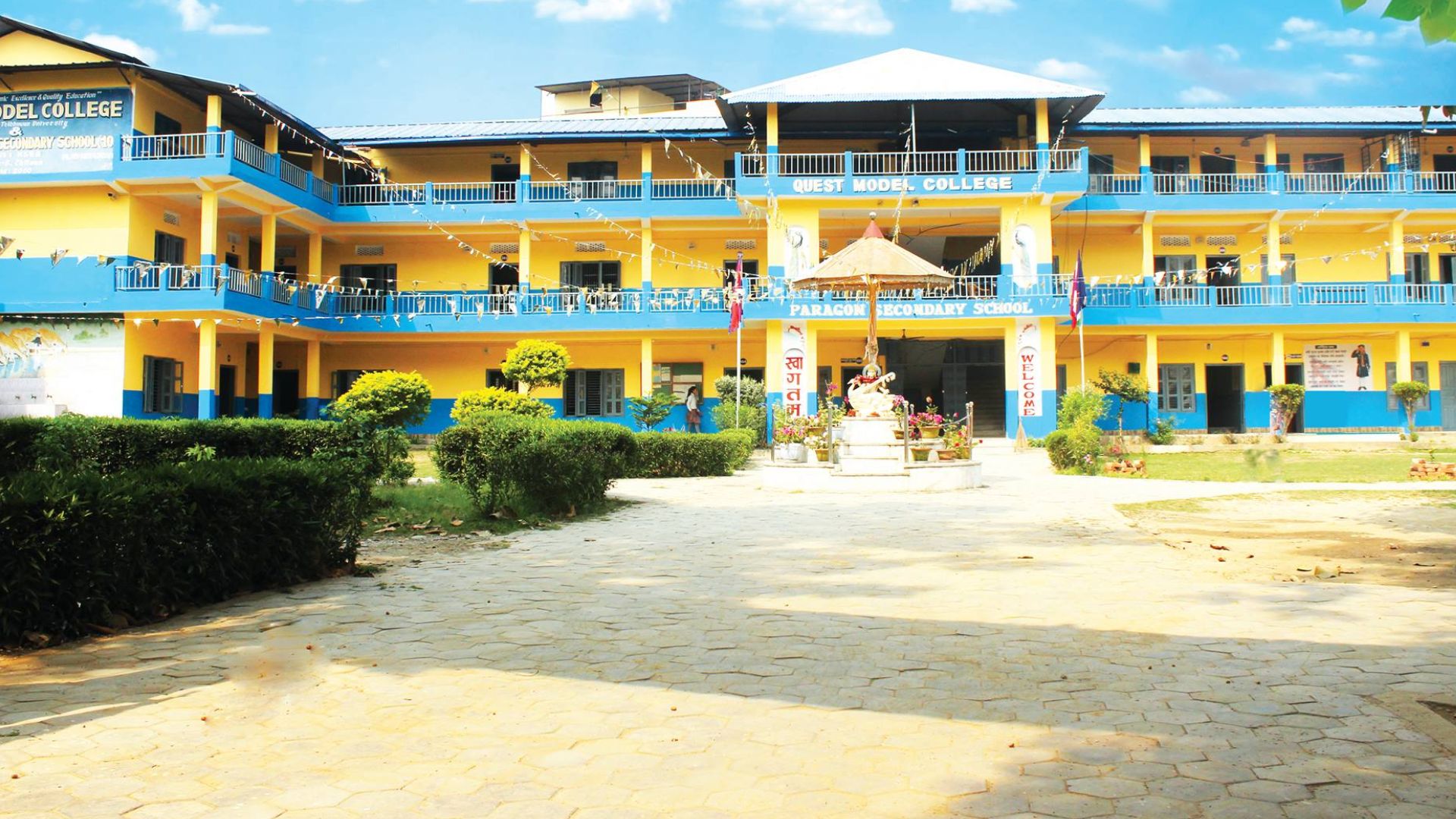
BBS at QMC is structured to develop managerial knowledge and practice-oriented skills relevant to business, industry, and government contexts. The learning setup includes technology-integrated classrooms, lab support, and student services such as counseling. Students also have access to facilities such as a library, science and computer labs, and academic support in English, Mathematics, and Accountancy.
The BBS curriculum includes:
Compulsory courses in language, statistics, and economics
Core courses across accounting, management, marketing, finance, HR/OB, strategy, taxation, entrepreneurship, research methods, and financial systems
Concentration area: three courses selected from one functional area (Accounting, Finance, Marketing, or Management) 45
First Year (500 marks)
MGT 201: Business English (100)
MGT 202: Business Statistics (100)
MGT 207: Microeconomics for Business (100)
MGT 211: Financial Accounting and Analysis (100)
MGT 213: Principles of Management (100) 5
Second Year (500 marks)
MGT 205: Business Communication (100)
MGT 209: Macroeconomics for Business (100)
MGT 212: Cost and Management Accounting (100)
MGT 223: Organizational Behavior & Human Resource Management (100)
MGT 215: Fundamentals of Financial Management (100)
Third Year (500 marks)
MGT 204: Business Law (100)
MGT 226: Foundation of Financial Systems (100)
MGT 217: Business Environment and Strategy (100)
MGT 224: Taxation in Nepal (100)
MGT 214: Fundamentals of Marketing (100)
Fourth Year (500 marks)
MGT 225: Entrepreneurship (100)
Concentration I (100)
Concentration II (100)
Concentration III (100)
MGT 221: Business Research Methods (50)
MGT 401: Final Project (50)
Students complete three courses from one functional area:
Accounting: ACC 250, ACC 251, ACC 252, ACC 255, ACC 256
Finance: FIN 250, FIN 251, FIN 255, FIN 253, FIN 254
Marketing: MKT 250, MKT 251, MKT 252, MKT 253, MKT 254
Management: MGT 251, MGT 256, MGT 257, MGT 258, MGT 259
The final project is a required academic component for fourth-year students in all concentration courses. Students complete fieldwork and spend four weeks studying and learning from an organization at a time set by the campus/college. After fieldwork, the project report follows the prescribed format and may include a presentation to faculty/class. Evaluation involves internal and external examiners through the campus/college research committee, followed by a viva-voce process, and final scrutiny through TU’s examination office.
Business Research Methods (MGT 221) supports the project process and carries 50 full marks with a pass mark of 17.5.
The BBS program is built to develop students into competent managers across sectors by combining broad conceptual knowledge with practical, reality-based skills for organizational operations and management.
By the end of the program, students typically develop:
Functional understanding of core business areas (accounting, finance, marketing, HR/OB, strategy, taxation, entrepreneurship)
Research literacy through business research methods and final project work
Communication skills through Business English and Business Communication
Analytical skills through statistics and economics courses
BBS at QMC supports skill growth in:
Business communication (written, oral, and professional formats)
Quantitative analysis and decision support (statistics and related tools)
Accounting and financial interpretation
Legal and regulatory awareness in business settings
Market understanding and basic marketing practice
Research, report writing, and presentation through the final project
Teaching approaches include lectures, group discussions, problem-solving exercises, guest lectures, practical work, and project work. Case-based instruction is also encouraged where required and feasible. QMC supports students through counseling services and academic support in English, Mathematics, and Accountancy.
Applicants for BBS:
must have completed 10+2 in business/commerce or an equivalent course from a recognized board/university, and
must meet any additional entry requirements set by the Faculty Board or the campus.
Information not provided. Please verify application steps, required documents, entry tests (if any), and intake timelines with the official source.
Final evaluation is done through the annual examination conducted by TU’s Office of the Controller of Examinations.
Students must maintain minimum 70% attendance to qualify for annual examinations.
A student cannot appear in the second-year final examinations without first appearing in the first-year final examinations.
Annual examination division thresholds are listed as: Third Division 35%, Second Division 45%, First Division 60%, Distinction Division 75%.
Many 100-mark papers show a pass mark of 35, and MGT 221 (50 marks) shows a pass mark of 17.5.
QMC runs scholarship schemes that include full scholarships for district toppers, scholarships for students achieving ‘A+’ grades, financial aid for students from remote, underprivileged, ethnic, and marginalized communities, and performance-based scholarships for entrance and internal exam toppers, along with other need-based support categories. Scholarship coverage for BBS should be verified at the time of admission.
BBS supports broad entry-level readiness for roles across business and administrative functions depending on the student’s concentration area and skill focus. The program also provides a foundation for graduate-level study in management and related fields. Career outcomes are not guaranteed and depend on academic performance, specialization choices, and individual capability.
Students often select BBS at QMC for:
TU affiliation and annual program structure for BBS
Access to campus learning facilities such as library and labs
Counseling and subject support in English, Mathematics, and Accountancy
A campus environment that includes ECA, tours, and project-based learning support services
BBS at Quest Model College is a four-year TU-affiliated annual program that blends foundational business knowledge, core functional coursework, a final-year concentration, and a required final project with fieldwork. The campus learning environment includes library and lab facilities, counseling support, and academic assistance in selected subjects. Students planning to enroll should verify current admission timelines, fees, scholarship terms, and available concentration streams at the time of application.
Yes. BBS at QMC is affiliated with Tribhuvan University (TU).
BBS is a four-year program with an annual examination system.
Applicants must have completed 10+2 in business/commerce or an equivalent course recognized by TU, and must meet any additional criteria set by the Faculty Board or campus.
The curriculum covers Business English, statistics, economics, accounting, management, marketing, finance, HR/organizational behavior, strategy, taxation, entrepreneurship, financial systems, research methods, and a final-year concentration area.
Students take three concentration courses in one area: Accounting, Finance, Marketing, or Management (subject to campus availability).
Yes. The fourth year includes a final project with fieldwork (four weeks) and a project report and evaluation process.
Students must have a minimum of 70% attendance to qualify for annual examinations.
Many 100-mark papers list a pass mark of 35, and MGT 221 (50 marks) lists a pass mark of 17.5. Division thresholds are: Third 35%, Second 45%, First 60%, and Distinction 75%.