Ten Plus Two (+2) Humanities
- 10+2
- +2 Humanities
- National Examinations Board (NEB)
- Duration2 Years
- Study ModeFull Time
- MediumEnglish
About Ten Plus Two (+2) Humanities
Ten Plus Two (+2) Humanities at United Academy
Ten Plus Two (+2) Humanities at United Academy, Kumaripati, Lalitpur, is a two-year higher secondary program affiliated with the National Examinations Board (NEB). United Academy is a co-educational +2 secondary school established in 1997. The Humanities stream is offered for students interested in social sciences, communication, writing, social issues, and community-based learning after SEE or an equivalent examination.
The program includes subjects such as English, Nepali, Mass Communication, Mathematics or Social Studies, Population Studies, Sociology, and Optional English. It includes field visits, projects, community engagement activities, debates, creative writing workshops, and research-related learning. United Academy lists the Humanities stream with morning and day shift options, along with field work scheduled according to course requirements.

Highlights
-
Course Name: Ten Plus Two (+2) Humanities
-
College: United Academy
-
Location: Kumaripati, Lalitpur, Nepal
-
Board: National Examinations Board (NEB)
-
Level: Higher Secondary
-
Duration: 2 years
-
Classes: XI and XII
-
Main Subject Areas: English, Nepali, Mass Communication, Mathematics or Social Studies, Population Studies, Sociology, and Optional English
-
Morning Shift: 6:30 AM to 11:30 AM
-
Day Shift: 11:40 AM to 4:50 PM
-
Field Work: Scheduled as per course requirements
-
Course Link: Ten Plus Two (+2) Humanities at United Academy
-
Learning Activities: Field visits, projects, community engagement, debates, creative writing, and research-related work
Curriculum Details
The +2 Humanities stream at United Academy follows the NEB Humanities stream structure. The curriculum is connected with social science study, communication, writing, and society-focused subjects. The course is suited to students who want to study human society, social relationships, communication, population issues, and related fields at the higher secondary level.
The subjects listed for the Humanities stream include:
-
English
-
Nepali
-
Mass Communication
-
Mathematics or Social Studies
-
Population Studies
-
Sociology
-
Optional English
The Humanities program also includes field visits, project activities, community engagement, debate, creative writing, and research-related academic work. Field work is scheduled according to course requirements.
The course information does not include a full subject-wise credit table. The stated subjects show that the stream is built around language study, social science, communication, population study, and field-based learning.
Objectives
-
Introduce students to humanities and social science subjects at the higher secondary level
-
Build academic grounding in communication, society, population, language, and social relationships
-
Connect classroom study with field visits, projects, and community engagement activities
-
Develop reading, writing, discussion, debate, and research-related habits
-
Prepare students for further study in Sociology, Psychology, Journalism, Social Work, Development Studies, and related fields
Scope
The +2 Humanities stream is connected with academic interests in social sciences, journalism, social work, communication, development studies, writing, and society-focused study. United Academy links the program with further study in Sociology, Psychology, Journalism, Social Work, and Development Studies.
These are possible academic directions after completing the Humanities stream. The course information does not give job placement figures, salary details, seat numbers, or employment guarantees. Students comparing Humanities programs can look at subject choices, class timings, field work, teaching methods, examination system, and activities such as debate, creative writing, and community projects.
Learning Outcomes
-
Understand introductory ideas in social sciences and communication
-
Study society, population, language, and media-related subjects
-
Take part in field visits and project work connected with course requirements
-
Practice discussion, debate, writing, and research-related activities
-
Complete assignments and teacher-guided projects
-
Prepare for class tests, terminal examinations, mock examinations, and send-up examinations
-
Use model questions, revision classes, tutorials, and handouts for NEB examination preparation
Skill Development
-
Reading and interpretation of social science texts
-
Writing practice through English, Optional English, and creative writing activities
-
Communication study through Mass Communication
-
Discussion and public speaking through debates
-
Research-related work through projects and field visits
-
Community-based observation through engagement activities
-
Assignment writing and presentation practice
-
Examination preparation through tests, model questions, and revision classes
Teaching Methodology
United Academy uses orientation lectures and course-study booklets for students entering Classes XI and XII. Students receive chapter-wise model questions to understand board examination patterns and possible question formats. Revision and discussion classes are held after send-up examinations.
The academic system includes:
-
Orientation on the course of study
-
Chapter-wise model questions
-
Revision and discussion classes
-
Special classes for selected merit students
-
Intensive Care Classes for students needing added academic help
-
Free tutorial classes
-
Handouts as reference materials
-
Assignments across subjects
-
Teacher-guided project work
-
Parent and guardian interaction after terminal examinations
Project work is based on classwork and data collected from field visits to commercial, industrial, media, sociocultural, and scientific organizations. Subject teachers guide the project process, and project marks are added to final send-up results.
United Academy also uses a Student as a Tutor Programme. After the second term examination, students deliver lectures on topics already covered from the beginning of the session. This gives students a formal way to review lessons through presentation and peer explanation.
For Humanities students, practical learning is also linked with field visits, projects, community engagement activities, debate, creative writing, and research-related tasks. These activities match the stream’s focus on society, communication, and human behavior.
Career Opportunities
After completing +2 Humanities, students may pursue further academic pathways connected with:
-
Sociology
-
Psychology
-
Journalism
-
Social Work
-
Development Studies
-
Mass Communication
-
Writing and communication-related study
-
Social science-related undergraduate programs
These pathways depend on the student’s subject combination, academic performance, entrance requirements, and further study choices. The course information does not state placement assurance, salary outcomes, or guaranteed admission into higher education programs.
Scholarships and Financial Aid
United Academy provides scholarship options for +2 students, including Humanities students. The merit-based entrance scholarship uses 75% entrance examination and 25% SEE GPA as the selection basis.
-
First position in entrance merit receives 100% admission fee and 100% tuition fee support.
-
The scholarship table includes one Humanities Faculty student under the first-position category.
-
Best Student Awards are provided to the top three students of each faculty in Classes XI and XII based on annual competition examination results.
-
Academic Awards are provided to the top three students per faculty in each terminal examination.
-
Students from United School and United Universal School have a sister-organization scholarship scheme.
-
Other listed schemes include Remote Area Scholarships, Best Athletics and Sports Scholarships, and District Topper Scholarships.
-
Financial support is available for students from financially challenging backgrounds as recommended by the Education Office of Lalitpur Metropolitan City.
Scholarship categories, seat availability, and fee support depend on the admission year and the Academy’s scholarship rules.
Admission Process
-
Students must have passed SEE or an equivalent examination.
-
Equivalent examinations include ICSE or CBSE.
-
Students applying before SEE results are available should submit their latest Class 10 school report card.
-
Applicants appear for an entrance examination.
-
Students who perform well in the entrance examination proceed to an ability test.
-
The ability test is used for subject selection across Science, Management, Humanities, and Law.
-
Students may apply by visiting the United Academy admissions office or through the official website.
Required Documents
-
Latest Class 10 school report card for students applying before SEE results are available
-
SEE or equivalent academic record for students applying after results are available
Exam and Result Process
United Academy uses internal assessments and written examinations across the academic year. The evaluation system includes Chapter-wise Tests, Zero-hour Tests, Unit Tests, Class Tests, Terminal Examinations, Mock Examinations, and Send-up Examinations.
The evaluation pattern assigns 25% of student performance to internal evaluation and 75% to written examinations. Internal evaluation includes homework, classroom behavior, disciplinary activities, attendance, internal examinations, and presentations.
The evaluation scheme also mentions one Unit Test, two Saturday Tests, three Terminal Examinations, and regular class tests in each subject. Revision and discussion classes are held after send-up examinations, and re-examination opportunities are listed for students needing further academic help.
For Humanities students, practical revision focuses on subjects such as Sociology, Mass Communication, and Population Studies before the NEB final examination.
Student Support and Facilities
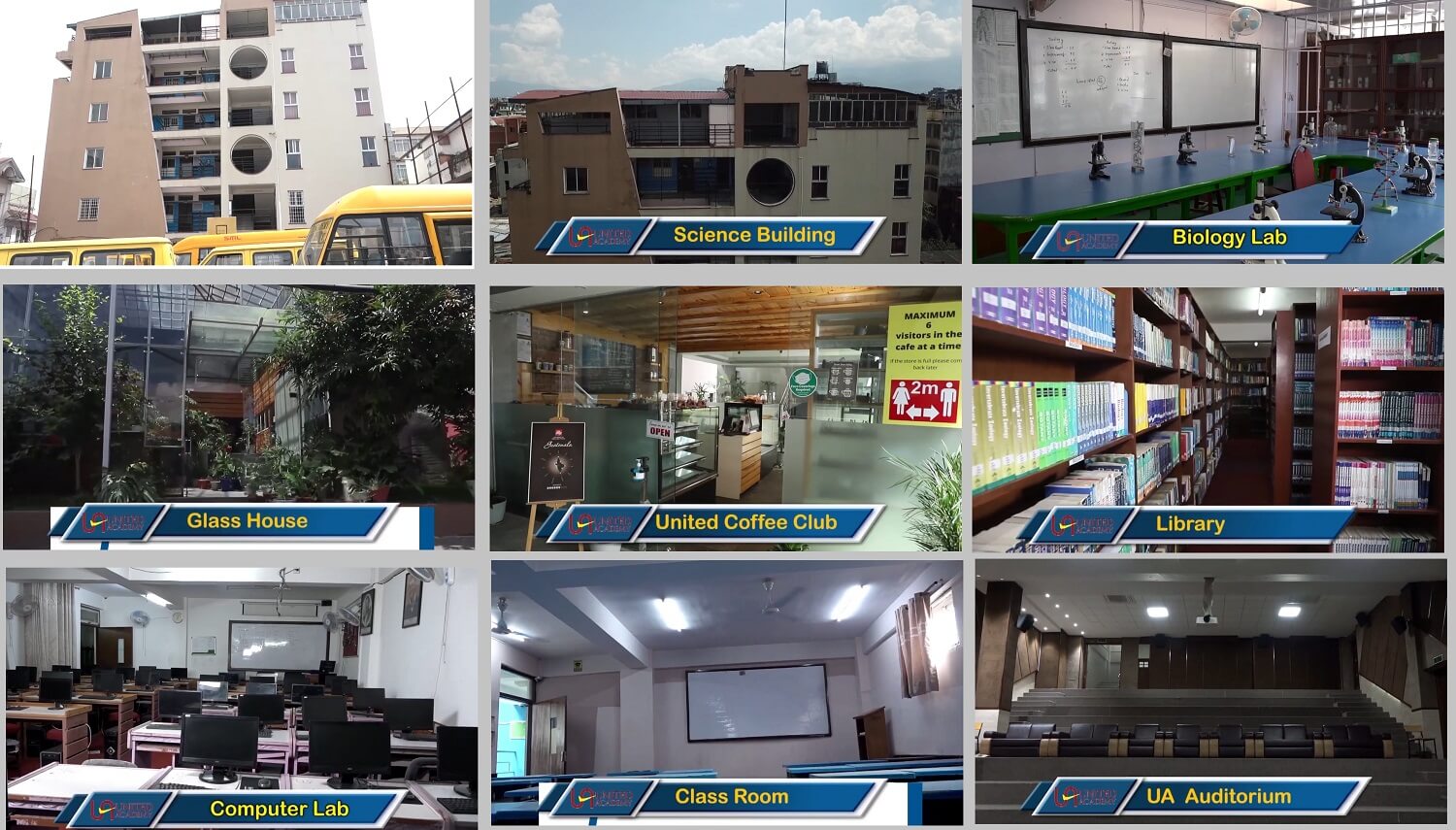
Humanities students study within the wider academic and student service system of United Academy. The Academy provides separate hostel facilities for boys and girls, health services, counselling services, food services, and student clubs.
The Health Centre operates from 6:00 AM to 5:00 PM and provides general treatment, first aid, health counselling, checkups, treatment for common illnesses, vaccinations, and health-related guidance. Emergency medical service is available for hostel students and staff.
Counselling services are available from Sunday to Friday. The counselling team works with students on academic stress, personal concerns, and interpersonal issues.
Food services include United Cafeteria Club, United Canteen, United Coffee Club, and United Cafe. Student clubs include Student Council Club, Literary Club, Nature Club, Cultural Club, Robotics Club, Social Work Club, and Sports Club.
Several student activities connect closely with Humanities study. The Literary Club publishes school magazines, the Social Work Club focuses on community service activities, the Cultural Club organizes cultural programs, and the Nature Club works on environmental awareness. These activities give Humanities students added space for writing, social observation, cultural participation, and community-related work.
Conclusion
Ten Plus Two (+2) Humanities at United Academy is an NEB-affiliated higher secondary stream for students who want to study social sciences, communication, language, population, and society-focused subjects after SEE. The course includes subjects such as English, Nepali, Mass Communication, Mathematics or Social Studies, Population Studies, Sociology, and Optional English.
The course details are strongest in subject areas, class timings, field work, project work, academic activities, teaching support, evaluation process, and student services. Students considering this program can review the Humanities subject combination, morning or day shift, field work requirements, entrance and ability-test process, scholarship rules, and current admission notice before applying.
Contact Information
Contact United Academy's administrative office for detailed information on the +2 Humanities course, including fees, scholarships, facilities, counseling, eligibility criteria, etc.
-
Location: Kumaripati, Lalitpur, Nepal, G.P.O Box: 8975 EPC 1195
-
Phone No: 01-5437530, 01-5438938
-
General Inquiries: info@united.edu.np
-
Website: https://academy.united.edu.np
Course Details
- Course Type+2 Humanities
- Level10+2
- Duration2 Years
- Affiliated To National Examinations Board (NEB)
- Study ModeFull Time
- MediumEnglish
- RecognitionMinistry of Education
-
Offered At
United Academy
Kumaripati, Lalitpur
Other Courses at United Academy 3
Latest Updates & Notices
- 19 Aug 26 HISSAN Lalitpur Honors United Academy, 4 Score 3.96 GPA
- 06 Jul 26 United School Students to Represent Nepal in Geneva
- 16 May 26 United Academy Lalitpur +2 Humanities Admission Open 2083
- 15 May 26 United Academy Lalitpur Admission Open 2083 NEB +2
- 05 Jul 25 United Academy Vacancy for 10+2 Teachers
- 30 Jun 25 United Academy Admission Open 2082 – Science, Management, Law, Humanities
- 27 Jan 25 United Academy Announces Audition Day for Creative Writing and Speaking
- 26 Jan 25 United Academy brings back United Robo Fest 3.0
Frequently Asked Questions
The listed subjects include English, Nepali, Mass Communication, Mathematics or Social Studies, Population Studies, Sociology, and Optional English.
The +2 Humanities program at United Academy is affiliated with the National Examinations Board (NEB).
The Humanities stream has a Morning Shift from 6:30 AM to 11:30 AM and a Day Shift from 11:40 AM to 4:50 PM.
Yes. Field work is scheduled as per course requirements. The program also includes field visits, projects, and community engagement activities.
The program is connected with further study in Sociology, Psychology, Journalism, Social Work, Development Studies, Mass Communication, and related social science fields.
Yes. Humanities students are included in the entrance merit scholarship table. The first-position category includes one Humanities Faculty student, and other scholarship schemes are also listed for +2 students.
Reviews
Questions & Discussions
Contact United Academy, Lalitpur
- AddressKumaripati, Lalitpur, Nepal, G.P.O Box: 8975 EPC 1195
- Phone+977-1-5437530
- Phone+977-1-5438938
- Phone+977-9712078748
- Phone+977-9712078749
- Emailinfo@united.edu.np
- Websiteacademy.united.edu.np
- Contact personUnited Academy, Lalitpur