The Bachelor of Civil Engineering (BE Civil) at Western Advance College of Engineering and Management (WACEM) is a four-year, full-time undergraduate program affiliated with Far Western University. Offered in Gaindakot-1, Nawalparasi (East), the course is divided into eight semesters and carries 167 credit hours.
It begins with mathematics, science, engineering drawing, programming, mechanics, and communication before moving into surveying, structural engineering, hydraulics, transportation, water resources, environmental engineering, construction, and project work. The later semesters include electives, a seminar, a survey camp, a minor project, and a field-based major project. Instruction is delivered in English through lectures, tutorials, practical classes, and laboratory work.
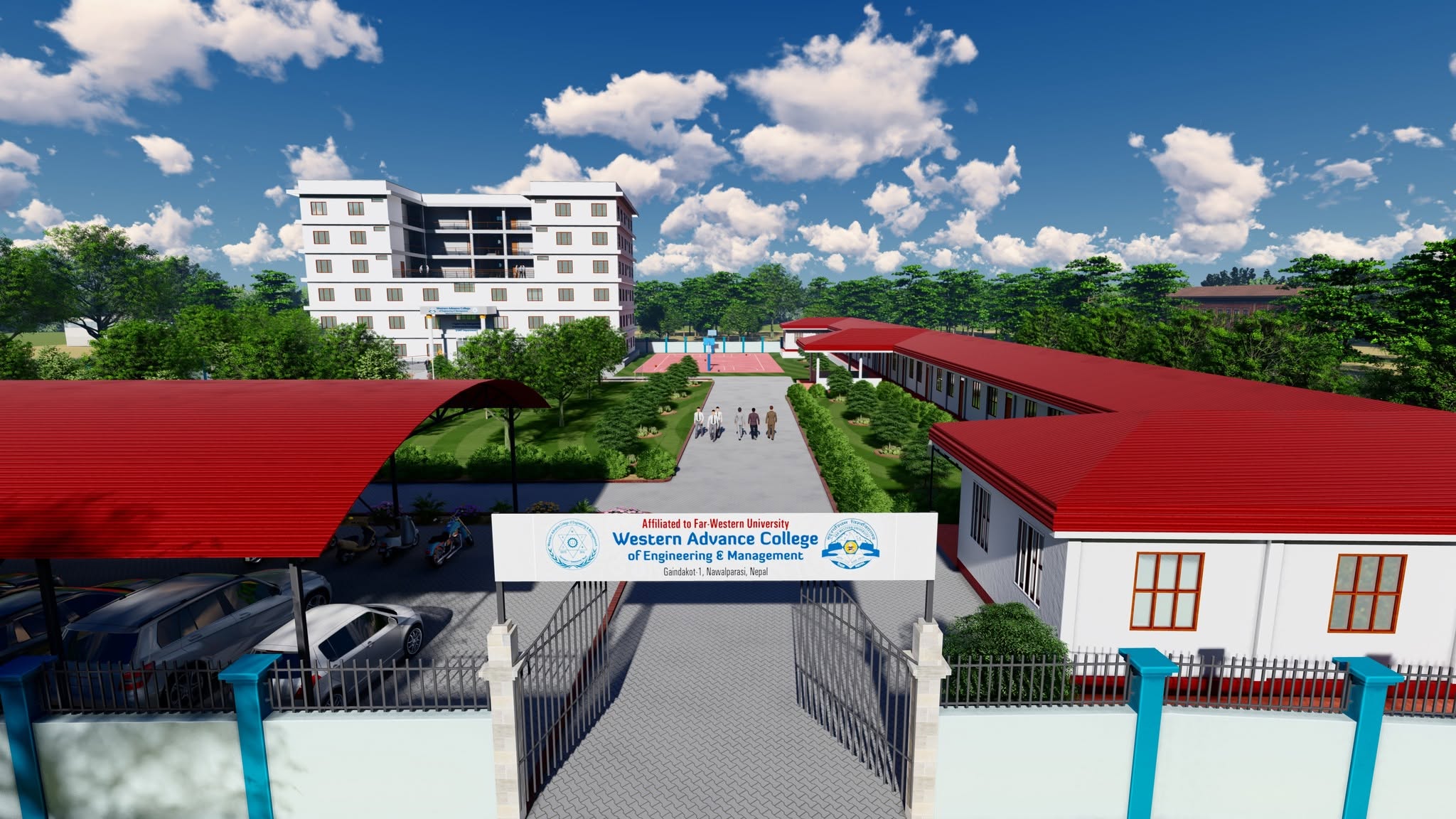
Course: Bachelor of Civil Engineering (BE Civil)
College: Western Advance College of Engineering and Management
Affiliation: Far Western University
Faculty: Faculty of Engineering
Level: Bachelor’s degree
Duration: Four years
Academic Structure: Eight semesters
Study Mode: Full-time
Total Credits: 167
Medium of Instruction: English
Location: Gaindakot-1, Nawalparasi (East), Gandaki Province
Eligibility: 10+2 with a ‘C’ grade or equivalent from a recognized board
The program covers the main technical areas involved in planning, analysing, designing, constructing, and managing civil engineering works. Students study structural systems, construction materials, soil and rock behaviour, surveying, transportation, water supply, irrigation, hydrology, environmental systems, and construction management.
The first year establishes a base in mathematics, chemistry, physics, programming, mechanics, drawing, communication, and construction materials. The second and third years introduce discipline-specific subjects, while the fourth year focuses on design, professional practice, electives, and project-based application. Each semester has a minimum duration of 90 working days or 15 weeks.
BE Civil may suit students interested in mathematics, physics, technical drawing, construction, infrastructure, surveying, and practical problem-solving.
Students should be prepared for numerical work, laboratory activities, field assignments, design exercises, technical reports, group tasks, presentations, and project development. The curriculum also requires engagement with computing, communication, economics, safety, and professional practice.
Candidates seeking admission must have completed 10+2 with a ‘C’ grade or an equivalent qualification from a recognized board.
The 167-credit curriculum combines lectures, tutorials, practical classes, laboratory work, field activities, electives, seminar work, and projects. Students complete at least four elective subjects carrying a combined 12 credits.
Tutorials extend concepts introduced through lectures, while practical and laboratory sessions develop applied understanding and basic technical skills. Presentations and multimedia-based instruction are encouraged during the fourth year.
The first two semesters cover Engineering Mathematics I and II, Engineering Chemistry, Engineering Drawing I and II, Basic Programming and Data Structure, Object Oriented Programming, Physics, Applied Mechanics, English for Communication, academic English, Construction Materials, and Fundamentals of Thermodynamics and Heat Transfer.
These subjects establish the scientific, mathematical, computing, drawing, and communication base required for later engineering study.
The third and fourth semesters include Engineering Mathematics III, Basic Mechanical Engineering, Engineering Survey I and II, Basic Electrical and Electronics Engineering, Strength of Materials, Engineering Geology, Fluid Mechanics, Structural Analysis I, Probability and Experimental Design, Building Drawing, Building Technology, Hydraulics, and Communication English II.
At this stage, students begin working more directly with civil engineering measurements, materials, structures, fluids, buildings, and technical analysis.
The fifth and sixth semesters cover Computer Methods in Civil Engineering, Engineering Economics, Structural Analysis II, Water Supply Engineering, Transportation Engineering, Hydrology and River Engineering, Survey Camp, Soil and Rock Mechanics, Irrigation Engineering, Design of Steel and Timber Structures, Sanitary and Environmental Engineering, Airport and Railway Engineering, Estimation, Costing and Valuation, Concrete Technology and Masonry Structure, and Seminar.
The survey camp and seminar add field observation, technical communication, analysis, presentation, and report-writing components to the academic work.
The seventh semester includes Design of RCC Structure, Hydropower Engineering, Foundation Engineering, Safety Engineering, Minor Project, Elective I, and Elective II.
The eighth semester covers RS and GIS Application to Engineering, Construction Management and Project Engineering, Engineering Professional Practice and Society, Major Project, Elective III, and Elective IV. The major project is field-based and may be connected with the student’s elective area.
Students can select courses from several civil engineering areas:
Structural engineering
Environmental engineering
Water resources engineering
Highway engineering
Infrastructure for sustainable development
Available subjects include Advanced Structural Engineering, Analysis and Design for Wind and Earthquake Effects, Air Pollution Engineering, Solid Waste Management, Environmental Impact Assessment, Water Resources Management, Sedimentation Engineering, Transport Project Planning and Evaluation, and Highway Design in Hilly Terrain.
Practical learning is included through laboratories, tutorials, engineering surveys, survey camp, seminar work, a minor project, and a major project.
The seminar develops critical analysis, oral presentation, technical writing, and report preparation. Students select a civil engineering topic, prepare a report, and present their work before subject experts and an audience.
Student performance is evaluated through internal assessment and final examinations.
For the theory component, 40 percent of the marks are assigned to internal assessment. Internal work may include attendance, class performance, assignments, tests, and quizzes. Practical subjects are generally evaluated continuously through laboratory performance, reports, presentations, and viva examinations.
Students require at least 70 percent attendance to qualify for the final examination. Most final examinations have a duration of three hours. A student must obtain at least 45 percent in both the internal and final components of each subject.
The course may help students develop abilities in:
Engineering drawing and CAD-based work
Land surveying and field measurement
Structural analysis and design
Construction materials and building technology
Soil, rock, and foundation analysis
Hydraulics, hydrology, and irrigation
Water supply and environmental engineering
Transportation, airport, and railway engineering
Estimation, costing, and valuation
Construction and project management
Technical reporting and presentation
Computer applications in civil engineering
Research and project development
Skill development depends on academic performance, practical participation, project quality, and continued technical learning.
Graduates may explore civil engineering-related work in construction, infrastructure development, environmental engineering, transportation, and urban planning. The curriculum also supports involvement in structural, water resources, surveying, estimation, project, and construction-related activities.
Students may continue into advanced study or research in civil engineering and its related areas. Career outcomes depend on individual ability, academic performance, practical experience, professional requirements, location, and available opportunities.
The course takes four years and is divided into eight semesters.
The complete curriculum carries 167 credit hours.
Applicants must have completed 10+2 with a ‘C’ grade or an equivalent qualification from a recognized board.
The medium of instruction is English.
Yes. The curriculum includes engineering surveying, a survey camp, practical classes, laboratory work, seminar activities, and a field-based major project.
Yes. Students complete four electives from structural, environmental, water resources, highway, and related civil engineering areas.
Assessment includes internal evaluation, practical or continuous assessment, and final examinations. Students must meet the attendance and separate pass requirements for internal and final components.