



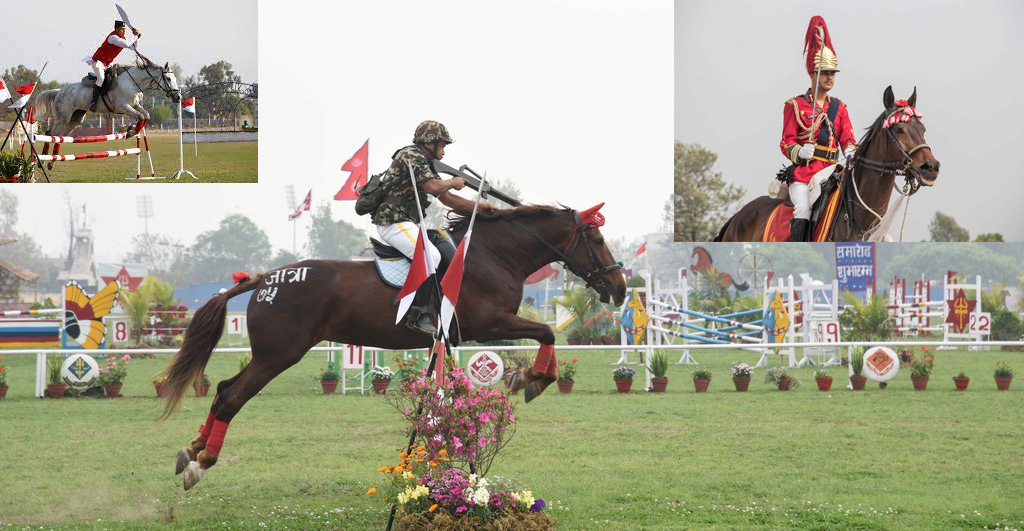
Ghode Jatra is an ancient and distinctive cultural festival of the Kathmandu Valley. It is celebrated every year on Chaitra Krishna Aunsi, the new moon day of the Nepali lunar month of Chaitra, with various traditional activities.
The festival, which also marks the arrival of spring, is regarded by the Newar community as an integral part of the three-day Pahan Charhe festival.
The main attractions include equestrian performances by the Nepal Army at Tundikhel in Kathmandu and traditional horse-racing events held at different locations in Lalitpur.
Mythological Legend and the Story of Guru Mapa
The origin of Ghode Jatra is linked with the ancient history of Kathmandu and traditional tantric beliefs.
According to a popular legend, a terrifying demon named Guru Mapa, referred to as Tundi in some accounts, once lived in the Tundikhel area of Kathmandu. The demon was believed to abduct and trouble children in the valley.
According to the traditional story, local residents and tantric practitioners eventually succeeded in killing the demon and buried him beneath the ground at Tundikhel.
A tradition then developed of running horses over the site every year so that the demon's spirit would not rise again and harm children. The pounding of horses' hooves over the supposed burial place is believed to keep the spirit under control. Over time, this practice developed into what is now known as Ghode Jatra.
Based on the same traditional belief, a ritual is still observed on the night of Ghode Jatra near a tree located southeast of Tundikhel. Food and ritual offerings, including sacrificial offerings or prasad, are presented there to appease the spirit of Guru Mapa and protect the city's children from harm.
Nepal Army Performances and the Festival's National Significance
Ghode Jatra has carried both military and cultural significance since the Malla period. During the Shah and Rana periods, it gradually developed into an occasion for displaying military skills at the national level.
In Vedic Sanatan tradition, the horse (Ashwa) is regarded as a symbol of speed, strength, and loyalty.
On the main day of Ghode Jatra, the Nepal Army and Nepal Police organize special programmes at Tundikhel in Kathmandu in the presence of senior state officials and members of the diplomatic community.
During the event, cavalry units perform horse races, gymnastics, acrobatics, equestrian skills, and various military drills.
Ghode Jatra in Lalitpur and the Tradition of the One-Eyed Horse
Ghode Jatra is not limited to Kathmandu. Lalitpur also has its own distinctive and longstanding traditions associated with the festival.
According to local accounts, Lalitpur's own Ghode Jatra tradition is believed to have begun around Nepal Sambat 777, reportedly so that local residents would not have to travel to Kathmandu to watch the festival.
In the Balkumari area of Lalitpur and in Bungamati, the festival is traditionally marked by running a one-eyed horse.
An older tradition in Balkumari involves giving alcohol to a horse before the race, with spectators watching the unusual movements of the intoxicated animal as part of the event. Horses for the tradition are brought from the cavalry unit at Narayanhiti Barracks.
In Bungamati, the festival is also observed through a tradition involving an artificially made horse.
Cultural Significance and Community Life
Ghode Jatra is more than a horse race or a display of military skills. In traditional belief, it also represents the victory of good over evil.
Special worship is offered to deities including Bhadrakali, Kankeshwari, and Lumadhi during the festival.
Among Newar communities, the occasion is also associated with family gatherings, traditional feasts, dances, and cultural processions.
Through these practices, Ghode Jatra continues to preserve different layers of Nepal's cultural heritage, including traditional beliefs, tantric history, military customs, community traditions, and the longstanding relationship between people and horses.
.png)

Comments 0
No comments yet. Be the first to start the conversation.