



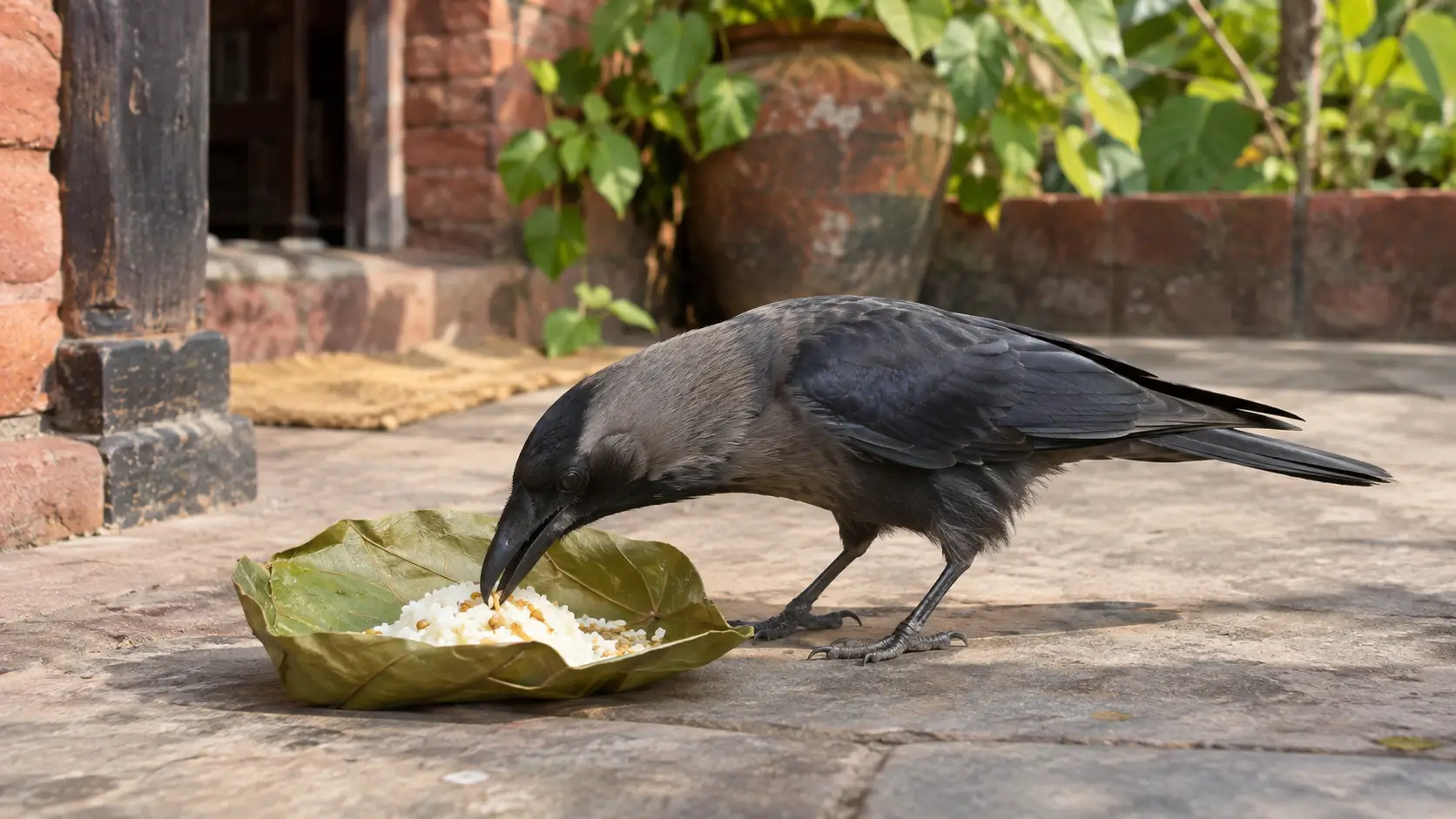
Kaag Tihar (काग तिहार), also written as Kag Tihar, is a Hindu festival in Nepal dedicated to honoring crows. It traditionally marks the opening of the main Tihar celebrations, a festival associated with lights, worship, family relationships and respect for animals.
The crow holds a significant place in Hindu mythology as a messenger of Yamaraj, the deity associated with death and justice. On Kaag Tihar, families offer food to crows and pray for peace, protection and well-being.
The festival is part of Yamapanchak, the period of Tihar observances associated with Yamaraj. It also reflects how Nepali religious traditions recognize animals and birds as part of human life.
Kaag Tihar is celebrated annually according to the Hindu lunar calendar. Its customs have been preserved through household rituals, oral traditions and community practices, although observances differ among families and regions.
When Is Kaag Tihar Celebrated?
Kaag Tihar is traditionally associated with Kartik Krishna Trayodashi, the thirteenth lunar day of the waning moon during the Nepali month of Kartik.
The festival generally falls in October or November on the Gregorian calendar. Its exact date changes each year because the Hindu lunar calendar does not correspond directly with the Gregorian calendar.
The annual festival schedule is determined according to the traditional Panchanga, which considers lunar dates and their religious significance.
In Nepal, the Nepal Panchanga Nirnayak Bikash Samiti publishes festival calendars used to determine religious observances. The arrangement of Tihar-related rituals may vary when lunar dates begin or end at different times.
For this reason, families should consult the relevant year's official Panchanga rather than assume that Kaag Tihar will fall on the same Gregorian date or weekday.
Why Is Kaag Tihar Celebrated?
Kaag Tihar is celebrated primarily because crows are traditionally regarded as messengers of Yamaraj.
According to Hindu religious beliefs, Yamaraj oversees death and justice, while crows serve as symbolic messengers who carry information about human activities.
Families offer food to these birds as an expression of respect and a prayer for protection from sorrow and misfortune.
The Nepal Tourism Board identifies crow worship as the opening observance of the traditional Tihar sequence and describes the bird's association with Yamaraj.
These beliefs provide the religious foundation of Kaag Tihar. They should be understood as cultural and spiritual interpretations rather than scientifically established claims about birds.
The Crow as a Messenger of Yamaraj
In traditional Nepali households, crows have long been associated with the arrival of news.
When a crow caws near a house, some people interpret its call as a sign that visitors or messages may arrive.
A familiar Nepali expression is Shubha bol, shubha bol, meaning "Speak good news."
The phrase reflects a household's wish for favorable news. It does not establish that a crow can predict future events.
The practice of feeding crows on Kaag Tihar is closely connected to these beliefs about communication, respect and good fortune.
Connection With Ancestor Worship
Crows also have a symbolic role in some Hindu remembrance rituals for deceased family members.
During Shraddha and related ancestral observances, certain traditions include setting aside food for crows. This offering is understood as a symbolic gesture of remembrance and respect for departed ancestors.
The practices differ according to family customs, regional traditions and religious interpretations.
Kaag Tihar is not itself an ancestral remembrance ceremony, but the crow's association with ancestors adds another dimension to its religious significance.
How Is Kaag Tihar Celebrated in Nepal?
Kaag Tihar is commonly observed in the morning through food offerings, prayers and respectful attention to crows.
The rituals are generally simple and can be performed at home without elaborate arrangements.
1. Preparing the Offerings
Families begin by selecting a clean place where crows can approach.
Traditional offering locations include courtyards, rooftops, gardens and other suitable outdoor areas.
Some households use leaf plates known as duna or tapari, while others use ordinary household plates.
The arrangement depends on family tradition and the available space.
2. Offering Food to Crows
Food is placed where crows can see and reach it.
Traditional offerings may include:
-
Cooked rice
-
Rice mixed with curd
-
Grains and seasonal fruits
-
Small portions of traditional festive food
The Nepal Tourism Board describes the use of rice offerings during crow worship.
Some families accompany the offerings with incense, an oil lamp or prayers. These elements are religious customs rather than compulsory practices followed identically by every household.
3. Calling and Feeding the Birds
After placing the food, family members may call the crows by imitating their familiar kaa-kaa sound.
They then allow the birds to approach and eat without disturbance.
Some households traditionally offer food to crows before family members begin their own morning meal.
This custom reflects the symbolic treatment of the crow as an honored recipient of the day's first offering.
However, whether a crow arrives immediately depends on its surroundings and behavior. The absence of a bird should not be interpreted as evidence of impending misfortune.
How Can Kaag Tihar Be Observed Responsibly?
Kaag Tihar offers an opportunity to show respect for birds while considering their welfare and the cleanliness of shared spaces.
Traditional offerings can be made in small quantities without leaving excessive food outdoors.
Several precautions are useful:
-
Select fresh, plain food rather than spoiled, heavily salted or spicy leftovers.
-
Place offerings away from busy roads, electrical equipment and other hazards.
-
Avoid plastic packaging, strings or decorations that birds may swallow or become entangled in.
-
Keep incense and burning oil lamps separate from food.
-
Remove uneaten food before it spoils.
-
Avoid chasing, catching or force-feeding birds.
Maintaining clean feeding areas is important because accumulated food waste can attract pests and contribute to unhealthy conditions.
The National Audubon Society advises regular cleaning of bird-feeding areas to reduce contamination and the transmission of diseases.
Families living in apartments or crowded neighborhoods can follow the religious tradition in ways appropriate to their surroundings. Respecting birds does not require creating unsafe feeding conditions.
What Is the Environmental Importance of Crows?
Crows contribute to ecosystems through their feeding behavior, adaptability and interactions with other organisms.
They are omnivorous birds, meaning they consume both plant and animal material.
Their diets may include insects, grains, fruits, food scraps and carrion.
Natural Scavenging and Waste Consumption
Crows consume various forms of organic material, including animal remains and discarded food.
This scavenging behavior contributes to the movement and breakdown of organic matter within ecosystems.
However, their presence does not eliminate the need for proper waste collection or sanitation.
Crows can also gather around poorly managed waste, creating challenges in densely populated areas.
Their environmental role should be understood through both their ecological contributions and their interactions with human settlements.
Intelligence and Social Behavior
Crows are recognized for their learning ability, memory and social communication.
Research at the University of Washington has shown that American crows can recognize individual human faces and remember people associated with threatening experiences.
Crows also communicate with other members of their groups and respond to changes in their surroundings.
These findings demonstrate complex behavior among studied crow species. They do not establish that all crow species possess identical abilities.
The scientific study of crows offers another reason to understand these birds beyond their religious symbolism.
Relationship With Agriculture
Crows may consume insects and other organisms found in agricultural environments.
However, they may also feed on cultivated grains and crops.
Their relationship with farming is therefore mixed rather than entirely beneficial or harmful.
Recognizing this distinction helps explain why interactions between people and crows differ across rural and urban settings.
How Does Kaag Tihar Fit Into the Five Days of Tihar?
Kaag Tihar introduces the traditional sequence of Tihar celebrations honoring animals, deities and family relationships.
The festival is commonly described through five principal observances.
|
Traditional Day |
Main Observance |
Cultural Significance |
|---|---|---|
|
First |
Kaag Tihar |
Honoring crows as messengers of Yamaraj |
|
Second |
Kukur Tihar |
Honoring dogs for their loyalty and religious significance |
|
Third |
Gai Tihar and Laxmi Puja |
Honoring cows and worshipping Goddess Laxmi |
|
Fourth |
Goru Puja, Govardhan Puja and Mha Puja |
Honoring oxen and observing religious and Newar traditions |
|
Fifth |
Bhai Tika |
Celebrating relationships and blessings between siblings |
This table represents the traditional sequence, not a fixed Gregorian calendar schedule.
Actual observances may overlap or occur on different dates according to the annual Panchanga. Customs also vary among Nepal's religious and cultural communities.
Mha Puja is particularly significant among Newar communities and is associated with self-worship and Nepal Sambat.
Other Religious Observances Associated With Kaag Tihar
Kaag Tihar occurs within a period that includes several related Hindu observances.
Dhanteras is associated with prosperity and traditional purchases of household utensils or precious metals. Dhanwantari Jayanti honors Dhanwantari, a figure associated with Ayurveda in Hindu tradition.
Yama Deepdan involves lighting a ceremonial lamp in connection with Yamaraj. In some traditions, the lamp is placed facing south, a direction symbolically associated with the deity.
Although these occasions are closely connected to the broader Tihar period, they should not be presented as occurring on the same Gregorian date every year.
Their calendar arrangement depends on lunar timing and the applicable religious calendar.
Cultural Significance of Kaag Tihar in Nepali Society
Kaag Tihar reflects the relationship between religious belief, household customs and the natural surroundings.
Its practice continues across generations through family participation rather than requiring a large public gathering.
For children, the celebration provides an opportunity to learn why crows are significant in Nepali folklore and how traditional beliefs influence people's treatment of animals.
It also encourages discussion about the difference between religious symbolism and observable bird behavior.
In rural communities, people may encounter crows around farmland and village settlements. In towns and cities, the birds are frequently seen around buildings, gardens and open spaces.
These everyday encounters help explain why crows occupy a familiar place in Nepali cultural life.
The significance of Kaag Tihar lies not only in the food offered but also in the respect expressed toward a bird that shares human surroundings.
Conclusion
Kaag Tihar is a traditional Nepali celebration that honors crows through food offerings, prayers and cultural remembrance.
Its religious significance comes from the crow's association with Yamaraj, while its broader meaning reflects Nepali folklore and relationships between people and wildlife.
The festival remains relevant as a family tradition and as an occasion to discuss responsible treatment of birds. Understanding both its cultural beliefs and ecological context helps preserve the observance without overstating its religious or scientific claims.




Comments 0
No comments yet. Be the first to start the conversation.