



Ten minutes can be enough to take a brisk walk, learn something useful, prepare food, reconnect with someone, or make tomorrow's responsibilities easier. The challenge is choosing an activity that matters to you and finding a realistic place for it in your day.
Small daily habits are useful because they allow you to work on one specific need without reorganizing your entire schedule. A student may want a short learning session between classes, while someone working irregular hours may prefer a flexible movement break or a quiet evening activity.
Research supports several behaviors covered here, including physical activity, effective learning techniques, planning, and consistent sleep routines. However, ten minutes is not a scientifically established duration for achieving every benefit.
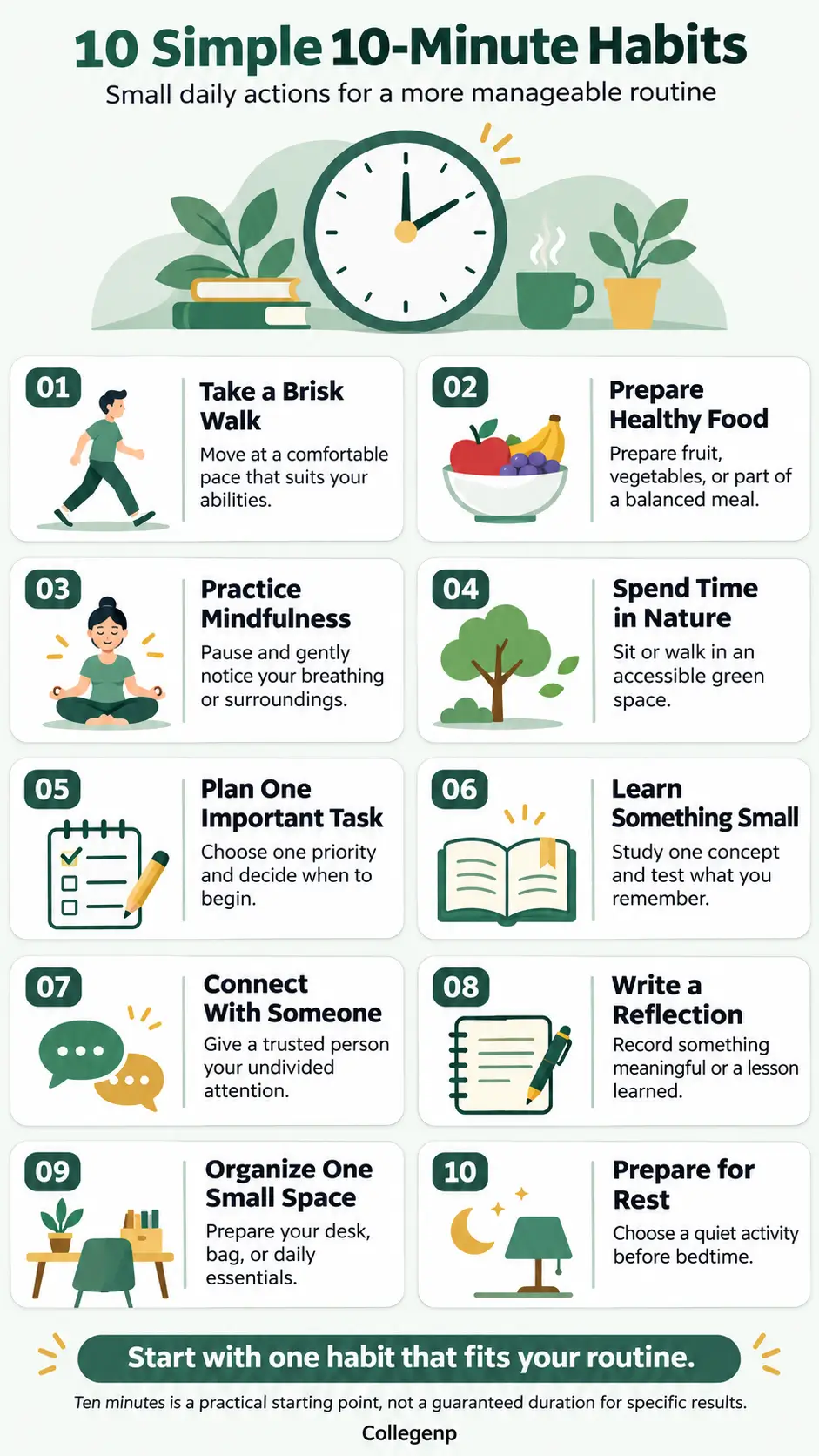
The following ten habits are options, not a compulsory 100-minute daily checklist. Each includes a practical action, a reason to consider it, and an important limitation.
Answer Summary: Ten minutes a day can provide a manageable starting point for a useful habit. Walking, mindful attention, focused learning, social connection, meal preparation, and evening routines serve different purposes. Research supports several of these behaviors, although benefits vary and the exact ten-minute duration is not universally proven. Choose one activity that addresses a current need, connect it to a recognizable part of your schedule, and assess whether it remains useful.
Key Takeaways:
-
Ten minutes is a practical starting point, not a guaranteed threshold for results.
-
Choose one habit that addresses a current need rather than attempting all ten.
-
Short periods of physical activity contribute toward recommended activity totals.
-
Specific cues can make intended actions easier to remember and repeat.
-
Evidence supporting a behavior does not necessarily establish the benefits of an exact ten-minute session.
-
Adapt or replace habits that do not suit your health, resources, or circumstances.
How to Choose the Right 10-Minute Habit
The most suitable habit is one that addresses something specific in your life and is manageable within your circumstances.
Instead of selecting activities because they sound impressive, identify a recurring difficulty.
For example:
-
Extended sitting: Consider a suitable movement break.
-
Unclear priorities: Identify one meaningful task and decide when to begin.
-
Difficulty remembering material: Practice recalling something you have studied.
-
Limited social contact: Arrange a welcome conversation with someone you trust.
-
Disorganized evenings: Begin a quieter transition toward bedtime.
Preference also matters. Someone who dislikes meditation may find walking more appealing. A person without access to outdoor space may prefer an indoor activity.
A habit develops through repeated behavior in a consistent context, gradually becoming easier to perform with less deliberate effort.
A 2024 systematic review by Singh and colleagues found considerable variation in how long health-related habits took to become automatic. It did not establish a universal deadline for forming a habit.
The aim is to select an action you can repeat without sacrificing necessary sleep, meals, responsibilities, or relationships.
10 Practical 10-Minute Habits to Try
These ten activities cover physical wellbeing, attention, learning, relationships, organization, and rest. Their order does not represent a scientific ranking.
1. Take a Brisk Walk or Choose Another Way to Move
Walking is among the more directly supported ten-minute activities.
The World Health Organization (WHO) recognizes that physical activity accumulated throughout the day contributes to health. Its guidance emphasizes that activity is beneficial even when performed in shorter periods.
A ten-minute walk can fit into a break between classes, part of a journey, or a period after sitting at a desk.
Choose a safe, accessible route and walk at a pace suitable for your abilities. For many adults, brisk walking means breathing somewhat faster while remaining able to speak.
If outdoor walking is unsuitable, consider gentle indoor movement or another accessible activity.
The important distinction is that ten minutes contributes to overall physical activity needs without necessarily fulfilling them.
For adults, WHO guidance recommends at least 150 minutes of moderate-intensity aerobic activity weekly. Walking briskly for ten minutes every day totals 70 minutes weekly, below that recommendation. Guidelines differ by age and individual circumstances.
A short walk is a useful starting activity, not a complete exercise plan.
2. Prepare One Nourishing Part of a Meal
Ten minutes of food preparation can make an upcoming meal more convenient.
You do not need to cook an entire meal. Prepare one component using ingredients available in your household.
You might wash fruit, prepare vegetables, rinse ready-to-use beans, or assemble part of a familiar dish.
For example, if preparing lunch involves several steps, completing one suitable task earlier means there is less preparation left when mealtime arrives.
A brief preparation period can also be useful when your schedule makes cooking difficult at certain times.
If fresh ingredients are expensive or unavailable, suitable frozen, canned, or other accessible foods can provide alternatives.
The purpose is to support adequate, varied, satisfying meals, not to restrict eating or follow rigid food rules.
Research and dietary guidance concern overall eating patterns, not a proven health effect from exactly ten minutes of preparation.
Judge this habit by whether it makes preparing or eating a suitable meal easier in your circumstances.
3. Pause for Mindfulness or Gentle Breathing
A mindful pause gives you an opportunity to notice the present moment without immediately responding to every distraction.
Mindfulness involves paying attention to experiences such as breathing, sounds, or physical sensations without rushing to judge them.
For a ten-minute practice, sit comfortably and notice your natural breathing. When your attention wanders, acknowledge the distraction and return to what you were observing.
You can keep your eyes open or focus on surrounding sounds instead.
Mindfulness can also be practiced while walking slowly in a safe environment.
The US National Center for Complementary and Integrative Health (NCCIH) reports that mindfulness research has identified benefits in some settings, while also recognizing differences in study quality, outcomes, and potential adverse experiences.
A short practice may provide a welcome pause, but it is not a treatment for a mental health condition.
If concentrating on your breathing feels uncomfortable, choose another focus or discontinue the activity. Mindfulness is optional, and there is no need to force a particular experience.
4. Spend Ten Minutes Near Nature
Spending a short period near an accessible natural setting can provide a change of surroundings.
You do not need a forest, hiking trail, or large garden.
A nearby park, a safe place with trees, or another accessible green area may provide a suitable setting.
Sit comfortably or walk at an appropriate pace. Notice ordinary details, such as moving leaves, changing light, or natural sounds.
A scoping review by Meredith and colleagues, published online in 2020 in Frontiers in Psychology, examined studies involving college-aged populations. It reported favorable findings from short exposure to natural settings, including activities lasting approximately 10–30 minutes.
However, the included studies varied in their settings, methods, and outcomes. Their findings do not establish that every person will experience the same benefit from exactly ten minutes outdoors.
Weather, mobility, personal safety, and access also matter.
If a suitable outdoor area is unavailable, choose another activity from this list. A routine should fit your environment rather than depend on facilities you cannot access.
5. Choose One Important Task and Decide When to Begin
When several responsibilities compete for attention, ten minutes can help turn an unclear intention into a specific next action.
Start by identifying one meaningful task.
It may involve submitting an assignment, arranging an appointment, preparing for a meeting, or completing a household responsibility.
Next, define the smallest useful action you need to take.
For example, replace "I need to study" with "I will open my science notebook and answer the first revision question."
Then connect that action to a recognizable event:
"If I finish breakfast and sit at my desk, I will open my notebook and begin the question."
This is an implementation intention, often described as an if–then plan.
A meta-analysis by psychologists Peter Gollwitzer and Paschal Sheeran found that linking intended actions to specific situations supported goal achievement across the settings studied.
Use any remaining time to prepare the necessary materials.
The research supports specific action planning, not a claim that every ten-minute planning session produces measurable productivity gains.
6. Learn One Small Thing and Test Your Memory
Ten minutes of focused learning can be useful when the material is narrow enough to practice meaningfully.
Choose one vocabulary term, a mathematical procedure, a concept from a course, or a feature of software you regularly use.
Spend a few minutes studying the material.
Then close the source and try to explain or reproduce what you remember.
Check your answer, correct misunderstandings, and note when to revisit the material.
This approach uses retrieval practice, which involves recalling information from memory, and spaced practice, which involves reviewing information across separate sessions.
A research review by Dunlosky and colleagues, published in Psychological Science in the Public Interest, identified practice testing and distributed practice as useful learning techniques across multiple educational contexts.
The evidence supports the learning strategies, not an exact improvement from every ten-minute session.
More demanding skills require additional instruction, feedback, and practice.
For workplace applications, microlearning habits offer further ways to connect brief learning sessions with practical tasks.
7. Give One Person Your Undivided Attention
Ten minutes of meaningful interaction can be worthwhile when strengthening an appropriate relationship is something you want to prioritize.
The aim is not to contact as many people as possible. It is to give your attention to someone with whom communication is welcome.
You might call a family member, check in with a friend, or have a suitable conversation with a colleague.
Ask a genuine question and listen to the response without repeatedly checking another screen.
If meeting is impractical, a thoughtful message can open a conversation without demanding an immediate reply.
The quality of the interaction matters. A longer conversation is not necessarily supportive, and frequent contact does not automatically make a relationship satisfying.
There is no established ten-minute daily conversation requirement that guarantees improved wellbeing or prevents loneliness.
Choose contact that respects both people's time and boundaries.
If a relationship feels unsafe or strained, reaching out to someone else you trust is more appropriate than forcing an interaction to complete a routine.
8. Write a Specific Gratitude or Reflection Note
A short written reflection can help you pay attention to an experience that might otherwise receive limited consideration.
Gratitude writing involves identifying something you appreciate and considering why it matters.
Instead of recording a general statement such as "Today was good," describe a particular event.
You might write about someone who helped you, a task that went more smoothly than expected, or an opportunity you appreciated.
Spend several minutes recording what happened and why it felt meaningful.
A 2025 meta-analysis by Choi and colleagues examined gratitude interventions across 145 studies in 28 countries. It found small average improvements in wellbeing, with meaningful variation between countries.
Those findings do not establish that every person will feel happier after a ten-minute writing exercise.
Gratitude also does not require ignoring difficult experiences.
If appreciation feels forced, write a neutral reflection instead: one observation, something learned, or a situation you want to understand more clearly.
The activity should support honest reflection, not require a particular emotional response.
9. Reset One Small Area of Your Daily Environment
A ten-minute reset can remove a practical obstacle from an upcoming activity.
Choose one small area that repeatedly creates inconvenience.
For example, you could clear the part of a desk needed for studying, arrange materials for tomorrow's class, return frequently used items to their usual location, or prepare a bag before leaving home.
Concentrate on the area that affects your next task.
If you often spend time searching for a notebook, decide where it belongs and return it there after use.
The practical purpose is to make necessary items easier to find and reduce the number of preparation steps later.
This is an organizational suggestion, not a scientifically established psychological intervention.
The available research does not demonstrate that exactly ten minutes of tidying improves cognitive performance or produces a specific mental health benefit.
For shared spaces, concentrate on an area you are permitted to use.
The goal is to solve a recurring inconvenience, not to maintain an idealized standard of cleanliness.
10. Begin a Quiet Transition Before Sleep
A brief evening routine can help create a recognizable transition from daily responsibilities toward rest.
For ten minutes, choose a quiet activity suited to your environment.
You might put away study materials, prepare clothing for the next day, read a familiar book, or make the sleeping area more comfortable.
If your phone regularly interrupts this period, consider placing it away from where you rest while keeping it accessible when needed.
The US Centers for Disease Control and Prevention (CDC) recommends consistent sleep schedules, a suitable sleeping environment, and turning off electronic devices at least 30 minutes before bedtime.
A ten-minute wind-down is a starting activity, not a substitute for broader sleep guidance or sufficient sleep.
People working irregular hours may need to adapt the routine to their actual sleeping period.
For students managing shared rooms and academic responsibilities, a realistic student sleep routine provides additional guidance.
Persistent sleep difficulties deserve appropriate professional assessment rather than reliance on a short routine alone.
 How to Make a Small Habit Easier to Repeat
Starting an activity and making it part of everyday life are different challenges. Repetition is easier to plan when the action has a recognizable place in your schedule.
Connect the Habit to a Reliable Cue
A cue is an event or situation that reminds you to perform a behavior.
For example, you might associate walking with finishing a meal, a learning exercise with opening your study notebook, or preparing tomorrow's materials with completing your evening responsibilities.
Choose a cue that already occurs in your routine.
For people working irregular hours, an event-based cue such as finishing a shift may be more suitable than a fixed clock time.
Make the First Action Easy to Begin
Reduce unnecessary preparation.
If you plan to read, keep suitable material accessible. If you want to walk, identify a safe location. If you intend to reflect, keep a notebook where you normally use it.
When ten minutes is unavailable, a shorter version may remain practical.
That adaptation does not establish equivalent research-supported benefits, but it provides another opportunity to repeat the intended behavior.
For further discussion of cues, planning, and everyday obstacles, see personal productivity skills for habit building.
Review the Habit Without Demanding a Perfect Streak
After practicing for a reasonable period, consider whether the activity serves its intended purpose.
Ask whether it fits your schedule, feels manageable, and addresses the difficulty you identified.
If you miss a day, return at the next suitable opportunity.
Habit-formation research does not support a fixed rule that every behavior becomes automatic after 21 days. The time required varies across individuals, behaviors, and circumstances.
A routine should remain useful rather than become another source of unnecessary pressure.
Common Mistakes Worth Avoiding
Small habits become less useful when expectations exceed what an activity can realistically accomplish.
One mistake is attempting all ten suggestions simultaneously. That turns a manageable activity into a demanding schedule.
Another is assuming that ten minutes represents an evidence-based dose for every outcome. Some research concerns short activities directly, while other evidence supports broader behaviors rather than a particular duration.
Avoid treating missed days as proof of failure or limited resources as a personal shortcoming.
Short routines also cannot replace necessary sleep, adequate meals, supportive relationships, or professional care when needed.
These suggestions provide general wellbeing information rather than individualized medical advice.
Final Thoughts
A useful ten-minute habit begins with identifying what needs attention in your daily life.
Choose an activity that fits your circumstances, connect it to a recognizable part of your schedule, and assess whether it serves its intended purpose.
Some habits have direct research support for short activities; others apply established principles through manageable actions.
Ten minutes does not need to change everything. It can provide a realistic opportunity to do something worthwhile.





Comments 0
No comments yet. Be the first to start the conversation.