



Health Skills: Sleep Hygiene for Students With a Realistic Routine
Student sleep often falls apart for practical reasons: homework that runs late, early start times, noisy living spaces, and phones that are both a study tool and a distraction. Sleep hygiene is the set of habits and room cues that make sleep more consistent, even when your schedule is busy. Strong sleep hygiene is not about perfection. It is about removing the most common blockers and building a routine you can repeat on school nights.
This guide is written for high school and college students. It focuses on realistic routines, including a short “busy-night” version and a longer wind-down for nights when you finish earlier. It also covers screens, caffeine, naps, and shared rooms, because those are the sticking points for many students.
Informational only: This article shares general education about sleep habits and is not medical advice. If sleep problems are persistent, severe, or affecting health and safety, a qualified health professional can help assess what is going on.
Summary
Sleep hygiene for students works best when you anchor a consistent wake time, then build a repeatable wind-down routine and a sleep-friendly environment around it. For teens, recommended sleep is 8–10 hours per 24 hours, so routines should protect enough time in bed on most school nights. Research suggests screen use in bed (especially interactive use) is a key risk for shorter sleep, and major health organizations warn that caffeine can affect sleep for hours.
Table of Content
- Health Skills: Sleep Hygiene for Students With a Realistic Routine
- What is sleep hygiene for students?
- How much sleep do students need?
- Why sleep hygiene matters for school and mood
- The realistic routine: start with a consistent wake time
- Screens: boundaries that still allow homework
- Caffeine, tea, coffee, and energy drinks
- Daytime anchors: light, movement, and naps
- Sleep environment in shared rooms and busy homes
- Exam weeks: protect sleep without losing study time
- When sleep hygiene is not enough
- Conclusion
- FAQs
- Reference
Key Takeaways
-
Sleep hygiene is daily habits plus a sleep-friendly room setup, not a single “hack.”
-
For teens, the recommended range is 8–10 hours per 24 hours, so “time in bed” matters.
-
A consistent wake time is a practical anchor; it helps bedtime become more predictable.
-
If you change only one screen habit, keep the bed screen-free; in-bed interactive screen use is linked with less sleep.
-
Caffeine can interfere with sleep for hours; late-day caffeine can push bedtime later.
-
Exam weeks go better with a short routine you can repeat, not large schedule swings.
-
If sleep is still poor after consistent habits, it may be time to talk with a health professional.
What is sleep hygiene for students?
Sleep hygiene for students is the combination of daily routines and sleep-environment choices that support consistent, uninterrupted sleep.
For students, “good sleep hygiene” usually means doing a few things reliably: keeping a stable sleep-wake schedule when possible, reducing late-night stimulation, and making the sleep space darker, quieter, and more comfortable.
Sleep hygiene is not a promise that you will fall asleep instantly. It is a foundation that reduces common sleep disruptors (screens, caffeine timing, irregular schedules), which can make it easier for sleep to arrive naturally.
How much sleep do students need?
Most teen students need more sleep than their schedules allow, and sleep needs remain important in college too. The American Academy of Sleep Medicine recommends that teenagers aged 13–18 sleep 8–10 hours per 24 hours on a regular basis.
The U.S. Centers for Disease Control and Prevention (CDC) lists 8–10 hours for ages 13–17 and 7 or more hours for adults ages 18–60.
A practical way to use those ranges is to focus on two signals:
-
You can wake up for school most days without feeling exhausted.
-
Daytime sleepiness is not taking over classes, homework, and mood.
Why many students feel sleepy late at night
Many teens experience a natural shift toward later sleep timing during adolescence, which can clash with early start times. The American Academy of Pediatrics has urged that middle and high schools aim for start times no earlier than 8:30 a.m., partly because earlier start times contribute to insufficient teen sleep.
Students usually cannot change school schedules, so the goal becomes managing the parts you can control: wake time consistency, evening stimulation, and sleep opportunity.
Why sleep hygiene matters for school and mood
Sleep hygiene matters because insufficient sleep can affect attention, learning, and emotional regulation—exactly what students depend on during school weeks. The CDC frames sleep as essential for health and functioning across the lifespan.
When sleep drops for several nights in a row, many students notice it as slower thinking, more irritability, and heavier reliance on caffeine.
A helpful mindset is to treat sleep like study infrastructure: not “extra time,” but something that influences how effective study time feels the next day.
The realistic routine: start with a consistent wake time
A realistic student routine starts by anchoring a consistent wake time, then building a short wind-down that is repeatable on school nights. Broad sleep guidance from organizations like NHLBI and Mayo Clinic emphasizes consistent sleep timing, managing what you eat and drink, and creating a restful environment.
Step 1: Pick a wake time you can follow most days
A consistent wake time is the simplest anchor because it helps your body anticipate sleepiness at a similar time each night. Sleep guidance commonly recommends sticking to a schedule, including on weekends when possible.
If your weekend wake time shifts a lot, Monday can feel like “mini jet lag,” even if you slept longer.
Step 2: Work backward to protect sleep opportunity
Once you know your wake time, work backward to create enough time in bed for your age group. For teens, that means planning around the 8–10 hour recommendation.
For many students, the first improvement is not “fall asleep faster,” but “give sleep enough space to happen.”
Step 3: Use two routines: a short one and a longer one
The most reliable routine is the one you can repeat on your busiest nights. Use a short routine on late homework nights and a longer routine when you finish earlier.
The 15-minute minimum routine (busy school nights)
This version is meant for nights when you are tired but still wired.
-
Close the day (2 minutes)
-
Write tomorrow’s first task (one sentence).
-
Pack what you need for the morning (bag, charger, ID).
-
Move screens away from bed (2 minutes)
-
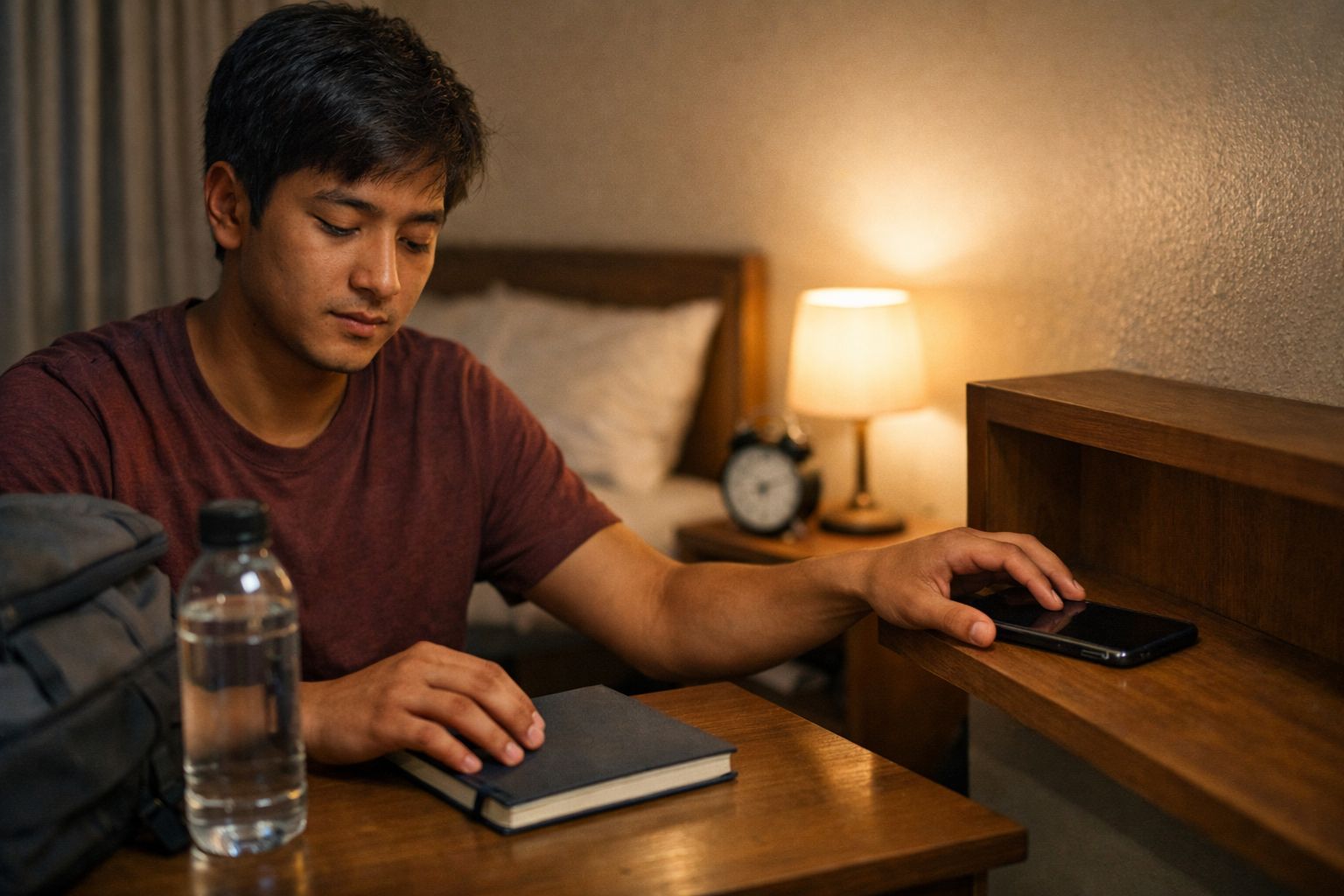
Put your phone on a desk, shelf, or across the room.
-
Keep the bed for sleep, not scrolling.
-
Fast hygiene + lights down (6 minutes)
-
Brush teeth, wash face, change clothes.
-
Dim lights if you can.
-
Quiet wind-down (5 minutes)
-
Read a few pages (paper book), or listen to calm audio at low volume.
-
Keep it boring on purpose.
If you do not fall asleep quickly, keep lights low and avoid switching to stimulating content. Return to the same quiet wind-down activity.
The 60-minute wind-down (when time allows)
This version gives your brain more time to slow down.
-
60–40 minutes before bed: stop-point planning
-
Decide where you will restart tomorrow (one bullet point).
-
Put study materials away so the room looks more “off duty.”
-
-
40–20 minutes before bed: low stimulation
-
Shower, stretch lightly, or read.
-
Keep conversations and media calmer.
-
-
20 minutes to bedtime: bedroom cues
-
Set the alarm.
-
Keep the bed screen-free.
-
Keep the room darker and quieter if possible.
-
Screens: boundaries that still allow homework
A student-friendly screen plan focuses on where and how screens are used, not only on a strict time cutoff. A large review of youth screen media and sleep found that most included studies reported an association between screen media use and delayed bedtime and/or shorter total sleep time.
A JAMA Pediatrics cohort study adds an important detail: screen time once in bed—especially interactive activities such as gaming or multitasking—was associated with less sleep.
The simplest boundary: keep the bed screen-free
Keeping screens out of bed is a practical rule because it targets the place where “five minutes” often turns into an hour. It also protects the bed as a cue for sleep.
If you want a second rule, make it: “One device at a time.” Multitasking (video plus scrolling plus messaging) is more stimulating than a single, calmer task.
If homework requires a screen
If you must use a laptop late:
-
Finish the most demanding tasks first, then switch to offline review near bedtime (summaries, flashcards, a handwritten plan for tomorrow).
-
Reduce stimulation by closing extra tabs and notifications.
-
Keep your work at a desk or table, not on the bed.
The goal is not zero screen time. The goal is reducing late-night stimulation and keeping the bed as a sleep-only place.
If your phone is your alarm
If you use your phone as an alarm, you can still keep it out of bed:
-
Place it across the room so turning it off requires standing up.
-
Avoid using the alarm screen as a reason to start scrolling.
Caffeine, tea, coffee, and energy drinks
Caffeine timing matters because caffeine can interfere with sleep for hours after you drink it. The National Heart, Lung, and Blood Institute (NHLBI) notes that caffeine’s effects can last up to 8 hours, so late-afternoon caffeine can make it harder to fall asleep at night.
Mayo Clinic also cautions that caffeine’s stimulating effects can take hours to wear off and can interfere with sleep.
A practical student approach
A workable approach is:
-
Keep caffeine earlier in the day, especially on school nights.
-
If you are relying on caffeine to stay awake, check whether the schedule problem is actually “not enough sleep opportunity,” not “low willpower.”
Energy drinks: extra caution for teens
For teens, major pediatric guidance is more cautious about stimulants. The CDC notes that the American Academy of Pediatrics states caffeine and other stimulants in energy drinks have no place in children’s and adolescents’ diets.
The American Academy of Child & Adolescent Psychiatry (AACAP) also advises against any use of energy drinks for children and teens and notes there is no proven safe dose of caffeine for children.
Daytime anchors: light, movement, and naps
Daytime habits can make nights easier by reinforcing your sleep-wake rhythm. General sleep guidance commonly recommends spending time outside, being physically active, and managing naps so they do not push bedtime later.
Morning light and movement
Getting daylight after waking and moving your body during the day can support a healthier sleep-wake pattern. NHLBI includes spending time outside and being physically active as healthy sleep habits.
For students, that can be as simple as walking part of the commute, stepping outside between classes, or sitting by a bright window early in the day.
Naps: helpful sometimes, disruptive sometimes
Naps can help when you are genuinely sleep-deprived, but long or late naps can make it harder to fall asleep at night. Mayo Clinic includes limiting daytime naps as part of core sleep tips.
If you nap, keep it early enough that bedtime does not drift later, and treat it as a short reset rather than a second night of sleep.
Exercise timing
Physical activity can support sleep quality, but intense exercise right before bed can be energizing for some people. Many sleep tips recommend keeping pre-bed time calmer and using the hour before bed for wind-down rather than high stimulation.
Sleep environment in shared rooms and busy homes
A sleep-friendly environment is usually dark, quiet, and comfortable, but students often do not control all those factors. The Sleep Foundation describes strong sleep hygiene as both daily routines and a bedroom environment that promotes consistent sleep.
NHLBI also recommends keeping the bedroom quiet, cool, and dark.
Shared rooms, hostels, and family spaces
If you share a room, focus on low-cost changes that reduce disruption:
-
Light: dim the room earlier when possible; avoid overhead lights close to bedtime.
-
Noise: if the space is loud, consider steady background sound (fan) or other safe, low-volume options.
-
Boundaries: agree on a quiet period or “lights down” time when possible.
If you must study in the same room you sleep in, make the bed a “sleep-only zone.” Even a small separation (desk for work, bed for sleep) can help.
Exam weeks: protect sleep without losing study time
During exam weeks, sleep hygiene often fails because students treat sleep as flexible and study as fixed. A more realistic goal is to protect the anchors: wake time, a short wind-down, and a bed that stays screen-free.
A realistic exam-week plan
Use three rules:
-
Keep wake time as steady as you can (even if bedtime shifts slightly).
-
Use the 15-minute routine every night you can.
-
Keep caffeine earlier, so it does not push sleep later.
The night before an exam
The night before an exam works better with stability than with last-minute changes:
-
Stop intense work earlier and switch to lighter review.
-
Write a short morning plan (what to pack, when to leave).
-
Keep screens out of bed; in-bed interactive screen use is linked with less sleep.
When sleep hygiene is not enough
Sleep hygiene is a foundation, but persistent sleep problems can signal a condition that needs professional support. If sleep issues continue for weeks despite consistent habits, or if daytime functioning is significantly affected, consider discussing it with a health professional.
Signs to talk with a qualified professional about
Examples that deserve attention include:
-
Ongoing trouble falling asleep or staying asleep most nights
-
Excessive daytime sleepiness that affects school
-
Loud snoring with possible breathing pauses
-
Restless sensations in legs that disrupt sleep
-
Sleep behaviors that create safety concerns
For teens, it can help to involve a parent or guardian in the conversation, especially if school performance or mood is being affected.
Conclusion
Sleep hygiene for students is most effective when it is built around realistic constraints: homework, screens, caffeine, and shared spaces. A consistent wake time, a repeatable wind-down routine, and a bed that stays screen-free are practical starting points. For teens, protecting enough time in bed matters because the recommended range is 8–10 hours per 24 hours. If sleep remains poor despite consistent habits, or daytime functioning keeps suffering, it is reasonable to seek help from a qualified health professional.
FAQs
1) How many hours should a teen student sleep?
Teenagers aged 13–18 are recommended to sleep 8–10 hours per 24 hours on a regular basis.
2) What is the best “minimum” bedtime routine for students?
A short, repeatable routine works best on school nights: pack for tomorrow, move screens away from bed, dim lights, and do a calm activity like reading for a few minutes.
3) Do screens always ruin sleep?
Screens do not affect everyone the same way, but research links youth screen use with later bedtimes and shorter sleep, and screen use in bed—especially interactive use—is associated with less sleep.
4) When should students stop caffeine?
Late-day caffeine can affect bedtime because caffeine can interfere with sleep for hours; NHLBI notes effects can last up to 8 hours.
5) Are energy drinks okay for teens during exams?
Major pediatric guidance advises against energy drinks for children and teens, and the CDC notes the American Academy of Pediatrics statement that stimulants in energy drinks have no place in children’s and adolescents’ diets.
Reference
-
National Heart, Lung, and Blood Institute (NIH). Healthy Sleep Habits. 2022.
-
National Heart, Lung, and Blood Institute (NIH). Your Guide to Healthy Sleep (PDF). 2011.
-
Paruthi S, et al. Recommended Amount of Sleep for Pediatric Populations: AASM Consensus Statement. Journal of Clinical Sleep Medicine. 2016.
-
U.S. Centers for Disease Control and Prevention (CDC). About Sleep. 2024.
-
U.S. Centers for Disease Control and Prevention (CDC). Sleep in Middle and High School Students (archived page).
-
Hale L, Guan S. Youth Screen Media Habits and Sleep. Sleep Medicine Clinics / PMC version. 2018.
-
Brosnan B, et al. Screen Use at Bedtime and Sleep Duration and Quality Among Youths. JAMA Pediatrics. 2024.
-
American Academy of Pediatrics (AAP). School Start Times for Adolescents. Pediatrics. 2014.
-
Wheaton AG, et al. School Start Times for Middle School and High School Students—United States, 2011–12 School Year. CDC MMWR. 2015.
-
U.S. Centers for Disease Control and Prevention (CDC). The Buzz on Energy Drinks. 2024.
-
American Academy of Child & Adolescent Psychiatry (AACAP). Caffeine and Children (Facts for Families).
-
Mayo Clinic. Sleep tips: 6 steps to better sleep.
-
Sleep Foundation. Mastering Sleep Hygiene: Your Path to Quality Sleep. 2025 update.
-
Harvard Medical School (Division of Sleep Medicine). Taking Action: Sleep Health Education Program (sleep schedule, barriers like caffeine/electronics, bed for sleep).






Comments 0
No comments yet. Be the first to start the conversation.