



College life and working student life are often compared as if one is automatically easier, smarter, or more responsible. That is not the right way to judge them. The real question is whether a student can protect study time, meet financial needs, build useful experience, and avoid turning every week into a crisis.
College life usually gives students more space for classes, assignments, campus activities, friendships, projects, and career exploration. Working student life adds income and real work experience, but it also adds shifts, commuting, fatigue, employer expectations, and less control over the week.
This comparison focuses on students who are enrolled in college while deciding whether to work during their studies. It is not mainly about the difference between college and a full-time job after graduation.
Quick Answer:
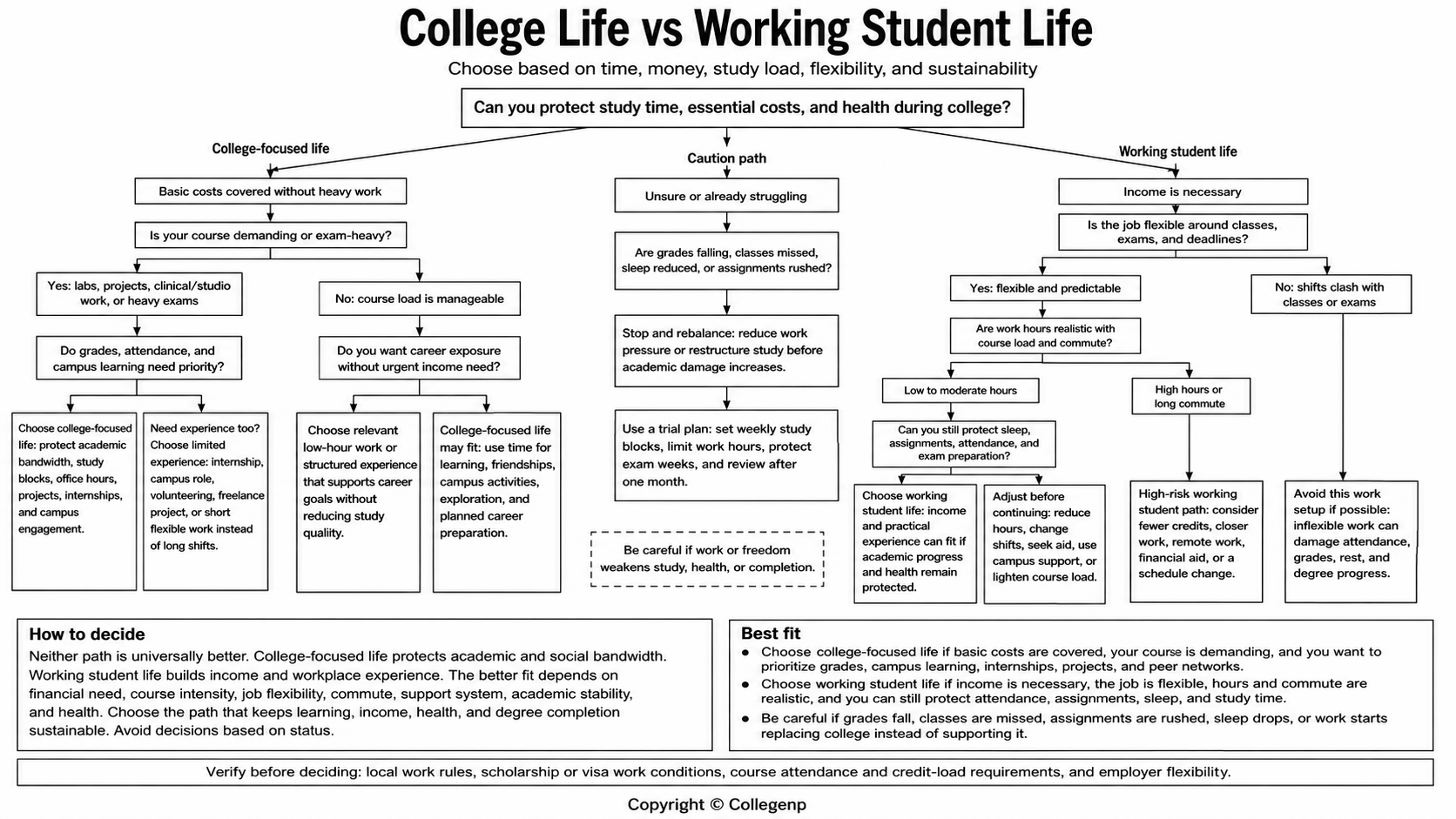
College-focused life is usually better for students who can cover basic costs without heavy term-time work and need more time for demanding coursework, campus involvement, internships, projects, or academic preparation.
Working student life is usually better for students who need income, want practical work experience, or can manage a flexible job without damaging class attendance, assignments, exams, sleep, and health.
The better choice depends on financial need, course intensity, commute, support system, job flexibility, and long-term goals. A small, flexible job can be manageable. Heavy or inflexible work can quietly reduce study quality, campus participation, and recovery time.
Table of Content
- What Are Students Really Deciding?
- Comparison Methodology
- Evidence Snapshot
- College Life vs Working Student Life: Comparison Table
- What College Life Usually Gives You
- Where College Life Can Fall Short
- What Working Student Life Usually Gives You
- Where Working Student Life Can Become Difficult
- Time, Money, Grades, and Social Life: The Real Trade-Off
- How Many Hours Should a Student Work?
- Personal and Social Factors
- Reader-Specific Recommendation
- Who Should Avoid Each Option?
- What Would Change the Verdict?
- Practical Ways to Make Working Student Life More Manageable
- Practical Decision Scenarios
- Common Mistakes Students Make
- Decision Checklist
- Final Verdict
What Are Students Really Deciding?
The comparison is not simply “college life vs working student life.” The deeper decision is how a student should divide limited time, money, energy, and attention during college.
Many students do not work because they want extra experience only. Some work because tuition, rent, food, transport, family responsibilities, or personal expenses make work necessary. Other students may not need income but want experience, confidence, or professional exposure.
This makes the comparison easy to misunderstand. A student with strong financial support, a short commute, and a demanding academic program is not in the same position as a student paying rent, supporting family, and working evening shifts after class.
Several surface-level claims can mislead readers:
-
“College life is easier” ignores academic pressure, exams, labs, projects, and uncertainty about the future.
-
“Working students are more mature” ignores exhaustion, missed classes, and unequal financial pressure.
-
“Any job is good experience” ignores job quality, relevance, flexibility, and workload.
-
“Students can simply work more” ignores the trade-off between income, study time, rest, and completion risk.
A fair comparison must test the issue through practical criteria: time, money, grades, skills, stress, social life, flexibility, commute, support system, and sustainability.
Comparison Methodology
This article compares college life and working student life using criteria that directly affect student decisions.
| Criteria | Why It Matters |
|---|---|
| Time control | Students need enough predictable time for classes, assignments, exam preparation, rest, and personal responsibilities. |
| Financial pressure | Income can reduce short-term pressure, but work does not automatically solve tuition, debt, or living-cost problems. |
| Academic focus | Coursework quality often depends on attendance, reading time, revision, office hours, labs, and project work. |
| Career readiness | Students can build career readiness through internships, projects, campus roles, volunteering, or paid work. |
| Social and campus life | Friendships, peer networks, clubs, and campus activities require repeated presence and available time. |
| Stress and recovery | A schedule that leaves no time for sleep, meals, travel, and recovery is not sustainable. |
| Flexibility | A flexible job can support study; an inflexible job can compete directly with lectures, exams, and deadlines. |
| Reader suitability | The better option changes by course difficulty, family situation, location, commute, and support system. |
The article does not use a numerical score because the best answer depends heavily on the student’s context. Instead, it gives conditional editorial judgment based on evidence and practical decision factors.
Evidence Snapshot
The evidence does not support a simple claim that working students always do better or worse. The more accurate conclusion is that work can help or harm depending on hours, flexibility, job quality, course load, and student support.
What is verified:
-
U.S. data from NCES College Student Employment shows that in 2020, 40% of full-time undergraduates and 74% of part-time undergraduates were employed. Among full-time undergraduates, 15% worked 20–34 hours per week and 10% worked 35 or more hours.
-
U.S. BLS October 2024 youth labor-force data shows that college students ages 16–24 had a 49.2% labor-force participation rate. Full-time college students participated at 44.6%, compared with 81.6% for part-time college students.
-
The Georgetown CEW working-learners report found that over a 25-year period, more than 70% of college students worked while enrolled and warned that students cannot simply work their way through college to fully offset debt.
-
The UK HEPI Student Academic Experience Survey 2025 reported that 68% of students undertook paid work during term time, while independent study time fell from 13.6 hours per week in 2024 to 11.6 hours in 2025.
-
The UK HEPI Student Working Lives report reported that 66% of students worked to cover basic living costs, 26% worked to support their families, and students in the study averaged 17 hours of paid work per week with a total weekly workload of about 50 hours including academic work and travel.
College Life vs Working Student Life: Comparison Table
| Criteria | College Life | Working Student Life | Editorial Judgment |
|---|---|---|---|
| Main focus | Classes, assignments, friendships, campus activities, exploration, and personal development. | Classes plus paid work, income responsibility, job expectations, and stricter scheduling. | College life protects academic and social bandwidth. Working student life adds financial and practical responsibility. |
| Time control | More flexible outside scheduled classes, though deadlines and exams still create pressure. | Less flexible because shifts, commuting, and employer needs compete with study time. | Time control is usually stronger in college-focused life. |
| Money | May depend more on family support, scholarships, savings, loans, or financial aid. | Provides income for transport, food, rent, books, tuition, or personal costs. | Working can reduce immediate pressure, but it may not fully solve education costs. |
| Academic focus | More time for lectures, reading, revision, office hours, labs, and group work. | Academic focus can remain strong only with realistic hours and employer flexibility. | Working student life becomes risky when work replaces essential study time. |
| Career readiness | Built through internships, projects, volunteering, research, networking, and campus leadership. | Built through workplace habits, customer/client exposure, teamwork, punctuality, and responsibility. | Both can build employability, but job quality and relevance matter. |
| Social life | More opportunity for clubs, peer groups, events, friendships, and campus networks. | Social life may shrink because free time is divided between work, study, travel, and rest. | Working students need to protect some campus presence if belonging and networking matter. |
| Stress pattern | Stress often peaks around exams, deadlines, and projects. | Stress can be more continuous because academic and work demands overlap. | Workload sustainability is the central risk in working student life. |
| Best fit | Students with demanding courses, financial support, strong academic goals, or a need for campus engagement. | Students who need income, want work exposure, or can manage flexible work without academic damage. | The better choice depends on constraints, not status. |
| Biggest risk | Less income or weaker practical work exposure if the student does not seek opportunities. | Reduced study time, missed classes, lower campus engagement, and fatigue if work hours are too high. | Both paths can fail without planning. |
What College Life Usually Gives You
More Academic Bandwidth
A student who is not working many hours usually has more space for lectures, readings, assignments, lab preparation, office hours, group projects, and exam revision. This does not mean college life is easy. It means the student’s main role is clearer: study first.
This matters most in demanding programs where academic work behaves like a job already. Courses with labs, studio work, clinical hours, fieldwork, major projects, or competitive exams can require more time than the official timetable suggests.
Editorial judgment: College-focused life is stronger when academic performance, course completion, and deep learning are the main priorities.
More Access to Campus Life
College life often includes clubs, sports, societies, competitions, peer groups, volunteering, student leadership, and informal networking. These experiences can support confidence, communication, belonging, and career exploration.
The value is not only social. Regular campus presence can help students meet classmates, form study groups, talk to teachers, attend events, and notice opportunities that are not always advertised clearly.
Editorial judgment: College life gives students more chances to build relationships and campus identity, but only if they use the time intentionally.
More Room to Explore
Students with fewer work obligations can test interests through electives, projects, internships, workshops, competitions, volunteering, research assistance, or self-directed learning. This is useful for students who are still unsure about their career direction.
Exploration is not wasted time when it helps a student make better academic and career choices. However, too much unstructured freedom can become a problem if the student avoids planning.
Editorial judgment: College life is valuable when students use flexibility for learning, skills, relationships, and career preparation.
A Softer Transition into Adult Responsibility
College life can give students a protected space to practice independence before taking on regular workplace responsibility. Students can learn budgeting, time management, communication, and decision-making gradually.
The weakness appears when students treat college as a pause from responsibility. A college-focused student still needs career planning, financial awareness, and practical skill-building.
Editorial judgment: College life works best when it combines academic focus with intentional preparation for work, not avoidance of work.
Where College Life Can Fall Short
College-focused life has real limitations.
First, it may create financial dependence. Students may rely on family support, loans, scholarships, savings, or financial aid. For some students, avoiding work is not realistic.
Second, it may delay practical exposure. A degree alone may not show workplace habits unless the student also builds experience through internships, projects, volunteering, campus roles, freelancing, or part-time work.
Third, it may create a comfort zone. Free time without planning can lead to procrastination, weak routines, and missed career preparation.
Fourth, it may reduce confidence in workplace settings. Students who never interact with professional environments may find the transition after graduation more difficult.
Editorial judgment: College life is not automatically better. It is strongest when the student uses available time for academic progress, personal growth, and planned career preparation.
What Working Student Life Usually Gives You
Income and Financial Responsibility
The most direct benefit of working student life is income. A job can help with rent, food, transport, books, internet, personal expenses, tuition contributions, or family responsibilities.
Earning while studying can also teach budgeting, discipline, and financial decision-making faster than theory alone. Students who manage their own expenses often become more aware of the real cost of education.
Editorial judgment: Working student life is stronger when income is necessary and the work schedule remains compatible with study.
Real Workplace Habits
Working students often develop punctuality, communication, responsibility, teamwork, customer service, conflict handling, and problem-solving in real settings. These habits can make the transition from college to work less surprising.
Even unrelated work can build transferable skills. However, it should not be oversold as equal to a relevant internship, supervised placement, or field-specific professional experience.
Editorial judgment: Work experience helps most when the job is legal, safe, flexible, fairly managed, and not damaging academic progress.
Career Exposure
A job related to the student’s field can clarify whether a career path fits. For example, a business student working in an office, a computing student doing basic technical support, or a media student assisting with content work may gain useful exposure.
Unrelated work can still help, but students should be honest about what it proves. A demanding retail or hospitality job may show resilience and communication, but it may not replace field-specific training.
Editorial judgment: Working student life can improve career readiness, but job relevance and quality matter more than the label “working student.”
Independence and Confidence
Earning money while studying can build confidence, especially for students who support themselves. It can also reduce dependence and help students understand responsibility in practical terms.
But independence should not come at the cost of failing courses, missing exams, losing sleep, or damaging health.
Editorial judgment: Working student life is valuable when independence remains sustainable.
Where Working Student Life Can Become Difficult
Working student life becomes difficult when paid work takes the time and energy needed for college.
The risk is not simply “having a job.” The bigger risk is heavy, unpredictable, or inflexible work that crowds out classes, reading, assignments, group projects, office hours, exam preparation, meals, sleep, travel, and recovery.
Common difficulties include:
-
Missing lectures because of shifts
-
Rushing assignments after work
-
Losing study time during exam weeks
-
Sleeping too little
-
Having no time for campus activities
-
Struggling with group projects because of schedule clashes
-
Feeling isolated from classmates
-
Taking longer to complete the degree
-
Treating college as secondary without realizing it
Editorial judgment: Working student life is not a problem when work is controlled. It becomes a problem when work controls the student’s academic calendar.
Time, Money, Grades, and Social Life: The Real Trade-Off
Time
Time is the most important difference between college life and working student life. College-focused students usually have more flexible hours outside class. Working students must divide the same week among study, work, travel, rest, and personal responsibilities.
A student who works 10 hours per week is not in the same situation as a student who works 25 or 35 hours per week. A remote, flexible job is not the same as a late-night shift with a long commute.
Practical judgment: When work begins replacing class attendance, study blocks, exam preparation, or sleep, the student needs to adjust the schedule.
Money
Working student life can reduce immediate financial pressure. For students who need income, working may not be optional.
However, students should not assume that more work always solves college costs. More work may create academic risk, delay completion, or reduce the value of the college experience.
Practical judgment: Income matters, but it must be weighed against the cost of lost study time, delayed graduation, and exhaustion.
Grades and Academic Progress
Work can affect grades when hours are heavy, shifts are unpredictable, or the student cannot protect study time. The impact depends on course difficulty, work hours, commute, sleep, support system, and planning habits.
A flexible job with limited hours may be manageable. Full-time work plus full-time study is possible for some students, especially adults with strong routines and support, but it is high-pressure and not suitable for many traditional full-time students.
Practical judgment: The question is not “Can students work?” The better question is “Can this student work these hours in this job during this course without academic damage?”
Social Life and Belonging
College life usually gives more room for friendships, clubs, events, and peer networks. Working students may miss these because free time is split across work, study, travel, and rest.
Social life should not be dismissed as a distraction. Healthy friendships and peer networks can support confidence, belonging, study motivation, and awareness of opportunities.
Practical judgment: Working students should protect at least some campus presence if relationships, peer learning, and networking matter to their goals.
How Many Hours Should a Student Work?
There is no safe universal number. Courses, countries, jobs, students, and support systems differ.
A student with a light semester, short commute, and flexible campus job may handle part-time work better than a student with labs, night shifts, long travel, family responsibility, and weekly deadlines.
A practical workload guide:
| Weekly Paid Work | Likely Fit | Caution |
|---|---|---|
| 0–10 hours | Often easier for full-time students, especially if the job is flexible or on campus. | Still protect exam weeks and major deadlines. |
| 10–20 hours | Can be manageable for some students with strong planning and employer flexibility. | Watch for missed readings, rushed assignments, and reduced sleep. |
| 20+ hours | Higher risk for full-time students, especially in demanding courses or with long commutes. | Consider reducing course load, seeking financial aid, changing shifts, or choosing more flexible work. |
| Full-time work plus full-time study | Possible for some students, but high-pressure and difficult to sustain for many. | Requires strong support, realistic expectations, and careful planning. |
Practical judgment: Work hours are too high when they regularly replace academic essentials or basic recovery.
Personal and Social Factors
This comparison affects more than schedules.
Family expectations can influence the decision. Some families may prefer students to focus only on study. Others may expect students to contribute financially. Neither expectation should be accepted blindly. The student needs a realistic plan.
Peer pressure can also distort judgment. Some students may feel that not working makes them less mature. Others may feel that working means they are missing the “real” college experience. Both views are too simplistic.
Confidence matters. Some students grow through workplace responsibility. Others need time to adjust academically before adding work.
Location and commute matter. A job that looks manageable on paper may become exhausting if travel time is long.
Support systems matter. Students with family support, scholarships, campus housing, flexible teachers, or understanding employers may manage better than students handling everything alone.
Practical judgment: The right decision is not based on social image. It is based on sustainability, academic progress, financial reality, and personal capacity.
Reader-Specific Recommendation
Choose College-Focused Life If
Choose college-focused life if your course is academically demanding, you can cover basic costs without heavy term-time work, and you want to prioritize grades, campus involvement, internships, projects, research, or competitive preparation.
This is also the better fit if your current study routine is weak, your grades are already unstable, or your course requires regular labs, studio work, clinical hours, or group projects.
Choose Working Student Life If
Choose working student life if income is necessary, your job is flexible, your employer respects exam periods, and you can still protect attendance, assignments, sleep, and study time.
It is also a good fit if the job gives relevant experience, builds useful skills, or helps you test a career direction without overwhelming your academic schedule.
Be Careful If
Be careful if your work shifts clash with classes, your commute is long, your grades are falling, your assignments are rushed, or you regularly lose sleep because of work.
Also be careful if you are working only because of pressure to look “productive.” Work should support your college goals, not quietly replace them.
Verify Before Deciding
Before choosing, verify:
-
Course timetable and attendance rules
-
Exam and assignment schedule
-
Work-hour expectations
-
Employer flexibility during exams
-
Travel time
-
Scholarship or financial-aid conditions
-
International student work rules, if applicable
-
Minimum wage and labor protections in your country
-
Whether part-time enrollment is possible
-
Whether the college offers financial counseling, career services, or student jobs
Who Should Avoid Each Option?
Who Should Avoid a Pure College-Focused Routine?
A pure college-focused routine may not suit students who need income for basic expenses, rent, food, transport, tuition, or family support. It may also not suit students who already have enough academic time but are not building any practical skills, work habits, or career exposure.
Students who choose college-focused life should still build experience through internships, projects, volunteering, campus leadership, research assistance, freelancing, or portfolio work where relevant.
Who Should Avoid Working Student Life?
Working student life may not suit students whose courses are already overloaded, whose grades are falling, whose jobs are inflexible, or whose commute makes the schedule unrealistic.
It may also be unsuitable when work creates repeated absence, poor sleep, missed deadlines, or constant exhaustion. In such cases, the student should consider reducing hours, changing jobs, seeking support, or adjusting course load.
What Would Change the Verdict?
The verdict changes when the student’s situation changes.
College-focused life becomes stronger when:
-
The course is demanding
-
Financial support is available
-
Grades are a priority
-
Campus engagement matters
-
The student needs time for internships, projects, or exam preparation
-
Work would create serious schedule conflict
Working student life becomes stronger when:
-
Income is necessary
-
The job is flexible
-
The work is close to campus or remote
-
The employer respects academic deadlines
-
The job is relevant to career goals
-
The student can maintain academic performance and health
The verdict also changes by country. Labor rules, wages, tuition, scholarships, student visas, and institutional policies vary widely. Any localized version of this article should verify local rules before publication.
Practical Ways to Make Working Student Life More Manageable
-
Protect fixed study blocks first. Put lectures, labs, assignments, and exam preparation into the calendar before accepting shifts.
-
Prefer flexible work. A flexible job is often better than a slightly higher-paying job that damages attendance.
-
Choose relevant work when possible. A course-related job, internship, campus role, or supervised placement may support long-term goals better than unrelated long shifts.
-
Tell your employer early about exams. Do not wait until exam week to ask for schedule changes.
-
Track warning signs. Missed classes, late assignments, poor sleep, skipped meals, and constant exhaustion mean the current balance is not working.
-
Use campus support. Academic advising, financial aid offices, career centers, and counseling services may help reduce pressure.
-
Adjust course load if needed. Taking fewer credits for one term may be better than failing several courses because the schedule was unrealistic.
Practical Decision Scenarios
These are fictional decision scenarios for clarity. They are not case studies or testimonials.
| Scenario | Better-Fit Interpretation |
|---|---|
| Student A has financial support and a demanding science course with labs. | A college-focused routine may be better during heavy semesters. The student can build experience through summer internships, research, or short projects. |
| Student B pays rent and transport. | Working student life may be necessary. The safer plan is flexible work, protected class attendance, and possibly a lighter course load. |
| Student C wants employability but does not need immediate income. | A relevant internship, campus role, volunteering, freelance project, or portfolio work may be more valuable than unrelated long shifts. |
| Student D is already missing classes because of work. | The priority should be reducing hours, changing shifts, seeking support, or adjusting enrollment before academic damage increases. |
| Student E has a long commute and an evening job. | The risk is high because travel time becomes hidden workload. Remote, nearby, or fewer hours may be safer. |
Common Mistakes Students Make
Mistake 1: Looking Only at Money
Income matters, but students should also count the cost of missed classes, rushed assignments, delayed graduation, and fatigue.
Mistake 2: Assuming Any Job Is Good Experience
Any legal and safe job can teach habits, but not all jobs support academic or career goals equally. Flexibility, relevance, and management quality matter.
Mistake 3: Ignoring Hidden Time Costs
Commuting, changing clothes, waiting for transport, recovering after shifts, and rescheduling study time all count as part of the workload.
Mistake 4: Treating College Life as Free Time
College-focused students still need routines, skill-building, networking, and career preparation.
Mistake 5: Following Peer Pressure
Some students work because they must. Others work because they feel they should. The decision should be based on need, capacity, and goals, not image.
Mistake 6: Waiting Too Long to Adjust
When grades fall or exhaustion becomes constant, students should not wait until failure becomes unavoidable. Early adjustment is safer.
Decision Checklist
Before choosing between college life and working student life, ask:
-
Can I cover basic costs without working?
-
How demanding is my course this semester?
-
How many fixed class, lab, or project hours do I have?
-
How many hours can I work without missing study time?
-
Is the job flexible around exams?
-
How long is the commute?
-
Will this job help my career, or only provide income?
-
Do I have enough time for sleep, food, travel, and recovery?
-
Are my grades currently stable?
-
What support does my college offer?
-
Are there scholarship, financial-aid, or campus-job options?
-
Do visa or local labor rules limit my work hours?
-
Would reducing course load be better than overloading myself?
-
What warning signs will tell me the balance is not working?
Final Verdict
College life is usually better for students who can afford to protect study time and want the full academic, social, and exploratory benefits of college. It gives more room for lectures, assignments, campus life, peer networks, internships, projects, and career planning.
Working student life is usually better for students who need income or want practical experience and can keep work hours flexible enough to protect academic progress. It can build responsibility, confidence, workplace habits, and financial independence.
The strongest answer is conditional. College life protects academic and social bandwidth. Working student life builds income and workplace experience. Neither path is automatically superior.
The wrong choice is the one that ignores the student’s real constraints. A student should choose the lifestyle that allows them to keep learning, stay financially realistic, build useful experience, and complete the degree without making every week unsustainable.







Comments 0
No comments yet. Be the first to start the conversation.