



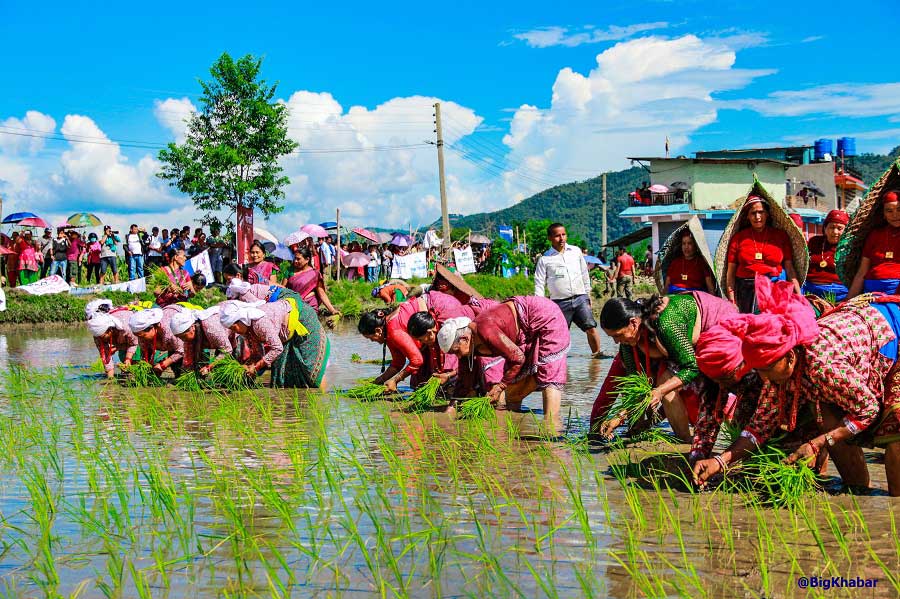
23rd National Paddy Day Being Observed with the Slogan of Climate-Friendly Technology, Self-Reliance and Prosperity in Paddy
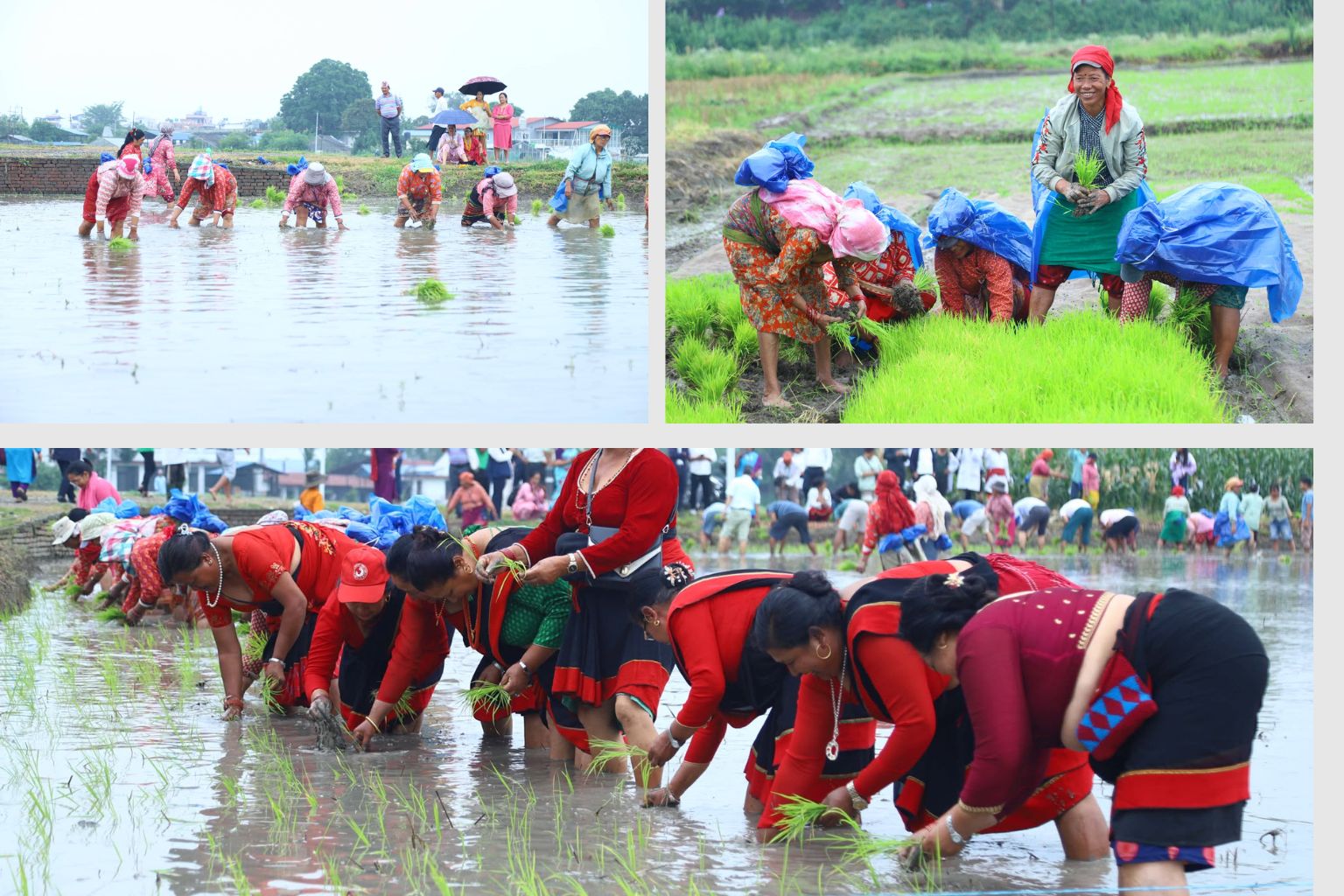
This year, the 23rd National Paddy Day and Rice Planting Festival is being observed with the slogan “Climate-friendly technology, self-reliance and prosperity in paddy.” Paddy is not only the main staple food of Nepalis but also a key foundation of tradition, culture and food security.
Status of Paddy Production and the Economy in Nepal
In Nepal, monsoon paddy is cultivated on nearly 1.43 million hectares of land, mainly as the principal crop in irrigated areas of the Tarai and hills. Nepal’s annual paddy production averages around 5.5 million metric tons. Based on prevailing market prices, the total value of this production comes to more than Rs 200 billion.
According to statistics, paddy accounts for an average of 3.5 percent of Nepal’s gross domestic product (GDP) and an average of 13 percent of agricultural GDP, the highest among agricultural commodities.
However, because a large area depends on seasonal rainfall, full access to high-yielding varieties has not been achieved, and fertilizers remain insufficient, Nepal’s paddy productivity is still limited to 4.1 metric tons per hectare. In other countries, the use of improved varieties has raised productivity to more than 5 metric tons per hectare.
Why Did Paddy and Rice Imports Increase?
Due to the gap between production and consumption, Nepal imports an annual average of 700,000 to 800,000 metric tons of paddy and rice. This is about 15 percent of total consumption. In the past two years, the value of imported paddy and rice has averaged Rs 30 billion to Rs 40 billion, while three years ago such imports had reached up to Rs 50 billion.
Various reasons are linked to Nepal, which had the capacity to export rice until the 2080s BS, becoming an importer at present:
-
Change in eating habits: In the eighties, a large population consumed local food grains such as millet and buckwheat, but now depends on rice, especially fine and aromatic rice.
-
Commercialization of livestock and poultry farming: A significant amount of paddy-based husk and broken rice is imported for feed.
-
Insufficient growth in production and productivity: Although production and productivity have increased by around 30 percent in the past 15 years, this is insufficient compared to the growth in population and per capita consumption.
-
Other reasons: Low investment in the agriculture sector, inadequate irrigation facilities, the impact of climate change, and rising cultivation costs have made paddy farming comparatively less profitable.
Global Status
Around 25 percent of the world’s farmers cultivate paddy on about 160 million hectares of land. From this, around 56 percent of the population consumes rice. Of the nearly 700 million metric tons of paddy produced annually worldwide, 90 percent of production and consumption takes place in Asia.
China and India alone account for 40 percent of total production. Although China has the highest production, India is the world’s largest rice-exporting country.
Way Forward and Strategy
To become self-reliant in paddy, there is a need to significantly increase current production and productivity. The following strategies have been pointed out for this:
-
Expansion of spring paddy: Expand spring paddy cultivation, which is currently being carried out on only about 130,000 hectares, by an additional 100,000 hectares.
-
Increase in productivity: Increase productivity by an additional 1 metric ton per hectare by providing irrigation, fertilizer, improved seeds and technology to around 1.3 million hectares cultivated in the main season.
-
Development of new varieties: Promote fine-grain paddy varieties according to consumer preference and develop varieties that can tolerate climate change, including submergence and drought.
-
Conservation of local varieties: Local and provincial governments should take initiatives for the conservation and promotion of popular local varieties such as Jorayal Basmati of Doti, Jetho Budho of Pokhara and Kalanamak of Kapilvastu.
To increase paddy production, efforts are being made by the government to expand irrigation projects, develop improved varieties through NARC, ensure fertilizer availability, determine the minimum support price and provide subsidies for agricultural insurance. However, the source states that further investment and coordination by the government, private sector and development partners are still needed in technology development, storage, processing and irrigation.

Comments 0
No comments yet. Be the first to start the conversation.