



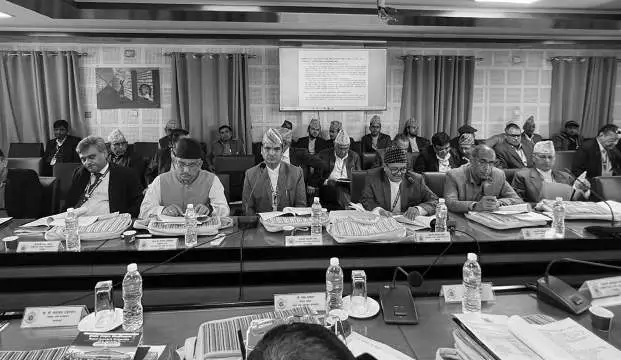
The 79th Senate meeting of Nepal Sanskrit University (NSU) was held on Kartik 17, 2083, approving a budget of Rs. 1.585 billion along with various academic and administrative proposals.
The meeting was chaired by Sasmit Pokharel, Pro-Chancellor of Nepal Sanskrit University and Minister for Education, Science and Technology. It began with the chanting of Vedic mantras by young Vedic students.
The proceedings were conducted by the university's Rector, Prof. Dr. Jagannath Regmi. Vice-Chancellor Prof. Dr. Bhim Prasad Khatiwada welcomed the Senate members and invited guests.
Vice-Chancellor's Address and Policy Action Plan
Addressing the Senate, Vice-Chancellor Prof. Dr. Khatiwada stated that Nepal Sanskrit University was established as a specialized institution with the objective of preserving and promoting Sanskrit literature and scholarship while developing Nepal into a center for Sanskrit studies.
He described the university as an institution representing Nepal's art, national identity, civilization, culture, and values. He expressed confidence that the 79th Senate would review the university's recent achievements and provide direction for its future development.
Vice-Chancellor Khatiwada announced plans to modernize the university's academic programs, establish relationships with international universities, and develop a technology-friendly environment for academic activities.
According to him, the university's existing accounting system will be integrated into an electronic accounting system. Teaching methods will also be made technology-based, while the university will move forward as a coordinating institution.
Priority will be given to technical subjects such as Yoga, Ayurveda, Naturopathy, and medicinal herbs. The university plans to introduce Acharya-level classes in at least one technical subject at each Vidyapeeth.
The university's libraries will be strengthened through physical resources and digital technology. Plans were also presented to introduce distance education and online teaching methods in the future.
The Vice-Chancellor further stated that Nepal Sanskrit University would assume a guiding and supportive role for all Sanskrit secondary schools and Gurukuls operating in Nepal.
He also outlined plans to establish and strengthen the Rashtraguru Yogi Naraharinath Research Promotion Centre. By expanding degree-oriented and non-degree research activities, the university aims to develop itself into a leading research institution.
Executive Council and Academic Council Appointments Approved
Vice-Chancellor Khatiwada presented proposals concerning nominations to the Executive Council and Academic Council, along with a proposal to organize an International Yoga Conference under miscellaneous business.
The Senate approved these proposals.
The details of the appointed officials are as follows:
Executive Council
-
Position: Member
-
Appointed Official: Associate Professor Dr. Raghunath Nepal
Academic Council
The following individuals were appointed as members of the Academic Council:
-
Prof. Dr. Devmani Bhattarai
-
Prof. Sumodvardhan Kaundinnyayan
-
Prof. Dr. Rishi Ram Regmi
-
Prof. Dr. Sagar Mani Subedi
-
Associate Professor Khageshwar Gautam
-
Prof. Dr. Dhruva Prasad Bhattarai
-
Prof. Bhim Prasad Kandel
-
Prof. Dr. Hari Prasad Pokharel
-
Prof. Dr. Arjun Prasad Bhattarai
-
Associate Professor Madhumalati Khatri
-
Prof. Satyaraj Subedi
-
Associate Professor Shyam Sundar Dhakal
-
Swami Satchidananda Saraswati
Rector Presents Annual Academic Programs and Progress Report
Rector Prof. Dr. Jagannath Regmi presented proposals concerning the university's annual academic programs.
The proposals included continuing existing academic activities and conducting the following programs:
-
Four-year Shastri program
-
Acharya program
-
Shiksha Shastri program
-
Bachelor's program in Ayurveda
-
Vidyavaridhi (PhD) program
The Rector reported that 3,284 students had graduated from the university during the previous academic year. The university has set a target of enrolling 5,506 students in the coming year.
Prof. Dr. Regmi also presented detailed reports and proposals covering several academic and research activities, including:
-
Doctoral research programs
-
Publication of books and journals
-
Publication and distribution of Panchang calendars
-
Various training programs
-
Conferences and subject-specific seminars
-
International academic relations and translation exchanges
-
Information dissemination and communication activities
-
Potential promotion of Gurukuls
-
Social outreach activities related to Ayurveda
-
Activities of the Rashtraguru Yogi Naraharinath Research Promotion Centre
At the end of his presentation, Rector Regmi also proposed a vote of thanks.
The Senate approved all the proposals with applause.
Registrar Presents Budget, Regulatory Amendments and Financial Proposals
University Registrar Prof. Dr. Navaraj Kattel presented the actual income and expenditure statement for the previous year and the estimated income and expenditure for the upcoming fiscal year.
The Senate approved the proposed budget allocation of Rs. 1,585,000,000 (Rs. 1.585 billion) for the upcoming fiscal year.
Amendments to University Regulations and Land Management
Registrar Kattel also presented proposals concerning:
-
Revisions and amendments to university regulations
-
Management of encroached university land
-
Commercial use of university land
-
Acquisition of land for the contact office at Basantapur
-
Pending university convocation arrangements
The Senate unanimously approved these proposals.
During the meeting, it was reported that the university had been unable to organize a convocation ceremony since 2077 BS.
Financial Assistance to Bhote Koshi Flood Victims
The meeting was also informed that Nepal Sanskrit University had transferred Rs. 7,344,860.63 to the Government of Nepal to support people affected by the Bhote Koshi floods.
Clarification on the Increased Budget
Some Senate members questioned the unexpected increase in the proposed budget compared with the previous year.
Responding to their concerns, Registrar Kattel explained that the higher allocation was necessary to implement newly introduced programs in addition to the university's regular activities.
Views of Experts and University Officials on Research and PhD Programs
Several officials and academic representatives shared their views on the university's research priorities, land management, and doctoral programs.
Proposal for Research on Manuscripts
Dr. Govinda Tandon, Chairman of Guthi Sansthan, suggested that Nepal Sanskrit University undertake a special project to study, research, and publish manuscripts preserved at the National Archives.
Discussion on University Land Ownership
Tribhuvan University Vice-Chancellor Prof. Dr. Bhola Thapa raised questions regarding the ownership of land associated with Nepal Sanskrit University's contact office.
Registrar Kattel addressed the concerns raised during the meeting.
Questions Regarding the Legitimacy of PhD Programs
Prof. Dr. Khadga KC, Chairman of the University Grants Commission (UGC), questioned the legality and official recognition of the PhD programs conducted by Nepal Sanskrit University.
He directed the university to conduct its doctoral programs through officially recognized procedures.
Prof. Dr. Mukunda Prasad Lamichhane, President of the Nepal Sanskrit University Professors' Association, responded to the issues raised by the UGC Chairman.
Clarification on Interdisciplinary Doctoral Research
Prof. Dr. Lamichhane explained that Nepal Sanskrit University's Research Centre was not affiliated with any particular faculty. Rather, it functioned as a research center with national and international scope.
He stated that, under the university's research guidelines, doctoral research could be conducted on any topic within a discipline connected to Sanskrit studies, regardless of whether the university had a postgraduate department dedicated to that particular subject.
He also stated that such research topics could be related to scientific disciplines.
As examples, he referred to international universities, including Oxford University, San Diego University, Cambridge University, Antonibrook University, and Heidenberg University, which he said conducted doctoral research in Sanskrit despite not necessarily having separate postgraduate Sanskrit departments.
He questioned why Nepal Sanskrit University should not be permitted to conduct doctoral research in other disciplines when the research topics were connected to subjects contained in Sanskrit literature.
Prof. Dr. Lamichhane also urged university officials to address the questions raised by the University Grants Commission promptly and through cooperation.
Sanskrit Education, Academic Responsibility and Nepal Vidya Bhushan Awards
Drawing the attention of the Senate Chairperson and Education Minister, Prof. Dr. Lamichhane stated that Sanskrit education was fundamentally concerned with spiritual knowledge and character development.
He observed that actions undertaken with good intentions were meaningful and productive.
He further stated that the university could provide the Government of Nepal with a group of distinguished academic thinkers capable of contributing perspectives on religious, cultural, educational, ethical, political, and spiritual matters.
Referring to ancient sages, royal sages, and divine sages, he also discussed the good intentions and philosophical contributions of Socrates, Plato, and Aristotle.
He drew the Education Minister's attention to the need to resume the distribution of the Nepal Vidya Bhushan medals, which had been suspended for five years.
These medals are awarded by the Government of Nepal to scholars who have earned doctoral degrees.
He urged the minister to make arrangements for their distribution as soon as possible.
Closing Address by Pro-Chancellor and Education Minister
Concluding the Senate meeting, Chairperson Sasmit Pokharel, Pro-Chancellor of Nepal Sanskrit University and Minister for Education, Science and Technology, stated that the university had been established because of the special importance of Sanskrit in Nepal.
He stressed that Nepal Sanskrit University should develop into a center for academic study and research related to Sanskrit.
He also emphasized that the university should remain free from political interference.
Referring to reports of political activities within the university, Minister Pokharel stated:
"The government has not engaged in politics. You yourselves know who has been involved in politics. University officials must become results-oriented."
Clarification on Land Ownership
Addressing the land ownership issue concerning the university's contact office at Basantapur, Minister Pokharel clarified that the land originally belonged to the government.
He stated that Tribhuvan University and Nepal Sanskrit University should not engage in disputes over the property.
The minister also emphasized the need to resolve land-related problems in the Dang region and affirmed the government's full commitment to addressing those issues.
Government Priority for Sanskrit Education
Minister Pokharel stated that Sanskrit education and related academic activities remained priorities for the government.
He directed Nepal Sanskrit University to undertake activities suited to its distinct institutional nature rather than simply following the approaches adopted by other universities.
Following his remarks, the minister formally declared the Senate meeting closed.
Participation in the Senate Meeting
The meeting was attended by Vice-Chancellors from various universities, Chancellors and Vice-Chancellors of academies, the Chairman of the University Grants Commission, distinguished scholars, professors, and university employees.
After the conclusion of the Senate meeting, a group photograph of the Senate members and invited guests was taken.
Published Date: November 2026

Comments 0
No comments yet. Be the first to start the conversation.