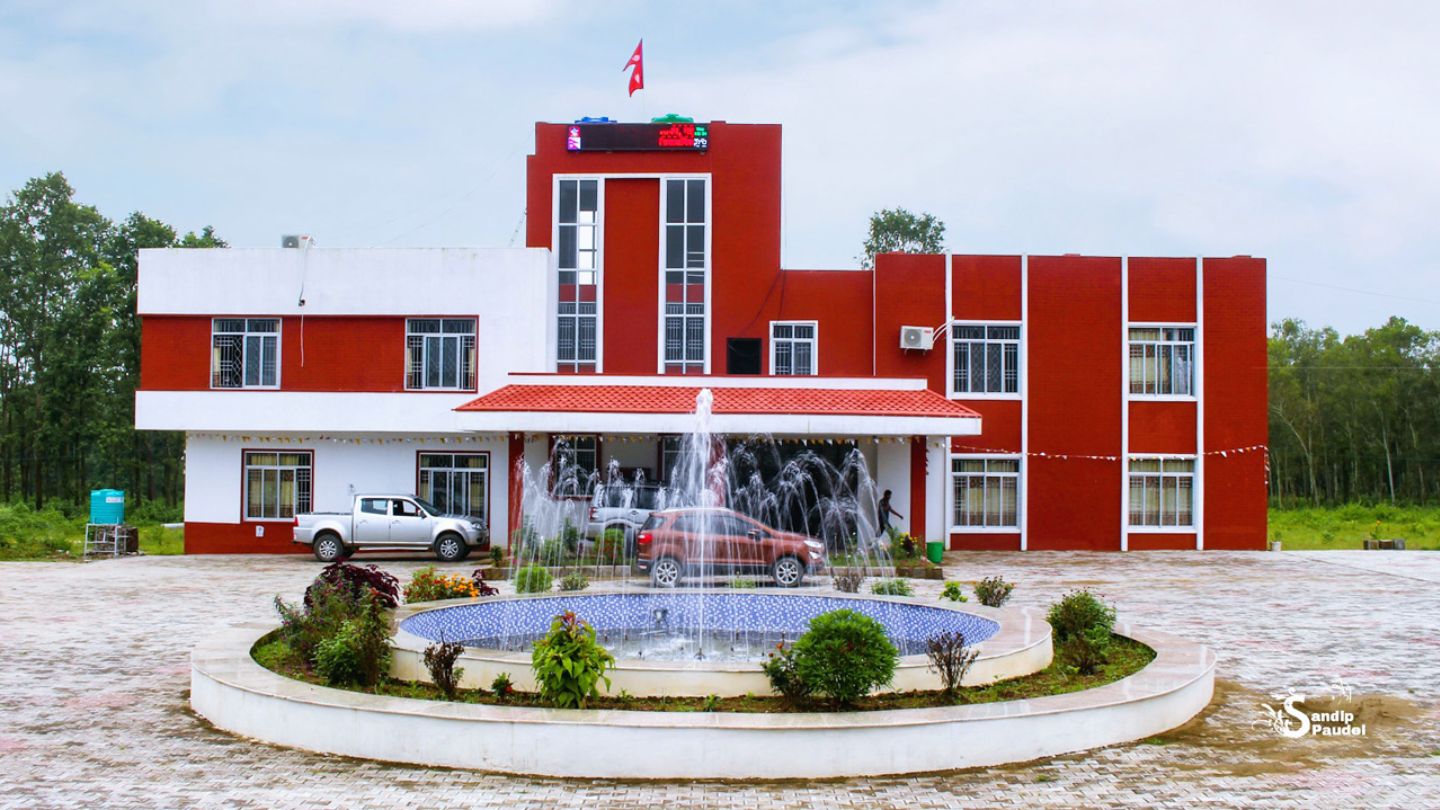
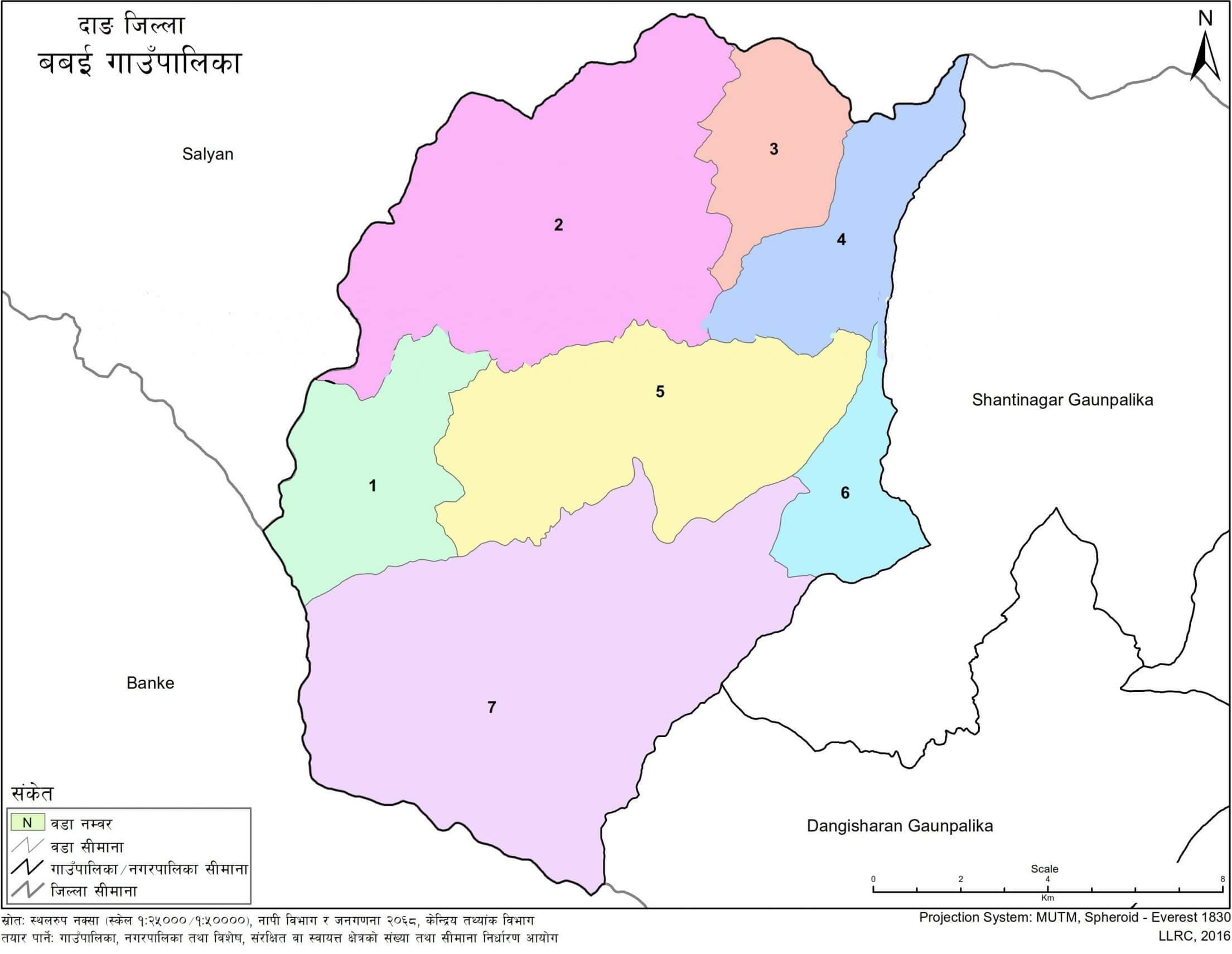
Babai Rural Municipality, also known as Babai Gaupalika, is a rural local government area in Dang District of Lumbini Province. It was formed by merging the former Panchkule and Purandhara Village Development Committees. The rural municipality lies 46 kilometers west of Ghorahi, the district headquarters, and covers 257.48 square kilometers.
Babai Rural Municipality is bordered by Shantinagar Rural Municipality and Dangisharan Rural Municipality to the east, Banke District to the west, Salyan District to the north, and Dangisharan Rural Municipality and Banke District to the south.
| Field | Details |
|---|---|
| Name: | Babai Rural Municipality |
| Local Name: | Babai Gaupalika |
| District: | Dang |
| Province: | Lumbini Province |
| Area: | 257.48 sq. km |
| Distance from District Headquarters: | 46 km west of Ghorahi |
| Formation: | Former Panchkule and Purandhara VDCs |
| Local Service Focus: | Administration, education, agriculture, infrastructure, environment, culture, tourism, and local development |
Babai Rural Municipality functions as a local administrative unit for its residents. Its service role is connected with ward-level public administration, local documentation, recommendations, registration-related work, and public record handling.
These services are important for residents who need local-level administrative support for household, settlement, civic, and community matters. Since Babai is organized into 7 wards, local service access is connected with both ward offices and the rural municipality office.
Education is a major public service area in Babai Rural Municipality. The municipality has school-level institutions as well as higher education access through Purandhara Campus, which is located at Purandhara-5, Hansapur, Babai, Dang, and is affiliated with Tribhuvan University.
The education profile includes public and private schools, basic-level schools, secondary schools, plus-two-level institutions, one technical school, and one college. Education-related local planning is linked with school access, continuation to secondary level, technical education, and higher education access.
Agriculture is a major income source in Babai Rural Municipality. Major crops include rice, wheat, maize, barley, mustard, potatoes, tobacco, sugarcane, lentils, peas, chickpeas, and soybeans.
Agriculture-related service priorities include irrigation, improved farming practices, access to agricultural inputs, local production support, and commercial agriculture. The municipality has fertile soil, including loamy and clayey soil, but farming is affected by traditional practices, rain-fed irrigation, high input costs, and limited access to modern agricultural technology.
Livelihood planning is also connected with foreign employment, skill-based training, dairy production, poultry production, fish farming, cottage industries, and agriculture-based enterprises.
Infrastructure is a core local service area for Babai Rural Municipality. The municipality has identified road improvement, drinking water management, public toilet management, irrigation, and settlement planning as important local development concerns.
Many roads in the municipality remain unpaved and of low quality. Road improvement is important for transport access, agricultural movement, education access, local trade, and public service delivery.
Water supply, sanitation, and public toilet management are also part of local service priorities. Irrigation development is important because agriculture remains dependent on rainwater in many areas.
Babai Rural Municipality has a land-use pattern dominated by forest. Forest area covers 75.79% of the municipality, while arable land covers 13.53%. Rivers, streams, ponds, grazing land, shrubland, and sandy land also form part of the local physical setting.
Environmental service priorities include forest conservation, natural resource protection, waste management, and planned use of local resources. Community forests, herbs, honey production, biodiversity, fertile land, and water resources are connected with both livelihood and conservation planning.
The municipality also faces environmental and settlement-management concerns. Waste management and environmental protection require planned local action.
Babai Rural Municipality has diverse cultural and religious practices. Festivals celebrated in the municipality include Dashain, Tihar, Maghi, Holi, Maha Shivaratri, Ram Navami, Krishna Janmashtami, Bakr Eid, Aitabari, Buddha Jayanti, and Christmas.
Local fairs such as Suwakoti Mela, Shivaratri Mela, and Barah Mela are part of community life. The Magar and Tharu communities are also part of Babai’s cultural identity.
Cultural service priorities include the preservation of local traditions, dances, attire, customs, festivals, fairs, and community heritage. Cultural practices are also connected with local tourism planning.
Purandhara Waterfall is a major natural attraction in Babai Rural Municipality. Tourism-related planning is connected with natural sites, cultural identity, festivals, fairs, and local heritage.
Local economic service areas include small cottage industries, agriculture-based industries, trade, commerce, training centers, financial services, and employment-related activities. These areas are linked with local income, youth participation, skills, and rural enterprise development.
Babai Rural Municipality’s local service needs are closely connected with roads, irrigation, employment, agriculture, drinking water, sanitation, settlement planning, environmental protection, and waste management.
Development opportunities are linked with forests, fertile agricultural land, water resources, biodiversity, educated human resources, youth population, national highway connection, cottage industries, herbs, agriculture-based enterprises, and tourism.
Babai Rural Municipality is located in Dang District of Lumbini Province. It lies 46 kilometers west of Ghorahi.
Babai Rural Municipality was formed by merging the former Panchkule and Purandhara Village Development Committees.
The main service areas include local administration, education, agriculture, infrastructure, environment, culture, tourism, and local development planning.
Agriculture-related priorities include irrigation, access to agricultural inputs, improved farming practices, commercial agriculture, dairy, poultry, fish farming, and agriculture-based enterprises.
Main infrastructure concerns include unpaved roads, drinking water management, public toilet management, irrigation, and planned settlement development.
Purandhara Waterfall is identified as a natural attraction in Babai Rural Municipality.
The Magar and Tharu communities are part of Babai Rural Municipality’s cultural identity.



.jpg)