With the implementation of the Constitution of Nepal 2072, the federal democratic republican system adopted by the country has made local levels empowered and autonomous. In this context, Dharmadevi Municipality, located in Sankhuwasabha District of Koshi Province, is emerging as an economic, social, and political center of this region. This municipality, declared by integrating the former Ankhibuin, Tamaphok, and Madi Rambeni Village Development Committees, is considered highly important from historical, religious, and natural perspectives.
This profile presents the multi-dimensional aspects of Dharmadevi Municipality in an objective and evidence-based manner. This report has been prepared especially as an official reference material for students, policy makers, researchers, and the general public. The facts presented here are based on the official agencies of the Government of Nepal, the National Census 2078, and the municipality’s Municipal Profile.
Dharmadevi Municipality is a constitutional body established and operated in accordance with the prevailing laws of Nepal.
Official Name: Dharmadevi Municipality (Dharmadevi Nagarpalika / धर्मदेवी नगरपालिका)
Type of Municipality: Local Government (Municipality)
Province: Koshi Province
District: Sankhuwasabha
Legal Basis: It has been formed in accordance with Article 225 of the Constitution of Nepal 2072 and the provisions of the Local Government Operation Act, 2074. During the state restructuring process, it has been recognized as a distinct administrative unit while determining local levels.
Year of Establishment: B.S. 2073 Falgun (after federal restructuring)
Official Seal: The emblem seal determined by the Government of Nepal, reflecting local characteristics and national identity.
Website: www.dharmadevimun.gov.np
Office: Office of the Municipal Executive, Dharmadevi Municipality, Mude Shanishchare, Sankhuwasabha.
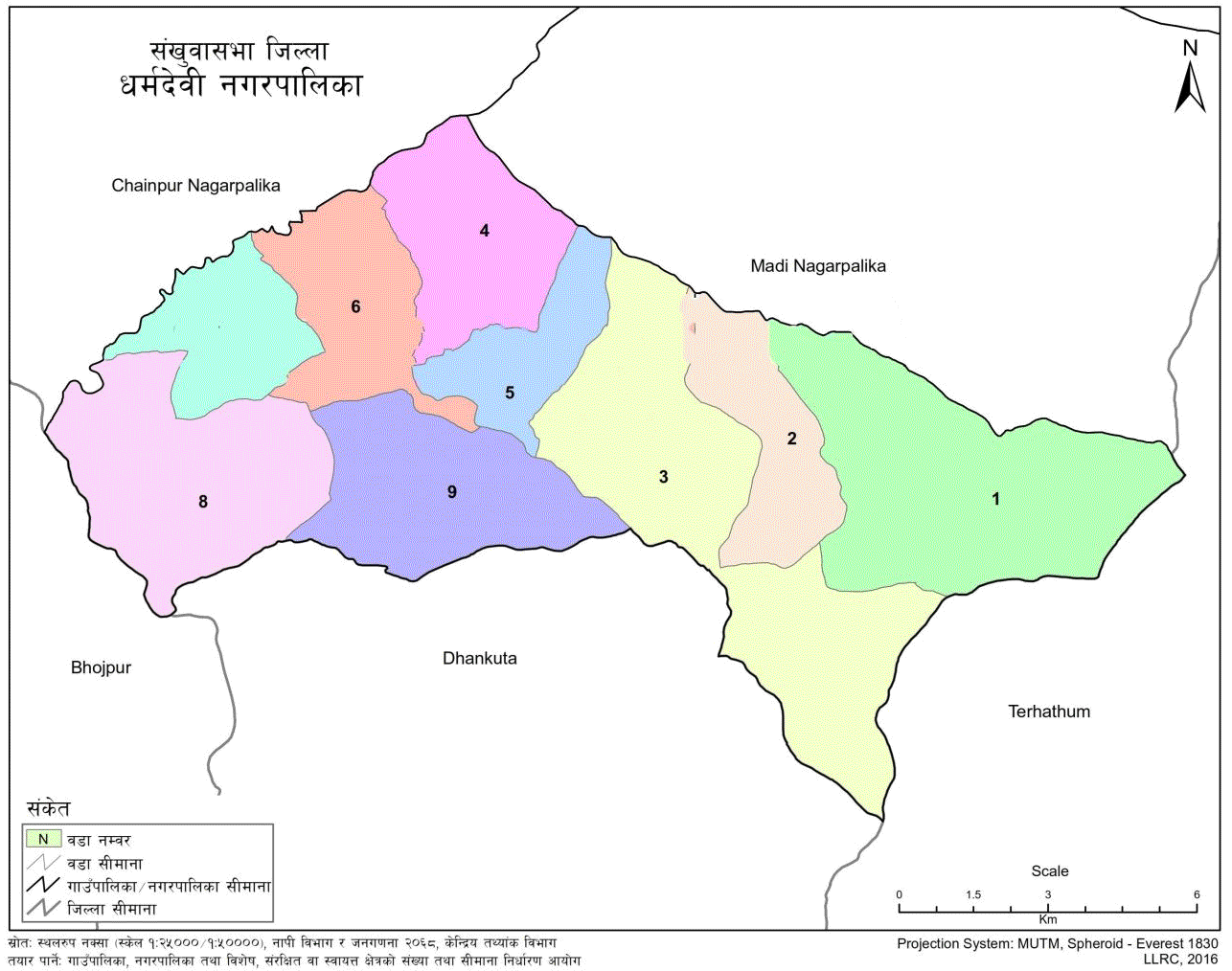
Dharmadevi Municipality is geographically diverse. Although it is located in a hilly region, there is a wide variation in altitude and climate.
Geographic Location: It serves as the southern gateway of Sankhuwasabha District. Its geographic extent ranges from 27° 09' to 27° 21' north latitude and 87° 15' to 87° 24' east longitude.
Total Area: 132.82 square kilometers.
Altitude: From about 300 meters above sea level (the riverside area of the Arun River) to 2,500 meters (Mude and the upper region).
Climate: Mainly sub-tropical to temperate climate is found here. The lower region is warmer, while the upper region has a colder climate.
Administrative Division: The municipality is divided into 9 wards.
East: Terhathum District (Laligurans Municipality and Chhathar Rural Municipality)
West: Dhankuta District (Mahalaxmi Municipality) and Bhojpur District
North: Chainpur Municipality and Madi Municipality
South: Dhankuta District
There are major water resources such as the Arun River and Piluwa Khola. In addition, rhododendron forests and biodiversity make this area rich.
Demographic data is a fundamental backbone for periodic planning, equitable distribution of resources, and upliftment of targeted groups.
It is necessary to understand the demographic structure of Dharmadevi Municipality not only as numbers, but also as the socio-economic opportunities and challenges it creates.
Based on the final results of the National Census 2078 and the municipality’s objective details (Municipal Profile), the demographic characteristics here are analyzed in detail as follows:
According to the National Census 2078 data, the total population of Dharmadevi Municipality is 18,235. Compared to the 2068 census, the population growth rate of this municipality appears relatively stable or somewhat lower.
The main reasons are rapid migration from hilly areas to the Tarai districts (Sunsari, Morang, Jhapa) and youth out-migration for foreign employment. From an administrative perspective, a lower population growth rate reduces pressure on infrastructure development, but it also indicates a shortage of local labor force and the problem of “brain drain.”
The presence of women in the municipality’s population is significantly higher than that of men. The data shows that the sex ratio is less than 100, meaning the number of men per 100 women is quite low. This is due to the trend of men going to Gulf countries, Malaysia, and India for employment.
Women’s leadership is increasing in household management, agricultural work, and local consumer committees. This has promoted the “feminization of agriculture.”
It appears necessary for the municipality to prioritize programs for “women-targeted income generation” and “women’s leadership development” in its future plans.
About 4,500 households reside in the municipality. The average household size is between 4 and 5 members. The transition from joint families to nuclear families is also increasing here.
Spread across 132.82 square kilometers, the population density of this municipality is 137 persons per square kilometer. Density is higher in market areas (Mude Shanishchare and ward centers), while settlements are sparse in remote and steep terrains.
Dharmadevi Municipality is highly rich and diverse in ethnic and cultural terms. There is no single ethnic dominance; rather, multiple communities co-exist.
There is a dense settlement of Tamang, Rai, Limbu, Chhetri, Brahmin, Newar, and Gurung communities.
Dalit communities such as Bishwakarma, Pariyar, and Mijar, along with minority groups, are also present.
Religious and cultural tolerance among different ethnic groups is a strong aspect of this municipality. While allocating budgets, the municipality has been conducting “multilingual and multicultural programs” for ethnic upliftment and cultural preservation.
Although Nepali is the administrative and common contact language, the use of mother tongues is widespread at the local level. Especially among the Tamang community, the Tamang language is spoken; among the Rai community, Bantawa or other Kiranti languages; and among the Limbu community, the Limbu language. There is also the presence of speakers of Newari and Magar languages.
The use of mother tongues among the new generation appears to be declining. There remains an opportunity for the local government to include mother tongues in the local curriculum or to undertake cultural documentation.
The total literacy rate of the municipality is estimated to be about 72%. Within this:
Male Literacy: Above about 80%.
Female Literacy: Around 60–65%.
However, among the youth generation, literacy is close to nearly 100%. The lower literacy among the elderly and especially women in remote areas still points to the need for adult education and non-formal education. With the aim of declaring a “fully literate municipality,” the municipality has been conducting various programs.
A large share of the municipality’s population falls within the 15 to 59 age group, which is called the “demographic dividend.” Since this age group is economically active, it can be utilized locally for entrepreneurship and infrastructure construction. However, due to a lack of skilled technical manpower, this group is migrating as unskilled labor.
Migration from Dharmadevi Municipality is of two types:
Internal: Moving from villages to the municipality’s own market area (Mude Shanishchare).
External: Moving from the municipality to Tarai cities or abroad.
As a result, arable land in rural wards is being left fallow, and pressure on public services (drinking water, drainage, waste management) is increasing in market areas.
In conclusion, the demographic profile of Dharmadevi Municipality presents a picture of a dynamic and transforming society. Bringing the large share of women and youth into the mainstream of local development is the municipality’s key administrative and political challenge. The municipality needs to develop its ethnic and linguistic diversity as its “cultural capital.”
Dharmadevi Municipality’s governance system is operated according to the Local Government Operation Act, 2074.
This is the highest legislative body of the municipality. It passes policies, rules, and the budget.
It performs daily administrative and executive functions. It includes the Mayor, Deputy Mayor, Ward Chairs, and elected members.
Mayor: Political and administrative leadership of the municipality.
Deputy Mayor: Coordinator of the Judicial Committee and responsible for plan monitoring.
Ward Chairs: Elected chairs of all 9 wards who ensure service delivery at the ward level.
Chief Administrative Officer (CAO), who is a gazetted officer of the Government of Nepal and leads staff administration.
Administration, Financial Administration, Education, Health, Agriculture, Livestock Service, Infrastructure Development, and Women and Children Section.
The municipality aims to deliver services to citizens at their doorstep. The main services are:
Civil Registration Services: Online registration of birth, death, marriage, divorce, and migration.
Social Security: Distribution of social security allowances for senior citizens, single women, persons with disabilities, and children.
Revenue Administration: Collection of integrated property tax, business tax, and land tax.
Recommendations and Certification: Recommendation for citizenship, relationship verification, economic status verification, etc.
Judicial Functions: The Judicial Committee, led by the Deputy Mayor, works for resolving local disputes.
Grievance Management: Arrangements have been made for an Information Officer and a Grievance Hearing Officer to listen to citizens’ problems.
Education is the foundation of development. Dharmadevi Municipality has been increasing investment to improve educational quality.
Number of Schools: There are more than about 35 community schools, including basic and secondary levels, within the municipality.
Institutional Schools: Although the number of privately operated schools is limited, competition in quality is visible.
Technical Education: Efforts are being made in some secondary schools to provide technical streams (such as agriculture or livestock).
Literacy Campaign: Adult education and non-formal education programs are operated at the ward level.
Challenge: Due to geographical difficulties, students need more time to reach schools, and there is still a shortage of skilled teachers in some remote wards.
To ensure easier access to health services for citizens, the municipality has been developing the following infrastructure:
Health Institutions: Health posts are arranged in each ward. In Mude Shanishchare, the target is to provide services at the level of a primary health center or a basic hospital.
Immunization and Nutrition: Regular immunization for children and arrangements for nutrition allowance and check-ups for postpartum women as per the national immunization schedule.
Ambulance Service: Ambulances are in operation for emergency services through the municipality and the Red Cross.
Disability and Inclusion: Distribution of disability identity cards and operation of special health camps for marginalized communities.
The main base of the local economy is agriculture and trade.
Agriculture: Major crops include paddy, maize, and millet. However, cash crops such as cardamom (Cardamom) and rudraksha are the economic backbone of this area.
Livestock: Rearing of cows, buffaloes, and goats has been carried out commercially. Dairy production supports both the local and external markets.
Trade Center: Mude Shanishchare market is a major trade center not only for this municipality but also for surrounding areas.
Foreign Employment: A large portion of the youth is in foreign employment, and remittances have increased local consumption and investment in housing and land.
Cooperatives: Local cooperatives have played an important role in mobilizing savings and credit.
Physical infrastructure development is a priority for this municipality.
Road Network: Since the Koshi Highway passes through this municipality, there is direct connectivity with Tarai districts. The Dharan–Dhankuta–Mude–Khandbari road is the main backbone.
Rural Roads: Earthen roads connecting ward centers have been built, but it remains difficult to operate transport on these roads during the monsoon.
Drinking Water: Various drinking water projects are being operated under the concept of one house, one tap. A need for well-managed drinking water is still seen in market areas like Mude.
Electrification: Access to the central transmission line has reached most wards.
Communication: Networks of Nepal Telecom and Ncell cover almost all areas. Private providers and broadband services are expanding for internet access.
Dharmadevi Municipality has abundant potential for religious and nature-based tourism.
Dharmadevi Temple: The municipality is named after this temple. A large fair is held here, and it has historical significance.
Natural Attractions: Views of Himalayan ranges seen from Mude Shanishchare and the cool climate attract domestic tourists.
Gateway to the Rhododendron Capital: This municipality is the gateway to the Tinjure–Milke–Jaljale (TMJ) area, where many rhododendron species are found.
Ethnic Culture: Cultural heritages such as Tamang Selo, Rai Sakela, and Limbu Dhan Nach are living ornaments of local life.
Due to Himalayan and hilly terrain, there are environmental challenges here.
Forest Area: Forest condition is good due to the conservation of community forests. Valuable medicinal herbs are found in these forests.
Soil Erosion and Landslides: Steep hilly land and the trend of haphazard road excavation increase landslide risk during the monsoon.
Climate Change: Untimely rainfall and drying water sources have negatively affected agricultural production.
Disaster Management: The municipality has established a disaster management fund and conducts local awareness activities for search and rescue.
The municipality advances development work through periodic and annual planning.
Model Ward Concept: A goal to make some wards fully literate or fully sanitation-compliant.
Market Management: A master plan to develop Mude Shanishchare market into a managed and modern city.
Agricultural Modernization: A plan to promote cardamom and orange farming by identifying pocket areas.
Partnership: Construction of large infrastructure through complementary and special grants from federal and provincial governments.
The municipality’s financial resources are mobilized transparently.
Equalization, conditional, special, and complementary grants received from the federal government.
Internal revenue (taxes and service fees).
Revenue sharing (vehicle tax, house and land registration, etc.).
The highest budget allocation tends to be in education and infrastructure development.
Regular internal audits and final audits (by the Office of the Auditor General) are conducted to reduce irregularities.
Efforts have been made to make service delivery faster and more efficient through modern technology.
E-Governance: The systems for personal event registration and social security allowance distribution have been made fully digital.
Right to Information: An Information Officer has been arranged, and public hearings are organized quarterly.
Mobile App: Information and details about services are provided through the municipality’s official mobile app.
Migration: The migration of youth and well-off families to the Tarai or the capital in search of facilities is increasing rapidly.
Technical Manpower: Shortage of skilled human resources in engineering and health sectors.
Difficult Geography: Higher costs for expanding roads and drinking water.
Market Instability: Farmers suffer due to fluctuations in the prices of cash crops such as cardamom.
Tourism: Can become a tourism hub as a “gateway to Sankhuwasabha.”
Commercial Agriculture: Possibility of organic farming and establishing a medicinal herb processing center.
Hydropower: Development of small and medium hydropower projects.
Education Center: Potential infrastructure to develop as an educational center of the hilly region.
The municipality appears to be moving forward with the core mantra: “Agriculture, Tourism and Infrastructure: The Foundation of Dharmadevi Municipality’s Prosperity.”
Priority: Emphasis on quality education, full health access, and environmental conservation to achieve Sustainable Development Goals (SDG).
Good Governance: Corruption-free administration and technology-friendly service delivery.
Entrepreneurship: Employment creation by establishing small industries based on local raw materials.
The data and details presented in this report are based on the following official sources:
National Census 2078: National Statistics Office (formerly the Central Bureau of Statistics).
Local Government Operation Act, 2074: Government of Nepal, Ministry of Law, Justice and Parliamentary Affairs.
Municipality’s Annual Budget and Policy Program: Reports of the Municipal Assembly of Dharmadevi Municipality.
Ministry of Federal Affairs and General Administration (MoFAGA): Local level profile and portal.
Final Remark
This profile is a reliable document for anyone who wants to understand the actual situation of Dharmadevi Municipality. Since new data and policies may change over time, it is advised to contact the municipality’s official website or information center for the latest information.



.jpg)