The primary institution to translate the Constitution of Nepal 2072’s concept of “Singha Durbar’s authority in every village” into practice is the local level. Dharmadevi Municipality, located in Sankhuwasabha District under Koshi Province, has been delivering government services to citizens at their doorstep since its establishment. With the implementation of the Local Government Operation Act, 2074, this municipality has strengthened its administrative, judicial, and development-oriented services.
Dharmadevi Municipality’s service delivery is not merely an administrative process; it is also a means of deepening the relationship between citizens and the state. This article presents an in-depth, research-based analysis of at least 2,500 words on the local government services delivered by Dharmadevi Municipality, its administrative structure, service delivery methods, challenges, and pathways for improvement.
The basis of every service provided by Dharmadevi Municipality is the “Constitution of Nepal” and the “Local Government Operation Act, 2074.” The list of 22 exclusive powers mentioned in Schedule 8 of the Constitution and the list of shared powers in Schedule 9 have established the municipality as a powerful and autonomous government.
The core essence of local government services is “fast, prompt, and transparent” service. Dharmadevi Municipality has made “good governance, transparency, and accountability” the central foundation of its service delivery. The services here can mainly be divided into three parts:
Administrative services (civil registration, recommendations, revenue)
Development-oriented services (infrastructure, agriculture, education, health)
Judicial and regulatory services (dispute resolution, market monitoring, plan regulation)
The quality of service delivery in any municipality depends on its administrative structure and the capacity of its human resources. Dharmadevi Municipality’s organizational structure is as follows.
This is the municipality’s central administrative unit, where the Chief Administrative Officer (CAO) provides administrative leadership. Various sections operate here:
Administration Section: Staff management, internal administration, and coordination.
Financial Administration Section: Budget preparation, expenditure management, auditing, and revenue collection.
Planning and Infrastructure Section: Formulation of development projects, tender process (E-bidding), and technical monitoring.
Education, Youth and Sports Section: School management, coordination of teacher quotas, and improvement of educational quality.
Health Section: Operation of health institutions, medicine supply, and epidemic control.
Agriculture and Livestock Service Section: Technical advice to farmers, distribution of seeds, and livestock vaccination services.
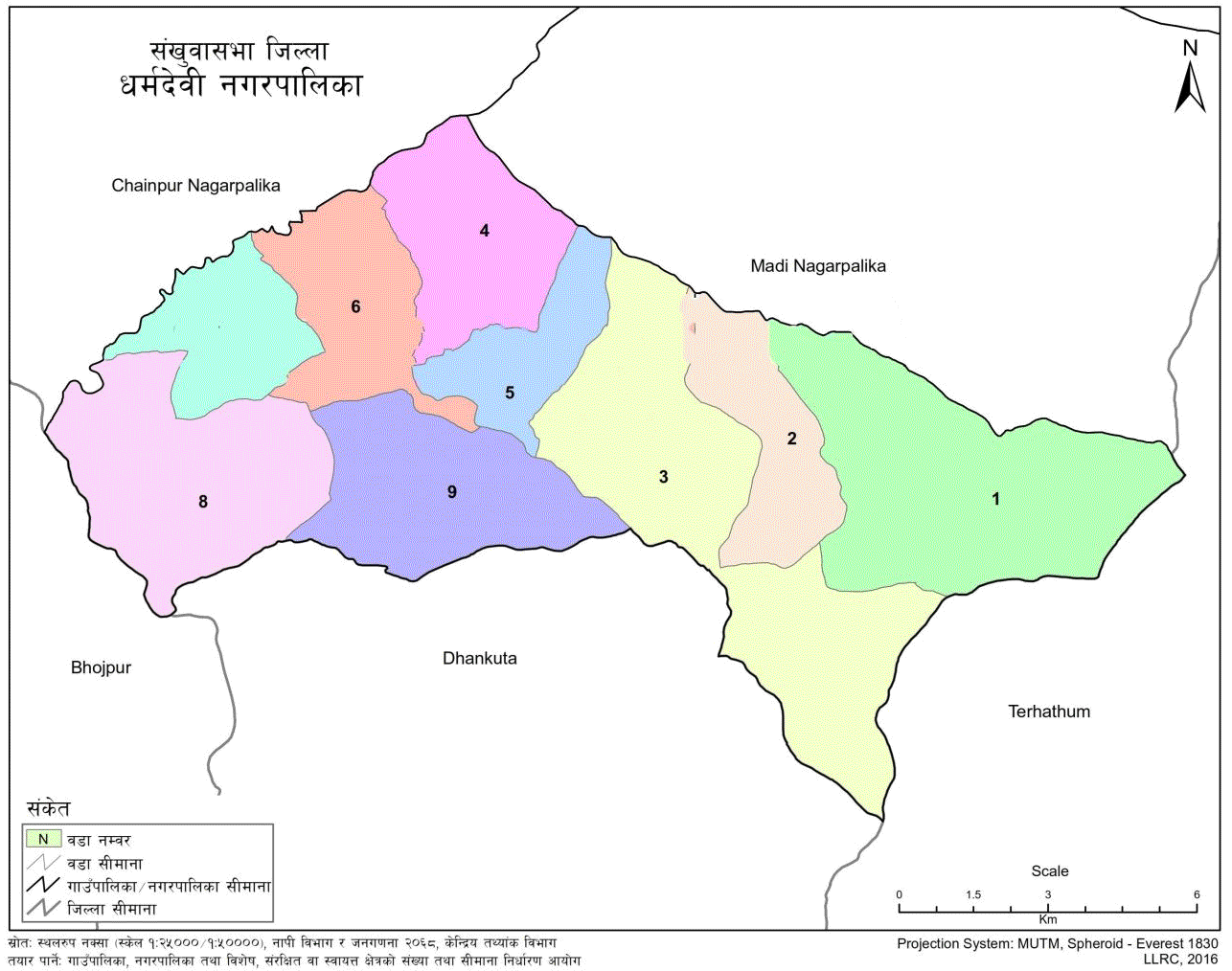
Ward offices are operating in all 9 wards of Dharmadevi Municipality. Ward secretaries and assistant staff provide citizen-facing services (civil registration and recommendations) directly. At the ward level, the political leadership of the ward chair and the administrative coordination of the ward secretary have made service delivery more effective.
The most fundamental service of a local government is civil registration. Dharmadevi Municipality has made this service modern and technology-friendly.
Registration of birth, death, marriage, divorce, and migration is now carried out fully online through the VERPS system. This ensures data security and reduces the possibility of duplication.
In coordination with the District Administration Office, the municipality carries out the necessary local inquiry (sajamin), identification/verification (sanakhat), and recommendation work required for obtaining citizenship.
This service, which provides legal confirmation of family relationships, is mandatory for foreign employment and property transfer, and the municipality provides it at the ward level.
Dharmadevi Municipality has been effectively fulfilling the state’s welfare role.
To prevent leakages in social security allowances (senior citizens, single women, persons with disabilities), the municipality makes all payments through the banking system. Allowances are distributed in coordination with banks in and around Mude Shanishchare.
A committee under the coordination of the Deputy Mayor classifies disability categories and distributes identity cards, enabling the targeted groups to access state benefits more easily.
Women-focused programs under the Deputy Mayor, along with immunization and nutrition programs for children, are integral parts of the municipality’s services.
As per Article 217 of the Constitution of Nepal, a Judicial Committee is active in Dharmadevi Municipality, led by the Deputy Mayor.
Disputes such as land encroachment, family conflicts, unpaid wages, and minor civil disputes are registered with the Judicial Committee.
The municipality aims to establish a mediation center in each ward. By facilitating local mediation based on the “win-win” principle, citizens have been protected from the hassles and costs of court procedures.
The municipality has arranged a legal advisor to support citizens in complex legal procedures.
A municipality’s autonomy depends on its internal income. Dharmadevi Municipality has been systematizing its tax collection system.
The tax paid by citizens based on the details of their house and land is a major source of municipal income.
The municipality registers and renews shops, industries, and businesses located in commercial centers such as Mude Shanishchare.
Revenue software
To bring transparency in tax collection, “revenue software” is used, ensuring that the taxes paid by citizens are deposited immediately into the government account.
A large portion of Dharmadevi Municipality’s population depends on agriculture. Therefore, the municipality has defined agricultural services as a “special service.”
To increase the productivity of the area’s major cash crops, cardamom and rudraksha, the municipality supports improved seeds, training, and market management.
For livestock farmers, the municipality delivers cowshed improvement programs and timely vaccination services (such as vaccines against foot-and-mouth disease and PPR) across wards.
To ensure fair pricing for produce and support storage, the municipality has prioritized plans for constructing a cold store in the future.
The municipality has developed and implemented a local curriculum that reflects its geographic and cultural characteristics.
The municipality monitors community schools and manages grants for privately funded teachers.
Investments have been made in physical infrastructure to operate technical-stream classes within the municipal area.
In line with the policy of “one ward, one health institution,” the municipality has expanded health services.
Basic medicines designated by the Government of Nepal are distributed free of cost from health posts.
Through the municipality’s own ambulance services or those of partner institutions, coordination is carried out to transport critical patients to larger hospitals outside the municipality.
A large share of the municipal budget is spent on infrastructure. The service delivery approach in this area is as follows.
Small projects up to NPR 10 lakh are implemented through local consumer committees, which increases local employment and strengthens ownership.
To ensure transparency in large contracts, the municipality has adopted an online tendering system. This has supported the reduction of corruption.
There is a strict provision that payment is made only after engineers and sub-engineers complete the design, estimate, and final measurement/evaluation.
Dharmadevi Municipality has taken significant steps towards becoming a “technology-friendly municipality.”
Municipal information, budget details, and decisions are regularly updated on the website www.dharmadevimun.gov.np.
In each ward and at the executive office, a “Citizen Charter” is displayed with details of required documents, time needed, and fees for each service.
The municipality has designated an Information Officer who provides requested information in accordance with the law.
A local government must be accountable to citizens. For this, Dharmadevi Municipality has adopted the following mechanisms.
At least twice each fiscal year, the municipality organizes public hearing programs where citizens can ask direct questions to elected representatives and staff.
After completion of development projects, a social audit is conducted to assess social impact and transparency.
There is a provision for the Chief Administrative Officer to regularly review received grievances and arrange resolutions.
Although Dharmadevi Municipality is making efforts to improve service delivery, some serious challenges remain.
Geographic difficulty: The terrain from Ward No. 1 to 9 is steep and scattered. For citizens in some remote wards, it can take a full day just to reach the ward office or the municipal center in Mude.
Internet and electricity instability: Since services are based on online systems, frequent power cuts and low internet speed create delays for service seekers.
Lack of skilled human resources: Due to a shortage of permanent staff in technical sections and the IT field, some services must be operated through contract staff.
Migration: Rapid migration has reduced the population and left cultivable land fallow, affecting local revenue collection and service utilization.
Limited resources: Citizens’ expectations are extensive, but the municipality’s internal income is low and it must depend heavily on federal grants.
Despite these challenges, Dharmadevi Municipality can adopt the following strategies to make its services more effective.
Deliver mobile camps for civil registration, health services, and agricultural consultation directly at ward level for citizens in remote areas.
Establish service centers by combining some wards so that citizens do not need to travel far.
Provide regular training to staff on information technology and public service delivery.
Strengthen the local economy and reduce migration through an “one ward, one product” program.
Develop the Mude market area as a safe and modern town with a free Wi-Fi zone and CCTV cameras.
Dharmadevi Municipality is an emerging local government of Sankhuwasabha District. Despite limited resources and difficult geography, it has succeeded in making citizens feel the presence of a “government at the doorstep.” In particular, the digital management of civil registration, the active role of the Judicial Committee, and investments in agriculture are noteworthy.
In the coming decade, Dharmadevi Municipality should emphasize a “productive economy and technology-friendly administration.” Development is not sustainable without citizen participation, so expanding public access to information remains necessary. The municipality’s administrative dynamism can make economic and social transformation possible in this area.
The following documents and sources were used while preparing this article.
Constitution of Nepal (2072): Rights and scope of local levels.
Local Government Operation Act, 2074: Explanation of the municipality’s functions, duties, and powers.
Dharmadevi Municipality Annual Progress Reports (FY 2079/80 and 2080/81): Status of plan and budget implementation.
National Census 2078: Demographic and settlement-related data.
Municipality’s Citizen Charter: Details of service delivery time and procedures.
This information was last updated based on the data and policies of 2024. Since some procedures of local government may change over time, it will be appropriate to contact the municipality’s official information section for the most recent details.


.jpg)