- DurationYear
About Nepal Police Salary Scale
Nepal Police Salary Scale 2082/83
Nepal Police (Nepal Prahari), carrying the motto “Satya Seva Surakshanam,” serves day and night to protect citizens. The service conditions and facilities for the public servants serving in this institution are not only a means of livelihood, but also the state’s recognition of their risk-bearing duty.
Prepared on the basis of the FY 2082/83 budget statement and the latest decisions of the Ministry of Finance, this article is intended to serve as an official guide, especially for young aspirants who see their future in Nepal Police, current personnel, parents, and policymakers.
Here, we present not only the basic salary, but the complete financial picture up to allowances, grades, deductions, and the final take-home pay deposited in the bank.

Scope and Reliability
This is fully based on official government data and rules. To remove reader confusion, this section clarifies what is included and what is not.
What is included?
-
All ranks of Nepal Police (from IGP to Followers)
-
Details including the new dearness allowance (NPR 5,000)
-
A complete table of grade counts and grade rates
-
Mandatory deductions (provident fund, pension, insurance)
-
Salary calculations with real examples
While preparing this article, the primary sources used are the Ministry of Finance budget report FY 2082/83, Nepal Police Regulations, and the latest decisions of the Council of Ministers.
New Changes Introduced in FY 2082/83
The Government of Nepal has introduced some important financial adjustments for public service employees for FY 2082/83 (AD 2025/26):
Increase in dearness allowance
In previous years, the monthly dearness allowance was NPR 2,000. Through this year’s budget, it has been increased to NPR 5,000 per month. This increase applies equally to all levels of police employees.
Basic pay scale continuation
The existing basic pay scale (Basic Pay Scale) implemented from Shrawan 1, 2079 BS has been continued this year as well. However, due to annual grade increments, the total salary of existing staff increases automatically over time.
Timely adjustment of ration allowance
Based on market price inflation, there have been adjustments in the ration “scale” in various districts, which has provided relief to police deployed in the field.
Nepal Police Salary Structure: Key Terms and Understanding
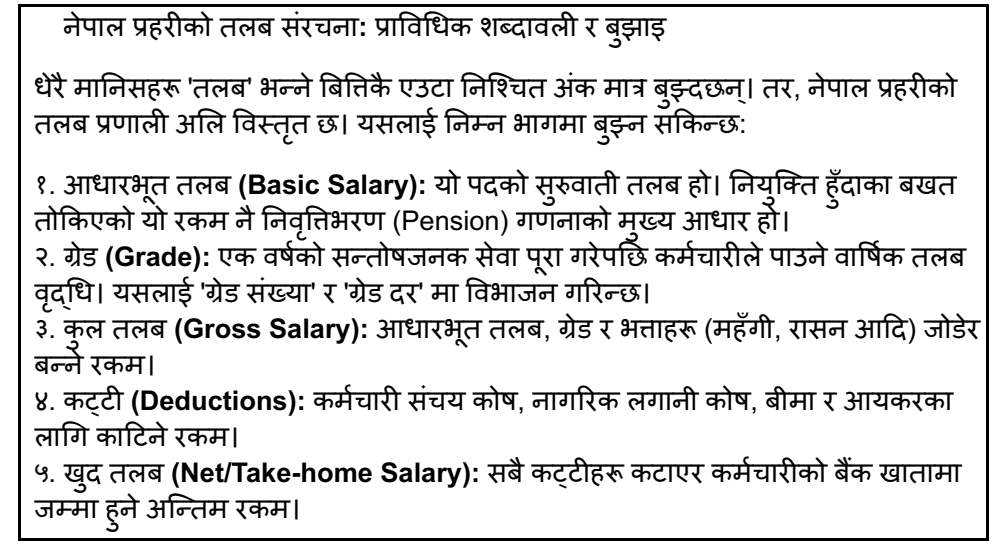
Many people assume “salary” means a single fixed figure. However, the Nepal Police salary system is more detailed. It can be understood in the following parts:
-
Basic salary: This is the initial salary for the post. The amount fixed at the time of appointment is the main basis for pension calculation.
-
Grade: The annual salary increment received after completing one year of satisfactory service. This is divided into grade count and grade rate.
-
Gross salary: The amount formed by adding basic salary, grade, and allowances (dearness, ration, etc.).
-
Deductions: Amounts deducted for Employees Provident Fund, Citizen Investment Trust, insurance, and income tax.
-
Net/Take-home salary: The final amount deposited into the employee’s bank account after all deductions.
Rank-wise Salary Scale of Nepal Police (FY 2082/83)
Below is the official salary scale for all ranks of Nepal Police. The total figures presented here exclude the monthly NPR 5,000 dearness allowance and the district-wise ration allowance, which are added separately.
Gazetted Ranks (Officer Level)
Police Inspector General (IGP)
-
Category: Special
-
Starting Basic Salary: NPR 72,082
-
Grade Count: 2
-
Grade Rate: NPR 2,403
-
Maximum Basic Salary: NPR 76,888
Police Additional Inspector General (AIG)
-
Category: Special
-
Starting Basic Salary: NPR 72,082
-
Grade Count: 2
-
Grade Rate: NPR 2,403
-
Maximum Basic Salary: NPR 76,888
Police Deputy Inspector General (DIG)
-
Category: First Class
-
Starting Basic Salary: NPR 56,787
-
Grade Count: 8
-
Grade Rate: NPR 1,893
-
Maximum Basic Salary: NPR 71,931
Police Senior Superintendent (SSP)
-
Category: First Class
-
Starting Basic Salary: NPR 52,603
-
Grade Count: 8
-
Grade Rate: NPR 1,754
-
Maximum Basic Salary: NPR 66,635
Police Superintendent (SP)
-
Category: Second Class
-
Starting Basic Salary: NPR 48,737
-
Grade Count: 8
-
Grade Rate: NPR 1,625
-
Maximum Basic Salary: NPR 61,737
Police Deputy Superintendent (DSP)
-
Category: Second Class
-
Starting Basic Salary: NPR 43,689
-
Grade Count: 8
-
Grade Rate: NPR 1,457
-
Maximum Basic Salary: NPR 55,345
Police Inspector (Inspector)
-
Category: Third Class
-
Starting Basic Salary: NPR 40,389
-
Grade Count: 8
-
Grade Rate: NPR 1,347
-
Maximum Basic Salary: NPR 51,165
Non-Gazetted and Others
Police Senior Sub-Inspector (Sr. SI)
-
Category: First
-
Starting Basic Salary: NPR 34,730
-
Grade Count: 8
-
Grade Rate: NPR 1,158
-
Maximum Basic Salary: NPR 43,994
Police Sub-Inspector (SI)
-
Category: First
-
Starting Basic Salary: NPR 34,730
-
Grade Count: 8
-
Grade Rate: NPR 1,158
-
Maximum Basic Salary: NPR 43,994
Police Assistant Sub-Inspector (ASI)
-
Category: Second
-
Starting Basic Salary: NPR 32,902
-
Grade Count: 8
-
Grade Rate: NPR 1,097
-
Maximum Basic Salary: NPR 41,678
Police Senior Havaldar
-
Category: Not specified
-
Starting Basic Salary: NPR 28,570
-
Grade Count: 8
-
Grade Rate: NPR 953
-
Maximum Basic Salary: NPR 36,194
Police Havaldar
-
Category: Not specified
-
Starting Basic Salary: NPR 27,612
-
Grade Count: 8
-
Grade Rate: NPR 921
-
Maximum Basic Salary: NPR 34,980
Police Assistant Havaldar
-
Category: Not specified
-
Starting Basic Salary: NPR 26,677
-
Grade Count: 8
-
Grade Rate: NPR 890
-
Maximum Basic Salary: NPR 33,797
Police Constable
-
Category: Not specified
-
Starting Basic Salary: NPR 26,082
-
Grade Count: 8
-
Grade Rate: NPR 870
-
Maximum Basic Salary: NPR 33,042
Police Followers
-
Category: Not specified
-
Starting Basic Salary: NPR 26,082
-
Grade Count: 8
-
Grade Rate: NPR 870
-
Maximum Basic Salary: NPR 33,042

Allowances and Benefits
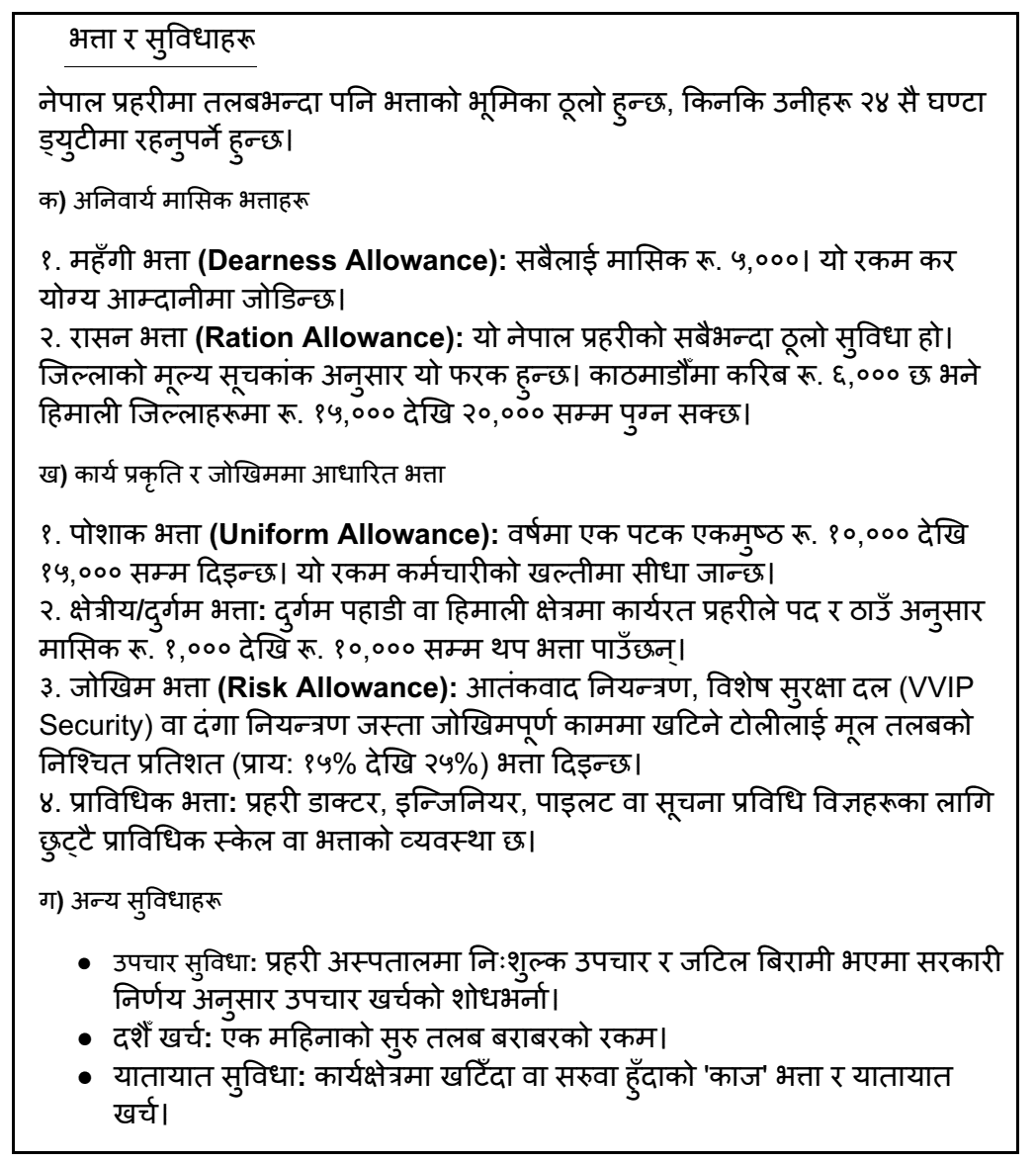
In Nepal Police, allowances often play a larger role than salary because personnel must remain on duty 24 hours a day.
A) Mandatory monthly allowances
1) Dearness allowance (Dearness Allowance)
-
Amount: NPR 5,000 per month for all - This amount is added to taxable income.
2) Ration allowance (Ration Allowance)
This is one of the largest benefits in Nepal Police. It varies by district based on the price index. In Kathmandu it is around NPR 6,000, while in Himalayan districts it can reach NPR 15,000 to NPR 20,000.
B) Allowances based on work nature and risk
1) Uniform allowance (Uniform Allowance)
A lump sum of NPR 10,000 to NPR 15,000 is provided once a year. This amount goes directly to the employee.
2) Regional/remote allowance
Police posted in remote hills or Himalayan areas receive an additional monthly allowance of NPR 1,000 to NPR 10,000 depending on rank and location.
3) Risk allowance (Risk Allowance)
Teams assigned to risky duties such as counter-terrorism, special security teams (VVIP Security), or riot control receive an allowance as a certain percentage of basic salary (usually 15% to 25%).
4) Technical allowance
Separate technical scales or allowances exist for police doctors, engineers, pilots, or information technology experts.
C) Other facilities
-
Treatment facility: Free treatment at police hospitals, and in complex cases, reimbursement of treatment expenses as per government decisions
-
Dashain expense: An amount equal to one month’s starting basic salary
-
Transport facility: “Kaaj” allowance and transport expenses during duty deployment or transfers
Mandatory Deductions from Salary
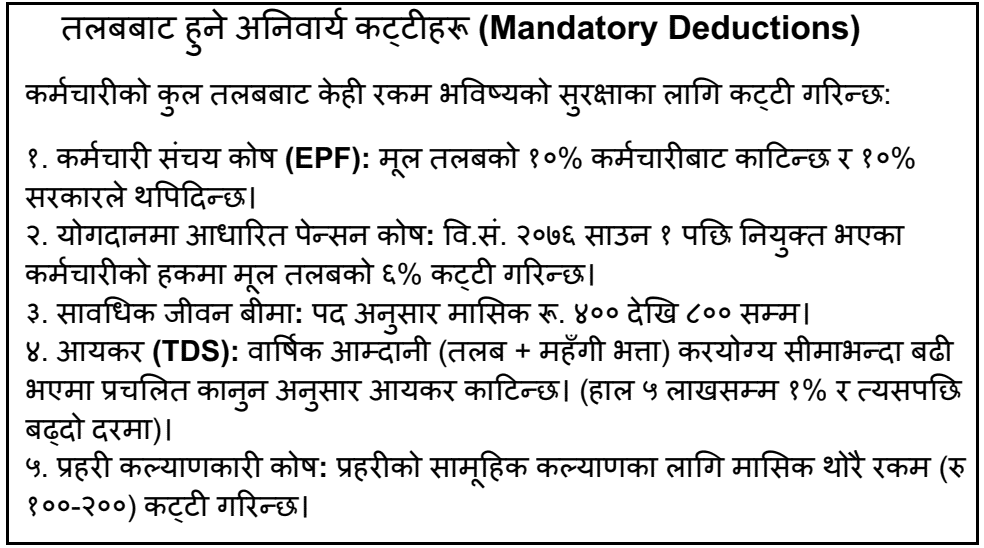
Certain amounts are deducted from the employee’s total salary for future security:
-
Employees Provident Fund (EPF) - 10% of basic salary is deducted from the employee, and the government adds another 10%.
-
Contributory pension fund - For employees appointed after Shrawan 1, 2076 BS, 6% of basic salary is deducted.
-
Term life insurance - Around NPR 400 to NPR 800 per month depending on post.
-
Income tax (TDS) - If annual income (salary + dearness allowance) exceeds the taxable threshold, income tax is deducted as per prevailing law (currently 1% up to NPR 500,000, and then at progressive rates).
-
Police Welfare Fund - A small monthly amount (NPR 100–200) is deducted for collective welfare of the police.
Take-home Pay Examples
Representative examples according to FY 2082/83 rates are presented below:
Example 1: Newly appointed Police Constable (initial stage)
-
Basic Salary: NPR 26,082
-
Dearness Allowance: NPR 5,000
-
Ration Allowance (estimated): NPR 6,500
-
Gross Income: NPR 37,582
-
Deductions (EPF + pension + insurance): about NPR 4,500
-
Estimated Net (Take-home): NPR 33,082
Example 2: Police Inspector (Inspector, completed 5 years of service)
-
Basic Salary: NPR 40,389
-
5 Grades (1,347 × 5): NPR 6,735
-
Dearness Allowance: NPR 5,000
-
Ration Allowance (estimated): NPR 6,500
-
Gross Income: NPR 58,624
-
Deductions (EPF + pension + tax + insurance): about NPR 9,500
-
Estimated Net (Take-home): NPR 49,124

Impact of Grade Increment and Promotion
How does salary increase as the service period grows in Nepal Police?
Annual grade
Each year, on a fixed day (usually Shrawan 1), the employee receives an increase equal to the grade rate of the post. This applies up to a maximum of 8 grades.
On promotion
If a Constable is promoted to Havaldar, the employee receives the starting salary of Havaldar. If the employee’s previous salary is higher than the Havaldar starting salary, salary matching is done and the employee is placed at a higher step.
Pension
After completing 20 years of service (a proposal of 16 years is under discussion for Constable/Havaldar), the employee becomes eligible for lifelong pension.
Comparative Analysis: Police and Other Services
The Nepal Police salary scale matches the Federal Civil Service. The basic salary of a Gazetted Third Class Section Officer and a Police Inspector is the same: NPR 40,389. However, due to ration allowance and the 24-hour nature of the job, the police gross income appears higher than that of civil servants.
The salaries of the Armed Police Force (APF) and the Nepal Army are also at a similar level to Nepal Police.
Frequently Asked Questions (FAQs)
Do Police Constables also receive the NPR 5,000 dearness allowance?
Yes. Under FY 2082/83 rules, everyone from Constable to Inspector General receives the same NPR 5,000 dearness allowance.
What does grade rate mean?
It is the fixed amount added after completing one year of service. For example, if an Inspector’s grade rate is NPR 1,347, then after 5 years, NPR 6,735 is added to the salary.
Why is police salary paid only through banks?
For transparency and good governance, the Government of Nepal has made it mandatory to pay salaries of all public servants only through banking channels.
Why does ration allowance differ by district?
Market prices are not the same everywhere in Nepal. Since the price of rice in Humla differs from Kathmandu, ration allowance is determined based on local market rates.
Is extra money paid for overtime work?
Nepal Police does not have a separate overtime payment. Instead, snack allowance or special security allowance (as determined by the budget) is provided.
Official Verification and Sources
This article is prepared for readers’ information. For any legal claim, please refer to the official Government Gazette or the applicable regulations.
-
Fiscal Year: 2082/83 (BS)
-
Source 1: Ministry of Finance, Budget Statement 2082
-
Source 2: Nepal Police Regulations, 2071 (with amendments)
-
Source 3: Salary Scale Report of the Ministry of Federal Affairs and General Administration
-
Final Verification Date: BS 2082 Poush (December 2025)
Conclusion
The Nepal Police salary scale provides a foundation for a respectable middle-class livelihood. However, considering the risk of the work area and the working hours, there is also a debate that this salary is not sufficient. Yet, due to pension, gratuity, medical facilities, and the power and prestige received in society, Nepal Police still remains the first choice of service for millions of youth.
If you want to enter the police service, make the spirit of national service your main objective, not salary alone. I believe this article has provided you with a clear roadmap on the financial side.
BS 2082 Poush (December 2025)
Service Details
- Service TypeNepal Police
- DurationYear
- RecognitionMinistry of Home Affairs
-
Offered At
Nepal Police (Nepal Prahari)
Naxal, Kathmandu
Other Services at Nepal Police (Nepal Prahari) 4
Reviews
Questions & Discussions
Contact Nepal Police (Nepal Prahari), Kathmandu
- AddressNaxal, Kathmandu, Bagmati Pradesh, Nepal
- Phone+977-1-5719900
- Email111@nepalpolice.gov.np
- Websitenepalpolice.gov.np
- Contact personNepal Police (Nepal Prahari), Headquater