



BCA Under TU Humanities and Social Sciences
At present, when we say Bachelor of Computer Application (BCA), we understand it as “Bachelor in Computer Application”, a course that Tribhuvan University (TU) has introduced under Humanities and Social Sciences. This particular program is not very old. However, BCA itself is not new to Nepal; it was already being taught earlier in other universities.
In fact, BCA is an IT course. It has been designed especially for students who do not have a science background. Previously, we tended to assume that only people from the science stream would go into the IT sector. In recent years, however, we have seen that capable and skillful people who have studied Management or Humanities have also proven that they can do very well in this sector. Based on that experience, Tribhuvan University launched this course so that faculties other than Science could also offer IT courses and their students could perform well in IT.
Because of this, one important point is that students from Science as well as other backgrounds can study this course. It is a completely IT-related course, as the name “Computer Application” itself suggests. Bachelor in Computer Application is a bachelor-level program to be studied after Plus Two, that is, after the intermediate level. In BCA, students learn what they can do using different computer applications and in which sectors they can work with those applications.
Tribhuvan University has introduced IT courses through different streams. For example, CSIT comes under Science and Technology and is studied by students with a science background. BIM is a course introduced under Management. That does not mean that students who have studied Science cannot study BIM; it is simply a course brought through the Management stream. In a similar way, BCA has been introduced so that students who have studied Humanities can also work in the IT sector.
This is where the difference lies. In CSIT, students have to study some Science, including Physics, and that course is somewhat more focused on the theoretical portion. In our case, BCA is meant for students who have studied Humanities and have not studied Physics. Therefore, such subjects have not been included here.
Credit Structure and Main Academic Components
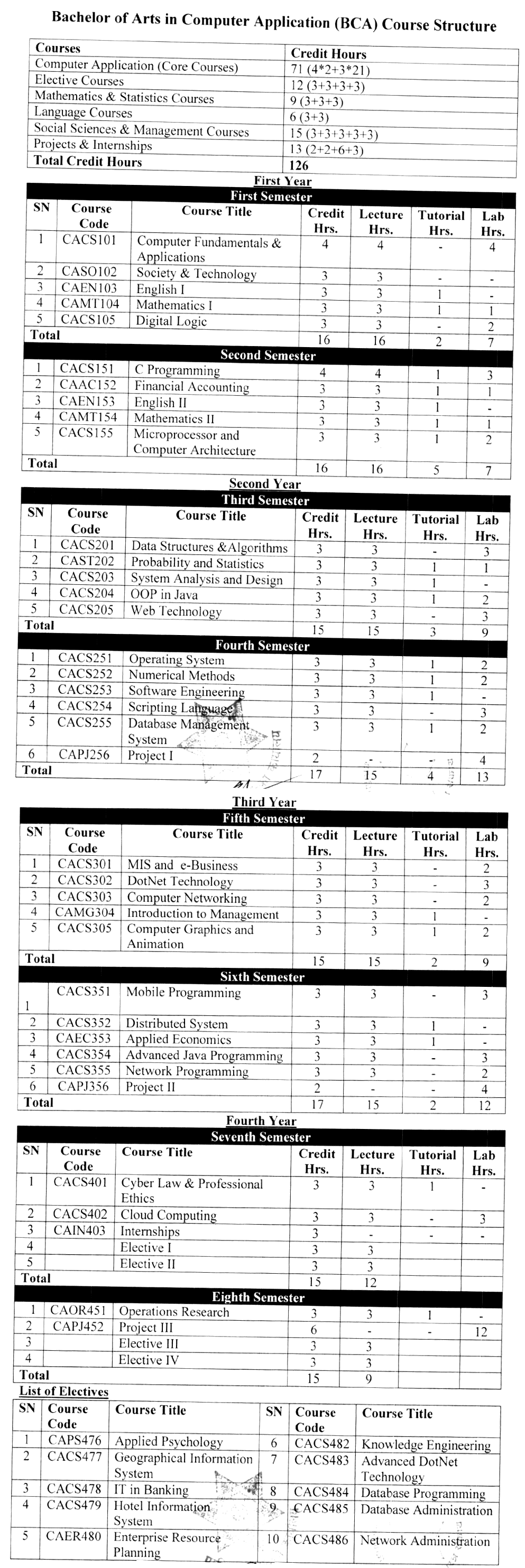
The BCA program carries a total of 126 credits. While designing the syllabus, the major focus has been placed on computer applications. Out of the total, almost 76 credits are in computer applications. However, at the bachelor level it is not sufficient to study only the core subjects. Along with that, social science is also needed. A person must understand society as well. If I am a skillful person but I do not understand society, I will not be able to work effectively there.
For that reason, there are some courses related to society. For example, in the first semester itself students study a subject called Society and Technology, which deals with what our society is like and how to bring innovation through technology within it. Another point is that when we say computer application, many aspects are related to mathematics. We need mathematics for programming and for areas such as artificial intelligence, which you may have heard about. Therefore, some credits are also allocated to mathematics-related courses.
As I have mentioned in two parts, the major area where the syllabus focuses is computer applications. In addition, there are general subjects that help students understand society and organisations. Then there is language, which we need for communication. Some portions of the syllabus mention courses related to this. Just as we are talking now using a language, there are language courses in the program as well, including English.
Even with all these components, the course would still not be complete. Another important aspect is that the technologies we use in our day-to-day life today will become obsolete tomorrow. To address this, separate credits have been allocated for project work and internship. Project work is included so that when a student does a project, it is based on the current environment and on what is practically in use at present.
Then there is the internship. By internship we mean that during the four-year period the student will work in some organisation where they are likely to work in the future. Separate credits have also been assigned for that. So, if I summarise the sequence overall: the first major area is computer applications. The second is the mathematics and statistics needed to support that area, on the basis of which the syllabus has been built. The third area is the general subjects that help students understand society and organisations. The fourth is the language we need.
Application-Oriented Teaching Approach
When we say computer application, as I mentioned briefly at the beginning regarding the science background, while designing this BCA course the focus has not been kept heavily on basic principles and background theory. That does not mean that the aim is only to produce skillful workers without any foundation; some background is certainly needed. But the main focus here is on the application side.
For example, by the time a student completes the computer course in the first semester, they will be capable of doing the kinds of tasks that a computer operator is expected to do. The learning starts with Word and Excel. In the field, these are the tasks people actually perform. For instance, designing banners, designing forms, creating Google Forms, or conducting surveys—activities that previously used to be done by going from house to house and writing everything by hand—are now handled differently. In this course, such aspects are given more emphasis on the application side at the beginning.
Later on, students can branch out. Some may go into graphic design, some into programming, and some into maintenance. In this way, both sides are balanced to some extent, but the main focus is still on applications, and compared to engineering the theoretical portion is given slightly less emphasis.
Eligibility and Admission Requirements
As I have been saying from the beginning, this is a bachelor-level course, so you must have completed Plus Two or an equivalent level. There is no restriction regarding the stream. Students from Science, Management, Humanities, and Education can all study it. The minimum requirement is a D+ grade, which is not a very high criterion, because anyone who has passed Plus Two will generally have that grade.
The major criterion is that Tribhuvan University conducts a Central Entrance examination, and you must pass that entrance exam. For this academic year, the entrance was held recently. The results have been published, and only the students whose names appear in the merit list of that entrance examination are allowed to study BCA. Those who did not take the entrance, or who took it but did not pass, cannot study BCA.
Since this is a bachelor-level course, by default we understand that a student has passed Plus Two or an equivalent qualification, such as an intermediate diploma course from CTEVT that is recognised as equivalent. Those students can also study BCA, but the main criterion is that they must have passed the Central Entrance conducted by Tribhuvan University.
Fees and Scholarship Provisions
The fees differ somewhat from college to college. For example, in the college where I am involved, the course normally costs around 6 lakhs. In general, the total cost ranges between 4 and 10 lakhs. For most colleges, the four-year course costs around 5 to 6 lakhs.
There is one set of scholarship criteria specified by Tribhuvan University, and that is followed. Beyond that, there are some variations from college to college. When colleges set their own criteria, they usually provide scholarships on the basis of the student's Plus Two grade. In addition, as I mentioned earlier, there are scholarships based on the merit points in the Central Entrance, that is, on the student's rank in the merit list. So scholarships are provided according to both Tribhuvan University's rules and each college's own rules.
Further Study Opportunities and Job Prospects
After completing the course, there are two or three aspects to consider. In the context of Nepal, one question we ask is whether a student who has completed this bachelor course can pursue further studies. Since BCA is a course recognised by Tribhuvan University, and Tribhuvan University is a university recognised worldwide, students can pursue further studies after BCA, such as MCA or other computer-related courses or other master's programs.
Another aspect is job prospects within the nation. From the Public Service Commission to other government agencies, whenever vacancies are announced for IT Officers or IT-related positions, BCA and CSIT are listed together as eligible degrees. So there are sufficient opportunities to enter government service as well.
But this area is relatively small compared to another major area. A much larger area is the software industry. In our country itself, there are software companies that are handling a large volume of work while operating from here and serving clients across the country. There are many such companies, and BCA graduates have opportunities in those places.
Distinctive Advantages in an Engineering College Environment
IT used to be an area covered mainly by science-background programs. Our college is an engineering college, so BCA students here get a flavour that they may not find elsewhere. When they come to study BCA, they receive that engineering flavour in terms of facilities—whether faculty facilities or library facilities. Because BCA is conducted within the same college, it is not treated as something separate from the rest; students naturally gain that flavour.
Our college also has a long history, and you may have seen on Facebook that we have ongoing MOUs with organisations such as Fusemachines, Leapfrog, and Sudrishya. We have a strong linkage with them. Our college's own tagline is “Where Academia Collaborates with the Industries”. Because there is such a connection, it would not be correct to say that only we provide certain things and others do not; of course, there is the environment to teach according to the syllabus designed by Tribhuvan University. Along with that, students also get to understand what is happening in the industry outside.
Because of these tie-ups, we receive feedback about what skills are needed in the market. From the very beginning, starting with the first semester, we have been conducting training programmes immediately after the end of the semester based on what the market currently demands. Students must, of course, pass the examinations that Tribhuvan University conducts in order to obtain the degree. Alongside that, we provide training based on what is happening in the market.
For example, when our students finished their first semester during the COVID period, we were able to conduct only online classes. Now that we have started coming physically to the college, we have begun the training for our second-semester students. There was some delay due to COVID, but one thing COVID-19 has shown to IT students and to the IT sector in general is that IT has now become necessary.
These days, in our own homes, everyone from elderly grandparents onward has used Zoom at some point—whether for meetings or other purposes. In the past, some people used to say, “Why should I pay my electricity bill through eSewa or Khalti?” But now many of them have changed. In the future, we must avoid unnecessary crowds, and IT is what we need to reduce crowding—whether at the electricity office, the telephone office, or even in our classes.
At present we are using both platforms: we conduct physically those activities that are more efficient face to face, and where things can be handled online, we use the online mode. BCA programs are now available in many places. However, a college with such a long history and extensive collaboration with industries does have some differences compared to others.
Scope and Advice for Plus Two Graduates
Usually, when we are studying or thinking about studying something, our question tends to be, “What is the scope of this subject?” My view is that every subject has scope. The real issue is where our interest lies. If we have genuine interest, then even in a subject that some people might say has no scope, there is actually a large scope, and we can certainly do something meaningful in it.
Therefore, what I would like to say first to brothers and sisters who have already passed Plus Two is that you need to be self-determined. If you truly feel, “I can do well in the IT sector; I am interested in entering IT,” then you should join this course.
It should not be that you have no interest in IT but, just because at present many changes are happening in the IT sector—because of COVID or the broader shift towards a digital Nepal—you decide to study this course anyway. Students who are self-determined and genuinely interested should come into the IT sector. So I feel that, before anything else, you must first be clear within yourself.
BCA Program Offered Colleges in Nepal
Here is the list of BCA Colleges in Nepal
| S.N. | College / Campus | Location |
|---|---|---|
| 1 | Thames International College | Surya Bikram Gyawali Marg, Old Baneshwor, Kathmandu |
| 2 | Kathford International College of Engineering and Management | Balkumari, Lalitpur |
| 3 | Kantipur College of Management and Information Technology | Mid Baneshwor, Kathmandu |
| 4 | K and K International College | New Baneshwor, Kathmandu |
| 5 | New Summit College | Shantinagar Gate, New Baneshwor, Kathmandu |
| 6 | Janamaitri Multiple Campus | Kuleshwor, Kathmandu |
| 7 | Academia International College | Gwarko Chowk, Lalitpur |
| 8 | Prime College | Naya Bazar, Khusibu, Kathmandu |
| 9 | Saraswati Multiple Campus | Lekhnath Marg, Thamel, Kathmandu |
| 10 | Southwestern State College | Basundhara, Kathmandu |
| 11 | Padmashree College | Tinkune, Kathmandu |
| 12 | Nepal Mega College | Babarmahal, Kathmandu |
| 13 | NIST Higher Education | Lainchour, Kathmandu |
| 14 | Kathmandu BernHardt College | Bafal Marg, Kathmandu |
| 15 | Texas International College | Mitrapark, Chabahil, Kathmandu |
| 16 | Triton SS/ College | Koteshwor-32 (Near Balkumari Bridge), Kathmandu |
| 17 | Swastik College | Madhyapur Thimi -3, Chardobato, Madhyapur Thimi, Bhaktapur |
| 18 | AADIM National College | Chabahil, Chuchchepati, Kathmandu |
| 19 | National College of Computer Studies (NCCS) | Paknajol, Kathmandu |
| 20 | Universal College | Maitidevi, Kathmandu |
| 21 | DAV College | Bhanimandal, Lalitpur |
| 22 | Samarpan Academy Institute of Crisis Management Studies | Dhumbarahi -4, Kathmandu |
| 23 | Madan Bhandari Memorial College | New Baneshwor, Kathmandu |
| 24 | Samriddhi College | Lokanthali-16, Madhyapur Thimi, Bhaktapur |
| 25 | Kathmandu Model College | Bagbazar, Kathmandu |
| 26 | Himalaya College of Engineering | Chyasal-9, Lalitpur |
| 27 | V.S. International College | Minbhawan, Kathmandu |
| 28 | Vedas College | Jawalakhel, Lalitpur |
| 29 | Ed-Mark College | Kalanki, Kathmandu |
| 30 | Kathmandu College of Central State | Soalteemode, Kalimati, Kathmandu |
| 31 | Pascal National College | Satdobato, Lalitpur |
| 32 | Sagarmatha College of Science and Technology | Sanepa, Lalitpur |
| 33 | Reliance College | Saraswotinagar, Chabahil, Kathmandu |
| 34 | St. Lawrence SS/College | Chuchhepati, Chabahil, Kathmandu |
| 35 | United College | Kumaripati, Lalitpur |
| 36 | Yeti International College | Buddhanagar, Baneshwor, Kathmandu |
| 37 | Chitwan College of Technology | Bharatpur 12, Asthachok, Chitwan |
| 38 | Greenfield National College | Bafal, Chetana Marg, Nagarjun, Kathmandu |
| 39 | Kathmandu College of Technology | Lokanthali, Madhyapur Thimi, Bhaktapur |
| 40 | NIMS College | Prayagpokhari, Lagankhel, Lalitpur |
| 41 | Caribbean College | Kumaripati, Lalitpur |
| 42 | Gyan Deep College | Tulsipur, Dang |
| 43 | AIMS International College | Lagankhel, Lalitpur |
| 44 | Jaya Multiple Campus | Makalbari, Gokarneshwar, Kathmandu |
| 45 | Arunima College | Bauddha, Kathmandu |
| 46 | Ganeshman Singh Multiple Campus | Kalimati, Kathmandu |
| 47 | Damak Multiple Campus | Damak, Jhapa |
| 48 | Shaheed Smarak College | Bakhanpur, Sharada Nagar, Bharatpur, Chitwan |
| 49 | Hetauda City College | Kanti Rajpath-4, Hetauda, Makwanpur |
| 50 | NIST College Banepa | Karunamarg, Banepa, Kavrepalanchok |
| 51 | Arniko Multiple Campus | Talchikhel, Satdobato, Lalitpur |
| 52 | Rainbow International College | Chhauni, Dallu, Kathmandu |
| 53 | Kabhre Multiple Campus | Banepa, Kavrepalanchok |
| 54 | Banke Bageshwori Campus | Surkhet Road, Nepalgunj, Banke |
| 55 | Whitefield International College | Nayabazaar, Town Planning, Kathmandu |
| 56 | GP Koirala Memorial College | Siphal, Chabhil, Kathmandu |
| 57 | Model Multiple College | Janakpur, Janakpurdham, Dhanusha |
| 58 | Everest Innovative College | Soalteemode, Kalimati, Kathmandu |
| 59 | Kathmandu National College | Koteshwor, Opposite of Bhatbhateni, Kathmandu |
| 60 | Bhaktapur Multiple Campus | Doodhpati-17, Bhaktapur |
| 61 | Pashupati Multiple Campus | Mitrapark, Chabhil, Kathmandu |
| 62 | Shahid Smarak College | Kirtipur, Kathmandu |
| 63 | Deerwalk Institute of Technology | Sifal, Kathmandu |
| 64 | Trinity International College | Dillibazar Height, Kathmandu |
| 65 | Kathmandu Shiksha Campus | Satungal, Kathmandu |
| 66 | Divya Gyan College | Putalisadak-28, Kamaladi Mode, Kathmandu |
| 67 | Prithvi Narayan Campus | Bagar, Pokhara, Kaski |
| 68 | Birendra Multiple Campus | Bharatpur, Chitwan |
| 69 | Kathmandu Business Campus | Banasthali, Balaju 16, Kathmandu |
| 70 | National Institute of Sciences (Lalitpur-NIST) | Gwarko, Lalitpur |
| 71 | Nepathya College | Sukkhanagar, Butwal, Tilottama, Rupandehi |
| 72 | Milton International College | New Baneshwar, Kathmandu |
| 73 | Vinayak Siddha College | Chabahil, Maijubahal, Kathmandu |
| 74 | The Times International College | Dillibazar, Kathmandu |
| 75 | Bajra International College | Arab Bank, Bouddha-Jorpati Road, Gokarneshwar, Kathmandu |
| 76 | Nepalaya College | Ganeshman Singh Path, Kalanki, Nagarjun, Kathmandu |
| 77 | National Infotech College | Shiromani Tole, Birgunj, Parsa |
| 78 | GoldenGate International College | Battisputali, Old Baneshwor, Kathmandu |
| 79 | Everest College, Thapathali | Thapathali, Kathmandu |
| 80 | Patan Multiple Campus | Patan Dhoka, Lalitpur |
| 81 | Araniko College | Bhanimandal, Lalitpur |
| 82 | Mechi Multiple Campus | Bhadrapur, Jhapa |
| 83 | Doti Multiple Campus | Silgadhi, Dipayal Silgadi, Doti |
| 84 | Mahendra Multiple Campus, Nepalgunj | Bhansar Road, Nepalgunj, Banke |
| 85 | Ratna Rajya Laxmi Campus | Pradashani Marga, Kathmandu |
| 86 | National Integrated College | Dillibazar, Kathmandu |
| 87 | Model Campus Damak | Damak-10, Model Chowk, Damak, Jhapa |
| 88 | Dibyabhumi Multiple College | Kupondole, Lalitpur |
| 89 | Nihareeka College of Management and IT | Bargachhi, Biratnagar, Morang |
| 90 | ACHS College of IT and Computer Science | Dhobidhara, Putalisadak, Kathmandu |
| 91 | Mega National College | Kumaripati, Lalitpur |
| 92 | Lumbini City College | Tilottama, Rupandehi |
| 93 | Saptagandaki Multiple Campus | Bharatpur, Chitwan |
| 94 | Maiya Devi Girl's College | Bharatpur, Chitwan |
| 95 | Ambition College | Old Baneshwor, Kathmandu |
| 96 | Jana Bhawana Campus | Chapagaun, Godawari, Lalitpur |
| 97 | Nesfield International College | Gyan Griha, Batukbhairabsthan, Lagankhel, Lalitpur |
| 98 | Itahari Namuna College | Itahari, Sunsari |
| 99 | Nagarjuna College of Information Technology | Sankhamul Bridge, Lalitpur |
| 100 | Public Youth Campus Janakpur | Janakpur, Janakpurdham, Dhanusha |
| 101 | Vishwa Adarsha College | Itahari, Sunsari |
| 102 | Koshi Saint James College | Itahari, Sunsari |
| 103 | Mahendra Morang Adarsha Multiple Campus | Roadcyes Chwok, Biratnagar, Morang |
| 104 | Morgan International College | Basundhara-3, Kathmandu |
| 105 | Nepal Kasthamandap College | Kalanki, (Near Makalu Petrol Pump), Kathmandu |
| 106 | Lumbini Academic College | Chuchchepati, Chabhil, Kathmandu |
| 107 | Asian School of Management and Technology | Gongabu Chowk, Kathmandu |
| 108 | Ambikeshwari Campus | Ghorahi, Dang |
| 109 | Lumbini ICT Campus | Gaindakot, Nawalpur |
| 110 | Butwal Kalika Campus | Ramnagar, Butwal, Rupandehi |
| 111 | Nepalgunj College | Korenpur, Kasturi Marg, Nepalgunj, Banke |
| 112 | Janajyoti Multiple Campus Mahendranagar | Bhansi, Bhimdattnagar, Bheemdatt, Kanchanpur |
| 113 | Advanced College of Engineering and Management | Bhuwaneshwori Marg-14, Kalanki, Kathmandu |
| 114 | Lalitpur Engineering College | Chakupat, Patan Dhoka, Lalitpur |
| 115 | Sahara Campus | Birendranagar, Surkhet |
| 116 | Xavier International College | Tushal, Bouddha, Gokarneshwar, Kathmandu |
| 117 | MRM College | Banasthali, Next to Global IME Bank, Kathmandu |
| 118 | Orchid International College | Gaushala, Bijaya Chowk, Kathmandu |
FAQs
What is the Bachelor of Computer Application (BCA) program under Tribhuvan University?
The BCA is an IT-focused bachelor-level program introduced by Tribhuvan University under the Faculty of Humanities and Social Sciences. It is designed to teach students how to use computer applications to solve practical problems and work in different IT-related fields.
Is BCA a new course in Nepal?
BCA under Tribhuvan University is relatively new, but BCA itself is not new in Nepal. It had already been introduced earlier by other universities before TU started this program.
Who is BCA mainly designed for?
BCA is designed especially for students who do not have a science background, such as those from Management and Humanities. However, students from Science and other streams can also study it.
How is BCA different from CSIT and BIM under Tribhuvan University?
CSIT is run under Science and Technology and includes subjects like Physics with more theoretical focus. BIM is introduced under Management. BCA, under Humanities and Social Sciences, focuses more on computer applications and does not include subjects like Physics, making it more application-oriented for non-science students.
How many credits does the BCA program have, and what is the major focus?
The BCA program has a total of 126 credits. Almost 76 of these credits are in computer application courses, which are the major focus of the program.
What types of subjects are included in the BCA curriculum?
The curriculum includes computer application courses, social science courses (such as Society and Technology in the first semester), mathematics-related courses, general subjects related to society and organisations, language courses including English, and separate credits for project work and internship.
What skills can a student expect to gain in the early semesters of BCA?
By the end of the first semester, a student is expected to be able to perform tasks similar to a computer operator, such as working with Word and Excel, designing banners and forms, creating Google Forms, and conducting surveys in an application-oriented way.
What is the eligibility requirement to study BCA under Tribhuvan University?
Applicants must have completed Plus Two or an equivalent level (from Science, Management, Humanities, or Education) with at least a D+ grade. Students with equivalent diplomas from CTEVT can also apply. The key requirement is passing the Central Entrance examination conducted by Tribhuvan University.
What is the approximate fee range for the BCA program?
The total fee for the four-year BCA program generally ranges from about 4 to 10 lakhs. In many colleges, the cost is around 5 to 6 lakhs, and in the college mentioned in the article, the fee is around 6 lakhs.
What types of scholarships are available for BCA students?
There are scholarship criteria set by Tribhuvan University, and colleges also have their own rules. Scholarships are usually provided based on the student’s Plus Two grades and their rank in the merit list of the Central Entrance examination.
What further study options are available after completing BCA?
Since BCA is a course recognised by Tribhuvan University, graduates can pursue further studies such as MCA, other computer-related programs, or other master’s degrees.
What are the job prospects for BCA graduates in Nepal?
Within Nepal, BCA graduates are eligible for IT-related positions such as IT Officer in government agencies, where BCA and CSIT are listed together as qualifying degrees. There are also opportunities in software companies operating within the country that handle a large amount of work from Nepal.
What is the advantage of studying BCA in an engineering college environment as described in the article?
In an engineering college, BCA students benefit from an engineering-oriented environment, including faculty and library facilities, and industry collaborations with organisations like Fusemachines, Leapfrog, and Sudrishya. The college runs continuous training from the first semester onward based on market needs and maintains the theme of “Where Academia Collaborates with the Industries.”





Comments 0
No comments yet. Be the first to start the conversation.