



Choosing between BCA and BIT in Nepal is not only a question of which IT degree sounds stronger. The practical decision is whether you want a more application-development route or a broader information-technology systems route, and whether you meet the latest entrance and eligibility rules for the university and college you plan to join.
This comparison mainly focuses on TU BCA under the Faculty of Humanities and Social Sciences (FOHSS) and TU BIT under the Institute of Science and Technology (IOST), because official curriculum and admission documents are publicly available for both. BCA and BIT programs offered by other Nepali universities or foreign-affiliated institutions may differ in duration, credit hours, eligibility, fee structure, recognition, and assessment model. Verify the latest official notice before applying.
Table of Content
- Quick Answer: Choose BCA If..., Choose BIT If...
- Anatomy of the Issue: What Are You Really Deciding?
- Comparison Methodology
- What is BCA in Nepal?
- What is BIT in Nepal?
- BCA vs BIT in Nepal: Main Comparison Table
- Detailed Comparison
- BCA or BIT for Different Student Profiles
- Realistic Student Scenarios
- Personal and Social Factors
- What Would Change the Verdict?
- Who Should Avoid Each Option?
- Decision Checklist Before Admission
- Common Mistakes Students Make
- Final Verdict: BCA vs BIT in Nepal
Quick Answer: Choose BCA If..., Choose BIT If...
Choose BCA if your main goal is to build software, websites, mobile apps, databases, and practical computer applications. Choose BIT if you want a wider IT route that includes networks, systems, databases, information security, web technologies, IT operations, and technology use inside organizations.
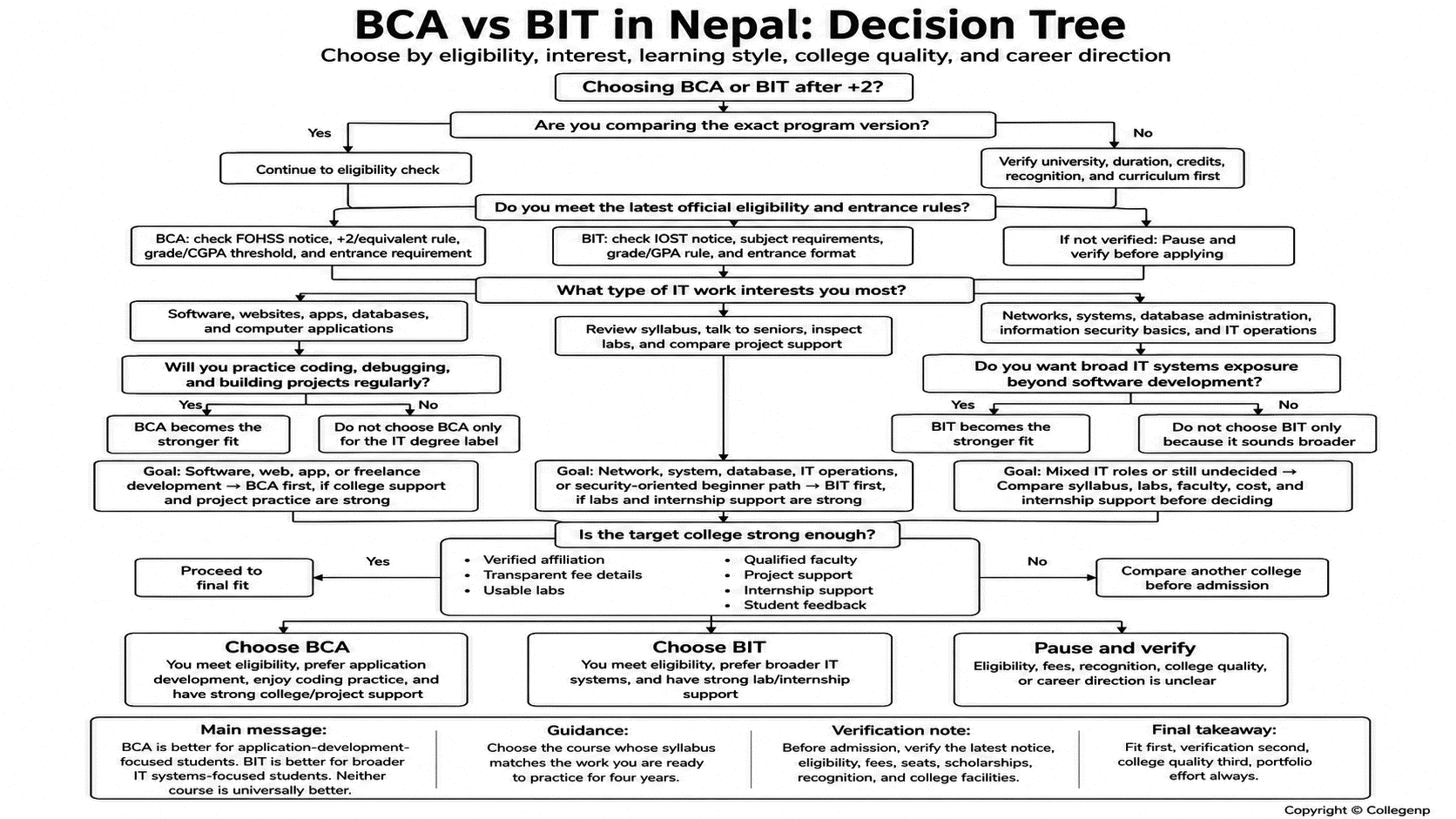
Neither course is automatically better for every student. BCA is the cleaner starting fit for application-development-focused students, while BIT is the cleaner starting fit for students who want broader IT systems exposure. The better choice depends on your +2 background, entrance eligibility, learning style, target college, and the portfolio you are willing to build during the course.
| Choose BCA if... | Choose BIT if... |
|---|---|
| You enjoy building applications, websites, software projects, and database-backed systems. | You are interested in IT infrastructure, networking, system administration, information security, databases, and organizational IT. |
| You want an application-focused route and are ready to build a coding portfolio. | You want a broader IT route that is not limited to software development. |
| You are from any +2 stream and want an IT degree commonly positioned toward programming and computer applications. | You meet the latest BIT admission subject requirements and want exposure to both technical and allied IT subjects. |
| You are likely to pursue web, app, database, or software-oriented projects from the first year. | You are likely to build networking labs, systems projects, database administration practice, security basics, and IT operations skills. |
Anatomy of the Issue: What Are You Really Deciding?
Many students ask, “Which has more scope: BCA or BIT?” That question is too broad to guide admission. Scope does not come from the degree name alone. It comes from the match between the curriculum, your interest, your college environment, your projects, and the kind of work you are willing to practice for four years.
The confusion exists because both courses belong to the wider IT field. Both can include programming, database, web technology, project work, and professional communication. The difference is emphasis. BCA is more directly tied to computer applications and software development. BIT is broader and gives more space to systems, networks, database administration, information security, IT operations, and organizational use of technology.
Surface-level claims can mislead students. “BCA is easy,” “BIT has more scope,” “BCA means software job,” and “BIT means cybersecurity” are weak decision rules. A BCA student who does not practice coding will not become job-ready just because of the degree name. A BIT student who does not build practical systems, database, networking, or security skills will also struggle to turn breadth into career value.
The better question is: which course gives you a more suitable starting path for the work you are ready to do consistently?
Comparison Methodology
This comparison uses five practical criteria:
-
Curriculum orientation
-
Eligibility and entrance practicality
-
Learning style and workload
-
Career and portfolio fit
-
Verification risk, including fees, recognition, admission rules, and college quality
No numeric score is used because it would create false precision. The article uses official-source facts where available and editorial judgment where the result depends on student goals, college quality, current admission notice, and individual effort.
What is BCA in Nepal?
BCA stands for Bachelor of Computer Applications. In the TU context, the 2025 curriculum positions the program toward IT industry careers, software development, IT entrepreneurship, related fields, and further higher education.
The TU BCA 2025 curriculum identifies the program as a 130-credit course of four academic years. Each year is divided into two semesters, and the medium of instruction and examination is English. The curriculum also includes project and internship components.
In practical terms, BCA is usually the more direct starting fit for students who want to spend more of their undergraduate energy on programming, web development, mobile applications, database-backed systems, software projects, and application-oriented IT work.
What is BIT in Nepal?
BIT is commonly expanded as Bachelor or Bachelors in Information Technology in TU-related materials. In the TU context, the IOST curriculum combines core information technology with mathematics, statistics, management, economics, sociology, psychology, research methodology, technical writing, electives, project work, and internship.
TU BIT is a four-year/eight-semester program with 120 credit hours. It is still related to programming and software, but it is not limited to application development. It gives a broader route into networks, systems, database administration, information security, IT support, IT operations, and organizational use of technology.
That makes BIT a stronger starting fit for students who want exposure to wider IT infrastructure and systems-related areas, not only software development.
BCA vs BIT in Nepal: Main Comparison Table
| Criteria | BCA | BIT | Editorial Judgment |
|---|---|---|---|
| Main identity | Computer applications and software/ application development. | Information technology systems, networks, databases, security, web technologies, and organizational IT. | BCA is more direct for application building; BIT is broader for systems and IT operations. |
| TU governing body | Faculty of Humanities and Social Sciences, Tribhuvan University. | Institute of Science and Technology, Tribhuvan University. | Different faculties/ institutes mean different admission notices and academic administration. |
| Duration | Four academic years in the TU 2025 curriculum. | Four years/ eight semesters in the TU IOST curriculum. | Both are four-year undergraduate routes in the TU context. |
| Credit hours | 130 credits in the TU BCA 2025 curriculum. | 120 credits in the TU BIT curriculum. | Do not assume all BCA/ BIT variants in Nepal use the same credit structure. |
| Eligibility direction | +2/ equivalent in any discipline with the stated threshold in the 2025 curriculum, plus FOHSS entrance. | For the 2083 intake, English and Mathematics or Computer subject requirements and grade/ GPA rules apply. | BCA may look more open by discipline; BIT eligibility must be checked against the annual notice. |
| Best starting fit | Students who want coding, software, websites, apps, and database-backed systems. | Students who want networks, systems, database administration, security, IT support, and organizational IT. | Choose by the work you will practice, not by a vague claim about scope. |
| Career caution | Does not guarantee software jobs. | Does not guarantee network, security, or admin jobs. | Projects, labs, internships, and communication matter heavily in IT hiring. |
Detailed Comparison
1. Curriculum Orientation
BCA is more directly application-oriented. Its course identity fits students who want to create software, web applications, mobile applications, database-backed systems, and practical computer solutions. It is not only about coding, but coding and application development are closer to the center of the course identity.
BIT is broader. It includes programming and software-related subjects, but also gives stronger space to networking, system administration, database administration, information security, management information systems, e-governance, research methodology, technical writing, and allied areas.
Editorial judgment: Choose BCA if you want depth in application-building habits. Choose BIT if you want broader IT systems exposure and are comfortable studying different branches of IT before specializing.
2. Eligibility and Entrance
Eligibility can decide the matter before preference does. TU BCA 2025 states +2/equivalent in any discipline with the stated academic threshold and an entrance conducted by FOHSS. However, the FOHSS program page still shows older or different threshold wording. Because of this mismatch, applicants should treat the latest admission notice as the operational source.
For TU BIT, the curriculum broadly mentions twelve years of schooling, minimum second division, and passing the IOST entrance. The admission notice gives more specific subject and grade rules. It includes English and Mathematics or Computer subject requirements at +2/equivalent level, with additional pathways for A Level and CTEVT diploma students.
Editorial judgment: BCA may be more accessible by discipline in the TU curriculum wording, but students should not rely on general summaries. BIT applicants especially need to verify subject and grade requirements for the current intake.
3. Learning Style and Workload
BCA suits students who can sit with code, debug errors, design small systems, and improve projects over time. Students who enjoy building visible outputs, such as websites, apps, dashboards, database projects, or software tools, may feel more aligned with BCA.
BIT suits students who are comfortable moving across programming, networking, system administration, databases, security basics, management systems, and organizational IT use. The learning path may feel broader because students are not focusing only on software application development.
Editorial judgment: BCA is not automatically easier. BIT is not automatically harder. The difficulty depends on the student’s interest, math comfort, lab discipline, college support, and willingness to practice outside class.
4. Career and Portfolio Fit
For software developer, web developer, app developer, and freelance development pathways, BCA is usually the more direct starting fit. For network administrator, system administrator, database administrator, information security beginner roles, IT officer, and IT operations roles, BIT is usually the more natural starting fit.
This does not mean career paths are locked. BIT students can become software developers if they build strong coding projects. BCA students can move toward networking or cybersecurity if they build labs, certifications, and practical systems knowledge. The degree creates a starting direction, not a permanent boundary.
Editorial judgment: Do not choose by job title alone. Choose by the portfolio you are willing to build.
| Career goal | Better starting fit | Practical meaning |
|---|---|---|
| Software developer / web developer | BCA | BCA is more directly application-oriented; BIT can also work with strong coding projects. |
| Mobile app developer | BCA | The student still needs practical app projects; the degree alone is not enough. |
| Database developer / database administrator | Both | Both include database-related learning; internships and portfolio depth decide a lot. |
| Network administrator / system administrator | BIT | BIT is more naturally aligned with networks, systems, and infrastructure. |
| Information security / cybersecurity beginner path | BIT | BIT has stronger systems/security alignment, but real readiness requires labs, projects, and further training. |
| IT officer / IT support / operations | Both | BIT may fit broader operations; BCA can fit if the student builds troubleshooting and systems skills. |
| Freelance web/app work | BCA | BCA may be more direct, but freelancing depends on portfolio, communication, reliability, and problem-solving. |
5. Cost, Access, and College Quality
The degree name is not enough if the college environment is weak. A good BCA program should have usable programming labs, database support, project mentoring, and internship guidance. A good BIT program should have usable networking, systems, database, security, and IT lab facilities, not only classroom theory.
Fees, scholarships, refund policies, device requirements, exam fees, internship costs, and project expenses can vary by college. This article does not publish exact fee ranges because current official, college-specific fee data was not consistently verified across institutions.
Editorial judgment: A strong college environment can change the verdict. A well-run BIT program may be better for a software-focused student than a weak BCA program, and a well-run BCA program may be better for a systems-curious student than a poorly supported BIT program.
6. Recognition and Future Study
BCA and BIT can both support further study in IT, computing, or management-related areas, but eligibility depends on the target university and program. For foreign-affiliated degrees or non-TU versions, students should verify awarding university, equivalence, credit hours, duration, recognition, and future study requirements before admission.
Editorial judgment: Do not assume that all BCA or BIT degrees are evaluated equally by every university, employer, or equivalence authority. Recognition is tied to the exact awarding institution and program structure.
BCA or BIT for Different Student Profiles
| Your situation | Recommended direction |
|---|---|
| You want to build software, websites, apps, and database-backed systems. | Choose BCA first, then compare college quality and project support. |
| You like networks, servers, Linux, security basics, database administration, and IT operations. | Choose BIT first, then compare labs, internship support, and systems-related faculty strength. |
| You are from Management and studied Computer or Mathematics. | Check both. For BIT, confirm current subject and grade rules in the official IOST notice. |
| You are weak in mathematics but interested in coding. | Do not choose blindly. Review the entrance pattern, syllabus, and your willingness to practice logic regularly. |
| You want the course with the highest salary. | Do not decide by salary claims. No degree guarantees income; skill depth, portfolio, and opportunity matter. |
| You want to study abroad later. | Check recognition, credit hours, awarding university, and target program eligibility before admission. |
Realistic Student Scenarios
These are illustrative decision examples, not real case studies or success stories.
A +2 Management student with Computer who enjoys building small websites may find BCA the cleaner starting fit, provided the student is ready to practice coding consistently and compare colleges by lab, faculty, project support, and internship guidance.
A student who likes routers, Linux, servers, databases, and how organizations manage IT systems may find BIT the better starting fit because the curriculum direction is broader than application development alone.
A student who only wants a course with “high scope” should pause. The safer step is to inspect the syllabus, verify eligibility, compare college facilities, talk to current students, and then decide.
Personal and Social Factors
Students often face pressure from parents, friends, college counselors, and social assumptions about which IT degree has more prestige or scope. That pressure can push a student toward a course that does not match their interest or working style.
A student who enjoys building software may lose focus in a broader systems-heavy route if they do not want that breadth. A student who enjoys infrastructure, networks, and organizational IT may feel limited if they choose a route mainly because friends say software jobs are popular.
Financial pressure also matters. Transport, device cost, exam fees, project expenses, internet access, and possible training costs can affect the real cost of study. Location and support system matter too. A student who needs close guidance may need a college with stronger mentoring, not only a popular course name. The safe decision is to compare both the course and the college environment together.
What Would Change the Verdict?
College quality: a strong BIT college may be better for a software-focused student than a weak BCA college, and the reverse can also be true.
Eligibility: if you do not meet current BIT subject or grade requirements, BCA may become the practical option, provided you meet BCA rules.
Cost and access: travel distance, fee transparency, device requirements, and scholarship availability can change the practical decision.
Career goal: if your goal changes from application development to systems/security, BIT may become more suitable; if it changes toward software products, BCA may become more suitable.
Recognition needs: foreign-affiliated or non-TU degrees require separate verification for equivalence, credit hours, and future study plans.
Who Should Avoid Each Option?
Avoid choosing BCA blindly if:
-
You dislike sustained coding practice and only want an IT degree label.
-
Your main interest is networking, system administration, or infrastructure, and you do not want extra self-study.
-
You expect software jobs without building projects, internships, GitHub work, or practical problem-solving habits.
-
You have not verified the latest FOHSS admission notice and target college details.
Avoid choosing BIT blindly if:
-
You want only application development and do not want broader systems, network, database, security, or organization-related subjects.
-
You do not meet current subject and grade requirements but assume BIT is open to every stream.
-
You expect a cybersecurity or network role only because of the degree name.
-
You have not checked whether the college has usable systems, networking, database, and lab facilities.
Decision Checklist Before Admission
-
Confirm the latest official admission notice, eligibility, entrance format, deadline, and required documents.
-
Ask for the full fee structure in writing, including admission, semester, exam, lab, project, internship, and refund rules.
-
Check affiliation, awarding university, recognition, and equivalence where relevant.
-
Inspect labs, class routine, faculty profiles, project support, and internship support.
-
Talk to current students or recent graduates without depending only on admissions staff.
-
Compare your own learning style: coding depth for BCA, broader systems and IT operations exposure for BIT.
-
Do not finalize admission based only on social pressure, a single counselor, or a salary claim.
Common Mistakes Students Make
Choosing BCA only because someone says it is easy. Software development requires continuous practice.
Choosing BIT only because someone says it has more scope. A broad curriculum still needs specialization.
Believing exact salary numbers without credible, current, role-specific data. Salary depends on skills, role, experience, location, employer, and market conditions.
Comparing college advertisements as if they are neutral career advice. Admissions material may highlight strengths but may not show weaknesses.
Ignoring annual admission notices. Eligibility, deadlines, entrance details, and fees can change.
Assuming all BCA or BIT degrees in Nepal are the same. TU, PU, Gandaki University, and foreign-affiliated programs may differ in curriculum, recognition, credit hours, fees, and eligibility.
Final Verdict: BCA vs BIT in Nepal
BCA vs BIT in Nepal should not be reduced to a fixed claim that one course is universally better. Choose BCA if you want a more direct application-development path and are ready to build software projects seriously. Choose BIT if you want a wider IT systems path and are interested in networks, databases, security, systems, and technology inside organizations.
BCA’s strongest point is its clearer alignment with software, web, app, and computer application development. Its main risk is that students may assume the degree itself creates job readiness without sustained coding practice. BIT’s strongest point is its broader IT systems orientation. Its main risk is that students may treat breadth as scope without developing a practical specialization.
The most practical takeaway is this: choose the syllabus that matches the work you are willing to practice for four years, then choose the college that gives you better labs, teachers, projects, internship support, transparent fees, and verified affiliation. Before applying, verify the current admission notice, eligibility, fee structure, seats, scholarship rules, and exact curriculum of your target university and college.







Comments 0
No comments yet. Be the first to start the conversation.