




If you've completed a degree from a foreign university and want to use it in Nepal, you may need an equivalence certificate. But before preparing documents or paying an application fee, you should establish whether the qualification falls under the correct authority and what academic recognition you need.
Nepal's University Grants Commission (UGC) now handles equivalence of foreign university degrees through its official online portal. Tribhuvan University's Curriculum Development Centre stopped accepting new higher-education equivalence applications from 2083 Shrawan 1 (July 2026).
That change makes some older application instructions unreliable for new applicants. There are also important differences between recognizing a university degree, accepting a qualification for admission, and meeting professional licensing requirements.
Whether you're returning from overseas, considering a foreign-affiliated college in Nepal, or preparing for further study or employment, the following checks will help you identify the right process.
Answer Summary: Foreign university-degree equivalence in Nepal is handled by UGC through its online application system. Before applying, confirm the actual awarding university, exact degree and program, study duration and delivery mode, previous academic qualifications, and intended use of the award. Foreign school certificates and technical diplomas follow separate procedures. An equivalence certificate establishes academic comparability but does not automatically satisfy admission, recruitment, or professional registration requirements.
Key Takeaways:
-
UGC Nepal handles new foreign university-degree equivalence applications, replacing TU's earlier role.
-
Foreign Grade 10/12 qualifications and technical diplomas have separate equivalence authorities.
-
Recognition of a foreign university does not automatically establish equivalence for every qualification it awards.
-
UGC distinguishes previously assessed qualifications from those requiring a new procedural review.
-
Applicants need their current degree records and documents from the immediately preceding academic level.
-
Academic equivalence does not replace separate university admission or professional council requirements.
What Does Foreign Degree Equivalence Mean in Nepal?
Foreign degree equivalence is the formal assessment of whether an academic qualification awarded by a foreign university corresponds to a qualification in Nepal's higher-education system.
According to UGC, equivalence confirms academic comparability between a foreign degree and the relevant qualification in Nepal.
For example, someone returning with an overseas bachelor's degree may need an equivalence certificate when applying for postgraduate education or a government position.
However, academic equivalence does not settle every question about using that degree.
Three separate decisions are relevant:
-
Academic equivalence determines whether the foreign award corresponds to a qualification in Nepal.
-
Admission or employment eligibility determines whether the award meets the requirements of a particular university, employer, or recruitment notice.
-
Professional registration determines whether a graduate satisfies the conditions for entering a regulated profession.
These decisions are connected but serve different purposes.
A foreign engineering graduate, for instance, may obtain academic equivalence but still need registration through the Nepal Engineering Council.
Similarly, receiving equivalence in Nepal does not automatically establish acceptance in another country. A foreign university or professional regulator applies its own recognition requirements.
The need for an equivalence certificate also depends on your intended use. Although UGC identifies higher study, government service, professional registration, and employment as common purposes, not every receiving organization follows identical procedures.
The useful first question is not simply whether a foreign degree is recognized. It is whether your exact qualification satisfies the requirements of the institution or authority where you intend to use it.
Which Authority Handles Foreign Qualification Equivalence?
The responsible authority depends on the level and type of foreign qualification.
University degrees, school certificates, and technical qualifications should not be treated as interchangeable, even when they were awarded outside Nepal.
| Qualification | First authority to check | Main consideration |
|---|---|---|
| Foreign bachelor's, master's, M.Phil., Ph.D., or comparable university degree | University Grants Commission (UGC), Nepal | Higher-education degree equivalence |
| Foreign Grade 10 or Grade 12 certificate | Government Curriculum Development Centre (CDC), Sanothimi | School-level equivalence |
| Foreign technical diploma, certificate-level, or pre-diploma qualification | Council for Technical Education and Vocational Training (CTEVT) | Technical and vocational qualification equivalence |
UGC Nepal: Foreign University Degrees
UGC is the current authority responsible for assessing equivalence of degrees obtained from foreign universities.
Its official equivalence service covers qualifications across disciplines, including management, humanities, engineering, health sciences, education, and other higher-education fields.
Previously, Tribhuvan University's Curriculum Development Centre handled foreign higher-education degree equivalence.
However, TU's official notice confirms that it stopped receiving new equivalence applications from 2083 Shrawan 1.
TU subsequently published a notice on 10 October 2026 concerning its remaining equivalence work.
If you have an application already submitted through TU, check the instructions for that existing case. Do not assume that the new UGC procedure automatically replaces every outstanding historical arrangement.
For new foreign university-degree applications, use UGC's current portal.
School Certificates and Technical Qualifications
Foreign school-level qualifications follow a separate process.
Nepal's government Curriculum Development Centre in Sanothimi publishes a school-level equivalence guideline covering recognition and equivalence matters.
This government CDC is different from Tribhuvan University's Curriculum Development Centre.
For technical and vocational qualifications, CTEVT maintains its own equivalence regulations, including the Curriculum Development and Equivalence Determination Regulations, 2080.
If your foreign qualification is described as a diploma, establish its academic level before selecting an authority.
A technical diploma and a university-awarded qualification can have different recognition routes despite using similar terminology.
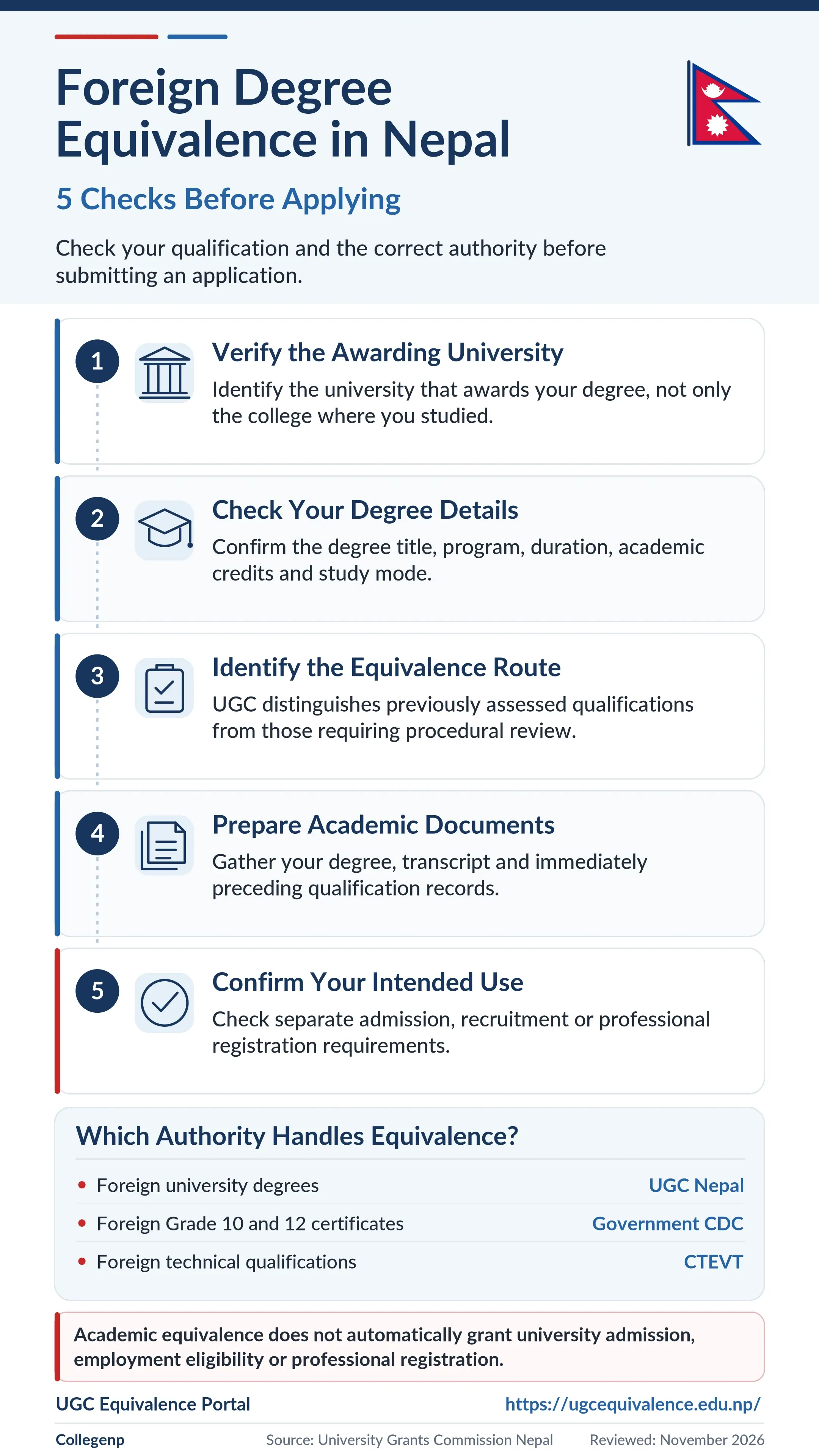
Five Checks Before Applying for Foreign Degree Equivalence
Before beginning an application, examine your qualification from five angles.
These checks are also useful if you're considering enrolling in a foreign university or a foreign-affiliated college in Nepal.
1. Confirm the Actual Awarding University
Start by identifying the institution legally responsible for awarding your degree.
The college where you attend classes and the university issuing the final qualification are not necessarily the same organization.
For example, a student studying at a foreign-affiliated college in Nepal may receive a degree from an overseas university.
In that situation, confirm:
-
The official name of the awarding university.
-
The exact degree and program title.
-
The institution and location delivering the program.
-
Whether the awarding university confirms that specific teaching arrangement.
-
Whether the Nepal-based institution has the applicable government permission.
This distinction matters because institutional permission, foreign university recognition, and academic equivalence are separate questions.
Nepal's education ministry has specific responsibilities for permitting and regulating institutions operating programs under foreign university affiliation.
Its Higher and Technical Education Division identifies institutional permission, renewal, monitoring, and regulation among its responsibilities.
A college's permission to operate does not independently establish that every qualification it offers will receive academic equivalence.
If you're considering a foreign university-affiliated college in Nepal, use historical college listings for background research rather than as confirmation of current program approval.
Request the current institutional and program documents and verify the awarding arrangement before enrollment.
2. Examine the Exact Degree and Study Arrangement
The university's name alone cannot determine the equivalence of a particular qualification.
Two degrees from the same institution can differ in their academic level, curriculum, duration, assessment structure, and delivery arrangements.
Useful details to establish include:
-
Full degree title and subject.
-
Academic level and entry requirements.
-
Program duration and academic credits.
-
Curriculum and assessment arrangements.
-
Study location and delivery mode.
-
Practical training, laboratory, clinical, or research requirements where relevant.
These are sensible preparation checks, not a claim that UGC requires every item as a standard document upload.
The distinction becomes especially important for shorter degree programs and online study.
Are Three-Year Foreign Bachelor's Degrees Accepted?
A three-year bachelor's degree should not be assumed equivalent or non-equivalent solely because of its duration.
Higher-education systems organize bachelor's qualifications differently. Academic credits, entry requirements, curricula, and assessment arrangements can vary between institutions.
The publicly available UGC guidance reviewed for this article does not establish a universal rule accepting or rejecting every three-year foreign bachelor's degree.
Applicants should obtain clarification about the exact qualification rather than relying on broad statements about three-year versus four-year degrees.
For background on these differences, see three-year versus four-year degree recognition pathways.
What About Online or Distance-Learning Degrees?
Online, distance, hybrid, and campus-based programs may operate under different academic and regulatory arrangements.
The public UGC guidance examined does not establish a blanket acceptance or prohibition covering every foreign online degree.
Before relying on an online qualification for a particular purpose in Nepal, confirm its awarding university, academic structure, delivery mode, and applicable recognition requirements with UGC.
Rules from another country's education regulator should not be treated as Nepal's equivalence rules.
3. Check Whether Regular or Procedural Equivalence Applies
UGC identifies two categories of equivalence: regular equivalence and procedural equivalence.
Regular equivalence applies to universities and qualifications that have already been assessed and approved through an earlier evaluation.
Procedural equivalence applies to universities or programs undergoing assessment for the first time. These cases are referred to the relevant subject committee before a decision is made.
This distinction affects how applicants should plan.
A qualification already assessed may follow a more straightforward process. A new or unfamiliar program can require further academic review.
UGC's published FAQ states that regular equivalence certificates are usually issued within a few working days after the required documents have been verified.
Procedural equivalence may take approximately one month because of the additional subject-committee review.
These are indicative processing periods, not guaranteed completion dates.
If you need equivalence for an upcoming admission or recruitment deadline, allow for possible additional review rather than assuming the shortest stated period applies to your case.
4. Check Your Previous Academic Qualifications
UGC examines the qualification used to enter the foreign degree program, not only the final degree being assessed.
Its published requirements identify the immediately lower academic level as part of the application documentation.
| Degree being assessed | Previous academic qualification |
|---|---|
| Bachelor's degree | Higher secondary (+2) |
| Master's degree | Bachelor's degree |
| M.Phil. or Ph.D. | Master's degree |
The relevant certificate and academic transcript from the preceding level are part of the standard document requirements.
UGC also clarifies that School Leaving Certificate (SLC) or Secondary Education Examination (SEE) documents are generally not required for bachelor's, master's, M.Phil., or Ph.D. applications.
An exception may apply where the immediately preceding qualification belongs to an older academic system that predates the +2 structure.
Applicants with foreign school-level qualifications should check whether separate school-equivalence requirements apply to their academic history.
Do not assume that every previous qualification requires a separate equivalence certificate without confirmation from the responsible authority.
5. Identify Why You Need Equivalence
Your intended use determines which additional requirements deserve attention.
You may need the foreign degree for postgraduate study, government recruitment, professional registration, or employment.
For further study, examine the receiving university's admission requirements.
For government service, read the exact educational qualifications stated in the relevant recruitment notice.
For professional practice, consult the appropriate professional council before assuming academic equivalence establishes registration eligibility.
A degree can be academically comparable to a Nepali qualification while still failing to satisfy a separate subject-specific admission or professional requirement.
That is why checking your intended use before applying is as important as checking the degree itself.
Documents Required for UGC Foreign Degree Equivalence
UGC's published FAQ identifies a standard set of academic documents and additional records for particular qualifications.
The requirements depend on the nature of the degree and the applicant's academic background.
Standard Academic Documents
Applicants should prepare:
-
The degree certificate for the foreign qualification being assessed.
-
The academic transcript for that qualification.
-
The certificate and transcript from the immediately preceding academic level.
Check that the official records accurately identify the awarding institution, degree title, and academic history.
Where names, dates, or degree titles differ between documents, seek clarification or corrected evidence from the issuing institution.
This is a practical preparation recommendation, not an assertion that UGC requires a particular affidavit or notarized correction for every discrepancy.
Passport, Visa, and Residence Records
UGC's FAQ identifies passport, visa, or residence-permit documentation for applicants who studied outside Nepal and India.
This condition should not be extended to every applicant regardless of study location.
Follow the current portal's instructions for your situation.
Internship and Clinical-Practice Evidence
UGC may require internship or clinical-practice records where applicable.
Applicants whose qualifications include practical or clinical training should check which documents are relevant to their specific degree.
Additional professional council requirements may apply separately.
Research Records for M.Phil. and Ph.D.
Research-degree applicants may need additional documents, including:
-
Enrollment or research registration records.
-
Research progress reports.
-
Thesis defence and approval evidence.
-
Supervisor appointment letters.
-
Viva voce-related documents, where applicable.
UGC identifies these additional records in its published requirements.
If your final award certificate is unavailable, or your institution uses an unusual documentation system, ask UGC which alternative evidence it currently accepts.
The public guidance does not establish a universal provisional-certificate procedure for every applicant.
How to Apply for Foreign Degree Equivalence Through UGC
UGC provides an online application service covering account creation, document submission, fee payment, and certificate issuance.
The application process described on its official portal is as follows:
-
Visit https://ugcequivalence.edu.np/.
-
Select Sign Up and create an applicant account.
-
Verify your email address and log in.
-
Open the Application menu and complete the required academic information.
-
Upload the documents relevant to your qualification.
-
Submit the application and proceed to the payment section using the available online payment options.
UGC states that applicants do not need to visit its office for most requests.
However, this should not be interpreted as a guarantee that no application will require further verification or communication.
The portal also states that application fees are generally non-refundable, except where permitted by the Commission's decision or applicable law.
Review your application category and supporting documents before making a payment.
If you encounter technical difficulties or require clarification, use the support information provided on the official UGC website.
Avoid following outdated TU payment instructions or application procedures intended for the earlier system.
What an Equivalence Certificate Cannot Replace
An equivalence certificate provides academic recognition, but universities, employers, and professional regulators may make additional decisions.
University Admission and Government Recruitment
A university may require equivalence while also examining subject prerequisites, academic results, entrance requirements, and other admission conditions.
A foreign bachelor's degree receiving equivalence does not automatically establish eligibility for every postgraduate program.
Government recruitment can involve similar distinctions.
A recruitment notice may specify an exact academic qualification, subject, level, or additional eligibility condition.
Equivalence can help establish comparability but does not replace the requirements of the recruitment authority.
Engineering and Nursing Registration
Professional councils operate separate registration and licensing procedures.
The Nepal Engineering Council's Citizen Charter identifies an equivalence certificate from the relevant Nepali authority among the documents required when an applicant studied engineering at a foreign institution.
The council also has its own registration and examination requirements.
The Nepal Nursing Council provides another example.
Its B.Sc. Nursing National Licensure Examination guidelines, revised in 2025, specify additional requirements for Nepali nursing graduates educated abroad.
These include a Medical Education Commission eligibility letter, an equivalence certificate, and evidence of recognition by the relevant nursing regulator or authorized authority in the country of study.
The nursing guideline contains references to older equivalence authorities. Applicants should read those alongside the later transfer of higher-education equivalence responsibilities to UGC.
Requirements differ between professions, so engineering and nursing rules should not be applied automatically to unrelated qualifications.
No Objection Certificate and Document Attestation
A No Objection Certificate (NOC), document attestation, and academic equivalence serve different purposes.
An NOC concerns the administrative process associated with permission to study abroad.
Document attestation concerns verification or authentication of documents.
Academic equivalence concerns the comparability of a foreign qualification within Nepal's education system.
Possessing an NOC or an attested degree does not independently establish academic equivalence.
For separate information on the pre-departure process, see how to obtain an NOC for study abroad from Nepal.
What Should You Do When a Degree Detail Is Unclear?
Some qualifications require clarification beyond UGC's standard published FAQ.
If your final degree certificate is missing, contact the awarding university for official evidence of the award and ask UGC whether that evidence is acceptable.
If the program is unusually short, uses a non-standard qualification title, or was completed online, request confirmation concerning the specific qualification and its delivery arrangements.
If you studied at a foreign-affiliated college in Nepal, verify the relevant local permission and confirm the degree-awarding arrangement with the foreign university.
For an application previously submitted through TU, consult the current TU and UGC notices concerning historical cases. Do not assume that all pending applications or previously issued certificates are covered by an identical administrative arrangement.
Where records conflict, preserve the original documentation and seek clarification from the issuing authority.
An unclear case does not automatically mean a qualification has been rejected. It means the available information is insufficient to establish the decision.
Conclusion
Foreign degree equivalence in Nepal begins with identifying the correct authority and examining the exact qualification.
For new foreign university-degree applications, UGC is the current authority. School certificates and technical diplomas have separate procedures.
Before applying, confirm the awarding university, program structure, previous qualifications, supporting documents, and intended use of the degree.
The central distinction is between holding a foreign qualification, obtaining academic equivalence, and meeting the requirements for your next academic or professional step.
Checking each separately provides a clearer basis for making decisions and preparing an accurate application.
Last Substantively Reviewed: 7 November 2026.
Information Note: This article provides general educational and administrative guidance, not an individual equivalence or professional licensing determination. Applicants should confirm current requirements with the responsible authority before making payments, submitting documents, or relying on a qualification for admission, recruitment, or professional registration.



Comments 0
No comments yet. Be the first to start the conversation.