




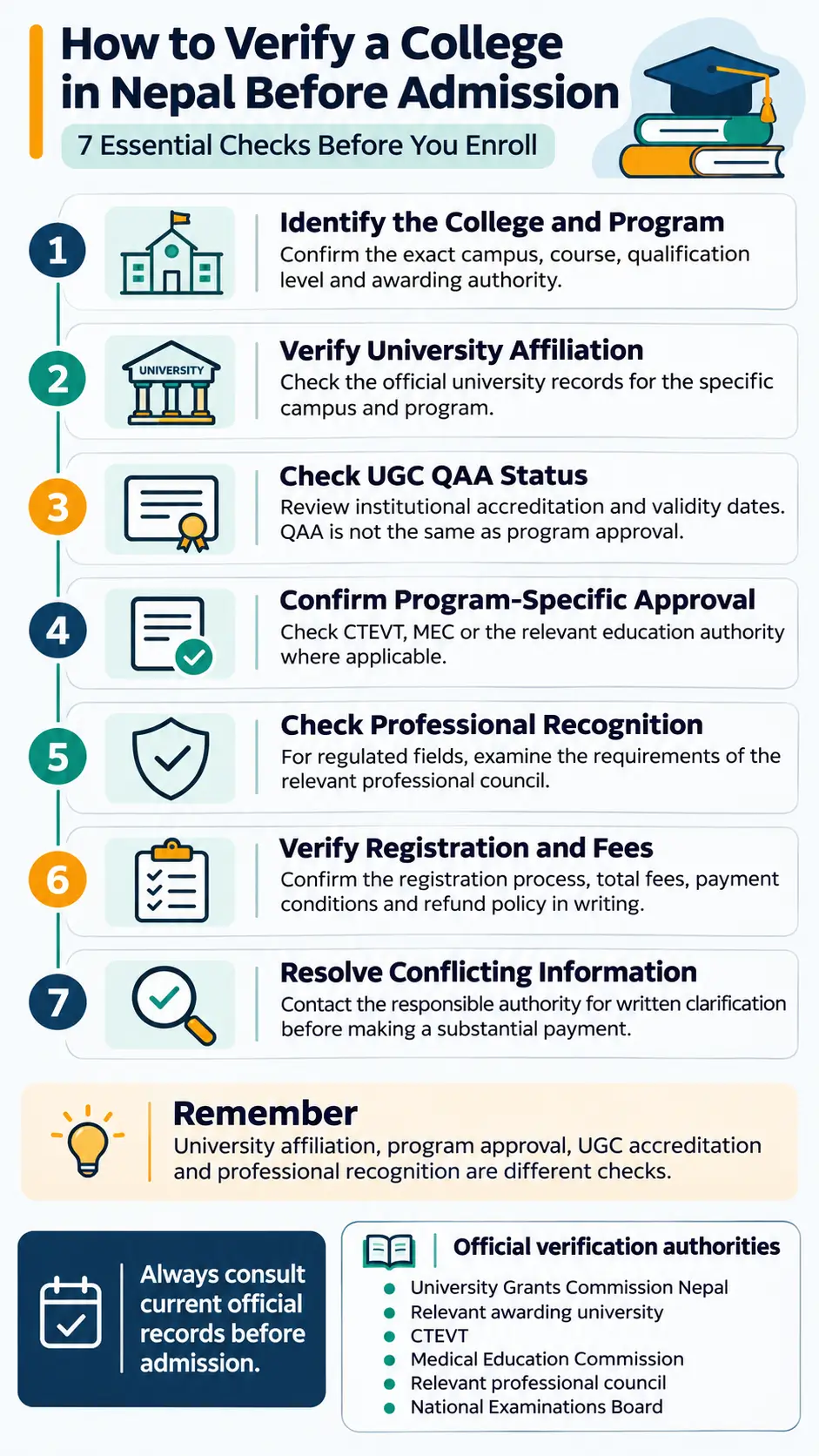
Before taking admission to a college in Nepal, students should verify that the institution is authorized to offer their intended academic program. A college's admission brochure, website or claim of university affiliation is useful background information, but it does not establish approval for every course.
The central issue is whether the exact campus can offer the specific qualification a student plans to pursue.
A college may have university affiliation for some programs, while another advertised course requires separate confirmation. Technical diplomas, medical education, engineering degrees, foreign-affiliated programs and Grade 11–12 education also involve different authorities.
Students need to distinguish university affiliation, program approval, institutional accreditation and professional recognition. These terms describe different forms of authorization or assessment, and confusing them can lead to poorly informed admission decisions.
The purpose of verification is not to judge a college by its ownership, reputation or advertising. It is to establish who awards the qualification, which authority permits the program, and whether additional conditions apply.
Answer Summary: To verify a college in Nepal before admission, identify the exact campus, program, qualification level and awarding authority. Check the college and course through the relevant university, education council or government authority. Examine University Grants Commission (UGC) Quality Assurance and Accreditation (QAA) separately from program approval. For regulated professions, confirm additional recognition requirements. If official information is incomplete or conflicting, request written clarification before paying admission fees.
Key Takeaways:-
Check the exact campus and program, not only the college name.
-
Confirm the university or authority responsible for awarding the qualification.
-
University affiliation does not establish permission for every advertised course.
-
UGC QAA accreditation and academic program approval serve different purposes.
-
Medical, technical and professional programs may require additional checks.
-
Keep written confirmation of admission conditions, fees and registration procedures.
 1. Identify the Qualification and Awarding Authority
The first step is to identify what qualification the college intends to award and who has authority over it.
The term “college” is used for different educational institutions in Nepal. It may describe a university-affiliated campus, a technical institute, a foreign-affiliated higher-education provider or a school offering Grades 11 and 12.
These institutions should not be checked through the same approval system.
Before examining official records, collect the following details from the college:
-
Full institutional name and physical campus location.
-
Exact program title and academic level.
-
Proposed awarding university, board or council.
-
Admission year or academic session.
-
Whether the qualification is awarded by a Nepali or foreign institution.
The distinction between a certificate, diploma and degree also matters. A short training certificate is not necessarily equivalent to a formally awarded technical diploma or university degree.
Which authority should students contact?
|
Type of qualification |
Primary authority to check |
Main verification question |
|---|---|---|
|
Nepali university degree |
Awarding university and relevant faculty or institute |
Is this campus authorized to offer the exact program? |
|
Technical diploma or pre-diploma |
Council for Technical Education and Vocational Training (CTEVT) |
Is the institute listed for the intended qualification? |
|
Medical or applicable health-professional program |
Medical Education Commission (MEC) and relevant academic authority |
Is the program covered by the applicable admission framework? |
|
Foreign-university degree taught in Nepal |
Responsible Nepali education ministry and foreign awarding university |
Is the local program permitted and the awarding relationship confirmed? |
|
Grade 11 or 12 qualification |
Relevant education authority and National Examinations Board (NEB) |
Is the institution permitted to offer the grade and subjects, with an appropriate registration pathway? |
This table identifies where to begin. Additional checks depend on the qualification and its intended use.
2. Verify University Affiliation and Program Approval
For a Nepali university degree, students should seek confirmation from the awarding university or the academic office responsible for the program.
An affiliated college operates under an academic relationship with a university. However, the presence of a college in a university directory does not establish authorization for every qualification advertised by that college.
Check the official affiliated-college records
Start with the university's official website and find its affiliated-college directory, faculty records, program notices or admission information.
Tribhuvan University's Institute of Science and Technology (IoST), for example, publishes an affiliated-college list with campus names, locations and bachelor's or master's program fields. This illustrates how a program-specific record provides more useful evidence than a general statement of affiliation.
Compare the official record with the college's advertised information.
If a campus is listed for BSc CSIT, that entry should not be treated as confirmation that the campus also offers a BBA, BCA or another unrelated qualification.
Likewise, permission for one academic level does not establish permission for a higher-level program.
Understand constituent and affiliated campuses
A constituent campus forms part of its university's institutional structure. An affiliated campus operates through a university affiliation arrangement but may have separate management.
This distinction concerns institutional administration and academic relationships. It does not establish that either category is automatically superior in teaching quality.
Students can consult Collegenp's explanation of constituent campuses and affiliated colleges in Nepal for further context.
For admission verification, the more consequential issue is whether the responsible university recognizes the intended program at the identified campus.
Confirm university registration and examinations
Affiliation should lead to a recognized academic pathway, including applicable student registration and examinations.
Ask the college how admitted students are registered with the awarding university and which office administers the relevant examination system.
The answers should be consistent with the university's procedures.
A college may issue its own admission receipt, identity card or internal examination results. Those documents do not, by themselves, establish that a student has been registered for a university qualification.
If registration arrangements are unclear, contact the university's relevant registration, examination or faculty office.
3. Check UGC Accreditation Without Confusing It With Approval
UGC Quality Assurance and Accreditation is an institutional quality-assessment process. It is different from university affiliation and permission to conduct a particular academic program.
The University Grants Commission publishes information about higher-education institutions that have received QAA accreditation.
Its QAA records contain institutional details, accreditation dates, expiry dates and reaccreditation information.
These records can help students examine an institution's quality-assurance status after establishing its academic authorization.
How to check QAA status
Search for the institution's official name in the UGC records.
Then compare its location and university with the campus under consideration.
Pay attention to the accreditation period. A college may appear in a historical list even when the original accreditation period has expired.
If the institution has undergone reaccreditation, examine the latest relevant entry rather than relying on an older certificate.
Does a college need QAA to be legitimate?
Absence from the UGC QAA list does not, by itself, establish that a college is unauthorized or that its qualifications are invalid.
Program permission and QAA accreditation answer separate questions.
Similarly, an institution's QAA status does not prove that every course it advertises has received the necessary academic authorization.
Students should verify affiliation or program permission through the responsible authority first. QAA information can then contribute to a broader assessment of institutional quality.
4. Verify Technical, Medical and Professional Programs Separately
Some qualifications involve additional regulatory requirements beyond ordinary university affiliation.
Students considering technical training or a regulated profession should identify both the academic awarding authority and the relevant professional or sector regulator.
CTEVT diploma and pre-diploma programs
Students seeking technical qualifications under CTEVT should check the institute and course through the council's official system.
CTEVT directs users to its institution mapping system for information about institutes and programs. The mapping interface provides filters for qualification level, program and location.
Search for the intended diploma or pre-diploma, then compare the institute's name and location with the advertised program.
An institute's presence in a technical-education directory is not sufficient evidence for an unrelated qualification.
If a program cannot be located, students should request clarification from CTEVT's relevant affiliation office or provincial authority. Current admission eligibility and application arrangements should be checked separately against the applicable intake notice.
Medical and health-professional education
Medical education requires particular attention to program-specific admission arrangements and professional recognition.
The Medical Education Commission publishes notices concerning medical education, including seat determination for particular academic sessions.
For a program falling within the MEC framework, applicants should check the college, exact qualification, relevant seat-determination notice and applicable entrance or admission procedure.
A medical college's inclusion in an earlier academic-session notice should not be interpreted as confirmation of its future intake.
Professional requirements are also distinct from admission permission.
Depending on the field, the relevant bodies may include the Nepal Medical Council, Nepal Nursing Council, Nepal Pharmacy Council or Nepal Health Professional Council.
Students intending to enter a regulated health profession should verify the council's requirements for the exact qualification and registration category.
Completion of an academic program does not mean professional registration is automatic.
Engineering colleges and Nepal Engineering Council recognition
Engineering applicants should check university affiliation and then examine the Nepal Engineering Council's professional recognition framework.
The Nepal Engineering Council maintains a registered-colleges lookup and publishes information concerning recognition and professional registration.
Students should compare the relevant institution and engineering program with the council's records.
Where information is unclear, they should request clarification from NEC rather than relying on a college's general claim that its engineering courses are recognized.
An engineering degree and professional registration are separate matters. Eligibility depends on the council's applicable requirements.
5. Verify Foreign-Affiliated Colleges Through Two Authorities
A college teaching a foreign-university program in Nepal requires verification of both its local permission and its relationship with the foreign awarding institution.
The responsible Nepali education ministry publishes information about institutions permitted to operate higher-education programs affiliated with foreign educational institutions.
The ministry's higher and technical education functions also cover permission, renewal and monitoring of foreign-affiliated higher-education institutions.
Check the college's permission in Nepal
Ask the college for its current permission documentation and the precise program covered.
Compare this with the relevant ministry record.
The institution's presence on a historical permission list does not establish that every current course or campus arrangement is covered.
Where permission depends on renewal or other conditions, students should verify the applicable status rather than relying on an older document.
Confirm the foreign university's involvement
Contact the foreign awarding university independently through its official website.
Ask whether it recognizes the Nepal-based teaching institution, the exact program and the intended award.
If the university publishes approved partner locations, compare the college's claims with that information.
Students should also establish which institution issues the final degree certificate and academic transcript.
A college's use of a foreign university's name or logo is not sufficient evidence of an active awarding relationship.
Check equivalence and recognition for the intended purpose
A foreign qualification may require a separate assessment for postgraduate admission, employment or professional registration.
The outcome can depend on the qualification, assessing authority and intended use.
Students seeking recognition in Nepal should consult the relevant equivalence authority. Those planning further study or employment abroad should check the requirements of the receiving institution or regulator.
Foreign affiliation does not establish automatic equivalence in Nepal or acceptance in every other country.
6. Check Grade 11 and 12 Institutions Through School Authorities
An institution advertising itself as a “+2 college” generally follows the school-education pathway rather than university-degree affiliation.
For Grades 11 and 12, students should examine the relevant education authority's permission arrangements and the institution's registration and examination procedures.
The National Examinations Board provides official information and services relating to examinations and school qualifications, including Grade 12.
Permission to operate particular grades or subjects may also require confirmation through the relevant local education authority.
Students should ask whether the institution can enroll them in the intended grade and subject combination and complete the necessary examination registration.
A school's association with a separate bachelor's-level college does not establish university status for its Grade 11–12 courses.
7. Examine Documents and Resolve Conflicting Information
College verification requires attention to the dates, scope and authenticity of available documents.
An affiliation letter may establish a historical academic relationship without confirming every program currently offered. A document may also relate to a different campus, academic level or admission period.
Students should compare official records with the institution's information carefully.
What to do when a college is missing from an official list
A missing search result does not automatically prove that the college is unauthorized.
Official lists may be incomplete, records may use an earlier institutional name, or websites may be temporarily inaccessible.
Try the institution's full name, relevant campus name and official abbreviation.
Check the responsible university's faculty notices or admission records. If no suitable evidence appears, contact the authority directly.
The appropriate conclusion is that the position remains unverified until reliable clarification is obtained.
How to handle conflicting documents
Conflicting information deserves attention when it concerns the program, campus, awarding authority or applicable academic session.
For example, a college brochure may advertise a course that does not appear in the university list available to the student.
That difference does not establish misconduct. It does mean the available records have not yet confirmed the course.
Ask the college for the relevant authorization reference and request confirmation from the issuing authority.
When records differ, compare their dates and whether a later official notice amends an earlier decision.
Do not treat an undated brochure as stronger evidence than a relevant, current official communication.
A useful personal verification record should capture the institution's name, exact program, authority consulted, date of the evidence and any unresolved question.
8. What to Ask the College Before Paying Admission Fees
Once academic authorization is reasonably established, students should examine the practical terms of enrollment.
Ask for written information about the admission procedure, registration requirements, tuition and other compulsory charges.
The college should be able to explain which fees are payable to the institution and which are associated with the awarding authority or examination system, where applicable.
Students should also request the applicable cancellation and refund policy.
These financial and administrative checks do not establish program approval, but they help clarify what admission involves.
Before paying, ask for written confirmation of:
-
The exact qualification and awarding institution.
-
The program's affiliation or permission reference.
-
The applicable entrance and registration procedure.
-
The current fee schedule and payment conditions.
-
The cancellation and refund policy.
-
The handling and return of original academic documents.
-
Any conditions affecting admission or continued enrollment.
Keep copies of official correspondence and payment receipts.
How to request written confirmation
A concise inquiry can help an authority identify the institution and program without ambiguity.
Please confirm whether [full college name and campus location] is authorized to offer [exact program and qualification level] for [intended academic session]. Kindly identify the relevant affiliation or permission record and the awarding authority. Please also clarify the applicable student registration arrangements.
Send the request using contact information obtained independently from the responsible authority's official website.
A verbal assurance may answer an initial question, but written confirmation provides a more reliable record when the issue affects enrollment.
Students comparing institutions can subsequently consider curriculum, teaching resources, affordability and location through Collegenp's guide to choosing a college in Nepal.
9. Final College Verification Checklist
Before confirming admission, students can use this checklist to review the evidence collected.
Where an unresolved question concerns the institution's authority to offer the qualification, students should seek reliable confirmation before making a substantial payment.
Conclusion
Verifying a college in Nepal means establishing that the exact campus can offer the intended qualification under the relevant academic and regulatory framework.
The most useful evidence comes from the awarding university, responsible education authority or applicable professional regulator.
University affiliation, program permission, UGC accreditation and professional recognition should be examined separately because each answers a different question.
Students who confirm these details and retain written records are better placed to evaluate a college's academic suitability and admission conditions without relying solely on promotional claims.
Verification reminder: Affiliation, program permission, accreditation validity, intake conditions and professional recognition can change. Students should consult the latest applicable records from the responsible authority before enrollment.



Comments 0
No comments yet. Be the first to start the conversation.