



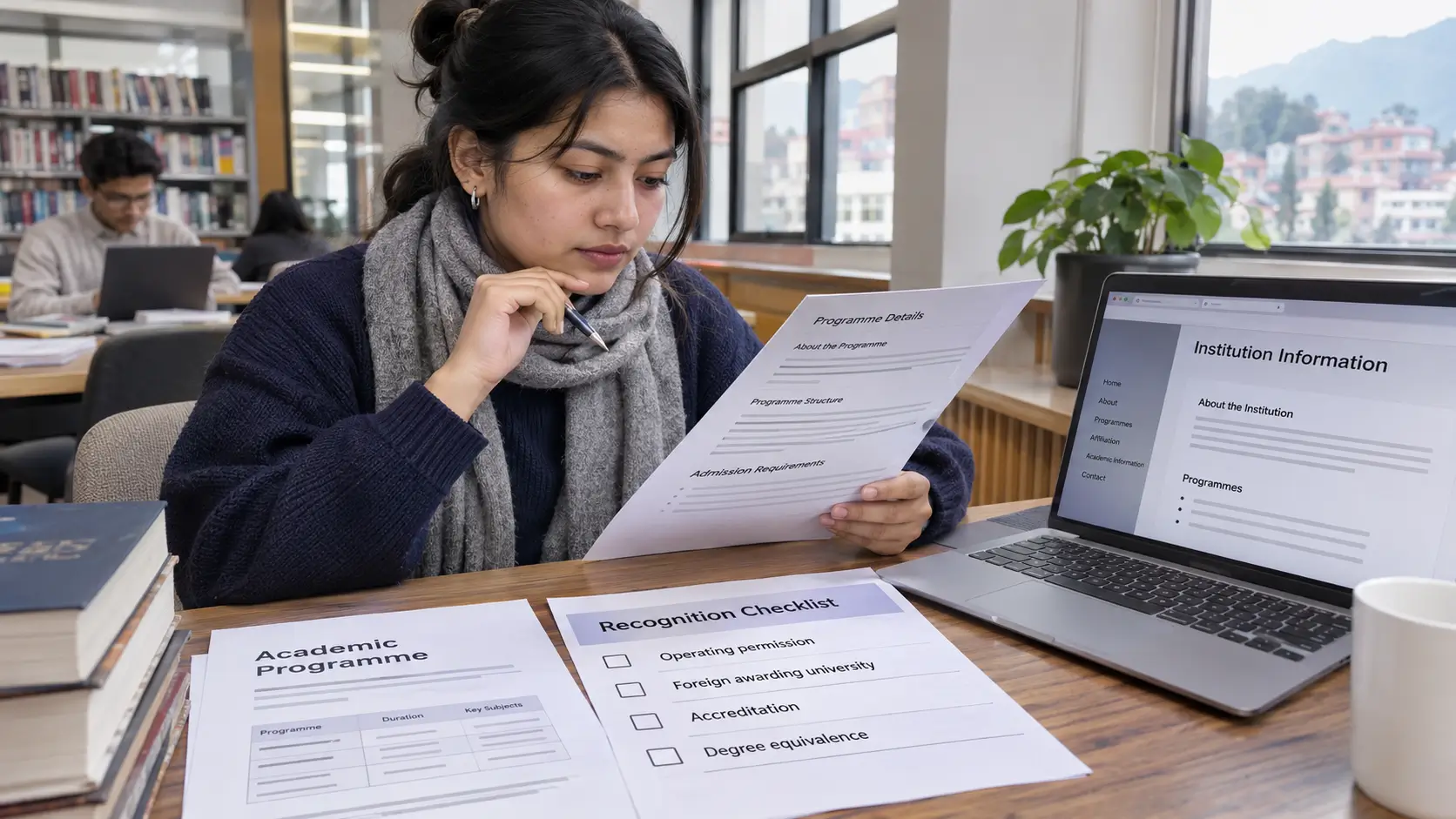
A foreign-affiliated college in Nepal may offer a degree awarded by an overseas university. However, a foreign university partnership does not automatically establish that the college has permission to operate the programme or that its qualification will be accepted for every academic or professional purpose.
For students considering admission, the central issue is not whether a college advertises foreign affiliation. It is whether the exact programme, teaching location and awarding arrangement have the necessary recognition.
This distinction matters when graduates apply for postgraduate education, government employment, professional registration or further study abroad. Different authorities assess different aspects of a qualification.
Nepal's Foreign Educational Programmes (Operation and Regulation) Regulations, 2083 BS (2026), provide an updated legal framework for these educational arrangements. Students therefore need to distinguish current government permission from older affiliation documents and institutional claims.
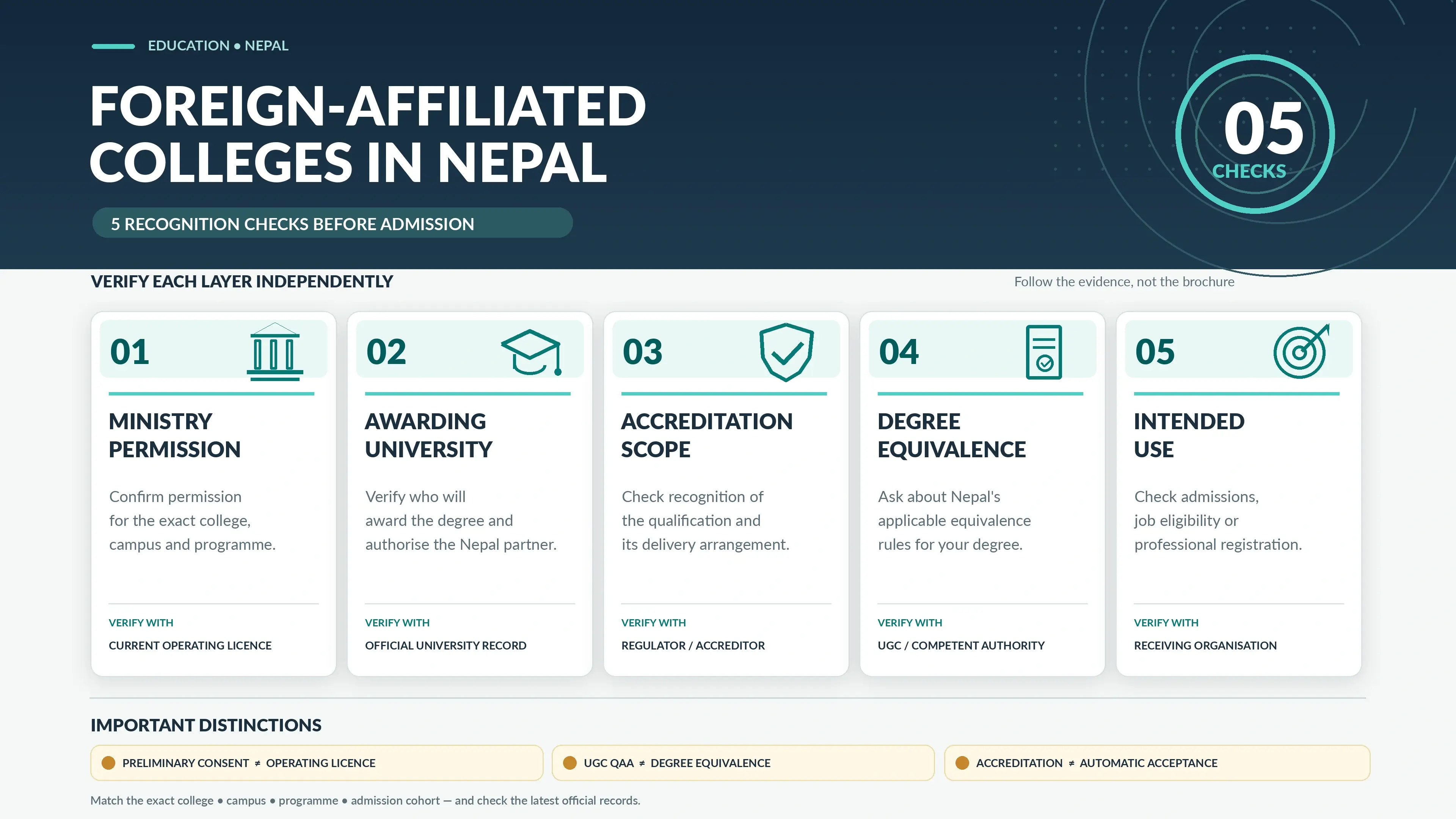
Answer Summary: To verify a foreign-affiliated college in Nepal, check the education ministry's operating permission for the exact institution, campus and programme. Independently confirm the foreign university that awards the degree, examine the relevant accreditation records, and verify whether the qualification meets your intended academic or professional requirements. Ministry permission, university recognition, accreditation and degree equivalence are separate checks. Confirmation of one does not establish the others.
Key Takeaways:-
Check the ministry's current permission for the specific programme and campus.
-
Preliminary consent is different from an operating licence.
-
Confirm the degree-awarding university directly through official channels.
-
Examine whether accreditation covers the relevant qualification and delivery arrangement.
-
Degree equivalence in Nepal requires a separate assessment where applicable.
-
Professional councils and receiving universities may impose additional requirements.
 What Does Recognition Mean for a Foreign-Affiliated College?
Recognition refers to several different forms of authorisation or acceptance. No single document necessarily answers every question about a foreign-affiliated qualification.
A Nepal-based college may deliver teaching, assessments and student services while an overseas university awards the final degree. This arrangement involves responsibilities that should be verified separately.
|
Recognition question |
Authority or evidence |
What it establishes |
|---|---|---|
|
Can the programme operate in Nepal? |
Education ministry's operating permission |
Authorisation within the specified scope |
|
Who awards the qualification? |
Foreign university's official confirmation |
Identity and authority of the degree-awarding institution |
|
Is the qualification accredited? |
Relevant foreign regulator or recognised accreditor |
Recognition or accreditation within its stated scope |
|
Is the degree equivalent in Nepal? |
UGC or other competent authority, as applicable |
Recognition under the relevant equivalence criteria |
|
Can the qualification be used for a particular purpose? |
Receiving university, employer, recruitment authority or professional council |
Eligibility under that organisation's requirements |
An institution may satisfy one requirement without automatically satisfying the others.
For example, a ministry-issued operating licence concerns the programme's permission to operate in Nepal. It does not independently establish whether another university will accept its graduates into a master's programme.
Similarly, a legitimate foreign university may possess degree-awarding authority in its home country without that fact alone establishing permission for a particular Nepal teaching centre.
Students should begin by identifying the college's registered name, campus, programme title, awarding university, admission period and intended use of the qualification.

Nepal's Rules for Foreign-Affiliated Colleges
Nepal's Foreign Educational Programmes (Operation and Regulation) Regulations, 2083, officially titled विदेशी शैक्षिक कार्यक्रम (सञ्चालन र नियमन) नियमावली, २०८३, establish requirements governing foreign-affiliated educational programmes.
The regulation was published in the Nepal Gazette on 2083/03/25 BS and is available through the Ministry of Education and Sports.
It distinguishes preliminary government consent from permission to operate an academic programme. The regulation also addresses licensing, renewal, institutional changes and publication of permission information.
Preliminary Consent Is Not Permission to Admit Students
Rules 3 and 4 concern preliminary consent, known as Preliminary Consent (पूर्व सहमति).
Under these provisions, an institution seeking to establish a foreign-affiliated educational arrangement must submit information relating to its proposed overseas university, educational programme and institutional plans.
Preliminary consent permits the applicant to proceed with preparatory arrangements subject to the applicable conditions.
The regulation provides a three-year validity period for this preliminary consent.
However, this consent should not be interpreted as the final operating licence for an advertised academic programme.
Operating Licences and Their Validity
Rules 7 and 8 address the separate operating licence, known as Operating Licenses (सञ्चालन अनुमतिपत्र).
The licensing process requires programme-related documentation and regulatory examination. Relevant information includes the foreign university's authority, curriculum, qualification level, credit structure, assessment arrangements and supporting institutional requirements.
An operating licence issued under Rule 8 has a five-year validity period.
Rules 10–12 address renewal, including the requirement to apply at least six months before the licence expires.
These provisions apply within the regulation's specified framework. Institutions operating before the regulation also have transitional provisions that must be considered when assessing their status.
A student should not assume that a previously issued permission document establishes current authorisation without checking renewals and subsequent regulatory decisions.
How to Verify Ministry Permission
The first practical step is to check whether the responsible ministry has authorised the institution to deliver the proposed programme in Nepal.
Step 1: Find the Official Permission Record
The ministry publishes information about educational institutions permitted to conduct higher-education programmes under foreign affiliation.
Start with its official list of permitted foreign-affiliated institutions.
This publication provides a government source for identifying permitted institutions. However, the publication page alone should not be treated as a continuously updated certification of every programme.
Its underlying detailed schedule and subsequent changes must be examined before confirming a particular college's current status.
A directory such as Collegenp's list of foreign university-affiliated colleges and courses in Nepal can assist with finding programmes, but directory inclusion does not independently establish government permission.
Step 2: Match the Exact Programme
Compare the ministry documentation with the college's current admission information.
Check the following:
-
Registered institutional name and physical campus
-
Foreign university granting the affiliation
-
Exact programme and qualification title
-
Academic level and approved teaching arrangement
-
Operating licence details and validity
-
Relevant renewals or approved amendments
These details matter because an institution may offer several qualifications under different arrangements.
Permission concerning one programme should not automatically be applied to another programme at the same college.
Similarly, approval for a particular campus does not establish permission for a different teaching location.
Step 3: Check Later Decisions
Rule 19 of the 2083 regulations requires the ministry to publish information concerning institutions licensed under the regulation and those whose permissions have been cancelled.
A previously published institutional list may need to be read alongside later notices concerning renewal, amendment or cancellation.
If the available records do not clearly identify the college and programme, request written confirmation from the ministry.
The ministry's Higher and Technical Education Division identifies responsibilities associated with foreign-affiliated higher-education programmes.
A written enquiry should identify the exact institution, campus, programme, foreign university and proposed admission period. This enables the responsible office to address the specific arrangement rather than an ambiguous college name.
How to Verify the Foreign Degree-Awarding University
After checking Nepal's operating permission, establish which foreign institution will award the qualification.
The teaching college and degree-awarding university may be different organisations.
The UK government's degree-recognition guidance explicitly explains that an institution teaching a degree programme is not necessarily authorised to award the degree itself.
Confirm the Awarding Relationship Directly
Ask the Nepal college for the official qualification title and the university name that will appear on the final degree certificate.
Then check the information independently through the foreign university's official website, recognised partner directory or authenticated university contact.
The enquiry should establish:
-
Whether the Nepal college is an authorised teaching partner
-
Whether the partnership covers the proposed programme and campus
-
Whether the university will award the stated qualification
-
Whether the arrangement applies to the relevant admission cohort
-
Which institution controls assessments, transcripts and academic records
A college brochure, university logo or memorandum of understanding may establish that a relationship is being claimed. None independently proves the current scope of the arrangement.
An older partnership document may also be insufficient when the programme, degree title or foreign university has changed.
The student needs confirmation that applies to the actual course of study.
How to Check Foreign Accreditation
Foreign accreditation should be examined according to the awarding university's home-country system.
Accreditation arrangements differ between jurisdictions. Some authorities maintain institutional registers, while others publish programme-level recognition or accreditation records.
The existence of a university in an official register does not automatically establish that every overseas teaching arrangement falls within the recorded scope.
United Kingdom
The UK government provides guidance on identifying institutions with recognised degree-awarding powers.
For qualifications awarded by UK institutions, students should confirm the awarding body and follow the recognition route applicable to the relevant UK jurisdiction.
An authorised university's name on a Nepal college brochure does not independently establish the college's current teaching partnership.
Malaysia
The Malaysian Qualifications Register, maintained by the Malaysian Qualifications Agency, provides official information about accredited programmes and qualifications.
Students can examine the relevant qualification's registration and accreditation details.
However, a programme appearing in Malaysia's register should not automatically be interpreted as confirmation that a specific Nepal teaching location is included. That distinction requires clarification from the university or relevant regulator.
Australia
Australia's Tertiary Education Quality and Standards Agency maintains a National Register of higher-education providers.
The register provides provider registration information and relevant course accreditation records.
Australian universities and other institutions with self-accrediting authority may accredit their own courses. Consequently, the absence of an individual course from TEQSA's separately accredited-course listings is not, by itself, evidence that the qualification lacks accreditation.
For any country, students should distinguish the awarding university's recognition from approval of the particular overseas delivery arrangement.
Is a Foreign-Affiliated Degree Equivalent in Nepal?
Degree equivalence is a separate academic determination concerning how a qualification compares with qualifications recognised under Nepal's educational framework.
The University Grants Commission (UGC) Equivalence portal provides information about the evaluation of qualifications obtained from foreign universities.
Its published guidance distinguishes between regular equivalence, involving qualifications previously evaluated, and procedural equivalence, involving qualifications requiring further assessment.
The existence of this service does not establish automatic eligibility for every foreign degree taught at a Nepal-based college.
Check the Qualification and Intended Purpose
A meaningful enquiry should include the exact degree title, awarding university, qualification level, curriculum, credits, duration and mode of study.
Students should also explain why equivalence is needed.
A qualification submitted for postgraduate admission may be assessed against different requirements from one presented for public-service recruitment or professional registration.
Applicants should consult UGC and the receiving university or authority where applicable.
The current division of responsibilities for some Nepal-delivered foreign qualifications and historically processed cases may require individual clarification. Students should not assume that one authority handles every qualification under identical procedures.
Can Equivalence Be Confirmed Before Admission?
Prospective students can request information about the applicable criteria and whether similar qualifications have previously been evaluated.
However, a general response about equivalence requirements is not the same as an individual equivalence certificate for a qualification that has not yet been awarded.
A college's statement that previous graduates received equivalence should also be examined carefully. Even where supported, it does not establish identical treatment for a different programme, cohort or awarding arrangement.
Before admission, the practical objective is to identify any known recognition requirements and unresolved risks.
Are Three-Year Foreign Bachelor's Degrees Recognised?
The duration of a foreign bachelor's degree is relevant to academic assessment, but it does not support a universal yes-or-no conclusion.
Students considering a three-year programme should verify its entry qualification, academic level, credits, curriculum, study mode and intended receiving institution's requirements.
Neither the statement that every three-year foreign degree is unacceptable nor the claim that every ministry-permitted three-year programme automatically receives equivalence is supported as a universal rule.
Readers comparing programme structures can also consult the separate Collegenp article on three-year and four-year degree recognition pathways.
Is UGC QAA the Same as Degree Equivalence?
No. Quality Assurance and Accreditation (QAA) and degree equivalence serve different purposes.
QAA examines institutional quality-assurance arrangements within the relevant accreditation framework. Degree equivalence concerns the academic standing of a particular qualification.
UGC maintains a separate list of higher-education institutions receiving QAA, including accreditation-related information.
A college's QAA status is not an individual graduate's degree-equivalence decision.
Nor does institutional QAA replace the ministry's permission for a foreign-affiliated programme.
These records may be relevant to different questions, but their meanings should not be combined.
Professional Registration and Acceptance Abroad
Academic recognition does not automatically establish eligibility for regulated professional practice.
Students preparing for professions such as engineering, medicine, nursing, law or teaching may need to meet additional requirements established by the appropriate professional council or competent authority.
The applicable conditions depend on the qualification, profession and jurisdiction.
A ministry operating licence or foreign university accreditation should not be presented as a guarantee of professional registration.
The same principle applies to international postgraduate admission.
Universities abroad may examine the awarding institution, qualification level, credits, academic performance and programme requirements. An award accepted by one institution may not meet another institution's admission criteria.
For students planning to work outside Nepal, destination-country professional rules may create further requirements.
The relevant question is not whether the degree is described as internationally recognised, but whether the intended receiving organisation accepts the specific qualification for the proposed purpose.
Documents to Check Before Admission
A useful verification record connects each document to the question it answers and the authority responsible for confirming it.
|
Document or information |
Details to check |
Who can confirm |
|---|---|---|
|
Ministry operating licence |
Institution, campus, programme, validity and renewal |
Responsible ministry |
|
Foreign university confirmation |
Partner relationship, programme, cohort and award title |
Awarding university |
|
Recognition or accreditation record |
Qualification, level, scope and applicable dates |
Home-country regulator or accreditor |
|
Academic programme specification |
Curriculum, credits, assessment and degree requirements |
Awarding university |
|
Equivalence information |
Qualification-specific criteria and review procedure |
UGC or competent authority |
|
Professional eligibility requirements |
Qualification and registration conditions |
Relevant professional council |
A useful record has consistent names, dates and programme details across independent sources.
If one document names a different university or campus, the discrepancy needs clarification rather than assumption.
Check Academic and Financial Arrangements
Recognition is the first concern, but students should also understand how the programme operates.
Before making admission payments, obtain written information about the programme's total charges, payment schedule, additional academic costs and refund conditions.
Ask which institution administers examinations, maintains student records and issues transcripts.
Students may also examine the programme specification to understand curriculum depth, assessment methods, practical learning requirements and academic progression.
These considerations help evaluate the educational arrangement beyond its legal status. They do not independently establish recognition.
Keep dated copies of official documents and written responses. Personal academic records and identification documents should be stored securely rather than shared publicly.
What If a College Is Missing From the Ministry List?
An institution's absence from an online list is not, by itself, proof that it lacks permission.
Government records may use registered legal names rather than public college brands. A publication may also require examination alongside subsequent notices or amendments.
First, confirm the institution's registered name and compare the campus, programme and awarding university.
Request the college's current operating licence and relevant renewal or amendment documents.
If the records remain unclear, contact the responsible ministry division with the precise programme details.
A college's inability to provide clear documentation warrants further verification, but an unresolved enquiry should not automatically be converted into an allegation of wrongdoing.
Where material permission questions remain unanswered, prospective students can avoid making irreversible admission payments until the position is clarified.
What If the Foreign University Partner Changes?
A change in foreign university, programme or operating location can affect which documentation applies to enrolled students.
The 2083 regulations address changes to institutional arrangements and include provisions relevant to continuing students when affiliation changes.
Students should request written clarification identifying the approved change, the institution responsible for their existing qualification and how completed academic work will be treated.
The explanation should establish whether assessments and credits remain valid, how students will complete their programme and which university will issue the final degree.
An announcement of a new foreign partnership does not automatically establish that students enrolled under an earlier arrangement have transferred to the new awarding university.
Where the college's explanation is unclear, students can seek confirmation from the awarding university and ministry.
Graduates facing documentation or equivalence difficulties should similarly identify the actual awarding institution, programme and study period before requesting a decision from the appropriate authority.
Conclusion
Recognition of a foreign-affiliated college in Nepal is not established by a university logo, an affiliation claim or a single government document.
A reliable assessment requires current ministry permission for the programme, independent confirmation of the foreign awarding institution, examination of the applicable accreditation scope and clarification of how the qualification will be assessed for its intended use.
Students should compare official records, seek written answers to material discrepancies and distinguish institutional authorisation from individual academic or professional eligibility.
Last reviewed: 5 November 2026.
This article provides general educational and regulatory information, not an individual legal, licensing or equivalence determination. The complete current ministry permission schedule, individual institutions' licence status and qualification-specific equivalence outcomes require separate official verification. Relevant regulations, ministry notices and receiving-authority requirements should be checked before an admission or qualification-related decision.






Comments 0
No comments yet. Be the first to start the conversation.