




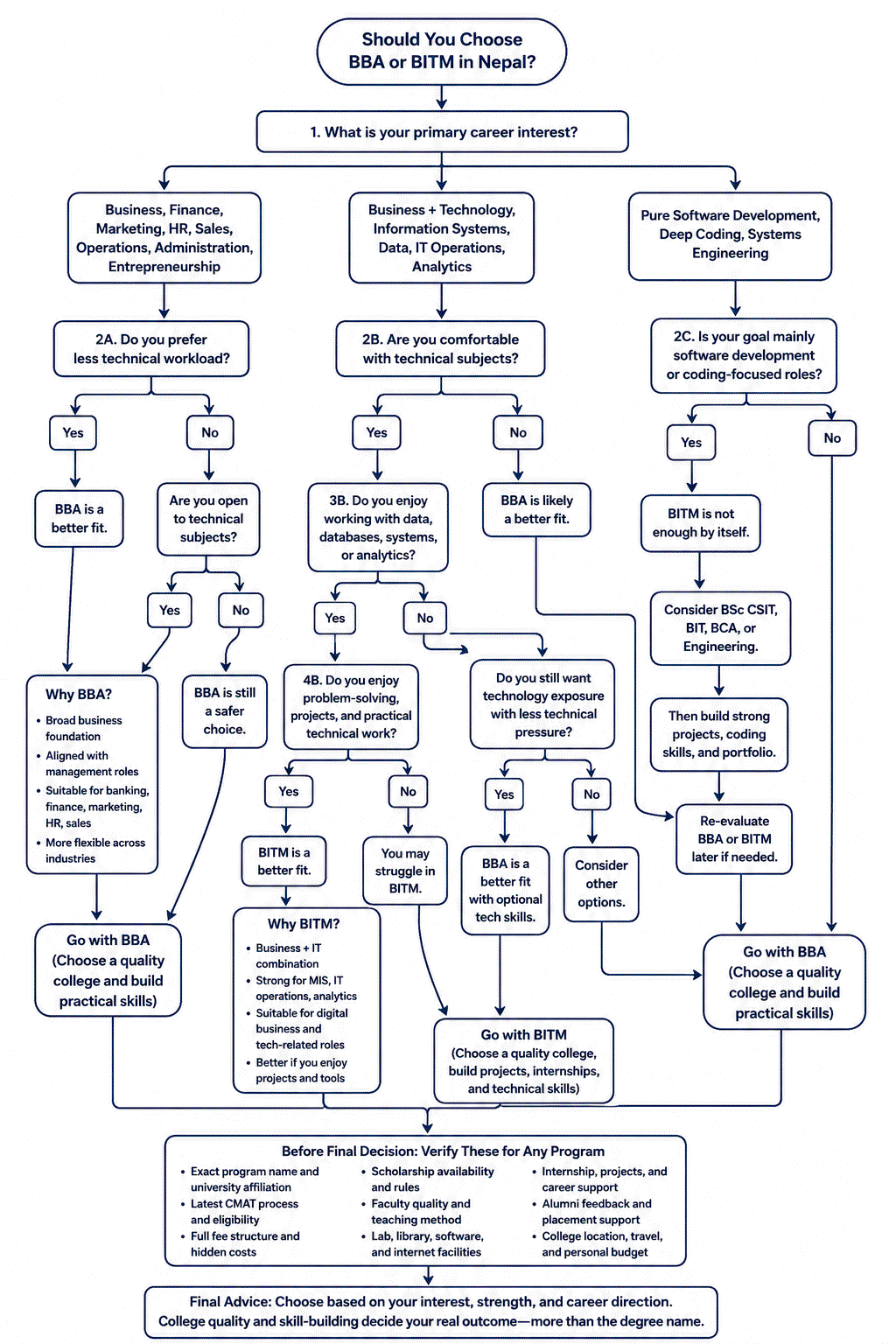
BBA vs BITM in Nepal is not a simple choice between “business” and “IT.” For most +2 students, the real decision is whether they want a broad business-management degree or a management degree with stronger technology exposure.
BBA is usually more suitable for students aiming for banking, finance, marketing, HR, sales, operations, administration, entrepreneurship, or general management. BITM is usually more suitable for students who want to work where business and technology overlap, such as information systems, databases, business analytics, IT operations, digital business, or software-adjacent project roles.
This article mainly focuses on the Tribhuvan University Faculty of Management context. Foreign-affiliated BBA or IT-management programs in Nepal may have different duration, curriculum, fees, assessment systems, and admission rules.
Admission dates, fees, seats, scholarship rules, and syllabus details can change. Verify the latest TU FoM notice and the college’s official information before applying.
Quick Answer
Choose BBA if you want a broader business degree with less technical pressure. It is more directly aligned with management, finance, marketing, HR, banking, sales, operations, and entrepreneurship.
Choose BITM if you want business knowledge with stronger exposure to technology, systems, databases, analytics, and IT project work.
Neither degree guarantees a job, salary, placement, or foreign study pathway. The better choice depends on your career goal, subject interest, college quality, internship access, budget, and ability to build skills beyond the syllabus.
Table of Content
- Anatomy of the Issue
- Comparison Methodology
- BBA vs BITM in Nepal: Key Comparison
- What Is BBA in Nepal?
- What Is BITM in Nepal?
- Course Focus and Workload
- Career Scope: BBA vs BITM
- Who Should Choose BBA?
- Who Should Choose BITM?
- Who Should Avoid Each Option?
- Personal and Social Factors
- What Would Change the Verdict?
- Decision Checklist Before Admission
- Common Mistakes
- Final Verdict: BBA vs BITM in Nepal
Anatomy of the Issue
Many students ask, “Which has more scope: BBA or BITM?” That question is too broad. Scope depends on the role you are preparing for, the skills you build, and the quality of the college you attend.
The confusion usually comes from three assumptions.
First, students often believe the degree name alone decides career outcomes. It does not. A BBA student with strong communication, finance, Excel, sales, marketing, or business-development skills can do better than a weak BITM student. A BITM student with real projects, coding practice, database work, and business understanding can do better than a BBA student who only passes exams.
Second, BITM is still confused with BIM, BIT, BCA, and BSc CSIT. In the TU FoM context, BITM is the active bachelor program name, while BIM is shown as phased out. Students should confirm the exact degree name in current admission documents before applying.
Third, students are often influenced by friends, family expectations, and college advertisements. Those factors may matter socially, but they should not replace a practical check of subjects, cost, college quality, and career fit.
Comparison Methodology
This comparison uses seven practical criteria:
| Criteria | Why it matters |
|---|---|
| Course focus | Shows whether the degree is business-heavy or tech-business oriented. |
| Technical workload | Helps students avoid choosing a program they may not enjoy or sustain. |
| Career alignment | Connects the degree with realistic entry-level work areas. |
| Admission and eligibility | Helps students verify whether they can apply through the current process. |
| Skill evidence | Shows what employers may look for beyond marks. |
| College quality risk | Recognizes that the same degree can produce different outcomes in different colleges. |
| Long-term flexibility | Helps students consider MBA, IT-management, entrepreneurship, or further study options. |
This article does not use a numerical score because verified salary, placement, fee, and college-quality data are not strong enough for a fair scoring system.
BBA vs BITM in Nepal: Key Comparison
| Criteria | BBA | BITM | Editorial judgment |
|---|---|---|---|
| Core focus | Business administration and management | Information technology plus management | BBA is broader; BITM is more tech-business focused. |
| Technical depth | Lower technical load, with some computer/MIS exposure | Higher exposure to computing, systems, databases, and projects | BITM suits students who can handle technical practice. |
| Career direction | Banking, finance, marketing, HR, sales, operations, administration | MIS, analytics, database support, IT operations, digital business | Choose by target work environment, not trend. |
| Skill evidence | Reports, presentations, internships, business projects | Projects, dashboards, databases, coding practice, internships | BITM needs stronger visible technical evidence. |
| Main risk | May feel too general for tech-focused students | May feel difficult for students avoiding technical subjects | Fit matters more than popularity. |
What Is BBA in Nepal?
BBA stands for Bachelor of Business Administration. In the TU context, it is a four-year semester-based management degree under the Faculty of Management. It focuses on business administration, accounting, finance, marketing, economics, communication, human resource management, entrepreneurship, research, and related management areas.
BBA is suitable for students who want a broad business foundation. It can support entry-level roles in banks, finance companies, corporate offices, service firms, startups, NGOs, and family businesses.
BBA is not automatically easy. Students still need accounting discipline, writing ability, presentations, teamwork, analytical thinking, and professional communication.
What Is BITM in Nepal?
BITM stands for Bachelor of Information Technology Management. It is a management degree with stronger technology exposure. It sits between business education and technology-focused study.
BITM is more technical than a general BBA, but it should not be treated as the same as computer engineering, pure computer science, BCA, BIT, or BSc CSIT. Its value is in the business-technology overlap: information systems, databases, IT project work, analytics, digital operations, and management decision support.
BITM can be useful for students who want technology exposure, but it rewards practice. A student who avoids projects, tools, coding practice, and internships may not get the expected advantage from the degree.
Course Focus and Workload
BBA is stronger for students who prefer business discussions, accounting, finance, communication, market research, presentations, and management case work. It keeps the path broad across several business functions.
BITM is stronger for students who enjoy business but also want to understand systems, data, software processes, and IT-supported organizational work. It requires more comfort with technical logic, database concepts, computing subjects, and project-based learning.
The practical judgment is clear: choose BBA if you want broad business. Choose BITM if you want tech-business. Do not choose BITM only because IT sounds attractive, and do not choose BBA only because it appears safer.
Career Scope: BBA vs BITM
Possible BBA-aligned entry paths include management trainee, junior officer, banking support, finance assistant, sales executive, marketing assistant, digital marketing assistant, HR assistant, administration, operations, customer success, business development, and entrepreneurship.
Possible BITM-aligned entry paths include MIS assistant, IT support, database assistant, system support, junior business analyst, QA or project coordinator, tech operations assistant, analytics assistant, e-commerce support, and digital business roles.
For banking and finance, BBA is more directly aligned. For MIS, IT operations, digital business, and analytics-support roles, BITM is more directly aligned.
For software development, BITM can help, but it is not enough by itself. Software roles require coding practice, projects, debugging ability, internships, and portfolio evidence.
Who Should Choose BBA?
Choose BBA if you want a broad management degree and do not want your bachelor’s study to depend heavily on technical subjects.
BBA is a stronger fit if you are interested in banking, finance, marketing, HR, sales, operations, administration, entrepreneurship, or MBA-style progression.
A practical example: a +2 management student who enjoys accounting, communication, finance, and business case discussions but has little interest in coding will usually fit BBA better than BITM.
Who Should Choose BITM?
Choose BITM if you want business knowledge but also want stronger technology exposure.
BITM is a stronger fit if you are interested in information systems, databases, programming basics, business analytics, digital business, IT operations, or project coordination between business and technical teams.
A practical example: a student who enjoys business but also likes building simple websites, learning programming basics, using dashboards, or understanding how software supports organizations may fit BITM better than BBA.
Who Should Avoid Each Option?
Avoid BBA if your main interest is technical systems, databases, programming, analytics tools, and IT project work. You may find BBA too general unless you build technical skills separately.
Avoid BITM if you dislike logic-heavy computer subjects, troubleshooting, database work, programming practice, or technical projects. BITM is not a good choice only because it sounds modern.
Neither degree is ideal for students looking for a guaranteed shortcut. Both require assignments, presentations, exams, internships, and self-development.
Personal and Social Factors
Parents may prefer BBA because it is familiar. Friends may prefer BITM because it sounds technology-oriented. Colleges may present both programs as career-focused. These signals can influence a student, but they are not enough for a decision.
Students should consider their learning style, confidence, budget, travel distance, class timing, support system, and long-term goal. BBA may suit students who can improve business communication and presentation skills. BITM may suit students who can sit with technical problems and practice regularly outside class.
Financial pressure also matters. Before admission, ask for the full fee breakdown, including admission, semester, exam, lab, library, deposits, and other charges.
What Would Change the Verdict?
The verdict changes if the college quality changes. A strong BITM college with qualified technical faculty, working labs, project guidance, and internship support may be better than a weak BBA college. A strong BBA college with good faculty, business exposure, internship links, presentation culture, and alumni support may be better than a weak BITM college.
The verdict also changes by goal. For banking and general business, BBA is usually more directly aligned. For IT-management and digital business, BITM is usually more directly aligned. For pure software development, BITM helps only if the student builds serious coding skill and project evidence.
Foreign-affiliated programs may also change the verdict because their curriculum, assessment, fees, recognition, and transfer pathways may differ from TU FoM programs.
Decision Checklist Before Admission
Before choosing BBA or BITM, verify:
-
Exact program name and university affiliation
-
Latest syllabus and credit structure
-
Current CMAT process and eligibility
-
Full fee breakdown and hidden costs
-
Scholarship rules in writing
-
Faculty profile and teaching quality
-
Lab quality, software access, and internet facility for BITM
-
Internship, project, and career-support system
-
Recent exam results and alumni examples
-
Location, travel time, family budget, and long-term value
Common Mistakes
The first mistake is choosing by salary claims. Salary depends on role, employer, location, interview performance, internship, communication, skill level, and market condition.
The second mistake is assuming BITM guarantees IT jobs. It does not. BITM students need technical evidence.
The third mistake is dismissing BBA as ordinary. A strong BBA student with finance, marketing, Excel, communication, and internship experience can be competitive.
The fourth mistake is ignoring college quality. A good program choice can become weak if teaching, labs, internship support, or fee transparency are poor.
Final Verdict: BBA vs BITM in Nepal
BBA vs BITM in Nepal has no single winner for every student.
Choose BBA if you want a broad business and management path. It is more directly aligned with banking, finance, marketing, HR, sales, operations, administration, entrepreneurship, and general management.
Choose BITM if you want business knowledge with stronger technology exposure. It is more directly aligned with information systems, databases, business analytics, IT operations, digital business, and software-adjacent project roles.
The strongest point of BBA is flexibility across business functions. Its limitation is that it may feel too general for students who want deeper technical exposure.
The strongest point of BITM is its business-technology blend. Its limitation is that students who avoid technical practice may not receive the expected career benefit.
The practical takeaway is simple: choose BBA for broad business. Choose BITM for tech-business. Then verify the college carefully and build skills beyond the syllabus.







Comments 0
No comments yet. Be the first to start the conversation.