



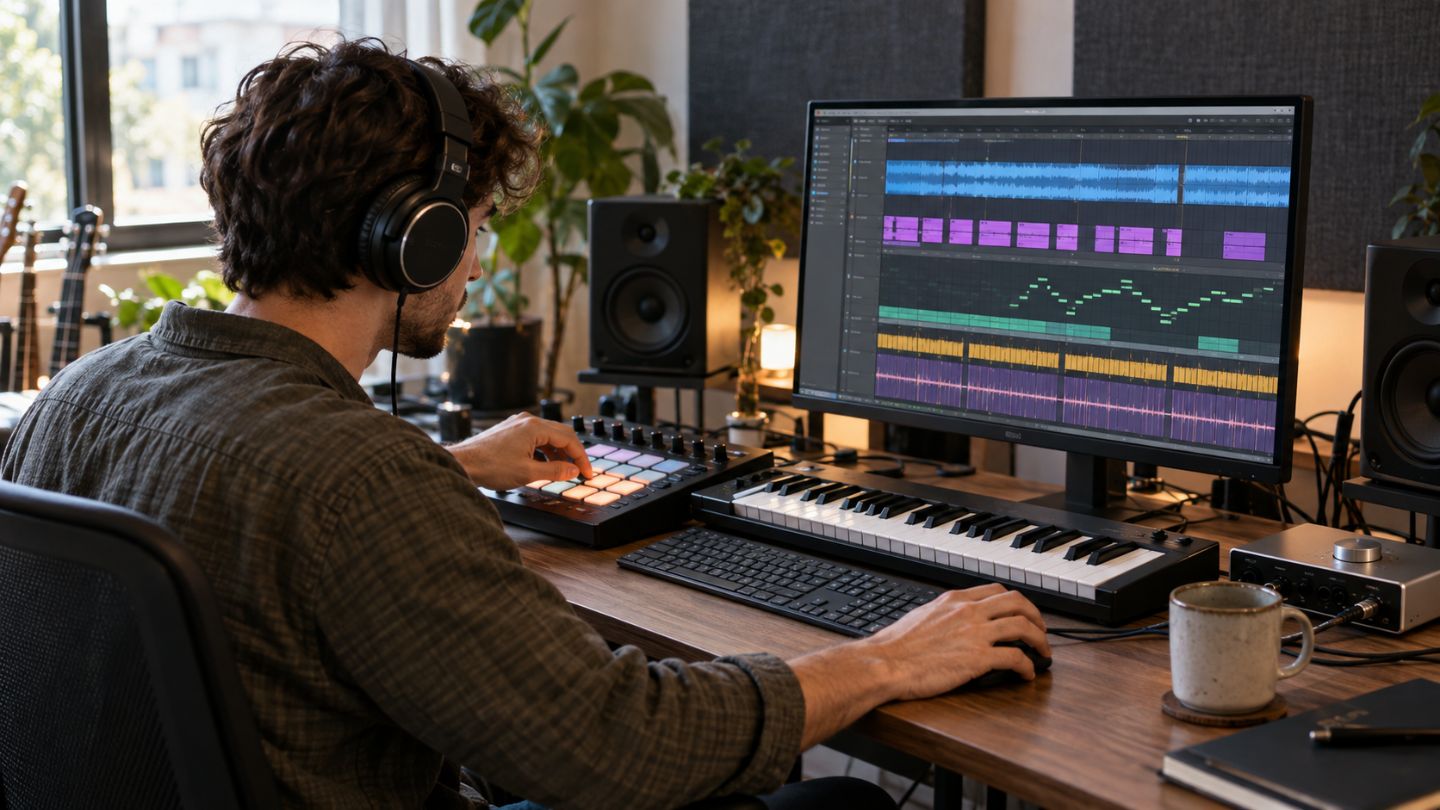
Every producer knows the feeling of opening a new session and having no clear idea where to begin. The drums sound predictable, the melody goes nowhere, and before long you are cycling through presets rather than actually making music.
AI tools can be useful in exactly that situation. A producer can use an ai music maker to sketch a beat, test a melodic direction, or create a rough idea that can later be dragged into a DAW and rebuilt. The first result does not need to sound finished. It only needs to give you something interesting enough to react to.
That is where AI beat makers and melody generators make the most sense. They are not automatic hit machines, and they do not remove the producer from the process. Their real value is helping a session move forward when the starting point is still unclear.
Beat Makers Can Help Break the Blank-Session Problem
Making a beat is rarely difficult because producers do not understand drums. The harder part is deciding what this particular track needs.
You may already know that you want something around 100 BPM with warm drums and a loose bass line, but you may not know whether the track should lean toward hip-hop, R&B, electronic pop, or something between them.
An AI beat maker can quickly turn that uncertainty into several directions you can hear. One version might use dry drums and more space, another could introduce heavier percussion, while a third may push the idea toward a darker electronic sound.
You may not like any of them exactly as they are, and that is not necessarily a problem. Sometimes hearing the wrong groove makes the right one much easier to identify.
Instead of staring at an empty timeline and wondering what to make, you are reacting to something concrete. That changes the session from invention out of nowhere into a process of choosing, editing, and refining.
Melody Generators Solve a Different Kind of Creative Block
A good groove can keep a track moving, but melody is often what gives it identity.
This is also where many producers get stuck. You can have drums, bass, and a clean arrangement and still feel that the track has nothing memorable at its center. Adding more layers usually does not solve that problem.
A melody generator can be useful because it introduces musical shapes you might not naturally reach for. It might produce a four-note phrase with an unusual rhythm, a chord movement you would not normally choose, or a melodic ending that suddenly gives the track a direction.
The important part is not keeping everything it generates.
A producer might keep two notes, change the rhythm, replay the phrase with another instrument, or use the basic contour while replacing almost everything else. The output becomes raw material rather than a finished composition.
For producers, that distinction matters. The most useful part of AI generation often begins after the generator stops.
The Best AI Output Is Often the One You Change
There is a tendency to judge AI music tools by how polished the first result sounds. That makes sense if you need background music quickly, but for producers it can be the wrong standard.
A polished generation may actually leave very little room for creative decisions. A rougher idea with one strange bass movement or an unusual melodic phrase can be much more valuable because it gives you something to develop.
Producers already understand this idea from sampling. You may hear a few seconds in an old recording and immediately imagine a completely different track around it. Once you pitch, chop, filter, replay, and rearrange the material, the original source becomes only one part of a new production.
AI-generated material can be treated in a similar way.
You might drag a loop into your session, mute the original bass, keep the percussion, replay the chords, and simplify the melody. After ten minutes of editing, you may realize the rhythm was the only part worth keeping.
That still makes the generation useful.
The better question is not always, “Would I release this?” It is often, “Is there something here I can turn into a better idea?”
Different AI Music Tools Solve Different Problems
It helps to stop thinking of every AI music generator as the same type of tool.
Some are most useful for beat creation. They help when you need a groove, drum direction, tempo, or general sense of energy.
Others focus more on melodies and harmony. These can be helpful when the rhythmic foundation is already there but the track needs a hook, chord movement, or stronger musical identity.
Full-track generators solve a different problem again. They can provide broader references for arrangement, instrumentation, song structure, or overall mood.
A producer might use all three categories in completely different situations.
You do not necessarily need one platform that does everything. It can be more useful to identify what is slowing the session down and choose a tool that addresses that specific problem.
Prompting Works Better When You Think Like a Producer
Generic prompts usually produce generic music.
“Make a cool beat” tells the system almost nothing. Even something like “dark trap beat” leaves a lot of creative decisions undefined.
Producers already think in much more specific terms. You think about tempo, drum texture, groove, space around the vocal, bass movement, instrumentation, and how the track should develop over time.
That same thinking improves AI generation.
Instead of asking for a “chill R&B beat,” you could describe a mid-tempo groove with soft electric keys, restrained drums, warm bass, and enough space for a lead vocal. That gives the generator a clearer job.
It also makes revision easier. If the drums work but the melody feels too bright, you can change the melodic direction while keeping the rest of the concept. If the result feels too crowded, you know that the next version needs less instrumentation rather than a completely different idea.
Good prompting is not really about learning secret words. It is about being able to describe what you want to hear.
That is already part of producing.
Generate Contrast Instead of Endless Variations
Generating ten nearly identical beats rarely helps.
Three deliberately different directions can be much more useful.
Imagine you already have a vocal demo but no production. One version could be built around acoustic guitar and light percussion. Another might use sparse electronic drums and deep synth bass. A third could move somewhere unexpected, perhaps toward a faster broken-beat rhythm with very little harmony.
The goal is not necessarily to choose one of those versions.
You are testing the boundaries of the song.
This is one of the more interesting uses of generative music tools. They can make it easier to explore ideas that might otherwise feel too time-consuming to try manually.
Most of those experiments will go nowhere. That is normal. Occasionally, however, the least obvious direction reveals a rhythm, texture, or arrangement choice that changes the entire track.
A Generated Beat Still Has to Work Inside the Session
A beat can sound impressive by itself and immediately become a problem when you add vocals.
The kick may be too dominant. The melody might compete with the singer. The arrangement could peak too early, leaving the chorus nowhere to go.
This is where production judgment matters.
You may need to cut eight bars, change the snare, simplify the bass line, or remove an instrument that looked important in isolation but no longer serves the track.
It is often useful to stop listening to generated material as a complete song and start listening to it as material inside a session.
Ask what survives when you remove half of it. Notice whether the groove still works when the vocal arrives. Pay attention to which elements actually improve the track rather than simply making it sound fuller.
Those decisions usually matter more than how impressive the original generation sounded.
More Layers Do Not Automatically Make a Better Beat
AI-generated music often arrives sounding full and polished. That can encourage producers to keep adding more.
Usually, the track does not need it.
Some of the most effective beats work because a small number of elements have clear jobs. The drums create movement, the bass gives the groove weight, and one strong melodic idea gives the listener something to remember.
Everything else has to justify its place.
When working with generated material, muting can be more useful than adding. If the melody becomes clearer without a pad underneath it, remove the pad. If the groove improves when several percussion layers disappear, keep it simple.
Generation makes it easy to add ideas. Producing often means deciding which of those ideas do not need to stay.
AI Can Also Push Producers Outside Their Usual Habits
Most producers develop patterns over time.
You reach for similar drum sounds, similar chord voicings, familiar tempos, and bass lines that begin in comfortable places. Those habits can become part of a recognizable style, but they can also turn into autopilot.
AI tools can be useful when you deliberately ask them to move outside those habits.
A hip-hop producer might test percussion influenced by another rhythmic tradition. An electronic producer could explore a stripped-back soul arrangement. Someone who usually works at slower tempos might begin with a much faster groove.
The result may not represent the genre perfectly, and that is worth keeping in mind. Genre is more than a BPM range and a handful of instruments.
Still, even an imperfect interpretation can introduce a rhythm, texture, or structural idea that you would not have reached for on your own.
You do not have to keep the label. You only need to keep the useful idea.
Knowing When to Stop Generating Matters
One of the easiest traps with AI music tools is generating too much.
Once you can create another variation quickly, there is always a reason to try one more. A groove that was already good enough suddenly feels temporary because there might be something better in the next version.
Producers already deal with endless presets, samples, plugins, and sounds. AI adds another almost unlimited source of choices.
At some point, exploration has to stop.
If you have a groove you keep returning to, develop it. If one melody still sounds interesting after several listens, work on it instead of replacing it.
A finished track usually appears only after someone decides that the search is over and the production has begun.
AI can help you find a starting point, but it cannot make that commitment for you.
What AI Beat Makers Still Cannot Replace
There is a difference between generating competent music and developing a recognizable musical identity.
AI can suggest a groove, produce a usable melodic idea, or create a starting point that a producer can develop further. But producers are often remembered for decisions that would never appear in a basic prompt.
Why does the bass arrive slightly late? Why do the drums disappear before the chorus? Why does one section become smaller when everyone expects it to become bigger?
Those choices are taste.
AI can provide more raw material for those decisions, but more material does not automatically create more identity.
There are also practical concerns. If generated material is going into a commercial release, client project, sample pack, or distributed track, producers should understand the licensing and usage rights attached to that output before building an entire project around it.
It may not be the most exciting part of the workflow, but it is still part of producing responsibly.
The Producer's Role Is Changing, Not Disappearing
AI beat makers and melody generators may increasingly be treated less as standalone novelties and more as tools within the production process.
For some producers, they may simply become another way to begin a track.
Some producers start with drums. Others begin with a guitar, a sample, a chord progression, or a vocal. Increasingly, some will start with a generated idea that they immediately take apart.
What matters is what happens next.
The producer still has to recognize the useful eight seconds inside an average generation. They still have to hear when the chorus needs less rather than more, and they still have to decide which idea deserves another hour of work.
What you do with them becomes more important.
Conclusion
AI beat makers and melody generators are worth trying because they can make the beginning of a session easier to explore.
A generated beat can provide a groove worth rebuilding. A melody may be wrong except for three useful notes. An unexpected arrangement might push a track in a direction you would never have chosen on your own.
For producers, that is often enough.
The goal is not to keep generating until a finished song appears. It is to find something worth editing, replaying, cutting apart, and eventually turning into a track that reflects your own decisions.
AI can give you more places to start, but producing is still deciding where to go.
Artificial intelligence (AI)