



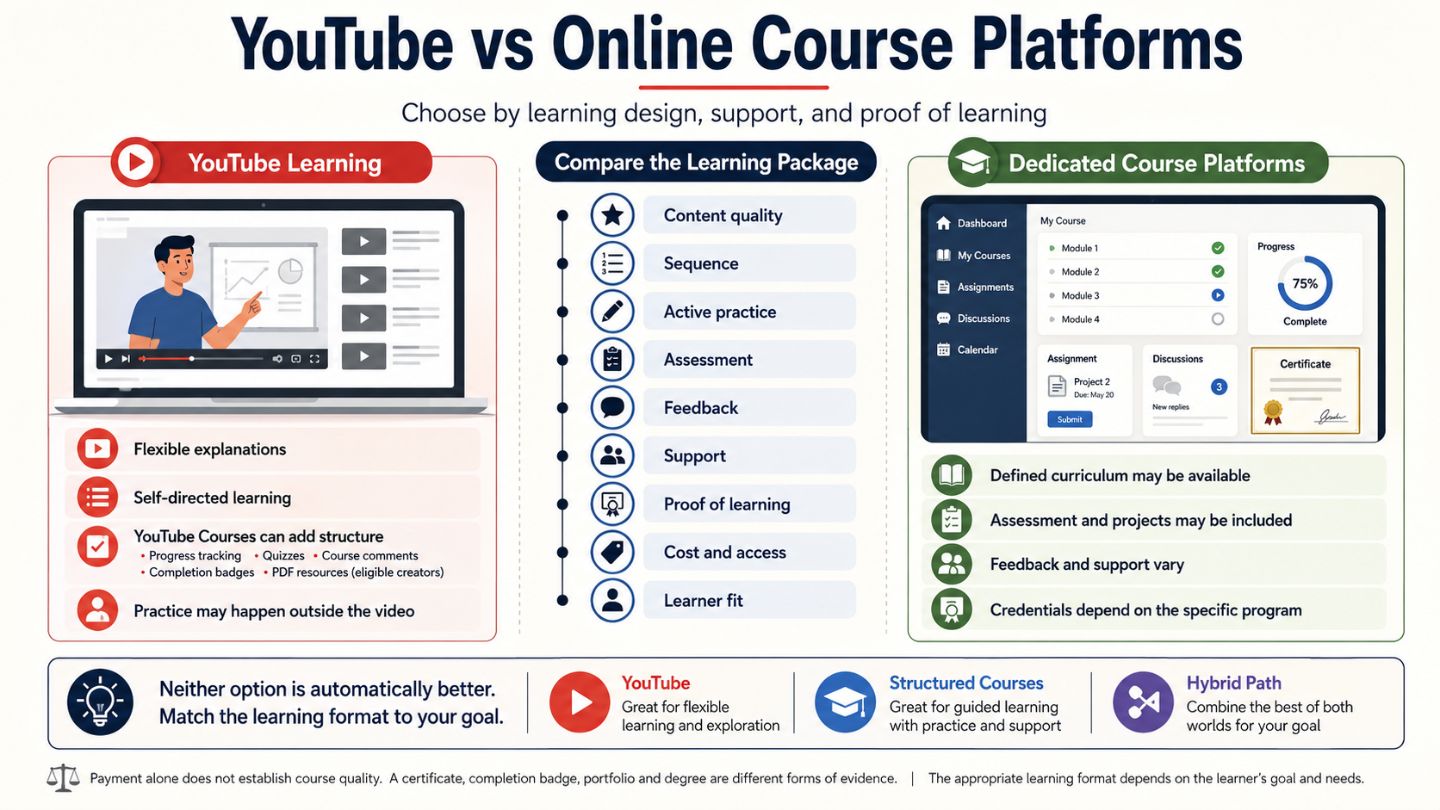
Choosing between YouTube and an online course platform is no longer a simple choice between free videos and structured paid courses. YouTube now includes a dedicated Courses format with several structured-learning features, while dedicated learning platforms vary in curriculum, assessment, feedback, support, credentials, access models, and teaching format. YouTube describes its Courses as structured, multi-session learning experiences rather than ordinary collections of individual videos.
The more useful question is not which platform wins. It is what the learning package for your goal requires.
A student trying to understand one difficult concept may mainly need a clear explanation followed by practice. A career changer building a technical skill may need a planned sequence, projects, assessment, feedback, or documented evidence of study. A hobby learner may value flexibility more than a credential. Some learners can meet their goals through YouTube, while others benefit from a dedicated course or a combination of both.
As of 14 August 2026, YouTube Courses include features such as progress tracking, creator-added quizzes, Course-specific comments, a dedicated Course tab, and completion badges. YouTube also states that ad-supported Courses are free to watch and available to all users.
Answer Summary: Neither YouTube nor a dedicated online course platform is automatically the stronger learning option. YouTube suits flexible explanation, demonstrations, exploration, and learners who can organize their own practice. A dedicated course may suit learners who need a planned curriculum, assessment, feedback, accountability, support, or a particular credential. Compare the learning design and evidence of learning rather than relying on a free-versus-paid platform label.
Table of Content
- What Changed With YouTube Courses?
- What Counts as an Online Course Platform?
- Compare the Learning Package, Not the Platform Label
- YouTube vs Online Course Platforms at a Glance
- When YouTube Fits the Learning Goal
- When a Dedicated Online Course Fits the Learning Goal
- What Are You Paying for in a Paid Course?
- How Should You Judge Proof of Learning?
- How a Hybrid Learning Path Works
- Decision Checklist: Which Option Fits Your Goal?
- Which Learning Option Fits Your Goal?
Key Takeaways:
-
Ordinary YouTube videos, playlists, and YouTube Courses are different learning formats.
-
YouTube Courses provide several structured-learning features that ordinary playlists do not automatically provide.
-
Dedicated course platforms and individual programs vary substantially.
-
Payment alone does not establish teaching quality.
-
Assessment, feedback, projects, and instructor access should be checked course by course.
-
Completion evidence, assessed credentials, portfolios, and degrees should not be treated as equivalent forms of proof.
-
The right format depends on the learning goal, required support, budget, time, and ability to study independently.
What Changed With YouTube Courses?
YouTube can now provide more structure than ordinary video-based learning, so describing the entire platform as unstructured is no longer accurate.
YouTube's viewer documentation describes Courses as structured learning experiences with progress tracking, quizzes, Course-specific comments, a dedicated Course tab, and completion badges. It also notes that ad-supported Courses are available to all users.
For creators, YouTube's Course creation guidance states that the feature is available globally to eligible creators with access to advanced features. Creators can organize videos into Courses and attach PDF learning resources, such as worksheets or study guides.
These features narrow part of the old distinction between YouTube and dedicated course platforms. They do not mean that every YouTube Course offers the same curriculum depth, assessment, feedback, support, or credential as a program hosted elsewhere.
Regular YouTube Videos and Playlists vs YouTube Courses
Regular videos and playlists can support serious study, but learners may need to design more of the pathway themselves.
When learning from separate videos, a learner may have to decide:
-
What to study first;
-
Which prerequisites matter;
-
Whether important topics are missing;
-
When to practise away from the video;
-
How to check understanding;
-
Whether the source is reliable and current.
A playlist can provide an intended sequence, but YouTube Courses have dedicated features not available in standard playlists.
The practical difference is responsibility. With ordinary videos, more planning often falls on the learner. A Course can organize more of that experience, although its educational quality still depends on how the material is designed.
What YouTube Courses Add
Current YouTube documentation lists several features associated with Courses:
-
progress tracking;
-
creator-added quizzes;
-
Course-specific comments;
-
a dedicated Course tab;
-
completion badges after all Course videos are finished;
-
PDF resources attached by eligible creators.
These additions make a simple "YouTube is unstructured" comparison outdated. The better question is how much structure, practice, feedback, and evidence of learning a particular resource provides.
What Counts as an Online Course Platform?
"Online course platform" covers several learning models rather than one standardized format.
A marketplace course, university-partner program, subscription library, and live cohort course can all be delivered online while providing substantially different learning experiences.
Course Marketplaces
Course marketplaces host courses created by different instructors or organizations.
Curriculum depth, assessment, instructor involvement, updated practices, and support can therefore differ even within the same marketplace.
The platform name alone does not establish the quality or depth of an individual course.
MOOC and University-Partner Platforms
Massive open online course platforms and university-partner platforms can host individual courses as well as larger credential programs.
For example, Coursera currently lists courses, Professional Certificates, subscriptions, and degree programs.
Similarly, edX's program overview distinguishes individual courses, certificate programs, microcredentials, executive education, and degree programs.
These first-party pages confirm that different program types exist. They do not establish that every program has the same academic status, assessment model, or career value.
Subscription Learning Libraries
Some learning services use a subscription model that gives learners access to multiple courses or programs while the subscription remains active.
For the learner, the important questions are whether the available material matches the intended goal, what practice and assessment are included, and what happens to access when the subscription ends.
A large library is useful only when its learning resources fit the learner's actual needs.
Cohort-Based and Live Courses
Cohort-based and live courses organize learning around a schedule or group rather than relying entirely on independent self-paced study.
Depending on the specific program, this may involve scheduled teaching, deadlines, peer interaction, or feedback. These features should be checked on the individual course page rather than assumed from the platform category.
Compare the Learning Package, Not the Platform Label
A useful comparison looks at everything surrounding the content, not only where the videos are hosted.
Nine criteria provide a practical framework.
1. Content Quality
Check whether the material is accurate, current enough for the subject, appropriate for the learner's level, and explained clearly.
2. Sequence
Check whether the resource moves logically from prerequisite knowledge to more advanced material.
Sequence matters particularly when later topics depend heavily on earlier ones.
3. Active Practice
Ask what the learner actually does with the material.
Depending on the subject, useful activity may involve solving problems, writing, building, analysing, recalling information, demonstrating a process, or applying a skill.
In the peer-reviewed article Effective Educational Videos: Principles and Guidelines for Maximizing Student Learning from Video Content, Cynthia J. Brame identifies cognitive-load management, student engagement, and active learning as important considerations for educational video. The paper does not show that one platform is inherently superior; it supports evaluating how video is designed and used.
4. Assessment
Check how understanding is measured.
Assessment might involve quizzes, assignments, projects, examinations, demonstrations, or another method suited to the subject.
5. Feedback
Determine whether the learner receives useful information about errors and how to improve.
Feedback may come from an instructor, peers, automated systems, or another source.
6. Support
Check whether help is available from an instructor, teaching assistant, peer group, community, or another support mechanism.
7. Proof of Learning
Identify what completion produces.
Possible forms include a badge, completion certificate, assessed credential, portfolio item, academic qualification, or another documented result.
8. Cost and Access
Check the full access terms rather than assuming a platform is entirely free or entirely paid.
Consider current pricing, billing arrangements, access duration, assessment access, and certificate conditions where they matter to the decision.
9. Learner Fit
Consider available time, study habits, preferred pace, independence, need for accountability, and the importance of interaction.
Neither YouTube nor dedicated course platforms occupy one fixed position across these criteria.
YouTube vs Online Course Platforms at a Glance
The exact resource should always be checked directly, but this comparison highlights the main differences learners may need to investigate.
| Criterion | YouTube Videos and Courses | Dedicated Course Platforms |
|---|---|---|
| Access | Many videos and ad-supported Courses are openly viewable | Free, paid, subscription, or program-specific access may apply |
| Learning sequence | Learner-built for many videos; structured sequence available in Courses | Often defined within a course or program, but depth varies |
| Practice | May happen outside the video; Courses can include quizzes | Exercises, projects, labs, quizzes, or other activities may be offered |
| Assessment | Course creators can add quizzes | May range from basic quizzes to substantial assessed work |
| Feedback | Comments or outside feedback may be available | May involve automated, peer, instructor, or no individual feedback |
| Support | Often creator- or community-dependent | May include instructor, peer, teaching-assistant, or scheduled support |
| Progress tracking | Available in YouTube Courses | Common on many platforms, but implementation varies |
| Completion evidence | Courses can provide completion badges | Some programs provide certificates or other credentials |
| Flexibility | Usually high | Depends on whether the course is self-paced, scheduled, live, or cohort-based |
| Learner responsibility | Often high | Ranges from highly independent to strongly structured |
YouTube-specific entries in the table reflect its current Course documentation.
The table is a screening tool, not a verdict. A well-designed open resource may meet a learner's needs, while a structured course may provide assessment, feedback, or support that would otherwise have to be arranged independently.
When YouTube Fits the Learning Goal
YouTube fits well when the learner values flexibility, needs explanation or demonstration, and can provide missing practice or structure independently.
You Need a Quick Explanation or Demonstration
YouTube can be useful for a narrow problem: understanding one concept, seeing a process demonstrated, reviewing a topic, or finding an alternative explanation.
A mathematics student, for example, might watch an explanation of a method and then practise through textbook or class exercises.
In that case, the video provides explanation while the practice provides active use of the material. Brame's review supports treating active learning as part of effective educational-video use rather than assuming that viewing alone is sufficient.
You Are Exploring a Topic Before Committing
YouTube can support low-commitment exploration because learners can sample topics, instructors, and teaching approaches before choosing a longer pathway.
Someone considering web development, economics, illustration, statistics, or language learning can examine introductory material before investing more time or money.
If the subject later requires deeper study, the learner can decide whether a coherent sequence, exercises, assessment, feedback, or formal evidence is necessary.
You Can Build Your Own Learning Path
Independent YouTube learning suits learners who can define a goal, identify prerequisites, select reliable material, and practise away from the videos.
A self-directed path can follow this sequence:
-
Define a specific learning outcome.
-
Identify prerequisite knowledge.
-
Select a coherent sequence instead of unrelated clips.
-
Pair lessons with appropriate practice.
-
Apply the material through problems, projects, writing, demonstrations, or another relevant task.
-
Review gaps using another reliable explanation or source.
-
Check whether the intended outcome can be demonstrated.
The amount of video watched should not be treated as equivalent to demonstrated learning.
If maintaining momentum is difficult, Collegenp's guide on how to use online courses without losing consistency covers routines for self-paced learners.
YouTube may be enough when explanation, exploration, flexibility, and independent practice are the main needs and no particular credential or structured support requirement is present.
When a Dedicated Online Course Fits the Learning Goal
A dedicated course may fit better when the learner needs several components that would otherwise have to be assembled independently.
You Want a Planned Sequence and Clear Learning Objectives
A defined course can reduce the planning burden by stating what comes first, what follows, and what the learner is expected to achieve.
Before enrolling, check whether the course clearly states:
-
intended level;
-
prerequisites;
-
learning objectives;
-
topic sequence;
-
expected activities;
-
assessment methods;
-
completion requirements.
The design of the individual course matters more than the size or visibility of the platform hosting it.
You Need Assessed Practice, Feedback, or Accountability
Depending on the program, a dedicated course may provide graded exercises, projects, automated feedback, peer review, instructor feedback, deadlines, scheduled sessions, progress milestones, or discussion spaces.
None of these features should be assumed across all course platforms. Coursera and edX themselves describe multiple program categories with different structures and requirements.
A dedicated course may be a better fit when the learning goal depends on structure, assessed work, feedback, scheduled participation, or support that the learner does not want to organize independently.
You Need a Specific Certificate, Degree, or Other Credential
A dedicated platform becomes more relevant when documented educational evidence is part of the goal.
Coursera and edX both distinguish shorter courses and certificate pathways from degree programs.
Before enrolling for a credential, check:
-
who teaches the course;
-
who issues the credential;
-
what assessment is required;
-
whether identity verification applies;
-
what completion represents;
-
whether accreditation is claimed;
-
which institution or authority is responsible for that accreditation claim;
-
whether the credential suits the intended academic, professional, or employment use.
Do not assume that an online-course certificate is universally recognized by employers or guarantees an employment outcome.
For a broader comparison of credential types, Collegenp's Certificate vs Degree: How to Choose the Right Credential explains why the intended outcome and external requirements should guide the choice.
What Are You Paying for in a Paid Course?
Payment is useful only when the course provides something the learner needs and can verify.
A paid course is not automatically better than a free learning resource.
Curriculum and Prerequisites
Start with the syllabus.
Check whether the course:
-
begins at the correct level;
-
identifies prerequisite knowledge;
-
covers the required topics;
-
develops them in a logical order;
-
matches the intended depth.
Practice, Projects, and Assessment
Look at what the learner is required to do, not only how much video the course contains.
Useful questions include:
-
Are exercises provided?
-
Are projects included?
-
How is understanding assessed?
-
Is there a final task?
-
Does the learner create work that demonstrates the skill?
The appropriate form of practice depends on the subject.
Feedback, Instructor Access, and Community
Terms such as "community" and "instructor support" can describe very different experiences.
Check:
-
who gives feedback;
-
whether feedback is automated, peer-based, or instructor-led;
-
whether live sessions are included;
-
whether questions receive responses;
-
how long support remains available;
-
whether community participation is optional or required.
A discussion area is not automatically equivalent to instructor feedback.
Refund, Subscription, and Access Terms
Payment and access terms can change.
Before enrolling, verify the current:
-
price and currency;
-
billing model;
-
subscription period;
-
cancellation process;
-
refund conditions;
-
duration of access;
-
certificate conditions;
-
access to required assessments or resources.
Exact platform prices are intentionally excluded because they are update-sensitive.
For a detailed pre-enrolment check, Collegenp's How to Choose an Online Course and Certificate provides a structured review of syllabus quality, assessment, providers, credentials, workload, and support.
How Should You Judge Proof of Learning?
Proof of learning can take several forms, and each communicates something different.
Completion Evidence
Completion evidence records that a learner finished a defined activity.
YouTube's completion badge is one example. YouTube states that viewers receive a completion badge after finishing all videos in a Course.
A completion record does not by itself show how deeply the learner was assessed.
Assessed Credential
An assessed credential indicates that a learner met requirements set by a particular issuer or program.
The important questions are:
-
what was assessed;
-
how it was assessed;
-
what standard had to be met;
-
who issued the credential.
The word "certificate" alone does not answer those questions.
Portfolio or Work Sample
A portfolio or work sample can show what a learner is able to produce.
Depending on the subject, this may include code, design work, writing, solved problems, presentations, practical projects, or research outputs.
A portfolio can supplement other evidence but does not replace a formal qualification where one is required.
Degree or Formal Academic Qualification
A degree is a formal academic qualification awarded under the requirements of a degree-granting institution.
An online course certificate should not be treated as equivalent to a degree simply because both can involve online study. Coursera and edX present certificate and degree programs as distinct categories.
External Recognition
External recognition depends on the decision-maker and context.
An employer, university, professional regulator, licensing authority, or other institution may apply its own requirements. If recognition matters, verify those requirements with the organization that will make the decision.
Do not assume that all online-course certificates carry the same external value.
How a Hybrid Learning Path Works
A hybrid approach can use different resources for different parts of the learning process.
A learner might use a structured course for sequence and assessment while using YouTube for alternative explanations, demonstrations, revision, or narrow questions.
The reverse can also work. Someone may begin with open YouTube material and move to a dedicated course after deciding that the subject requires deeper practice, formal assessment, or documented evidence.
Illustrative Student Pathway
A university student follows the official syllabus as the main sequence, uses YouTube to clarify difficult topics, and completes assigned problems or laboratory work for practice and assessment.
This is an illustration rather than a documented case.
Illustrative Working-Professional Pathway
A working learner chooses one structured course as the main sequence, completes its exercises or projects, and uses YouTube when a particular concept needs another explanation.
This is also an illustrative example rather than evidence of a specific learner outcome.
Illustrative Hobby-Learner Pathway
A hobby learner may rely mainly on YouTube videos or Courses when flexible study and personal learning are the goal and no external credential is required.
A dedicated course becomes more relevant if the learner later wants additional structure, feedback, assessment, or documented completion.
Decision Checklist: Which Option Fits Your Goal?
Choose by identifying the learning features required for the intended outcome.
Ask:
-
What specific subject, skill, or result am I working toward?
-
Do I know the prerequisites?
-
Does the topic need a planned sequence?
-
Can I judge source reliability independently?
-
Do I need exercises, projects, or formal assessment?
-
Do I need feedback from another person?
-
Would deadlines or scheduled sessions help me stay consistent?
-
Do I need documented evidence of learning?
-
If I need a credential, who needs to accept it?
-
Can I create a portfolio or work sample?
-
How much time can I commit?
-
What is my budget?
-
Can I organize my own study path?
-
Do I prefer self-paced study or scheduled participation?
-
Have I checked current payment and access terms?
A simple decision rule is:
-
Choose regular YouTube learning when you mainly need explanations, demonstrations, exploration, or supplementary study.
-
Choose a YouTube Course when you want a more organized YouTube-based pathway and the specific Course provides the structure you need.
-
Choose a dedicated self-paced course when you need a defined curriculum and course-specific practice, assessment, or credential features.
-
Choose a cohort or live format when scheduled participation, interaction, or external accountability is important.
-
Combine formats when one resource can provide the main pathway and another can address specific gaps.
Which Learning Option Fits Your Goal?
The stronger option is the one that supplies the learning package required by the goal.
YouTube can support learners who value flexible explanations, demonstrations, exploration, and self-directed study. Its Courses format also provides structured-learning features, making the old description of YouTube as uniformly unstructured inaccurate.
Dedicated course platforms can provide planned curricula, assessed work, feedback, support, scheduled participation, or credentials, but those features should be verified for the particular course. Official Coursera and edX pages themselves show that online platforms contain multiple types of programs rather than one uniform learning model.
For learners who need proof of learning, the decision should extend beyond whether a certificate exists. Check what was assessed, what work can be demonstrated, who issued the credential, and what the relevant institution, regulator, or employer requires.
A hybrid pathway can also make sense. Open video learning can provide explanation and exploration, while a structured course can supply sequence, practice, assessment, or accountability when those features are needed.
Choose by learning goal, course design, evidence of learning, budget, time, and level of self-direction rather than by platform label.




Comments 0
No comments yet. Be the first to start the conversation.