



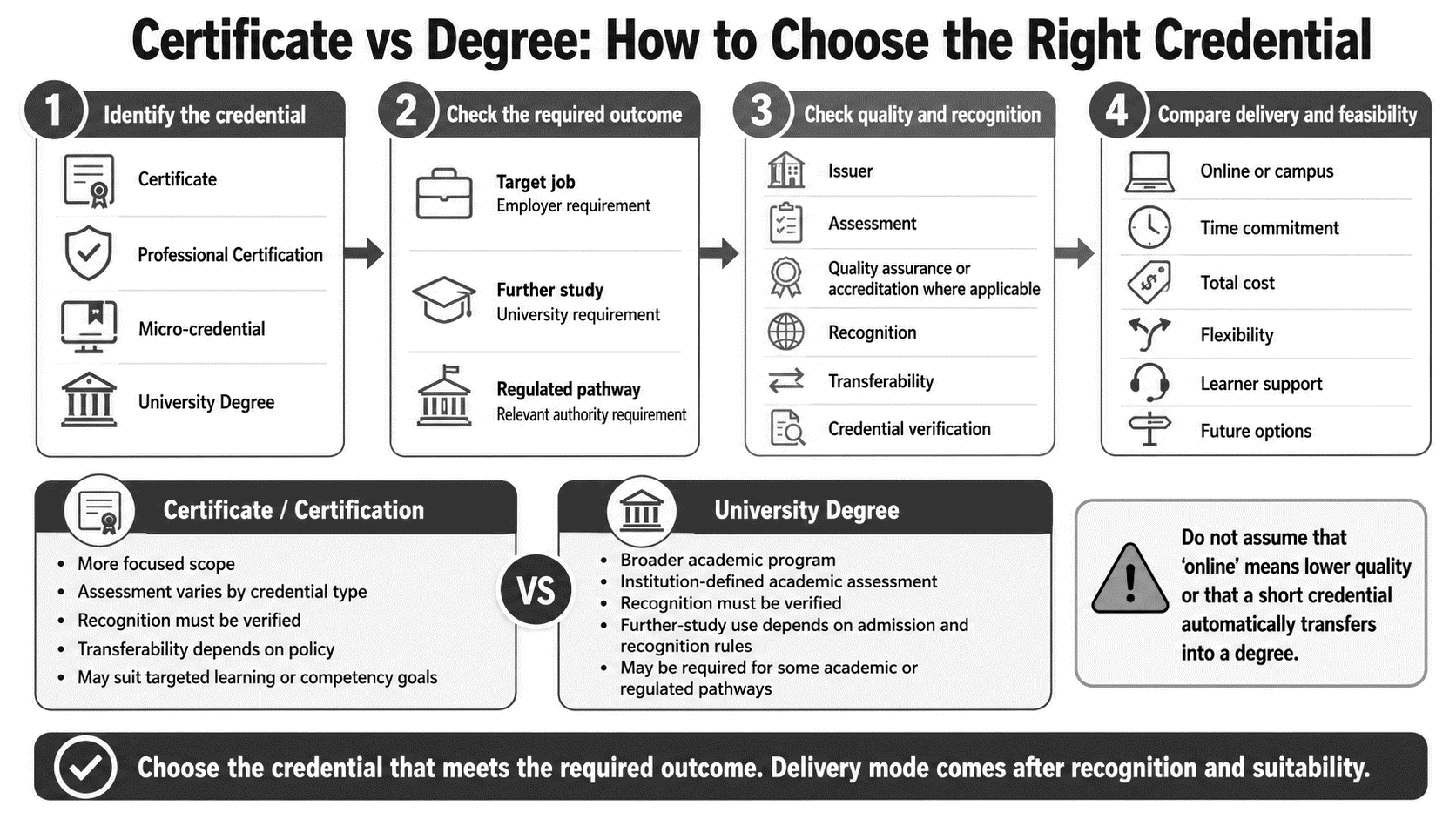
Choosing between an online certification and a university degree should start with the outcome you need. The important question is not which option is faster, cheaper, or more convenient, but whether the credential meets the requirements for your intended career, promotion, professional pathway, or further study.
The word “online” can make this comparison confusing because it describes delivery rather than credential level. An online program may lead to a certificate, professional certification, micro-credential, degree, or another type of award. These credentials can differ substantially in assessment, academic status, recognition, portability, and intended use.
This distinction matters for school-leavers who want to preserve future academic options, career changers seeking focused learning, working professionals considering certification, and learners who expect to use a credential across institutions or countries.
A sound decision starts by identifying who will evaluate the credential and what that organization requires. After that, compare recognition, assessment, total cost, time, flexibility, transferability, and future options.
Answer Summary: There is no universal winner in the certificate vs degree decision. A degree may be necessary when a job, regulator, university, or progression route requires one. A certificate or certification may fit a narrower goal when the relevant decision-maker accepts it. Treat online delivery separately from credential status, and verify the issuer, assessment, recognition, transferability, total cost, and intended use before enrolling.
Table of Content
- Online Certification vs University Degree: What Actually Changes?
- Certificate vs Degree: Quick Comparison
- Start With the Career or Study Requirement
- Check Recognition and Quality Before Paying
- Compare Time, Total Cost, and Opportunity Cost
- Compare Depth, Flexibility, and Evidence of Competence
- Check Transferability and Stackability
- What Labor-Market Data Can and Cannot Show
- Use a Four-Layer Decision Model
- Decision Matrix for Different Learners
- Red Flags for Online Credentials
- Cross-Border and Nepal Recognition
- Choose by Required Outcome, Not Delivery Mode
Key Takeaways:
-
“Online” describes delivery, not credential level.
-
Identify the exact credential before comparing it with a degree.
-
Start with the requirements for the intended job or study pathway.
-
Check the issuer, assessment, recognition, and applicable quality-assurance system.
-
Compare total cost and time to the required outcome, not advertised price alone.
-
Do not assume that academic credit, recognition, or licensing status transfers between institutions or jurisdictions.
-
Population-level earnings data cannot establish which credential will produce better results for an individual learner.
Online Certification vs University Degree: What Actually Changes?
Online delivery changes how learning is accessed. It does not, by itself, establish academic level, assessment rigor, recognition, portability, or suitability for a particular career.
The Credential Engine credential taxonomy distinguishes certificates, certifications, degrees, licenses, and micro-credentials. Its taxonomy describes certification as a renewable, revocable credential awarded for demonstrated knowledge, skills, and abilities, while a degree is an academic credential awarded after completion of a program of study.
That distinction prevents two common mistakes: describing every short online course as a “certification” and assuming that a university degree must be campus-based.
If the main decision is about learning format rather than credential type, Collegenp’s online learning vs classroom learning guide addresses the differences between delivery modes separately.
Certificate, Certification, Micro-Credential, and Degree
These terms should not be used interchangeably. Credential terminology can also differ across countries, education systems, and providers, so the label should be treated as a starting point rather than proof of status.
| Credential | What it can represent | What to verify |
|---|---|---|
| Certificate | Completion, participation, or demonstrated learning within a defined program or activity | Issuer, curriculum, assessment, credit, recognition |
| Certification | Demonstrated knowledge, skills, or abilities assessed under defined requirements | Certifying body, assessment, prerequisites, renewal rules |
| Micro-credential | A focused record of assessed learning achievement | Provider, outcomes, assessment, QA, recognition |
| Degree | Completion of a formal academic program of study | Institution or program status, level, recognition, progression requirements |
Credential Engine includes several certificate categories, showing why “certificate” alone does not reveal whether an award represents participation, course completion, academic study, or demonstrated competence.
For learners who need a deeper distinction between these terms, Collegenp’s certifications explained guide examines certificates, certifications, assessment, recognition, and credential-selection criteria in more detail.
Where Micro-Credentials Fit
Micro-credentials generally represent smaller, focused units of learning, but definitions and recognition systems are still not identical worldwide.
UNESCO IIEP’s micro-credential guidance describes them as records of focused learning achievement assessed against clearly defined standards. It also emphasizes quality assurance and notes that micro-credentials may have stand-alone value or contribute to other credentials through mechanisms such as recognition of prior learning.
That does not mean every micro-credential will automatically transfer into a degree. The receiving institution still determines whether and how prior learning or credit is accepted.
Certificate vs Degree: Quick Comparison
A certificate or certification often addresses a more focused objective, while a university degree generally represents a larger academic program. Neither characteristic determines the right choice until the learner knows what the intended outcome requires.
| Factor | Certificate or certification | University degree |
|---|---|---|
| Main purpose | Focused learning, completion, or validation of defined competence | Broader academic program and formal degree attainment |
| Recognition | Check the employer, institution, certifying body, or regulator | Check academic, professional, and jurisdictional recognition |
| Assessment | Varies substantially by credential type | Determined by the institution and degree program |
| Scope | Often narrower and more targeted | Usually broader within the field of study |
| Cost and time | May involve less study, plus possible examination or renewal costs | Usually involves a larger study commitment; costs vary |
| Transferability | Credit and stackability depend on applicable policies | Further-study use depends on recognition and admission rules |
| Typical purpose | Specific skill, learning, or competency objective | Degree-required pathway or broader academic progression |
The comparison becomes meaningful only after eliminating options that do not meet the required outcome.
Start With the Career or Study Requirement
The first practical task is to find out what the next decision-maker requires.
That decision-maker may be an employer, university, regulator, licensing authority, professional organization, or another institution. Requirements differ by profession and jurisdiction, so a global article cannot provide one reliable list of careers for which degrees or certifications are mandatory. The V0 evidence framework specifically treats professional licensing and recognition as jurisdiction-sensitive issues.
Use this sequence:
-
Define the intended job, promotion, license, admission route, or next qualification.
-
Identify the organization that controls or evaluates entry.
-
Check its current education, credential, assessment, and experience requirements.
-
Remove pathways that do not satisfy those conditions.
-
Compare the remaining options by quality, recognition, total cost, time, and future flexibility.
This prevents a common mistake: choosing the most convenient credential before confirming that it can be used for the intended outcome.
When a Degree May Be Required
A degree is necessary when the applicable employer, institution, regulator, licensing system, or academic pathway formally requires one.
The exact requirement should be checked with the authority responsible for the profession or study route. A rule applying to one occupation or country should not be generalized to another.
Where a degree is formally required, a shorter certificate or professional certification may still support additional learning. It should not, however, be presented as a replacement for the required qualification.
When a Certificate or Certification May Fit
A certificate or certification may fit when the intended goal is narrower and the relevant employer, institution, or certifying body accepts the credential for that purpose.
A career changer, for example, may need to determine whether an employer values a targeted credential alongside work samples, experience, or a portfolio. A working professional may need to verify whether a specific certification is required or recognized for progression.
Collegenp’s degree vs skills guide provides additional context for deciding when formal education requirements and demonstrable skills play different roles.
Readers examining employer screening can also refer to skills-first hiring: degrees vs skills. That resource is useful for career context, but individual employer requirements still need to be checked directly.
Check Recognition and Quality Before Paying
Recognition should be checked for the exact purpose for which the credential will be used. Useful learning does not automatically give a credential the academic, professional, transfer, or regulatory status a learner expects.
For U.S. higher education, the U.S. Department of Education’s accreditation guidance explains that accreditation is intended to ensure that higher-education institutions meet acceptable levels of quality. This is specifically a U.S. framework and should not be applied as a universal accreditation system.
Before enrolling, check:
-
Who provides the learning and who awards the credential?
-
What type of credential will be issued?
-
What learning outcomes or competencies are stated?
-
How are those outcomes assessed?
-
Is there an examination, project, practical assessment, or other evaluated work?
-
Which organization needs to recognize the credential?
-
What quality-assurance or accreditation system applies?
-
Can the credential be independently verified?
-
Is a transcript or credit record available where relevant?
-
For certification, are renewal or revocation conditions stated?
The word “accredited” is not sufficient by itself. Identify the relevant accrediting or quality-assurance body and determine what institution, program, or credential falls within its scope.
Compare Time, Total Cost, and Opportunity Cost
Compare the cost of reaching the required outcome rather than the advertised price of one course.
Depending on the credential, costs can include tuition or course charges, examinations, required materials, software, equipment, travel, prerequisite study, or certification renewal. Degree costs also differ substantially by institution, country, delivery method, and learner circumstances.
For that reason, a universal certificate-versus-degree price range would be misleading.
Time should be evaluated in the same way. A focused credential may involve less study than a degree, but that advantage has little practical value if it cannot satisfy the intended requirement.
A working professional may prioritize a schedule that fits around employment. A school-leaver may place greater weight on preserving admission to future academic programs.
Compare the cost and time of pathways that can actually serve the intended outcome.
Compare Depth, Flexibility, and Evidence of Competence
Credential type can indicate the kind of learning represented, but the label does not establish quality or rigor. Examine the actual curriculum, assessment, workload, and evidence produced by the program.
Degrees generally cover a broader academic program. Certificates can range from participation or completion awards to academic and competency-based credentials. Professional certification usually serves a different purpose: validating competence under the rules of a certifying body.
In some employment settings, relevant evidence may also include projects, work samples, portfolios, practical testing, internships, or experience. Their importance depends on the role and employer.
Online delivery can offer scheduling and location flexibility. Learners should still examine instructor access, technical requirements, assessment arrangements, feedback, and academic support.
If the main goal is supplemental skill-building rather than obtaining a formal qualification, Collegenp’s guide to online learning platforms for improving skills before graduation can be considered separately from the credential-recognition decision.
Check Transferability and Stackability
A certificate or micro-credential should not be assumed to count toward a later degree. Transferability depends on the receiving institution and the policies that apply to the particular credential.
If future study matters, verify:
-
whether academic credit is awarded;
-
whether a transcript or formal record is issued;
-
how learning outcomes and workload are documented;
-
whether a transfer or articulation agreement exists;
-
which institution accepts the credit;
-
whether acceptance is automatic or individually reviewed.
UNESCO’s micro-credential guidance recognizes that smaller credentials can contribute to other credentials in some systems, but it does not establish automatic transfer between institutions.
Written policy from the receiving institution provides a stronger basis for planning than a general provider statement that a credential is “stackable.”
What Labor-Market Data Can and Cannot Show
Labor-market statistics can provide useful background on educational attainment. They cannot determine the return of a specific certificate compared with a specific degree for an individual learner.
The U.S. Bureau of Labor Statistics education and earnings data reports earnings and unemployment by highest level of educational attainment. BLS also notes that its education categories do not account for apprenticeships and other forms of on-the-job training.
Similarly, OECD Education at a Glance 2025 reports education and labor-market indicators across OECD countries and partner economies. Outcomes differ across educational levels, skills, countries, and economic conditions.
These sources support a limited conclusion: educational attainment is associated with labor-market outcomes at the population level.
They do not prove that a particular degree causes a better outcome than a particular certificate for an individual learner. Field of study, occupation, experience, location, credential quality, individual performance, and labor-market conditions can all matter.
Broad attainment statistics should therefore not be converted into a guaranteed salary or return-on-investment claim. The V0 evidence review deliberately excluded an unresolved non-degree credential wage-gain statistic rather than using it without sufficient methodological verification.
Use a Four-Layer Decision Model
A certificate vs degree decision becomes easier to evaluate when it is divided into four checks.
1. Identify the Credential
Confirm what will actually be awarded: a certificate of completion, academic certificate, professional certification, micro-credential, license, degree, or another credential.
Do not rely on the course name alone.
2. Check the Required Outcome
Determine what the target employer, regulator, university, professional organization, or next career step requires.
An option that fails this test should not remain in the main comparison simply because it is cheaper or faster.
3. Check Quality and Recognition
Review the issuer, assessment, applicable quality assurance, recognition, portability, transfer conditions, and transparency of the credential.
4. Compare Delivery and Feasibility
Once the first three checks are satisfied, compare online or campus delivery, schedule, total cost, study time, learner support, and other practical constraints.
Convenience matters most when comparing options that already meet the intended requirement.
Decision Matrix for Different Learners
Different learners face different risks, so the first verification step changes with the intended pathway.
| Learner | First priority | Main verification question |
|---|---|---|
| School-leaver | Eligibility and future study | Will this credential preserve the academic routes I may need? |
| Career changer | Entry requirements | What credential and evidence does the target employer require or accept? |
| Working professional | Professional relevance | Is this credential recognized for the intended progression? |
| Regulated-pathway learner | Formal requirements | What does the responsible authority currently require? |
| Cost-sensitive learner | Valid outcome and total cost | Is the lower-cost route actually sufficient? |
| International/mobile learner | Portability | How will the receiving institution or authority evaluate the credential? |
A learner may fit more than one category. Someone working while planning an international move, for example, may need to evaluate professional recognition, academic portability, cost, and scheduling at the same time.
Red Flags for Online Credentials
Missing information about what a credential represents or how it can be used is a reason to verify further before paying.
Check carefully when:
-
the issuer is unclear;
-
the credential type is not defined;
-
assessment requirements are vague;
-
accreditation claims do not identify the applicable organization;
-
recognition claims do not specify who recognizes the credential or for what purpose;
-
transfer claims lack a receiving-institution policy or agreement;
-
certification renewal conditions are not disclosed;
-
employment, earnings, or universal-recognition claims lack a defined evidence base.
A provider’s presentation should not substitute for independent checks of the credential, assessment, issuer, and intended use.
Cross-Border and Nepal Recognition
Recognition can differ between countries, institutions, employers, and professional systems. Acceptance for one purpose does not establish the same status elsewhere.
Learners planning to use a credential internationally should check the receiving university, employer, qualifications authority, regulator, or professional organization connected to the intended use.
For Nepal-based readers, this article does not assign a general equivalence, licensing, or recognition status to foreign online credentials. The approved research specifically requires Nepal-related recognition claims to be verified with the appropriate authority for the particular purpose involved.
Where recognition affects admission, licensing, professional registration, or formal eligibility, confirm the current requirement with the responsible authority before paying for the credential.
Choose by Required Outcome, Not Delivery Mode
The certificate vs degree decision is most reliable when it begins with the next required outcome.
Identify the exact credential, determine who will evaluate it, confirm what that organization requires, and check assessment and recognition. Then compare cost, time, delivery mode, flexibility, and future options.
For some learners, a degree will be necessary because the intended pathway requires one. For others, a certificate or certification may address a specific learning or competence objective accepted by the relevant organization.
Neither path is universally superior. The credential needs to fit the purpose it is meant to serve.







Comments 0
No comments yet. Be the first to start the conversation.