



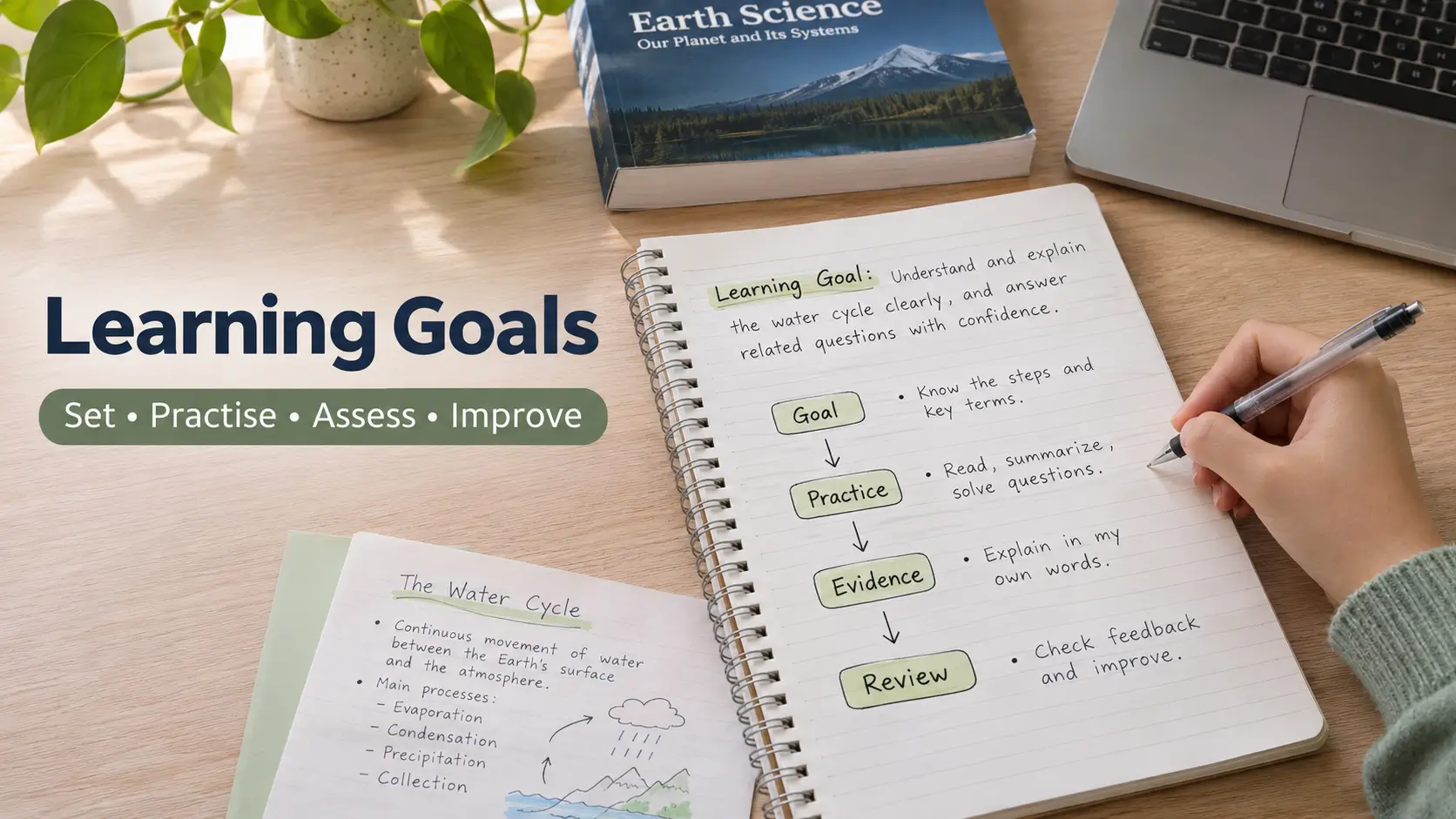
Learning goals describe the knowledge, understanding, or skills a person intends to develop. They help learners identify what they want to learn, choose suitable activities, and determine whether their understanding or ability is improving.
A student who wants to improve in mathematics, for example, may need to develop a clearer understanding of algebraic relationships rather than simply spend more time completing exercises. Someone learning academic writing may need to practise constructing arguments and evaluating evidence rather than concentrating entirely on essay length.
The distinction matters because studying, completing assignments, and achieving grades are related to learning but are not identical to it.
A learning goal concerns the capability being developed. A study activity provides an opportunity to develop that capability. An assessment or other demonstration provides evidence of what has been learned.
Educational institutions also use the terms learning goals, learning objectives, and learning outcomes differently. Understanding these differences can help students interpret course expectations and set appropriate personal goals.
Answer Summary: Learning goals identify what a learner intends to know, understand, or do. Effective goals connect that intention to relevant practice, observable evidence, feedback, and regular review. They can focus on developing knowledge, understanding concepts, or applying skills. Although clear goals can guide learning, writing them does not guarantee better grades. Their usefulness depends on the learning task, available support, chosen strategies, and how learners evaluate their development.
Key Takeaways:
-
Learning goals focus on developing knowledge, understanding, and skills.
-
Grades, study activities, and evidence of learning serve different purposes.
-
Learning goals can be broad, with smaller objectives making them easier to evaluate.
-
Effective practice should match the capability being developed.
-
Feedback and self-assessment help identify what needs further attention.
-
Learning goals can be revised when evidence or circumstances change.
What Are Learning Goals?
A learning goal is a statement describing what someone intends to learn or become capable of doing through instruction, practice, or experience.
Learning goals can apply to a single lesson, a university course, an independent study project, or a longer period of skill development.
They may address knowledge, conceptual understanding, practical abilities, or the application of learning in unfamiliar situations.
For example, developing the ability to interpret scientific evidence is a learning goal. Reading a science chapter may contribute to that goal, but reading alone does not establish that the learner can interpret evidence correctly.
The Yale Poorvu Center for Teaching and Learning describes learning goals as broad intentions that provide direction for more specific objectives and assessments.
Learning Goals, Study Activities, and Evidence of Learning
These three elements work together but answer different questions.
|
Element |
Meaning |
Example |
|---|---|---|
|
Learning goal |
Capability the learner intends to develop |
Understand how fractions represent quantities |
|
Learning activity |
Practice used to develop the capability |
Study worked examples and solve fraction problems |
|
Evidence of learning |
Demonstration of understanding or ability |
Solve unfamiliar fraction problems and explain the reasoning |
The distinction helps learners evaluate whether their activities address the intended knowledge or skill.
Completing an exercise records work undertaken. Explaining an unfamiliar problem accurately can provide stronger evidence of understanding.
Learning Goals vs. Learning Objectives and Learning Outcomes
Learning goals, objectives, and outcomes are related concepts, but educational institutions do not follow one universal definition.
Yale distinguishes broad goals, specific objectives, and demonstrable outcomes. Stanford University uses a similar distinction while treating learning outcomes as a broader category.
Cornell University, however, explicitly uses the terms learning goals, learning objectives, and learning outcomes as alternatives in its instructional guidance.
The following comparison is a useful working distinction rather than a universal classification.
|
Term |
Common meaning |
Main question |
|---|---|---|
|
Learning goal |
Broad knowledge or capability to develop |
What am I trying to learn? |
|
Learning objective |
More specific, observable learning target |
What should I be able to demonstrate? |
|
Learning outcome |
Intended or demonstrated knowledge or skill |
What learning should be evident? |
|
Performance target |
Desired assessment or performance result |
What result am I aiming for? |
For personal learning, a broad goal may be developing academic writing skills. A focused objective may involve constructing a defensible thesis supported by relevant evidence.
The objective makes part of the broader capability easier to assess.
Mastery Goals and Performance Goals
Educational psychology also distinguishes between mastery-oriented and performance-oriented goals.
Mastery goals emphasize developing competence, gaining understanding, or improving a skill. Performance goals emphasize demonstrating competence, achieving a desired result, or comparing performance against a standard or other learners.
The National Academies' How People Learn II discusses these orientations and notes that research findings concerning performance goals are mixed.
A student may reasonably pursue both understanding and a particular examination grade.
The practical issue is whether the grade target is accompanied by an understanding of the knowledge and skills required to perform well.
A grade indicates assessment performance. It does not independently explain which concepts have been mastered or which difficulties remain.
What Types of Learning Goals Can Students Set?
Learning goals can address different kinds of knowledge and ability. Their form should reflect what the learner intends to develop.
Knowledge and Conceptual Understanding
These goals concern learning information, explaining principles, and understanding relationships between ideas.
They may involve recalling terminology, describing processes, interpreting concepts, or comparing explanations.
The appropriate evidence depends on the depth of learning expected. Recognising a definition is different from explaining why a principle applies in a particular situation.
Application and Practical Skills
Skill-oriented goals concern using knowledge or performing meaningful tasks.
Examples include interpreting data, constructing arguments, conducting research, solving problems, or demonstrating a practical procedure.
Such goals require opportunities to apply learning rather than relying entirely on remembering descriptions of the skill.
Short-Term and Longer-Term Learning Goals
Learning goals also differ in scope.
A longer-term goal may concern a capability developed throughout a semester or course. A shorter-term objective may address one concept or skill needed for later work.
Neither timeframe is inherently superior. The appropriate scope depends on prior knowledge, the learning task, available support, and opportunities for practice.
Why Are Learning Goals Important?
Learning goals help learners connect educational intentions with practice and assessment.
They provide a reference for deciding what deserves attention, which learning activities are relevant, and what evidence should be examined.
For teachers, goals also help connect instruction with expected learning.
However, research does not support treating goal writing alone as a reliable method for improving academic performance.
What Research Says About Learning Goals
The National Academies' review explains that goals can influence attention, effort, planning, and responses to learning challenges. Their effects depend on learners and the surrounding educational context.
Task complexity is one consideration.
In a 1996 experiment, Dawn Winters and Gary Latham studied 114 business-school students completing simple and complex scheduling tasks.
For the simple task, an outcome goal produced more correct schedules than an instruction to do one's best. For the complex task, participants assigned a learning goal performed better than those assigned an outcome goal or the general instruction.
The findings concern those experimental tasks and participants. They do not establish that learning goals outperform performance goals in every educational setting.
Why Goals Need More Than Good Intentions
The Education Endowment Foundation (EEF) describes planning, monitoring, and evaluating as central elements of metacognition and self-regulated learning.
Its evidence concerns educational approaches that teach learners how to manage their learning, examine their work, and adjust strategies.
These approaches involve more than writing a goal. They may include instruction, modelling, practice, and feedback.
The evidence therefore should not be interpreted as showing that writing down a learning goal independently produces the same benefits.
How to Set Learning Goals You Can Evaluate
A useful learning goal identifies a meaningful capability and connects it to appropriate practice, evidence, and a realistic review point.
There is no single formula suitable for every subject or learner. The following approach brings together principles from instructional design and self-regulated learning.
1. Identify What You Want to Learn
Begin with the knowledge or skill that needs development.
A statement such as "improve mathematics" may express a genuine intention, but it does not identify the particular capability requiring attention.
A learner may need to strengthen conceptual understanding, mathematical reasoning, calculation accuracy, or the interpretation of word problems.
These are different learning needs and may require different forms of practice.
Course objectives, assignment criteria, earlier work, and teacher feedback can help identify a relevant priority.
For independent learning, the starting point may be a task the learner wants to perform competently.
2. Examine Your Current Understanding
Before selecting an objective, consider what you can already demonstrate.
This may involve reviewing an assignment, attempting a suitable question, explaining a concept without notes, or examining previous feedback.
The purpose is to identify what is understood and what needs further development.
One unsuccessful attempt does not establish a person's overall ability. It provides information that can guide the next learning decision.
The starting point also affects the goal's difficulty. An objective that requires several unfamiliar prerequisite skills may need to be divided into smaller learning targets.
3. Describe the Intended Learning and Its Evidence
A goal becomes easier to evaluate when it identifies what the learner should be capable of demonstrating.
Yale recommends using observable actions such as explain, compare, solve, analyse, and evaluate when developing focused learning objectives.
These verbs help connect learning intentions with suitable assessment.
A practical statement can follow this structure:
I want to develop [knowledge or skill], and I will check my learning by [relevant demonstration] using [appropriate criteria or feedback].
For an illustrative academic-writing goal, the capability may be constructing evidence-based arguments.
An appropriate demonstration could be a written argument with a clear claim, relevant evidence, and reasoning that connects the evidence to the claim.
The quality of the work matters more than the presence of an action verb alone.
4. Choose Practice That Matches the Goal
Learning activities should address the capability the learner intends to develop.
A goal involving factual recall may benefit from retrieving information without looking at notes and revisiting material across separate study sessions.
Dunlosky and colleagues' 2013 research review identified practice testing and distributed practice as useful across many studied learning conditions.
The review also considered the limitations and suitability of different techniques. It does not mean every study method serves every learning purpose equally.
An academic-writing goal, for instance, requires opportunities to construct and revise arguments. Recalling definitions of writing terminology cannot replace practising the skill.
Learners can consult evidence-based study skills when selecting appropriate methods.
5. Decide When and How to Review
A learning plan should include an opportunity to examine evidence and decide what happens next.
The review may follow an assignment, a unit of instruction, or a meaningful period of practice.
A useful review point should allow enough opportunity to work on the skill while remaining relevant to the learner's circumstances.
The SMART framework—specific, measurable, achievable, relevant, and time-bound—can help assess whether a focused goal is clear and feasible.
It is a planning aid rather than a guarantee of educational improvement. Broad educational goals may remain appropriate when supported by focused objectives.
Students seeking a more detailed explanation can refer to the SMART goal-setting guide for students.
Published Examples of Learning Goals
Published university examples show how general learning intentions can be connected to observable expectations.
They describe instructional objectives rather than documented personal success stories.
Example 1: Literary Argumentation at Stanford University
Stanford Teaching Commons provides a course-level example concerning students' ability to develop coherent literary arguments.
Its more focused objective expects students, by Week 5, to construct a coherent thesis supported by at least two pieces of evidence.
The example demonstrates four useful features:
-
A broad academic capability is identified.
-
A focused component of that capability is selected.
-
Observable evidence is specified.
-
A timeframe establishes when the objective should be demonstrated.
The focused objective supports the broader goal without suggesting that one thesis-writing exercise establishes complete mastery of literary analysis.
Example 2: Research Skills at KU Leuven
KU Leuven Learning Lab provides an example involving the ability to conduct a literature review and present findings in a written report following APA guidelines.
This connects a research capability with an assessable piece of work and a specified academic convention.
The example also illustrates why goals should identify the expected quality or conditions of a demonstration, not merely the activity to be completed.
KU Leuven recommends formulating learning goals from the student's perspective and connecting them with appropriate learning activities and assessment.
What Makes These Examples Useful?
Both examples distinguish a capability from the work used to demonstrate it.
They also give educators or learners a clearer basis for examining performance.
A goal does not require a complex assessment. Its evidence needs to be appropriate to the knowledge or skill being developed.
How to Track and Revise Learning Goals
Tracking learning means examining whether understanding or ability is developing, rather than recording completed activities alone.
Study logs can show whether planned sessions occurred. They cannot independently establish whether a learner has achieved the intended capability.
Check Meaningful Evidence
The form of evidence should match the learning goal.
For knowledge-focused goals, relevant questions may help examine recall and understanding.
For reasoning goals, explanations and solutions may reveal whether a learner can apply appropriate principles.
For practical abilities, demonstrations or completed work assessed against suitable criteria may provide stronger evidence.
Comparing earlier work with later attempts can also help identify changes, although improvement on one task does not necessarily establish competence across every related situation.
Use Feedback to Decide What Changes
Feedback is useful when it identifies something about the quality of current work and helps determine what requires attention.
A learner reviewing a goal can consider four questions:
-
What was I trying to learn?
-
What can I demonstrate now?
-
What does the evidence or feedback indicate?
-
What practice, explanation, or support do I need next?
These questions are a practical reflection aid, not a formally validated assessment instrument.
The answers may indicate that the learner should continue the current approach, practise a prerequisite skill, request feedback, or try a different method.
When Should a Learning Goal Be Revised?
Revision is appropriate when the goal no longer fits the learner's needs or when evidence shows that the current approach requires adjustment.
An unfamiliar prerequisite concept may need attention before a more advanced objective becomes realistic.
A goal may also need a different timeframe because of course requirements, accessibility needs, available resources, or other commitments.
Changing a goal does not necessarily mean reducing expectations. It can involve identifying a more appropriate route toward the intended capability.
Common Mistakes When Setting Learning Goals
Several planning problems can reduce the usefulness of learning goals.
Concentrating Entirely on Grades
Grades are legitimate assessment targets, but they do not identify every concept or skill needing development.
A learner may benefit from connecting a desired result with the specific capabilities assessed.
Measuring Study Time Instead of Learning
Study hours indicate time spent on an activity.
Understanding is better examined through relevant explanations, applications, solutions, or demonstrations.
Both measures can be useful, but they provide different information.
Making Goals Too Broad
A broad ambition may be appropriate for a longer period of learning.
If it does not guide immediate practice, identifying a smaller component can make the next action clearer.
Using Unsuitable Evidence
An assessment should reflect the intended capability.
A factual recall quiz may be appropriate for checking terminology, but it cannot fully assess argumentation, practical performance, or complex reasoning.
Ignoring Prior Knowledge and Available Support
Learning goals should account for necessary foundations, suitable materials, and access to instruction or feedback.
A demanding goal may require additional guidance or a revised sequence of learning activities.
Treating the First Plan as Fixed
Evidence from practice may indicate that the original method is ineffective or that another capability needs attention first.
A review process gives learners a basis for making those adjustments without relying on assumptions about improvement.
Learning Goals for Teachers and Course Designers
For educators, learning goals help communicate intended learning and connect it with instruction and assessment.
A learner-centred goal describes the knowledge or ability students should develop, rather than merely listing the content an instructor plans to cover.
Teachers can use more focused objectives to select activities, establish assessment criteria, and provide feedback connected to expected learning.
Stanford and Yale both emphasize the relationship between intended learning, observable student performance, and appropriate instructional activities.
Students may also develop personal learning goals within a course. These can complement formal curriculum requirements without replacing the institution's prescribed outcomes.
Conclusion
Learning goals give education a clearer purpose when they identify the knowledge, understanding, or skills a person intends to develop.
Their value depends on how the intention connects to appropriate practice, evidence, feedback, and reflection.
A useful starting point is to identify one relevant capability, examine current understanding, choose a meaningful way to demonstrate learning, and establish a realistic opportunity for review.
As knowledge and ability develop, learning goals can become more focused, expand into related skills, or change to reflect new evidence.





Comments 0
No comments yet. Be the first to start the conversation.