




Preparing for exams can become overwhelming when several subjects need attention, revision time is limited, and you are unsure whether your studying is effective. Spending more hours with your books does not necessarily solve these problems. What matters is understanding what the examination requires, choosing useful study methods, and organizing your available time realistically.
Effective exam preparation combines clear priorities, active recall, spaced revision, relevant practice questions, feedback, adequate rest, and practical ways to manage pressure. These approaches help students identify what they understand, recognize what needs improvement, and prepare more purposefully.
Research supports several learning techniques, particularly retrieval practice and distributed study. However, improving learning and managing exam anxiety are related but different tasks. A student can understand the material and still feel nervous about an examination.
The aim is not to eliminate every feeling of stress or guarantee a particular result. It is to make preparation more manageable while developing the knowledge and skills needed for the assessment.
10 Practical Exam Preparation Skills
1. Understand What Your Exam Actually Requires
Before opening your notes or creating a revision timetable, establish what the examination will assess.
Check the current syllabus, course outline, teacher's instructions, or official examination guidance. Identify the topics covered, question formats, duration, assessment criteria, and permitted materials.
These details influence how you should prepare.
A closed-book examination requires you to recall relevant information independently. An open-book examination still requires understanding, but you must also know how to locate and apply permitted information efficiently.
Similarly, preparation for multiple-choice questions differs from preparation for essays, calculations, or practical assessments.
The University of Portsmouth's examination guidance emphasizes that closed-book, open-book, and advance-release question formats require different approaches.
Once the requirements are clear, assess your existing knowledge.
Separate topics into those you can explain confidently, those you partly understand, and those requiring substantial attention. Use actual questions to test this judgment rather than relying entirely on familiarity with your notes.
For example, knowing the definition of a scientific principle does not necessarily mean you can apply it to an unfamiliar problem.
The purpose of this first step is to identify the gap between what the examination expects and what you can currently demonstrate.
Previous examination papers can help clarify question patterns, but they cannot guarantee what will appear in your examination.
2. Create a Realistic and Flexible Revision Plan
A revision timetable should reflect your actual circumstances, not an ideal day with unlimited study time.
Begin by identifying how much time remains before each examination. Account for school or university classes, work, family responsibilities, meals, sleep, and other commitments.
Then allocate available study periods to specific tasks.
Instead of writing "Revise mathematics," choose something measurable, such as "Complete algebra practice questions and review incorrect answers."
This makes it easier to begin studying and evaluate what you have accomplished.
The University of Sydney recommends accounting for everyday commitments, reviewing major topics before examining difficult areas in greater detail, and adjusting revision plans as necessary.
Prioritization matters when your workload exceeds your available time.
Consider three factors together: how relevant the topic is to the assessment, how well you understand it, and how much work improvement requires.
Do not automatically spend all your time on the hardest chapter. A difficult topic with limited assessment relevance may deserve less attention than an important topic you almost understand.
Equally, repeatedly reviewing familiar material can consume time without addressing significant weaknesses.
Reserve opportunities to revisit previously studied topics and allow flexibility for unexpected interruptions.
Students who share study spaces, have caring responsibilities, or cannot study for long uninterrupted periods may need shorter sessions distributed throughout the day.
A useful plan accommodates these limitations rather than treating them as failures.
For more detailed planning advice, see how to make a realistic study timetable.
3. Use Active Recall to Check What You Remember
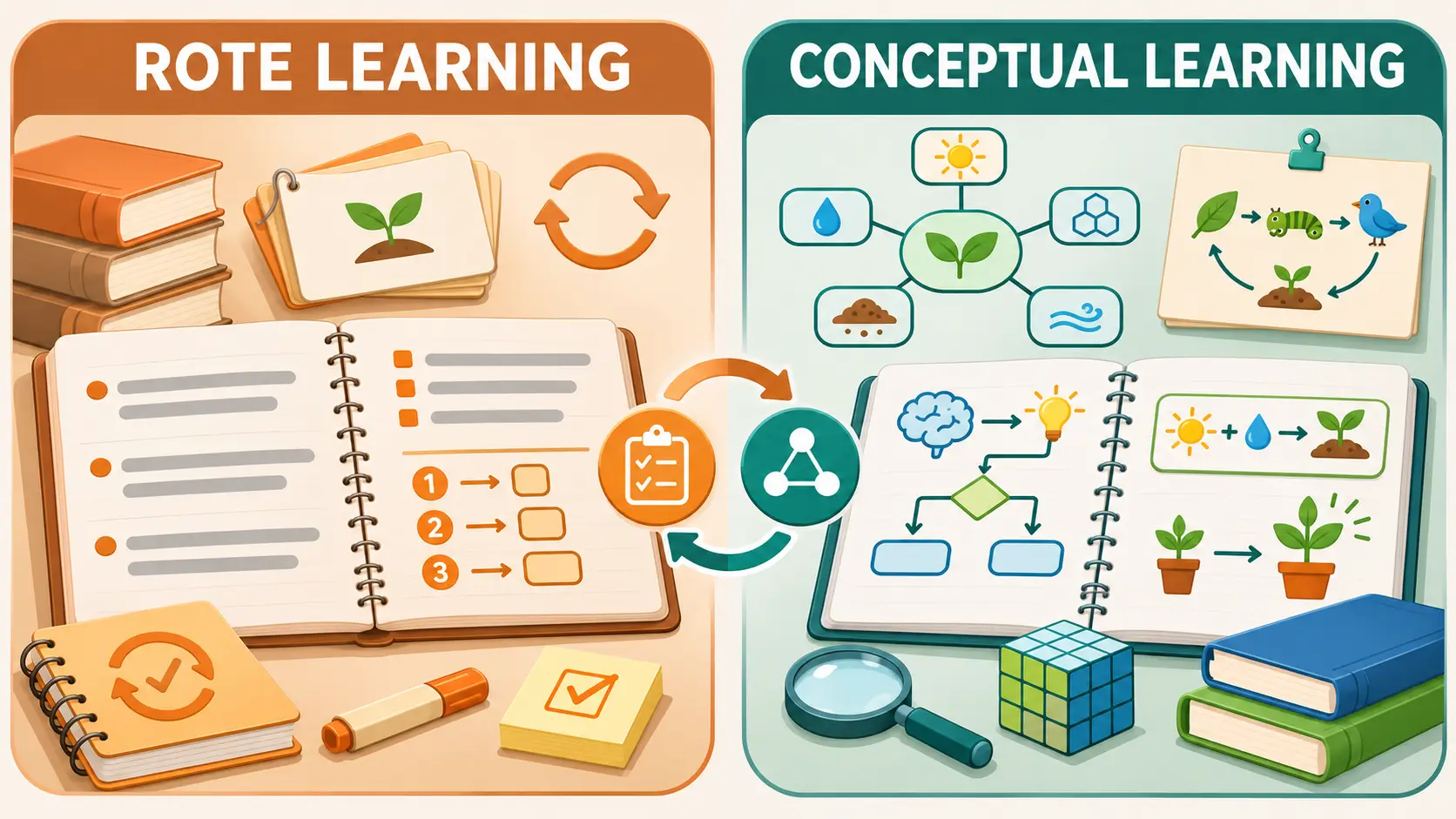
Reading notes is useful when encountering unfamiliar information. However, recognizing material while looking at it is different from recalling that information independently.
Active recall, also called retrieval practice, involves attempting to remember information without immediately consulting the source.
After studying a topic, close your notes and try answering a relevant question.
You might explain a concept in your own words, reproduce a formula, describe a process, or write a short response from memory.
Then check your answer against reliable learning materials.
Pay attention to missing information, inaccurate explanations, and concepts that were difficult to retrieve.
A 2026 meta-analysis published in Educational Psychology Review examined 53 studies involving 7,303 participants in primary and secondary school settings. It found an average benefit from retrieval practice, although outcomes varied according to the knowledge assessed, testing format, and relationship between practice and assessment tasks.
The findings support retrieval practice as a learning method, not merely a way to measure knowledge.
However, self-testing should not replace initial understanding.
If you cannot explain a concept because you have never understood it properly, return to a clear explanation, worked example, or teacher's guidance before testing yourself again.
Flashcards may suit definitions and factual relationships. Extended written answers and problem-solving questions are more appropriate when the examination requires explanation or application.
For a closer comparison, read active recall versus rereading.
The important distinction is between information that looks familiar and information you can successfully retrieve and use.
4. Space Your Revision Instead of Studying Everything at Once
Completing a chapter in one long session does not mean you will remember it when the examination arrives.
Spaced practice involves returning to material across separate study sessions rather than concentrating all review into one period.
For example, after learning a concept, revisit it during another revision session. Attempt to recall the explanation before opening your notes.
If you struggle, review the missing information and arrange another opportunity to practise.
If you can recall it accurately, move toward more demanding questions or another topic that needs attention.
The same 2026 research synthesis found an average benefit from distributed practice in school classrooms, with outcomes influenced by factors such as the interval between sessions and the timing of later assessments.
This does not establish one ideal revision schedule for every subject or student.
A student preparing several weeks ahead can distribute review opportunities across a longer period. Someone preparing with only a few days remaining needs a shorter, more selective approach.
Spaced practice also differs from active recall.
Spacing determines when you return to information. Retrieval practice determines what you do during that return visit.
Combining them can be practical: revisit material after an interval, attempt an answer without assistance, and check the result.
You can explore how to combine spaced revision with active recall.
The purpose is to give previously learned material further opportunities for retrieval, not to follow an unnecessarily complicated calendar.
5. Match Your Practice to the Skills Being Assessed
Not every examination rewards the same kind of preparation.
Memorizing definitions may help with factual questions, but it is insufficient when an assessment requires analysis, interpretation, calculations, or extended arguments.
Choose revision activities that develop the abilities your questions demand.
For mathematics, this might involve solving problems independently and checking each stage of the calculation.
For an essay-based subject, practise developing relevant arguments, selecting supporting evidence, and organizing an answer within the available time.
For a language examination, preparation may involve comprehension, vocabulary, grammar, or writing tasks, depending on the assessment.
For open-book examinations, practise finding information and applying it to questions rather than assuming access to notes removes the need to study.
Once you understand the basic methods, consider mixing related question types.
This approach, called interleaving, requires you to distinguish between different concepts or procedures rather than repeatedly applying one method to nearly identical questions.
For instance, a mixed mathematics exercise may require identifying which formula or problem-solving approach is appropriate.
Research suggests interleaving can benefit learning under suitable conditions, but its effectiveness depends on the content, practice design, and feedback available. It is not automatically superior for every task.
The practical principle is straightforward: prepare to perform the task the examination requires, not simply to recognize information in your notes.
6. Practise With Past Papers and Appropriate Time Limits
Past papers connect subject knowledge with the practical demands of an examination.
They can help you become familiar with question wording, response requirements, available time, and the amount of detail expected.
Begin with selected questions, preferably attempting them independently before checking solutions.
As your understanding develops, complete representative sections or full papers under conditions that resemble the actual assessment.
The NHS examination preparation guidance recommends using past papers to understand question formats and practise completing work within the allocated time.
After each attempt, review both your answers and your approach.
Consider whether you interpreted the instructions correctly, allocated time appropriately, and included the necessary information.
A correct answer completed far beyond the examination's time limit may indicate that further practice is useful.
However, timed practice should be introduced sensibly.
If you are still learning a topic, working through questions without strict timing may be more productive. Add realistic time limits when you are ready to practise examination performance.
If timed exercises increase anxiety significantly, begin with manageable sections rather than repeatedly attempting complete high-pressure tests.
Use current syllabuses and official guidance alongside past papers because examination requirements can change.
The purpose is to understand your readiness, identify difficulties, and improve your technique—not to predict your final score.
7. Learn From Mistakes and Use Feedback
Completing practice questions provides useful information only when you examine the results.
An incorrect answer may indicate missing knowledge, a misunderstood instruction, an unsuitable method, or difficulty managing time.
These problems require different responses.
When reviewing your work, identify why an answer was incorrect instead of simply recording the correct solution.
If you misunderstood a concept, return to the explanation. If you selected the wrong calculation method, practise recognizing when each method applies.
If you misread an instruction, pay closer attention to terms such as compare, evaluate, explain, or calculate.
Feedback research reinforces the importance of understanding what needs correction.
A meta-analysis published in Frontiers in Psychology, titled The Power of Feedback Revisited, found positive average effects of educational feedback while showing substantial variation according to the characteristics and information provided by that feedback.
This helps explain why a score alone is less informative than guidance identifying the problem and how to improve.
Keep a brief record of important mistakes.
For each one, note the difficulty, the correct explanation or method, and the type of question requiring further practice.
Return to a similar question later to check whether the problem has been addressed.
Avoid treating mistakes as evidence that you lack ability. They are information about your current performance on a particular task.
A productive revision session should leave you knowing not only what you completed, but also what you need to do next.
8. Manage Concentration, Distractions, and Breaks
A study period becomes more manageable when you know what you intend to accomplish.
Before beginning, identify one task and prepare the materials needed to complete it.
Reduce avoidable distractions where possible. This might mean silencing notifications, closing unrelated applications, or choosing a suitable place to work.
Avoid spending excessive time repeatedly organizing stationery, changing productivity applications, or redesigning your timetable.
These activities can feel like preparation without necessarily improving your understanding of the subject.
Breaks are also important.
Long, uninterrupted study periods are not automatically more productive than shorter sessions with opportunities to rest. The NHS recommends taking regular breaks during examination revision.
Some students find a timer useful. Others prefer pausing after completing a meaningful section of work.
There is no universal rule establishing that every student must follow an exact study-and-break interval.
Consider the demands of the task, your available time, and your ability to remain attentive.
If your surroundings are noisy or unpredictable, shorter focused sessions may be more practical than waiting for ideal conditions.
For further guidance, see how to improve concentration while studying.
Judge your study sessions by the learning tasks completed and checked, rather than by the number of uninterrupted hours.
9. Protect Sleep, Meals, and Recovery Time
Sleep and ordinary wellbeing deserve attention throughout examination preparation.
Sacrificing sleep to extend revision time can undermine the concentration and memory needed for effective learning.
The Centers for Disease Control and Prevention recommends 8–10 hours of sleep per 24 hours for adolescents aged 13–17 and at least 7 hours for adults aged 18–60. Sleep requirements can vary between individuals.
Try to maintain reasonably consistent sleeping and waking times.
Make time for regular meals and water, and include comfortable physical activity as part of your ordinary routine.
These habits support general wellbeing, but they should not be presented as guarantees of improved examination marks.
If you regularly struggle to sleep, review your routine and seek suitable professional guidance when necessary.
For practical suggestions, read a realistic sleep routine for students.
Students should also avoid relying on excessive caffeine or an all-night revision session as substitutes for preparation.
When time is limited, the answer is to revise priorities and choose useful tasks—not to disregard basic health needs.
10. Recognize Exam Pressure and Respond Appropriately
Feeling nervous before an important examination is not unusual.
Pressure may come from uncertainty about questions, expectations from others, previous results, or concern about the consequences of the assessment.
Different causes call for different responses.
If your concern involves material you do not understand, identify the specific concept and seek clarification.
If you are uncertain about examination arrangements, consult the official instructions rather than repeatedly guessing what might happen.
If you feel tense or distracted, taking a short break or using a comfortable relaxation exercise may help you refocus.
The NHS guidance on student stress recommends identifying sources of pressure, breaking work into manageable tasks, getting sufficient rest, and talking to supportive people.
These strategies are practical options, not guaranteed treatments for anxiety.
It also helps to distinguish what you can influence from what remains uncertain.
You can decide which topics to revise, whether to correct mistakes, and when to seek help. You cannot know every examination question in advance or guarantee a particular outcome.
If stress repeatedly interferes with studying, sleep, concentration, or ordinary activities, study techniques alone may not be enough.
Speak with a trusted adult, teacher, school counselor, or suitable health professional. Students who require assessment adjustments should contact their institution through its relevant support procedure.
Further guidance is available in managing exam stress before and during exams.
Effective preparation includes recognizing when additional support would be useful.
What to Do When You Have Very Little Revision Time
When an examination is approaching and substantial material remains unfinished, trying to cover everything equally is rarely a realistic strategy.
Begin by checking the official examination requirements and identifying the most important areas that still need attention.
Prioritize topics based on their assessment relevance, your current understanding, and the time needed for improvement.
Attempt a manageable number of representative questions and use the results to guide further revision.
Avoid spending your remaining study time repeatedly rewriting familiar notes or constructing an elaborate new schedule.
If you cannot understand an essential topic independently, seek clarification from a teacher or another reliable source where possible.
Protect normal sleep and meals even when preparation is incomplete.
A shorter preparation period limits how much material you can reasonably master. It does not make extreme study schedules necessary or reliable.
For more detailed options, see how to prepare for exams in seven days.
How to Know Whether You Are Ready
Feeling confident can be encouraging, but familiarity with study materials is not a reliable substitute for demonstrating what you know.
A more useful readiness check involves attempting questions that represent the actual assessment.
Consider whether you can recall essential information without unnecessary assistance, explain concepts accurately, apply relevant methods, and complete suitable questions within realistic time limits.
Review your answers against reliable solutions or marking criteria.
If difficulties remain, identify whether they involve knowledge, application, question interpretation, or timing.
You do not need to answer every practice question perfectly to recognize improvement.
The important question is whether your performance provides reasonable evidence that you can meet the examination's requirements.
Before and During the Examination
Practical arrangements deserve attention alongside academic revision.
Check the examination date, starting time, location or online access procedure, identification requirements, and permitted materials.
Prepare necessary items in advance and allow reasonable time for travel or technical setup.
If you have approved examination adjustments, confirm the relevant arrangements through your institution.
During the examination, read the instructions carefully before answering.
Identify how many questions must be completed, whether choices are available, and how much time you can allocate to each section.
Pay attention to instruction words and the level of explanation required.
If one question becomes difficult, consider moving to another question and returning later, provided the examination rules and format allow it.
Leave time to review answers where possible.
These decisions cannot prevent every unexpected difficulty, but they can help you use your preparation more effectively.
Prepare With a Clearer Sense of What Matters
Exam preparation becomes more manageable when each study activity has a purpose.
Understanding the examination requirements helps you choose what to study. Realistic planning makes the workload easier to organize. Retrieval practice, spaced revision, suitable questions, and feedback help you check and strengthen learning.
Rest, manageable routines, and appropriate support address needs that revision techniques alone cannot resolve.
The most useful next step is to identify one important topic, attempt a relevant question, check your understanding, and decide what needs attention next.
Repeated across your available preparation time, these actions provide a practical way to build examination readiness without placing unnecessary pressure on yourself.



Comments 0
No comments yet. Be the first to start the conversation.