



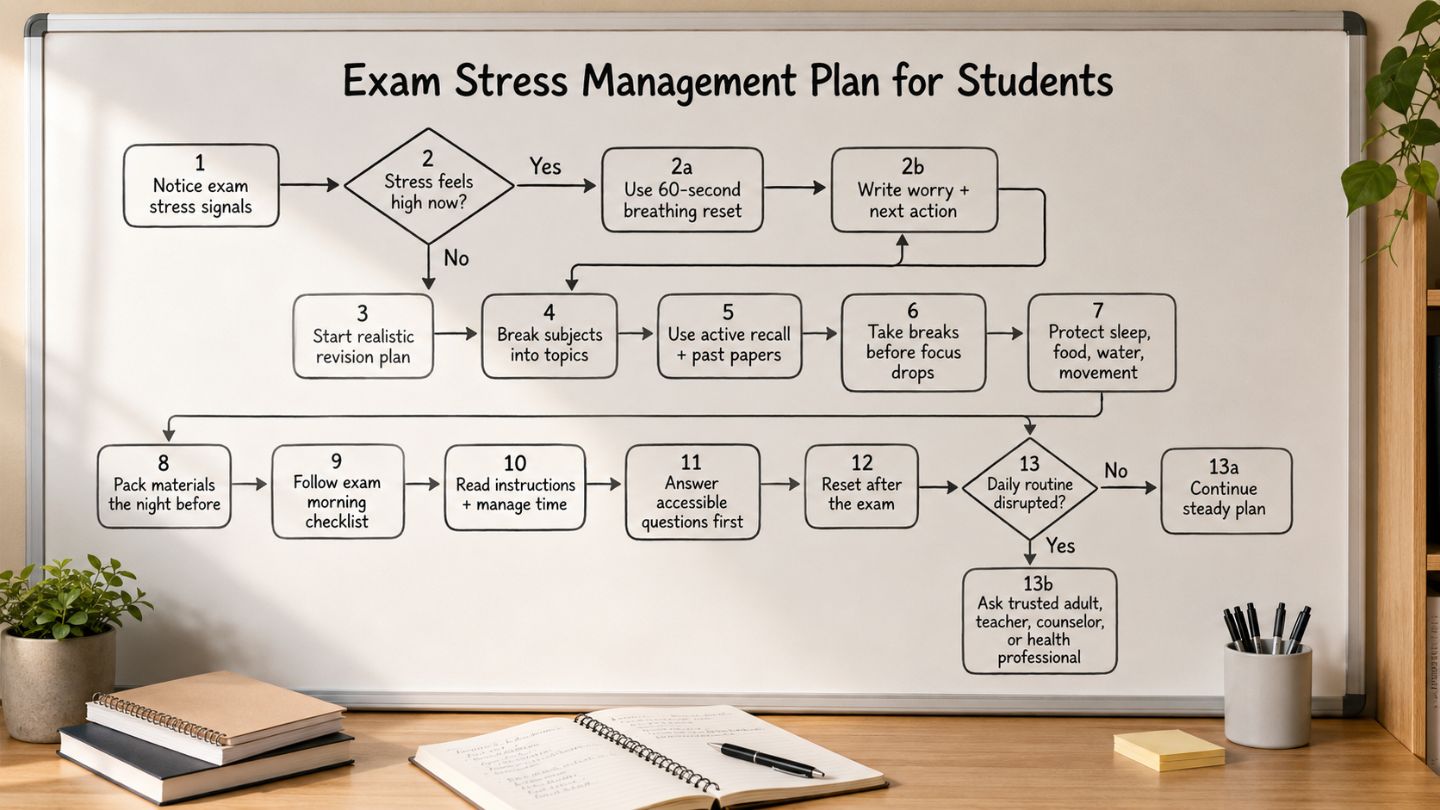
Exam stress is the pressure students feel while preparing for or taking exams. It can affect sleep, focus, revision habits, confidence, and body sensations such as tension, restlessness, or a racing heartbeat.
This guide explains how to manage exam stress for students with a clear plan for the weeks before exams, the night before, exam morning, the exam itself, and the period after each paper. It is written for school, college, university, board-exam, entrance-exam, and semester-exam contexts. Parents and teachers can also use it to support students without adding pressure.
This article is for general education and wellbeing information. It is not medical advice. If exam stress affects sleep, eating, attendance, relationships, concentration, or daily functioning, speak with a trusted adult, school counselor, college counselor, or qualified health professional. If you feel unsafe or at immediate risk, contact local emergency services or a trusted adult now.
Answer Summary:
Students can manage exam stress by planning revision early, using active study methods, taking regular breaks, protecting sleep, eating familiar meals, drinking water, moving the body, and using calming methods when pressure rises. The aim is not to remove every exam nerve. The aim is to keep stress manageable enough to study, recall information, complete the paper, and ask for support when needed.
Table of Content
- What Is Exam Stress?
- Why Do Students Feel Stressed Before Exams?
- Quick Relief When Exam Stress Feels High
- How to Reduce Exam Stress Before Exams
- The Night Before an Exam
- Exam Morning Checklist
- How to Stay Calm During the Exam
- What to Do After the Exam
- How Parents and Teachers Can Help
- When to Ask for Extra Support
- What Not to Do During Exam Season
- Suggested Revision Timetable Model
Key Takeaways
-
Exam stress is a pressure response linked to revision, tests, grades, and expectations.
-
A realistic revision timetable reduces uncertainty.
-
Active recall and practice questions are better than passive rereading for many learners.
-
Sleep supports memory, thinking, and concentration.
-
Short breathing and grounding methods can help during pressure spikes.
-
Comparing answers after an exam usually increases stress.
-
Extra support is needed when stress disrupts daily life.
What Is Exam Stress?
Exam stress is the mental and physical pressure connected to exams, revision, grades, and future academic decisions. It can show up as worry, tension, poor sleep, difficulty focusing, avoidance, irritability, headaches, stomach discomfort, or changes in appetite.
Some stress can remind a student to prepare. The problem begins when stress becomes so intense that it blocks revision, sleep, attendance, recall, or daily routines.
Exam stress vs exam anxiety
Exam stress usually rises around revision, deadlines, or exam days. It may reduce when the student has a realistic plan, enough rest, and support.
Exam anxiety is a stronger anxiety response around tests. It may include intense worry, self-doubt, blanking out, avoidance, or physical tension before or during the exam. The Mayo Clinic explanation of test anxiety recommends efficient study habits, a consistent pretest routine, relaxation methods, sleep, exercise, and professional counseling when needed.
Common signs students may notice
Students may notice exam stress through thoughts, body signals, and behavior.
Common signs include:
-
Trouble sleeping before exams
-
Rereading notes without focus
-
Avoiding difficult subjects
-
Feeling tense, restless, or irritable
-
Comparing revision pace with classmates
-
Worrying about marks repeatedly
-
Forgetting familiar material under pressure
-
Feeling upset after one difficult paper
-
Losing normal appetite or routine
These signs are signals to adjust the plan. They are not proof that a student lacks ability.
Why Do Students Feel Stressed Before Exams?
Students often feel stressed because exams combine time pressure, memory demands, expectations, and uncertainty. Stress can rise when the syllabus feels large, revision starts late, or students compare themselves with classmates.
Exam pressure can also come from family expectations, scholarship requirements, admission decisions, or fear of repeating a previous poor result. The YoungMinds guide on exam stress explains that exam pressure can affect mental health and may come from school, family, friends, or the student’s own expectations.
Main causes of exam stress
Common causes include:
-
Unclear revision priorities
-
Fear of disappointing parents or teachers
-
Too many subjects in a short period
-
Poor sleep during revision
-
Last-minute cramming
-
Lack of past-paper practice
-
Social media comparison
-
Previous difficult exam experience
-
Pressure linked to scholarships, admissions, or career plans
A good exam stress plan should reduce uncertainty instead of adding more pressure.
Quick Relief When Exam Stress Feels High
Quick relief works best when it gives the mind and body a clear next action. The goal is to reduce the pressure spike enough to return to studying, resting, or answering the next question.
The CDC guide to managing stress recommends healthy coping actions such as slow breathing, stretching, journaling, time outdoors, connection with trusted people, sleep, movement, and healthy food.
Use a 60-second breathing reset
A short breathing reset can help during revision, before entering the exam hall, or when your mind goes blank.
Try this:
-
Sit with both feet on the floor.
-
Relax your shoulders.
-
Breathe in slowly through your nose.
-
Pause briefly.
-
Exhale slowly.
-
Repeat for about one minute.
-
Name one next action.
The next action should be small: open one past paper, revise one diagram, answer one question, or pack one exam item.
Write the worry and the next action
Writing helps separate a worry from a task.
| Worry | Next action |
|---|---|
| I have not revised formulas. | Test five formulas from memory. |
| I feel behind in biology. | Revise one diagram and one short-answer topic. |
| I may run out of time. | Practice one timed section. |
| I cannot focus. | Study for 25 minutes, then take a short break. |
A written next action is better than replaying the same worry.
How to Reduce Exam Stress Before Exams
Students reduce exam stress before exams by using a realistic revision schedule, active study methods, breaks, sleep, food, water, movement, and support.
The NHS guidance on preparing for exams advises students to make a realistic revision schedule, break revision into manageable chunks, use past papers, take regular short breaks, do physical activity, and ask for help when needed.
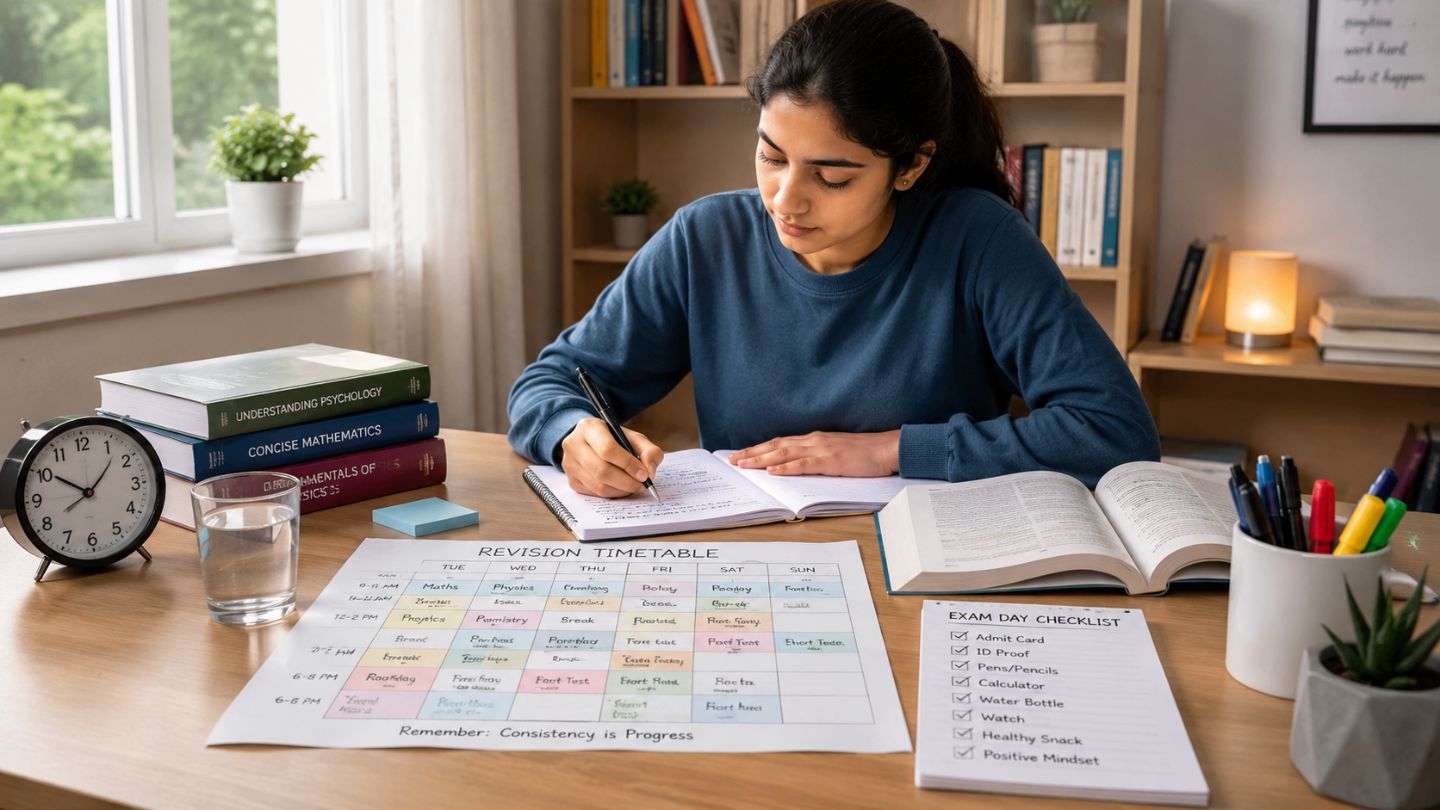
Make a realistic revision timetable
A revision timetable should show what to study, when to study, and when to stop. It should include study blocks, breaks, meals, sleep, school time, travel, and buffer time.
A useful method:
-
List all subjects.
-
Break each subject into topics.
-
Mark topics as strong, medium, or weak.
-
Put weak topics earlier in the schedule.
-
Add past-paper practice.
-
Add correction time.
-
Add breaks and sleep.
-
Leave buffer space for missed sessions.
A timetable that fills every hour is easy to abandon. A realistic timetable gives space for recovery and unexpected delays. Students who struggle with planning can also use Collegenp’s guide to easy time management tips for exam preparation for more support.
Use active revision instead of passive rereading
Active revision asks the brain to retrieve and apply information. Passive rereading may feel productive, but it may not show whether the student can recall the material in an exam.
Useful active methods include:
-
Answer past-paper questions.
-
Cover notes and write what you remember.
-
Use flashcards for definitions, formulas, and dates.
-
Explain a topic aloud.
-
Draw diagrams from memory.
-
Make an error log.
-
Rewrite weak answers after checking the mark scheme.
-
Teach a topic to a classmate or family member.
A major review of learning techniques by Dunlosky and colleagues rated practice testing and distributed practice as high-utility learning methods. Students who want a study-method comparison can read Collegenp’s guide to active recall vs passive review.
Space revision across days
Spaced revision means reviewing material across separate sessions instead of placing the whole topic into one long study session. This helps students return to topics before they fade from memory.
A simple spacing pattern:
| Day | Task |
|---|---|
| Day 1 | Learn or review the topic. |
| Day 2 | Test yourself without notes. |
| Day 4 | Do practice questions. |
| Day 7 | Review errors and repeat weak areas. |
The aim is to meet the same topic more than once before the exam.
Take breaks before focus drops
Breaks are part of study, not a reward for finishing every task. The HSE guide to managing exam stress recommends keeping a routine, taking regular breaks, limiting caffeine, sleeping well, asking for support, scanning exam questions, and answering easier questions first.
A practical pattern is:
-
25 to 40 minutes of focused revision
-
5 to 10 minutes away from the desk
-
A longer break after several study blocks
During breaks, avoid stressful group chats about who has studied more. Better options include walking, stretching, washing your face, refilling water, or sitting away from screens.
Avoid all-night cramming
All-night cramming can make students feel busy, but it may reduce attention and memory the next day.
The NHS advice for parents on exam stress says most teenagers need 8 to 10 hours of sleep a night and that good sleep improves thinking and concentration. It also says cramming all night before an exam is usually a poor idea. A meta-analytic review on sleep deprivation and memory reports that sleep loss before or after learning can harm memory for newly learned material.
Students who often revise late at night can use Collegenp’s guide to sleep hygiene for students to build a steadier routine.
Protect food, water, and movement
Food, water, and movement support focus during exam season. Students do not need a special exam diet, but they should avoid skipping meals or relying only on snacks and caffeine.
Helpful routines include:
-
Eat familiar meals.
-
Drink water through the day.
-
Avoid testing new foods on exam morning.
-
Limit late caffeine if it affects sleep.
-
Take short walks or stretch during revision.
-
Keep some normal activities during exam weeks.
These actions do not replace revision. They protect the attention and energy needed for revision.
The Night Before an Exam
The night before an exam should reduce uncertainty. The main tasks are packing materials, confirming details, reviewing lightly, and preparing for sleep.
A strong night-before routine lowers avoidable stress on exam morning.
Pack materials early
Check your school, college, university, or exam-board rules before packing.
Common exam items may include:
-
Pens and pencils
-
Eraser and sharpener
-
Calculator, if allowed
-
Geometry tools, if needed
-
Student ID or admit card
-
Water bottle, if allowed
-
Watch, if allowed
-
Required uniform or dress code items
-
Clear pencil case, if required
Also confirm:
-
Exam date
-
Start time
-
Reporting time
-
Room or exam center
-
Seat number, if given
-
Travel route
-
Allowed materials
Review lightly, then stop
A light review can help, but the night before is not the right time to learn a large unfinished syllabus.
Choose one or two tasks:
-
Review formulas.
-
Read one summary sheet.
-
Check common mistakes.
-
Review labeled diagrams.
-
Practice one short question.
-
Put notes away at a set time.
Stopping matters because tiredness can harm focus the next day.
Build a wind-down routine
A wind-down routine helps the body shift away from revision.
Try this:
-
Pack the bag.
-
Set alarms.
-
Prepare clothes.
-
Put notes away.
-
Avoid stressful exam chats.
-
Use a short breathing reset.
-
Sleep at a reasonable time.
The routine does not need to be perfect. It only needs to reduce morning stress.
Exam Morning Checklist
Exam morning should be calm and predictable. A checklist helps prevent rushing, missing materials, and last-minute comparison.
Use the morning to prepare your body, check supplies, and arrive with time to settle.
Before leaving home
Check:
-
Admit card or student ID
-
Pens, pencils, eraser, and sharpener
-
Calculator, if allowed
-
Water, if allowed
-
Required books or materials, if allowed
-
Travel route and reporting time
-
Uniform or dress requirement
Eat a familiar breakfast if possible. Drink water, but avoid drinking so much that it causes discomfort during the exam.
At the exam center
Before entering:
-
Avoid last-minute comparison.
-
Do not join tense group discussions.
-
Review only a small card or key formula sheet if needed.
-
Use slow breathing.
-
Listen to instructions carefully.
Comparison often increases pressure without improving performance.
How to Stay Calm During the Exam
Students stay calmer during an exam when they slow the first minute, read instructions, manage time, answer accessible questions, and return to harder questions later.
This section is about exam technique, not motivation. The aim is to protect marks already within reach and reduce avoidable mistakes.
Read the instructions first
Before answering, check:
-
How many questions to answer
-
Whether choices are available
-
How marks are divided
-
Time per section
-
Required format
-
Whether working must be shown
-
Whether diagrams, units, or examples are needed
Reading instructions prevents avoidable mistakes.
Make a quick time plan
Divide the exam time by sections or marks. If one question is taking too long, mark it and return later.
A simple approach:
-
Scan the paper.
-
Mark easy, medium, and difficult questions.
-
Start with accessible questions if allowed.
-
Leave time for harder questions.
-
Keep a few minutes for checking.
If your mind goes blank
A blank mind can happen under pressure. It does not mean the information is gone.
Try this:
-
Pause for a few seconds.
-
Relax your shoulders.
-
Exhale slowly.
-
Underline one keyword in the question.
-
Write any related formula, definition, diagram, or example.
-
Move to another question if recall does not return.
This gives the brain a new starting point.
What to Do After the Exam
After an exam, the goal is to recover and prepare for the next task. Long answer-comparison sessions often increase stress.
A short reset helps students move from one paper to the next without carrying extra pressure.
Avoid answer-comparison loops
After the exam, avoid long discussions about:
-
What answer was correct
-
Which question was hardest
-
Who wrote more
-
Whether the mark scheme will accept a wording
-
Whether one mistake ruined the paper
A better response is:
-
Drink water.
-
Eat something familiar.
-
Take a short walk.
-
Rest before the next revision block.
-
Review the next exam plan.
Reset for the next paper
Use this reset:
-
Stop discussing the finished paper.
-
Take a short break.
-
Check the next exam date and time.
-
Choose three priority topics.
-
Do one active revision block.
-
Sleep at a reasonable time.
A difficult exam should not control the rest of the exam period.
How Parents and Teachers Can Help
Parents and teachers help most when they reduce pressure and support routines. Students need structure, calm communication, and access to help when stress becomes hard to manage.
NHS advice for parents on exam stress recommends supporting sleep, food, revision space, flexibility, exercise, reassurance, and help-seeking when anxiety or low mood interferes with daily life.
What parents can do
Parents can help by:
-
Asking what support the student needs
-
Keeping home routines calm
-
Offering food, water, and a quiet study space
-
Avoiding comparison with siblings or classmates
-
Encouraging breaks and sleep
-
Helping organize exam materials
-
Listening without turning every conversation into marks
Pressure-based comments may increase stress. Practical support is usually more useful.
What teachers can do
Teachers can help by:
-
Clarifying exam formats
-
Sharing revision priorities
-
Explaining mark schemes
-
Encouraging practice questions
-
Noticing students who seem overwhelmed
-
Referring students to school support when needed
The CDC school mental health action guide says schools can support student mental health by creating safe environments, connecting students to caring adults, encouraging positive peer relationships, and linking students and families to support. Collegenp also has a related guide on how teachers support students’ mental health.
Teachers do not need to diagnose stress or anxiety. Their role is to notice barriers, clarify expectations, and connect students with the right support.
When to Ask for Extra Support
Students should ask for extra support when exam stress affects daily life or feels hard to manage alone. Support is appropriate when stress disrupts sleep, eating, attendance, concentration, relationships, or normal routines.
Asking for help is a practical step, not a sign of failure.
Who students can speak to
Students can speak with:
-
Parent or caregiver
-
Teacher
-
Class tutor
-
School counselor
-
College counselor
-
School nurse, where available
-
Trusted adult
-
Qualified health professional
For country-specific publication, add only verified local support services from official sources. Do not add helplines, phone numbers, or service claims without checking the official provider page. College readers who need broader wellbeing support can also review Collegenp’s guide to mental health resources for college students.
What Not to Do During Exam Season
Students can reduce stress by avoiding habits that increase pressure without improving learning.
Avoid:
-
Studying all night before the exam
-
Skipping meals
-
Using high caffeine intake to replace sleep
-
Comparing revision hours with classmates
-
Discussing answers for a long time after the exam
-
Ignoring repeated sleep problems
-
Treating one exam as proof of overall ability
-
Waiting too long to ask for help
A safer plan is steady revision, breaks, rest, and support.
Suggested Revision Timetable Model
This model can be adapted for school, college, board exams, entrance exams, or semester exams. It is a model, not a rule.
| Time | Activity |
|---|---|
| 7:00–8:00 | Wake up, breakfast, prepare materials |
| 9:00–9:40 | Active revision: weak topic |
| 9:40–9:50 | Break |
| 9:50–10:30 | Practice questions |
| 10:30–10:45 | Check answers and note errors |
| Afternoon | School, class, or second revision block |
| Evening | Light review and short walk |
| Night | Pack materials, wind down, sleep |
Students should adapt the timing to their schedule. The key is to include active practice, correction time, meals, breaks, and sleep.





Comments 0
No comments yet. Be the first to start the conversation.