




Artificial intelligence is no longer peripheral to education. A 2025 survey by HEPI and Kortext found that 92% of UK undergraduates reported using AI tools, with 88% using generative AI for assessed work. Students use these tools to explain concepts, draft ideas, summarize readings, check code, and practice questions. Teachers use them to create examples, review drafts, and design formative checks.
The real question is not whether AI appears in learning. The useful question is: how does AI affect student learning outcomes when the goal is understanding, retention, and skill growth — not just faster task completion?
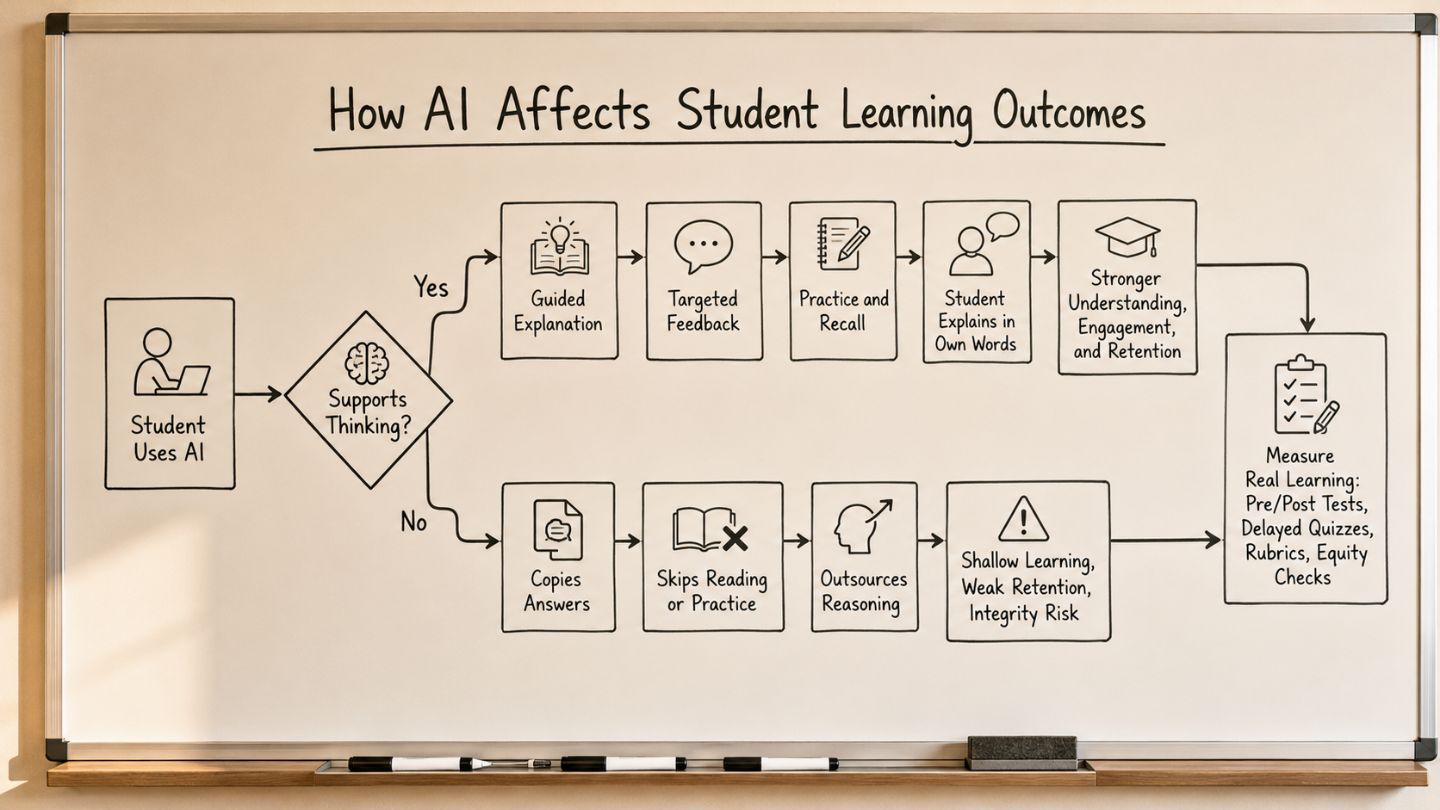
AI can improve student learning outcomes when it works as structured support: a tutor, feedback partner, adaptive practice tool, or guided concept explainer. It can weaken outcomes when students use it to skip reading, recall, writing, problem solving, or source checking. The strongest classroom question is not whether AI is good or bad, but whether a given activity makes students think, retrieve, explain, and apply knowledge.
This guide gives a balanced answer for educators, students, parents, school leaders, and education writers. It separates short-term performance from durable learning, summarizes current evidence, and gives practical ways to use AI without replacing the thinking that learning depends on.
Table of Content
- What Counts as a Student Learning Outcome?
- The Short Answer: AI Helps When It Scaffolds Learning
- What Research Says About AI and Learning Outcomes
- Positive Effects of AI on Student Learning
- Negative Effects and Risks of AI in Learning
- When AI Improves Learning vs When AI Harms Learning
- How Teachers Can Use AI Without Reducing Learning
- How Students Should Use AI Responsibly
- How Schools Can Measure AI's Effect on Learning Outcomes
- Conclusion
Key Takeaways
- AI affects learning through task design, not tool access alone.
- Structured tutoring and feedback uses have stronger research support than unrestricted answer use.
- Short-term task quality is not the same as durable learning.
- Retention checks matter because AI can reduce productive effort without the student noticing.
- Teachers need clear rules for disclosure, process evidence, and data privacy.
- Students learn more when AI gives hints and feedback, not finished work.
- Schools should measure performance, retention, equity, and assessment integrity together.
What Counts as a Student Learning Outcome?
A student learning outcome is evidence that a learner can do something meaningful after instruction. A grade captures part of the picture, but not all of it.
Academic Performance, Retention, and Skill Transfer
Academic performance includes quiz scores, assignment quality, course grades, and exam results. These measures are useful, but they can be inflated when AI supplies answers that students do not understand.
Retention asks whether students still remember and apply the material after time has passed. Skill transfer asks whether a student can use knowledge in a new problem, course, workplace, or community setting. For AI in education, retention and transfer are especially important because a tool can help a student finish a task without building memory or judgment.
Understanding effective learning strategies for college students makes these distinctions clearer: performance on one task and durable learning are measurably different outcomes.
Engagement, Motivation, and Critical Thinking
Engagement and motivation matter because students who stay active with a task are more likely to practice. AI can raise engagement when it gives immediate explanations, examples, or hints calibrated to a student's level.
Critical thinking needs a different test. A student is thinking critically when they question an answer, compare evidence, explain reasoning, and notice limits. AI can support this if it asks questions and points to gaps. It can reduce critical thinking if the student accepts answers without checking them. The habit of checking claims before sharing is exactly the skill that AI use can either strengthen or erode, depending on how the tool is used.
The Short Answer: AI Helps When It Scaffolds Learning
AI helps most when it scaffolds effort. It harms learning when it replaces effort.
Why Tool Design Matters
Scaffolding means giving enough support for a learner to move forward while still requiring the learner to think. In a classroom, scaffolding looks like hints, feedback, prompts, worked examples, practice questions, and teacher questions. AI can provide these supports at speed and at different levels of difficulty.
The danger appears when support becomes substitution. If the tool writes the answer, solves the problem, or summarizes the reading before the student has engaged with it, the learner may get a finished product without the practice needed for understanding. This distinction — between supporting thinking and replacing it — is the central finding in current AI-in-education research.
What Recent Evidence Says
The evidence supports a conditional answer. Kestin et al. (2025, Scientific Reports) report that a carefully structured AI tutor in an undergraduate physics setting produced stronger post-test learning than an in-class active-learning comparison, while using less time on task. The authors explicitly describe the tutor as carefully scaffolded and aligned with pedagogical principles — it was not a general chatbot.
Barcaui (2025, Social Sciences & Humanities Open) reports a different outcome: undergraduates who used ChatGPT as an unrestricted study aid scored lower on a surprise retention test 45 days later than students who used traditional methods. These two findings do not cancel each other. They point to the same principle: AI use requires learning design to produce learning gains.
A Student-Teacher Use Test
A practical test can guide classroom decisions: after AI support, can the student explain the answer without the tool, solve a similar problem, name the source of the claim, and describe the reasoning path? If yes, the tool likely supported learning. If no, the tool may have supported task completion more than understanding.
What Research Says About AI and Learning Outcomes
AI Tutoring and Adaptive Practice
AI tutoring works best when it behaves like a structured learning partner — prompting the student to predict, explain, attempt, receive feedback, and try again. In the Kestin et al. trial, the AI tutor was built around specific lesson goals, student activity, feedback loops, and instructor-designed prompts. This matters because many classroom AI failures come from assuming that a general-purpose answer tool is equivalent to a tutor. A tutor should guide thinking; an answer tool may bypass it.
Adaptive learning in artificial intelligence works on this same principle: the system should respond to what the student actually does, not just supply information on demand.
ChatGPT-Style Tools, Retention, and Cognitive Offloading
ChatGPT-style tools can lower the effort needed to produce a response. That is useful for brainstorming, translation support, or feedback on writing drafts — but it also creates cognitive offloading. Cognitive offloading occurs when a learner moves mental work to a tool. Some offloading is normal: calculators, dictionaries, and note systems all reduce effort in appropriate contexts.
The learning risk appears when the offloaded task is the skill being taught. If a writing class is teaching argument structure, letting AI build the full argument weakens the practice that course is designed to produce. If a math course is teaching problem setup, letting AI set up the problem hides the exact step the student needs to practise. This is why retrieval practice in daily lessons remains important even when AI tools are in the room — the act of recall itself is a learning mechanism, not just a test of learning.
Engagement and Motivation Evidence
Qi et al. (2025, Computers and Education: Artificial Intelligence) found positive effects of generative AI on university student motivation and engagement, with differences shaped by subject, learning strategy, and context. Engagement is valuable but should not be treated as proof of learning. A tool can be engaging because it is fast, friendly, or novel. Schools should pair engagement evidence with retrieval checks, delayed assessment, and student explanations.
Meta-Analysis Evidence on Academic Achievement
Dong, Tang, and Wang (2025, Computers and Education: Artificial Intelligence) analyzed 29 empirical studies with 2,657 participants and reported a positive overall effect of AI on academic performance. This supports the idea that AI can improve measured performance under some conditions. The cautious reading is that meta-analyses combine different tools, subjects, age groups, and assessment designs. A positive average does not mean every school should adopt every tool or that every student will learn more in every context.
Positive Effects of AI on Student Learning
AI can support learning when it increases feedback, practice, explanation, access, and teacher insight. These benefits are strongest when the teacher sets the learning purpose and the student is required to do the thinking.
Feedback, Personalization, Practice, and Accessibility
Students often wait days for written feedback. AI can give immediate feedback on practice questions, draft structure, misconceptions, or vocabulary. It can vary examples for students who need another route into the same concept.
For accessibility, AI can help convert text to simpler explanations, support language learners, or provide practice in multiple formats. For neurodivergent learners, AI tools can offer flexible pacing, alternative formats, and repeated practice without judgment. These uses are not automatic replacements for specialist teachers or support professionals. They work best when students are instructed to verify information and when personal or sensitive data is not entered into tools that lack institutional data protection approval.
Understanding AI tools for students — ethical and practical use helps frame this: the ethics of privacy and the practicality of learning gains are not separate questions.
Teacher Insight and Formative Assessment
Teachers can use AI to draft formative quizzes, create misconception checks, or produce differentiated examples. The teacher still needs to judge accuracy, curriculum fit, age suitability, and fairness. A practical classroom use: ask AI for three wrong answers that students commonly give for a concept, then have students diagnose why each answer is wrong. This keeps the thinking with the learner while using AI to generate practice material efficiently.
AI in teaching and learning — effects and limits examines this teacher-side use in more detail.
Student Confidence and Self-Regulated Learning
AI can help students ask questions they may hesitate to ask in class. It can also support self-regulated learning by providing practice plans, review reminders, or prompts for self-explanation. Roediger and Karpicke (2006) demonstrated that the act of testing significantly improves long-term retention. Dunlosky et al. (2013) rated practice testing and distributed practice as high-utility learning techniques across many learning contexts. AI study support should make these evidence-based habits easier to practise — not replace them with passive reading of generated answers.
Spaced repetition and active recall memory skills provides a practical framework students can apply alongside AI tools.
Negative Effects and Risks of AI in Learning
AI can weaken learning when it reduces effort at exactly the point where effort is needed. The main risks are overreliance, shallow work, false information, privacy exposure, equity gaps, and unclear assessment expectations.
Overreliance, Hallucinations, and Shallow Work
Overreliance occurs when students use AI as the first and last step. The student asks, copies, submits, and moves on. That process can produce fluent work but gives little evidence of understanding, and none of retention. AI systems also produce false or unsupported claims with confident language. Students need explicit routines: check sources, compare with course material, explain in their own words, and test recall without the tool.
How to evaluate research and spot weak evidence overclaims gives students a transferable framework for source verification that applies directly to AI output.
Assessment Integrity, Privacy, and Equity
Assessment integrity becomes harder when a take-home task can be completed by an AI tool. Schools may need more process evidence: drafts, version histories, oral checks, in-class writing, applied tasks, and clear disclosure expectations. What is a good Turnitin score is one institutional reference point, but AI-generated text often bypasses similarity detection entirely, which means process evidence and oral explanation become more important assessment tools.
Privacy matters particularly for student data. Students should not enter personal information, private peer work, or sensitive school records into AI tools without institutional approval. Equity matters because paid tools, strong internet access, English-language proficiency, and reliable device quality can widen gaps between learners. UNESCO's AI-in-education framework explicitly frames equity and inclusion as preconditions for beneficial AI use, not afterthoughts.
Critical Thinking Risks
Critical thinking weakens when students treat AI output as authority. A useful classroom rule: make students argue with the tool. They can ask for assumptions, counterexamples, missing evidence, and alternative explanations — then verify claims using course readings or credible sources. The goal is not to ban AI from reasoning tasks but to keep judgment with the learner.
AI ethics: responsibility, roles, and accountability provides the ethical framing that underpins responsible critical use.
When AI Improves Learning vs When AI Harms Learning
AI improves learning when it creates effortful practice. AI harms learning when it removes the practice the lesson is meant to build.
| Situation | Student action | Likely learning effect |
|---|---|---|
| AI gives hints before answers | Student attempts the task, then uses feedback to revise | Stronger reasoning and feedback use |
| AI asks the student to explain | Student retrieves and expresses ideas in their own words | Better retention and metacognition |
| AI produces the full answer first | Student copies or lightly edits without checking | Shallow work and weaker transfer |
| AI creates practice questions | Teacher checks accuracy; students solve without answer access | More practice with guardrails |
| AI replaces reading or problem setup | Student skips the core skill being taught | Reduced durable learning |
| AI supports accessibility carefully | Student receives format, language, or pacing support with privacy protections | More inclusive access |
How Teachers Can Use AI Without Reducing Learning
Teachers can use AI safely when they connect each use to a learning objective, require student explanation, and measure learning after the tool is removed.
Classroom Guardrails and Assessment Design
Set a clear AI-use policy for each assignment: state whether AI is allowed, which uses are permitted, what must be disclosed, and what evidence of student thinking is required.
For a reading task, AI may be allowed for vocabulary support but not for replacing the reading. For a writing task, AI may be allowed for feedback on clarity but not for producing the argument. For a mathematics task, AI may be allowed to generate extra practice while students must show their own problem setup and reasoning.
Teacher Workflow Examples
A teacher can ask AI to create five misconception-based questions, review and edit them for accuracy and curriculum fit, then have students answer individually, compare reasoning in pairs, and revise after feedback. A teacher can also ask AI to produce three levels of explanation for a concept, then have students judge which explanation fits a beginner and explain why. These activities use AI as material for thinking, not as a substitute for it.
How AI can help build strong teacher-student relationships explores the relational dimensions of this kind of structured AI use. The AI competency framework for teachers (UNESCO, 2024) describes teacher competencies across five dimensions: human-centred mindset, ethics, AI foundations, AI pedagogy, and professional learning.
How Students Should Use AI Responsibly
Students should use AI as a coach, not a ghostwriter. The safest study pattern is: attempt, hint, feedback, recall, and verification.
A Responsible Study Workflow
- Try the problem or reading without AI first.
- Ask AI for a hint rather than the answer.
- Write your own attempt.
- Ask for feedback on your reasoning.
- Close the tool and explain the answer from memory.
- Verify the answer against class notes, textbooks, or teacher guidance.
This workflow keeps the mental work with the student and makes AI part of practice rather than a bypass around it. AI literacy for students — using tools with care and confidence provides a broader framework for developing this kind of considered approach.
Learning strategy skills with deliberate practice also explains why the effort itself — not just the right answer — is what produces lasting skill.
Disclosure and Academic Integrity
Students should follow their institution's policy on AI use disclosure. A practical disclosure statement might read: AI was used to generate practice questions and to give feedback on clarity; final reasoning and wording are my own. The exact wording should follow local school or university policy, which varies by institution and country.
How Schools Can Measure AI's Effect on Learning Outcomes
Schools should measure AI impact through learning evidence, not tool enthusiasm. The strongest approach combines performance data, retention checks, process evidence, and equity indicators.
Pre/Post Tests, Retention Checks, and Process Evidence
A school can compare student understanding before and after an AI-supported activity, then test again after a delay. It can review drafts, annotations, problem-solving steps, reflections, and oral explanations. It can also compare results across students with different levels of access, language background, disability support needs, and prior achievement.
If AI improves short-term scores but delayed recall falls, the task should be redesigned.
A Practical Measurement Plan
Four questions serve as a practical evaluation guide:
- Did students perform better on the task?
- Can they explain the reasoning without AI?
- Do they retain the knowledge after a delay?
- Did the tool help all student groups fairly?
These questions keep the focus on learning outcomes rather than tool adoption. The OECD's 2026 Digital Education Outlook states directly that generative AI can boost task performance without creating real learning gains if used without pedagogical support — which means measurement must go beyond scores.
High-stakes testing and its impact on student outcomes provides relevant context on assessment design in the broader sense.
Conclusion
AI affects student learning outcomes by changing how students practise, receive feedback, and complete tasks. The evidence does not support a simple claim that AI is either beneficial or harmful for learning. Structured tutoring, formative feedback, adaptive practice, and guided explanation can support learning. Unrestricted answer use can weaken retention, critical thinking, and assessment validity.
A practical next step for any educator or student is to audit each AI use against the outcome it is supposed to improve. If the activity makes students retrieve, explain, verify, and apply knowledge, it is more likely to support learning. If it lets them bypass those actions, the task should be redesigned before the tool is used again.
Can AI replace teachers? A balanced debate on pros and cons addresses the broader institutional question that underlies this one.





Comments 0
No comments yet. Be the first to start the conversation.