




Online learning can be as effective as classroom learning when the course is well designed, the learner has enough support, and the subject fits the format. It is not equally effective for every learner, age group, or subject.
This article explains what research says, where online learning works well, where classroom learning remains stronger, and how students, parents, and working adults can choose between online, classroom, and blended learning.
Online learning means education delivered partly or fully through the internet. It may be live, recorded, self-paced, instructor-led, or combined with classroom sessions. Classroom learning means face-to-face instruction in a physical setting such as a school, college, training center, laboratory, or workshop. Blended learning combines online and in-person elements.
A U.S. Department of Education meta-analysis found that, on average, students in online learning conditions performed better than those receiving face-to-face instruction. The same report cautioned that blended conditions often included extra learning time or instructional elements, and that most evidence came from undergraduate and older learners rather than K-12 students.
Answer Summary:
Online learning can match classroom learning for many academic goals when it includes clear structure, teacher feedback, student interaction, practice, and fair assessment. Classroom learning is often stronger for younger students, hands-on subjects, social development, and learners who need routine. Blended learning often gives a practical balance because it combines online flexibility with face-to-face support.
Table of Content
- Quick Verdict: Is Online Learning as Effective?
- What Does Effective Learning Mean?
- What Research Says About Online vs Classroom Learning
- Online Learning vs Classroom Learning
- Where Online Learning Works Well
- Where Classroom Learning Works Well
- Why Blended Learning Matters
- Credentials, Careers, and Quality Signals
- How to Choose Between Online and Classroom Learning
- Common Mistakes to Avoid
- Conclusion
Key Takeaways
-
Online learning can be effective, but design matters.
-
Classroom learning often gives stronger routine and direct support.
-
Research evidence is stronger for older learners than for younger school students.
-
Blended learning often reduces the limits of both formats.
-
Hands-on subjects usually need in-person practice.
-
Internet access, devices, digital skills, and study space affect online learning.
-
Recognition and assessment quality matter when learning is linked to careers or higher study.
Quick Verdict: Is Online Learning as Effective?
Online learning is as effective as classroom learning in some situations, but not in all situations. The better question is whether the course has the right teaching design, interaction, assessment, and learner support.
A 2023 meta-analysis focused on teacher education found that online learning was at least as effective as in-class delivery in that context. It also found stronger results for blended and flipped approaches, while noting that pedagogy, not technology by itself, explains stronger outcomes.
For many college students and working adults, online learning can work well because it offers flexibility and repeated access to materials. For younger students, classroom learning often provides more structure, social development, and immediate teacher observation. For laboratory, workshop, clinical, arts, or performance-based subjects, online learning may support preparation and theory, but in-person practice is often still needed.
Readers comparing this topic with a broader mode-of-study decision may also find Collegenp’s article on online vs offline learning useful.
What Does Effective Learning Mean?
Effective learning means students understand, remember, apply, and receive feedback on what they are learning. Attendance alone does not prove effectiveness in either online or classroom learning.
A useful evaluation includes:
-
Academic performance: grades, test results, assignments, projects, or demonstrated skills.
-
Engagement: participation, discussion, attention, and task completion.
-
Retention: how well students remember and apply learning later.
-
Skill transfer: whether learning can be used in real tasks.
-
Support: access to teachers, peers, resources, and feedback.
-
Equity: whether students have the tools and conditions needed to participate.
The National Academies’ How People Learn II describes learning as shaped by learner characteristics, the learning environment, the content being learned, and the role of technology across the life span.
Students who want practical study methods can connect this topic with effective learning strategies for college students or effective learning strategies for school students, depending on their level.
What Research Says About Online vs Classroom Learning
Research does not support a simple claim that one format is better for everyone. It supports a conditional answer: online learning can work when instruction is well designed, but weak support can reduce outcomes.
The U.S. Department of Education review found average advantages for online learning conditions in reviewed studies, especially in blended settings. The same report cautioned that blended courses often included added time or resources, so stronger outcomes should not be credited to technology alone. It also found limited rigorous evidence for K-12 learners, which means findings from older learners should not be applied to children without caution.
Community college research gives a cautionary view. Xu and Jaggars found negative estimates for online-course persistence and final course grades in one statewide community college system, and recommended quality improvements before wider expansion of online enrollments.
The main lesson is clear: online learning should not be judged by access alone. A course with recorded videos but no feedback, no interaction, and weak assessment is unlikely to support deep learning. A classroom course based only on passive lectures can also be weak.
Online Learning vs Classroom Learning
Online learning is usually stronger for flexibility and access. Classroom learning is usually stronger for routine, immediate face-to-face support, social learning, and practical supervision.
| Factor | Online Learning | Classroom Learning |
|---|---|---|
| Flexibility | Strong for remote access and flexible schedules | Depends on timetable and location |
| Interaction | Strong when designed through live sessions, forums, feedback, or group work | Easier through face-to-face discussion |
| Feedback | Can be strong through digital comments, quizzes, and meetings | Immediate verbal and non-verbal feedback is easier |
| Motivation | Requires planning and self-regulation | Routine and teacher presence can support discipline |
| Social development | Needs planned peer interaction | Stronger for daily peer contact |
| Practical skills | Works for theory, demonstration, and simulation | Stronger for labs, workshops, clinical practice, and performance |
| Access | Helps learners far from campus | Requires travel or local availability |
| Equity risks | Internet, device, electricity, digital skills, and study-space gaps | Transport, location, and institutional access gaps |
| Assessment | Needs strong design and integrity checks | Easier direct supervision, but quality still varies |
Where Online Learning Works Well
Online learning works well when the learner is self-directed, the subject can be practiced digitally, and the course includes feedback and interaction.
It is often suitable for:
-
college-level theory courses
-
professional development
-
exam preparation
-
language practice
-
coding and digital skills
-
writing and research skills
-
business, management, and accounting concepts
-
working adults who need schedule flexibility
-
students who need recorded lessons for review
Online learning is not the same as watching videos. Good online courses include clear weekly goals, teacher presence, discussion, practice tasks, feedback, and fair assessment.
The Community of Inquiry framework describes quality online learning through teaching presence, cognitive presence, and social presence. Quality Matters also provides standards used to evaluate the design of online and hybrid courses.
For related reading, Collegenp’s article on online learning benefits, challenges, and opportunities can support readers who want a wider benefits-and-limits view.
Where Classroom Learning Works Well
Classroom learning works well when students need routine, direct supervision, peer contact, facilities, or hands-on practice.
It is often stronger for:
-
younger school students
-
students who need daily structure
-
laboratory science
-
clinical and health-related practice
-
vocational and technical workshops
-
arts, music, theatre, and sports
-
group projects that need close facilitation
-
learners without reliable internet or study space at home
OECD’s PISA 2022 analysis reported that during remote learning, 40% of students across OECD countries felt lonely, 50% felt anxious about schoolwork, and three in ten said teachers were not available when needed. These figures describe pandemic-era remote learning, not every planned online program.
OECD also explains that the education digital divide is not only about internet access and devices. It includes infrastructure, skills, affordability, use, and motivation.
Readers interested in access barriers may also review Collegenp’s article on the digital divide and universal internet access.
For school-age learners, classroom learning often supports social routines that online formats must work harder to recreate.
Why Blended Learning Matters
Blended learning often gives a practical middle path because it combines online resources with in-person support. Students can use online materials for preparation and review, then use classroom time for discussion, practice, labs, or feedback.
The World Bank’s remote-learning guidance states that availability of technology is necessary but not sufficient for effective remote learning. It also stresses the role of teachers and two-way interaction between teachers and students.
A blended course may work like this:
-
Students watch a short lesson before class.
-
They complete a short quiz online.
-
The teacher checks common errors.
-
Class time is used for discussion or practice.
-
Students submit work through a learning platform.
-
The teacher gives feedback before the next task.
This model can reduce passive lecture time and create more room for active learning. It also helps separate content delivery from practice, feedback, and application.
Credentials, Careers, and Quality Signals
For career decisions, the value of online learning depends on the provider, curriculum, assessment, recognition, and proof of skill. The learning mode alone does not make a course credible.
A certificate is usually shorter and focused on a specific skill or topic. A degree is usually longer, broader, and tied to formal academic requirements. Either can be useful, but the value depends on recognition, assessment quality, and relevance to the learner’s goal.
Before enrolling in any online or classroom program, check:
-
whether the institution or provider is recognized
-
whether the curriculum has clear learning outcomes
-
whether instructors are qualified
-
whether assessment is meaningful
-
whether students receive feedback
-
whether credits transfer, if transfer matters
-
whether the credential is accepted for the intended job or further study
-
whether the course includes projects, labs, placements, or portfolio work when needed
For U.S. higher education, the U.S. Department of Education says recognized institutional accrediting agencies are reliable authorities concerning the quality of education or training offered by the institutions or programs they accredit. Recognition systems differ by country, so students should verify local rules with the relevant education authority.
UNESCO’s 2023 Global Education Monitoring Report on technology in education examines education technology through relevance, equity, scalability, and sustainability. This supports a cautious approach: technology should be evaluated by its educational value, not by novelty or convenience alone.
How to Choose Between Online and Classroom Learning
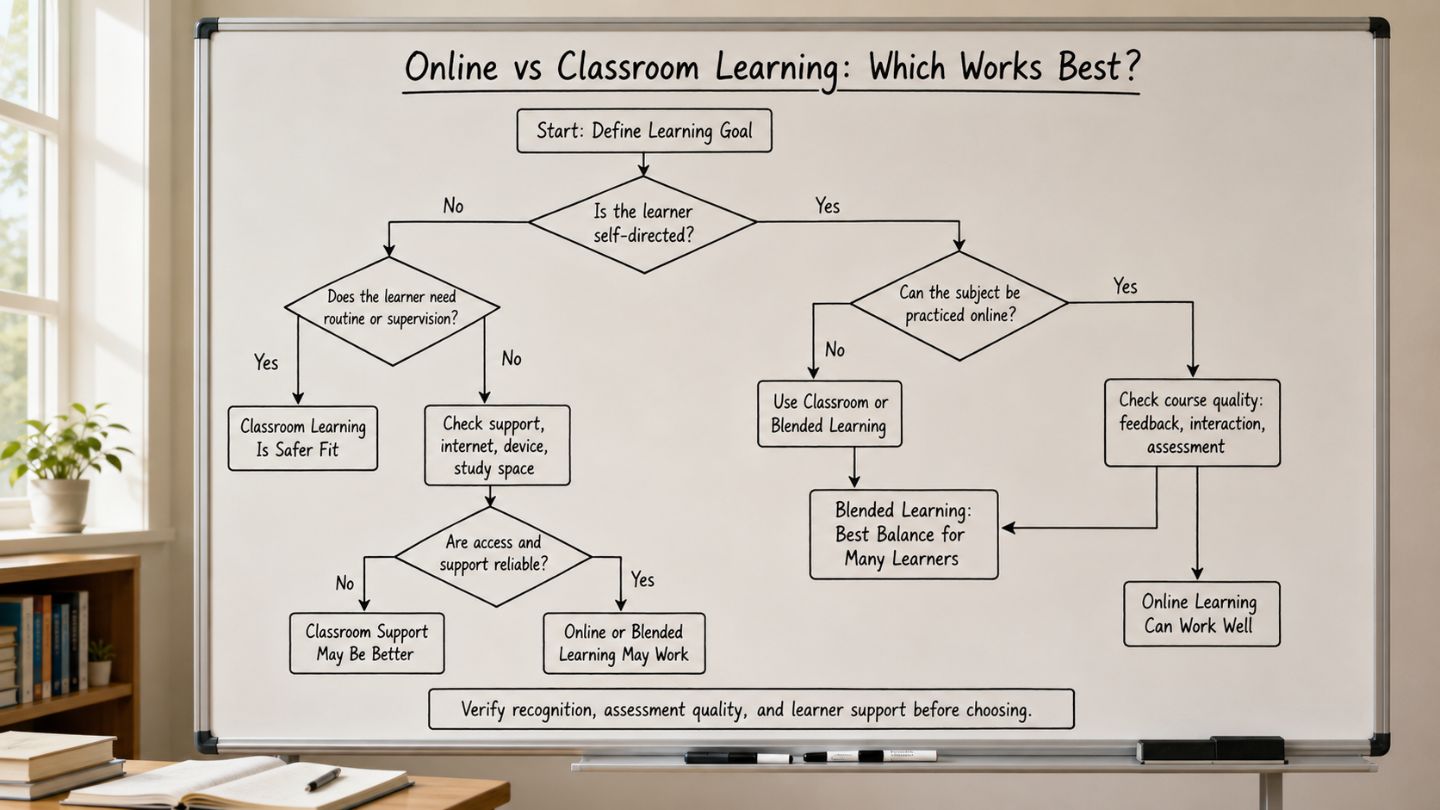
Choose the format that gives enough structure, support, practice, and recognition for your goal. A strong choice depends on the learner, subject, schedule, and available support.
Choose online learning when:
-
you need flexible scheduling
-
you can manage deadlines without daily reminders
-
the subject can be practiced digitally
-
the course includes teacher feedback
-
you have reliable internet and a suitable device
-
the provider is credible
-
the credential is recognized for your purpose
Choose classroom learning when:
-
you need routine and supervision
-
you learn better through face-to-face discussion
-
the subject requires labs, workshops, clinics, or performance
-
peer interaction is a major part of learning
-
home study conditions are weak
-
immediate teacher support is important
Choose blended learning when:
-
theory can be learned online but practice needs a classroom
-
you want flexibility without losing direct support
-
the course uses classroom time for discussion, labs, or coaching
-
assessment includes both digital and supervised work
Students thinking about online learning as part of career planning may also find Collegenp’s article on how technology improves the learning process relevant.
Common Mistakes to Avoid
Do not choose online learning only because it seems easier. A strong online course can require consistent reading, assignments, discussion, and independent study.
Do not choose classroom learning only because it feels more traditional. A physical classroom does not guarantee strong teaching, relevant curriculum, or meaningful feedback.
Do not rely on broad career claims. Check whether the credential is accepted in your target country, institution, profession, or employer category.
Do not assume emergency remote teaching during a crisis represents well-designed online education. Remote teaching during school closures often happened under difficult conditions and should be judged separately from planned online learning.
Conclusion
Online learning can be as effective as classroom learning when the course is well designed and the learner has the right support. Classroom learning remains important for younger students, hands-on subjects, structured routines, and social learning. Blended learning often provides a practical balance because it uses online tools for flexibility and classroom time for interaction, practice, and feedback.
Students, parents, and working adults should compare the course design, teacher access, assessment quality, credential recognition, subject type, and learning conditions before choosing a format. The strongest option is the one that supports the learner’s real goals, not the one that sounds more modern or more traditional.




Comments 0
No comments yet. Be the first to start the conversation.