



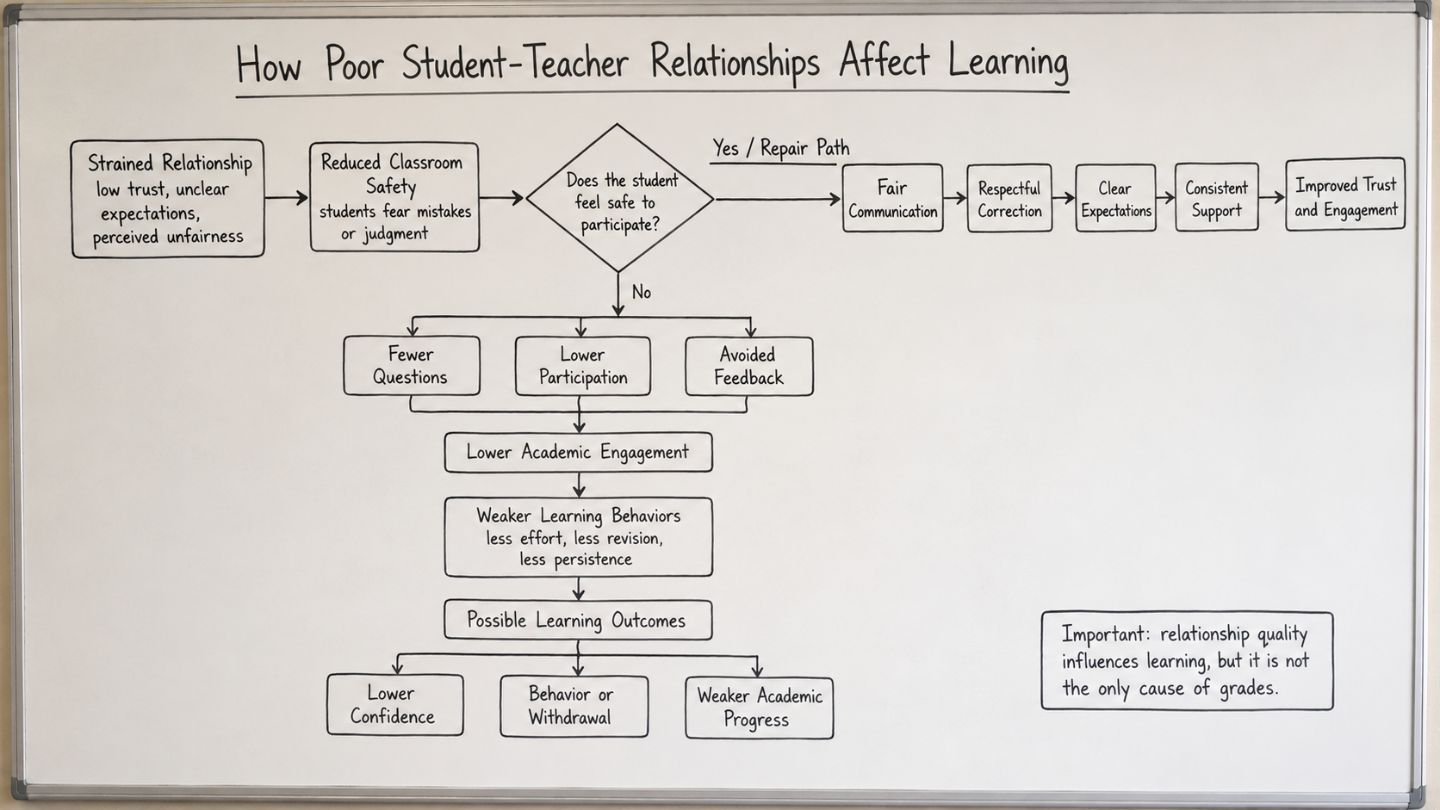
Poor student-teacher relationships can weaken learning by reducing trust, motivation, participation, help-seeking, feedback use, and classroom engagement. A poor relationship does not mean a teacher is strict. It means the professional classroom relationship lacks enough respect, fairness, clarity, support, or emotional safety for students to learn with confidence.
This topic matters because learning depends on interaction. Students ask questions, try difficult tasks, make mistakes, receive feedback, and return to the work with better understanding. When students expect embarrassment, unfair treatment, rejection, or harsh correction, they may protect themselves by staying silent, avoiding help, or doing only the minimum.
Research supports this concern, but it should be interpreted carefully. Teacher-student relationship quality is associated with engagement and academic achievement, yet it is not the only factor behind student performance. Prior knowledge, home support, health, school resources, teaching quality, curriculum, assessment systems, peer influence, and student effort also matter. The American Psychological Association states that improving students’ relationships with teachers has academic and social implications, while meta-analytic research links affective teacher-student relationships with school engagement and achievement.
Answer Summary:
Poor student-teacher relationships affect learning mainly through classroom behavior and engagement. Students may ask fewer questions, participate less, avoid feedback, lose confidence, or become resistant when they do not feel respected or fairly supported. Research links relationship quality with engagement, achievement, motivation, and well-being, but the link should not be treated as the only cause of grades. The practical response is fair communication, respectful correction, clear expectations, and early repair when trust weakens.
Table of Content
- What Is a Poor Student-Teacher Relationship?
- Poor Relationship vs Strict but Fair Teaching
- Main Effects on Learning
- Why Poor Relationships Affect Learning
- Common Causes of Poor Student-Teacher Relationships
- Effects by Education Level
- How Teachers, Students, Parents, and Schools Can Respond
- Relationship Quality Checklist
- What This Does Not Mean
- Conclusion
Key Takeaways:
-
Poor relationships reduce learning through trust, participation, engagement, and feedback.
-
Strict teaching is different from poor relationship quality when it remains fair, clear, and respectful.
-
Students may stop asking questions when mistakes feel unsafe.
-
Research supports association, not a single-cause explanation for grades.
-
Repair depends on consistent classroom behavior, not one dramatic conversation.
-
Schools can track relationship quality through surveys, observation, and participation patterns.
What Is a Poor Student-Teacher Relationship?
A poor student-teacher relationship is a strained professional classroom relationship where a student does not feel respected, fairly treated, supported, or safe to participate. It can include frequent conflict, emotional distance, unclear expectations, public embarrassment, harsh correction, perceived favoritism, or feedback that feels personal rather than instructional.
In a healthy classroom relationship, the teacher can still set firm rules, assign difficult work, correct mistakes, and expect effort. The difference is that students understand the reason for expectations and believe the teacher is acting fairly. The Australian Education Research Organisation (AERO) describes positive teacher-student relationships as supportive and fair, developing in learning environments where students feel safe, understood, and appreciated.
Students who want practical learning support can pair this topic with effective learning strategies for school students, especially when classroom confidence or participation has become difficult.
Poor Relationship vs Strict but Fair Teaching
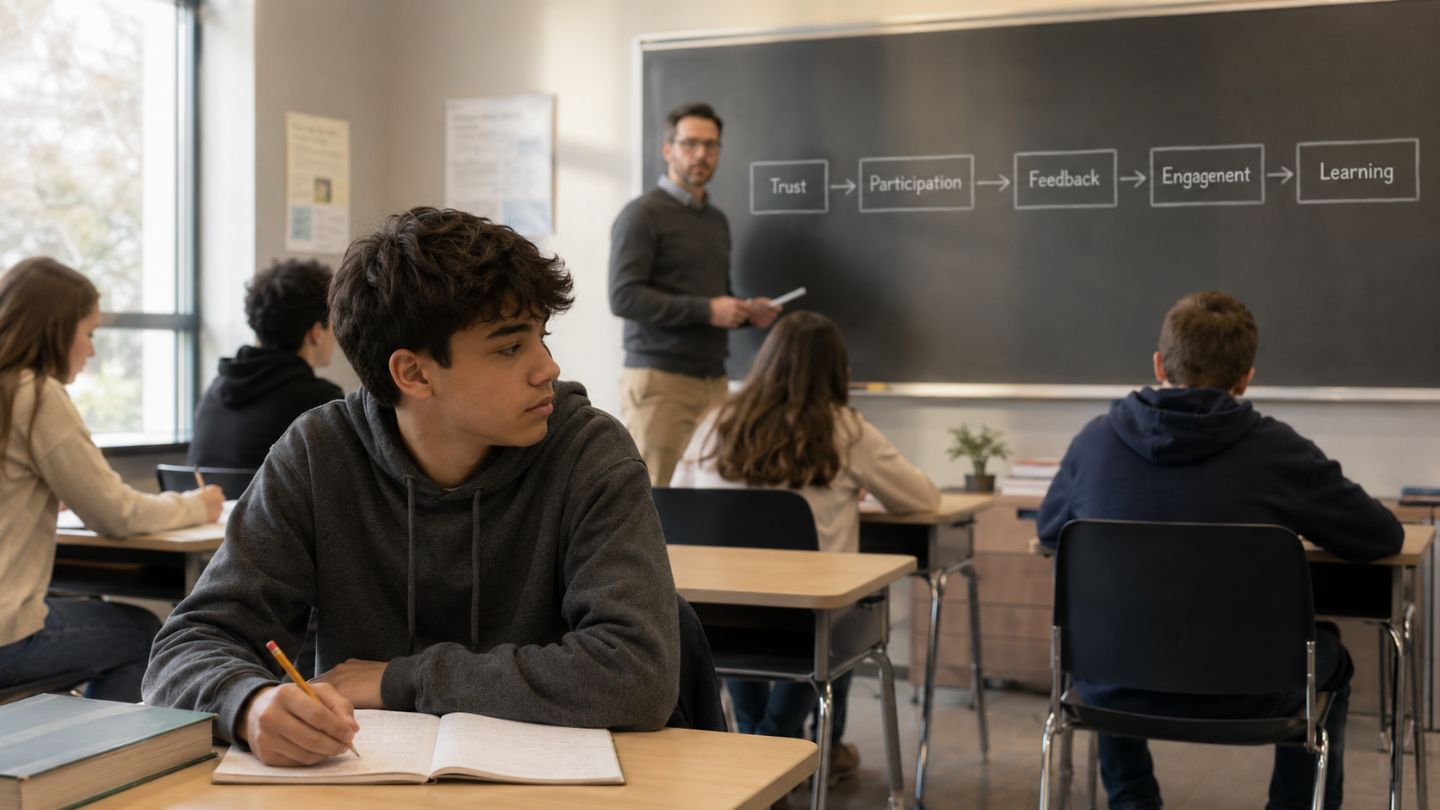
Strict teaching is not the same as poor relationship quality. A teacher can be demanding and still support learning when rules are clear, feedback is respectful, and students know what to expect.
| Classroom feature | Strict but fair teaching | Poor student-teacher relationship |
|---|---|---|
| Rules | Clear and consistent | Unclear or unevenly applied |
| Correction | Focuses on work or behavior | Feels personal or humiliating |
| Feedback | Shows how to revise | Makes students avoid trying |
| Participation | Mistakes are treated as part of learning | Mistakes feel socially risky |
| Trust | Students know the teacher is fair | Students feel ignored, targeted, or dismissed |
| Learning effect | Structure supports effort | Conflict reduces engagement |
This distinction matters because some students may dislike strict routines, but strict routines are not harmful by themselves. The concern begins when correction becomes unfair, unclear, disrespectful, or disconnected from learning.
Main Effects on Learning
Poor student-teacher relationships affect learning by changing how students behave in class. The first signs may appear as silence, low effort, missed assignments, weak feedback use, or resistance before grade changes become visible.
Lower Motivation
Poor relationships can reduce motivation when students feel unsupported, judged, or invisible. A student who believes the teacher has already formed a negative view may stop investing effort, even when the subject is still within reach.
Better teacher-student contact and mutual relationships were linked with higher learning motivation in a community school context.
For readers studying motivation more broadly, Collegenp’s article on the science of motivation in learning can be used as a related reading path.
Reduced Participation and Help-Seeking
Students learn less when they stop asking questions. In a strained relationship, a student may avoid speaking because the social risk feels higher than the academic benefit.
This can affect capable students as well as struggling students. A student may know part of an answer but stay silent to avoid embarrassment. Another student may misunderstand an assignment but submit weak work instead of asking for clarification. Over time, hidden confusion becomes a learning gap.
This is one reason communication skills matter for students as well as teachers. Students who need help asking questions, requesting clarification, or responding to feedback can benefit from communication skills for students.
Lower Academic Engagement
Academic engagement includes attention, effort, persistence, preparation, class involvement, and task completion. A 2024 Frontiers in Psychology article reported that teacher-student relationship quality was positively associated with university students’ academic engagement, with perceived social support and academic pressure involved in the pathway. The authors also noted limits, including the cross-sectional design and the Chinese university sample.
This matters because engagement is one classroom route through which relationship quality connects to learning. When students feel unsupported, they may spend less time on tasks, give up earlier, or treat assignments as compliance rather than learning.
Weaker Feedback Use
Feedback works when students believe it is meant to help them revise their work. When trust is weak, even accurate feedback can be ignored, resisted, or feared.
For example, “This answer is careless” may make a student defensive. “Your answer has the right idea, but the evidence is missing; add one example from the text” gives the student a concrete next step. The second response protects dignity while keeping academic standards.
Students who want to turn feedback into better study habits may find Collegenp’s guide on key learning strategies for student success useful as a follow-up.
Lower Academic Confidence
A strained relationship can reduce academic confidence when students begin to connect correction with personal failure. This is especially common in subjects where a student already feels weak.
A 2023 Frontiers in Psychology study of fourth and eighth graders in China found that teacher-student relationship quality was linked with academic achievement directly and indirectly through subjective well-being. The study also found grade-level differences, which supports discussing age and development rather than treating all students the same.
Academic confidence is also connected with emotional awareness, self-control, and classroom communication. Readers interested in this angle can read about how emotional intelligence shapes academic success for students.
More Classroom Behavior Problems
Poor relationships can create a conflict cycle. A student feels disrespected, withdraws or acts out, the teacher responds with more control, and the student becomes more resistant.
This does not mean behavior problems come only from teacher behavior. Stress, peer conflict, family circumstances, learning difficulties, and school discipline systems also affect behavior. McGrath and Van Bergen’s review examined students at risk of negative student-teacher relationships and discussed how such relationships relate to academic, social, behavioral, and emotional development.
Weaker School Belonging
When students feel disconnected from teachers, they may also feel less connected to school. The CDC defines school connectedness as students feeling that adults and peers at school care about them as individuals and about their learning. CDC guidance also links school connectedness with higher grades and test scores, better attendance, and high school graduation.
One difficult relationship does not mean a student will disengage from school. The risk grows when students repeatedly experience unfairness, humiliation, or lack of support across classrooms.
Why Poor Relationships Affect Learning
Poor relationships affect learning through a chain of classroom experiences. Weak trust reduces participation and help-seeking; low participation reduces feedback; weak feedback use slows revision; repeated failure or silence lowers confidence and engagement.
| Relationship issue | Learning pathway | Classroom sign | Better response |
|---|---|---|---|
| Low trust | Student avoids risk | Silence, no questions | Use predictable routines and respectful prompts |
| Harsh correction | Student fears mistakes | Incomplete answers | Give task-focused feedback |
| Perceived unfairness | Student stops trying | Low effort or resentment | Apply rules consistently |
| Emotional distance | Student feels unseen | Limited participation | Notice effort and learning needs |
| Poor communication | Student misunderstands work | Missed or weak assignments | Clarify criteria with examples |
| Repeated conflict | Student resists instruction | Disruption or withdrawal | Reset expectations calmly |
Roorda and colleagues’ 2017 meta-analysis examined whether student engagement mediates the link between affective teacher-student relationships and achievement. The sample included 189 studies and 249,198 students from preschool to high school, and the authors tested engagement as part of the relationship-achievement pathway.
This does not prove that every poor grade comes from a poor relationship. It does support a practical point: when relationships weaken engagement, learning is likely to suffer.
Common Causes of Poor Student-Teacher Relationships
Poor student-teacher relationships often grow from repeated small interactions, not one disagreement. Common causes include unclear rules, uneven discipline, poor communication, perceived favoritism, public criticism, low empathy, lack of individual support, and limited opportunities for students to speak safely.
School conditions also matter. Heavy syllabus pressure, large classes, exam-focused routines, limited counseling support, and teacher workload can make relationship-building harder. OECD’s 2025 report on high-quality teaching describes social-emotional support as involving a supportive classroom climate and positive relationships that are conducive to learning.
Effects by Education Level
The effects of poor relationships differ by age and education stage. Younger students may show distress or avoidance, adolescents may show resistance or silence, and university students may avoid academic contact.
Primary School
Primary students depend heavily on teacher reassurance, routines, and emotional safety. A poor relationship may appear as fear of school, refusal to answer, task avoidance, sudden tears, or increased behavior concerns.
The 2011 Roorda meta-analysis found that affective teacher-student relationship qualities were associated with engagement and achievement across preschool to high school studies. It also reported that negative relationship effects were stronger in primary than in secondary school.
Secondary School
Secondary students may care about achievement but avoid appearing vulnerable. They may stop asking questions, skip assignments, disengage during class, or respond with sarcasm.
Fairness becomes especially relevant at this stage because adolescents often compare how teachers treat different students. If students believe correction is inconsistent, they may stop viewing class rules as legitimate.
College and University
In higher education, poor relationships can reduce class discussion, office-hour use, feedback-seeking, and confidence in academic work. The 2024 Frontiers study on academic engagement supports the view that teacher-student relationship quality remains relevant beyond school-level education, while also cautioning that its findings come from a specific sample and design.
College readers can connect this topic with effective learning strategies for college students, especially when they need to manage independent learning, feedback, and academic communication.
How Teachers, Students, Parents, and Schools Can Respond
Repairing poor student-teacher relationships requires shared effort, but adults and institutions carry the main responsibility for fair and safe learning conditions. The goal is not friendship. The goal is a respectful professional relationship that helps students learn.
| Role | Useful action | Learning purpose |
|---|---|---|
| Teacher | Explain rules and grading criteria before tasks | Reduces confusion and perceived unfairness |
| Teacher | Correct privately when possible | Reduces shame and resistance |
| Teacher | Give feedback on work, not identity | Keeps revision possible |
| Teacher | Use consistent routines | Builds predictability |
| Student | Ask for clarification respectfully | Helps reveal confusion early |
| Student | Keep notes on instructions and feedback | Supports self-management |
| Parent or guardian | Look for repeated patterns before escalating | Keeps the response fair |
| School leader | Use anonymous student surveys | Detects relationship concerns early |
| School leader | Support teacher training in feedback and communication | Improves classroom consistency |
| Counselor or mentor | Help repair communication after conflict | Protects learning continuity |
AERO notes that trust and positive teacher-student relationships grow through repeated interactions, structure, predictability, routines, and consistency. That point is useful for repair: relationship quality usually improves through repeated fair actions, not one speech or one apology.
Practical Repair Sequence
When a relationship feels strained, a low-risk repair process can help:
-
Identify the pattern: Is the issue about feedback, discipline, participation, grading, tone, or misunderstanding?
-
Reduce public conflict: Move sensitive correction or discussion away from peer attention when possible.
-
Clarify expectations: Use examples, rubrics, or short written instructions.
-
Separate the learner from the mistake: Discuss the work or behavior, not the student’s identity.
-
Create a small success point: Give the student a clear task they can complete and improve.
-
Review after a short period: Check whether participation, questions, feedback use, or assignment completion has changed.
This process is useful because it focuses on learning behavior rather than blame.
Relationship Quality Checklist
Schools, teachers, students, and families can use these questions to identify whether relationship quality may be affecting learning:
-
Do students feel safe asking questions?
-
Are rules clear and applied consistently?
-
Is feedback specific enough for revision?
-
Are mistakes treated as part of learning?
-
Do quiet students receive fair chances to participate?
-
Are corrections focused on work or behavior rather than personal traits?
-
Do students know where to seek help when classroom conflict continues?
-
Are attendance, participation, and assignment patterns changing after conflict?
-
Is the same student repeatedly corrected without a repair attempt?
-
Is student feedback collected in a safe and anonymous way?
These prompts should be used to detect patterns, not to label one person as the cause of every classroom problem.
What This Does Not Mean
Poor student-teacher relationships should not be used to blame one person for every learning problem. A student can struggle even with a supportive teacher. A teacher can work hard and still face difficult classroom conditions. A school can value relationships and still need stronger systems.
The balanced interpretation is this: relationship quality is one learning condition among several. It deserves attention because it is visible in daily classroom life and can often be improved through clearer expectations, fairer communication, and early support.
Conclusion
Poor student-teacher relationships affect learning by weakening trust, participation, motivation, feedback use, confidence, and engagement. The evidence supports a careful claim: relationship quality is associated with learning outcomes, especially through engagement and classroom climate, but it is not the single cause of academic success or failure.
For students, the first step is to keep asking for clarification in respectful and safe ways. For teachers, the first step is to make expectations, correction, and feedback predictable and fair. For parents, the first step is to look for repeated patterns before escalating concerns. For schools, the first step is to measure relationship quality and support teachers with training, observation, and counseling systems.




Comments 0
No comments yet. Be the first to start the conversation.