




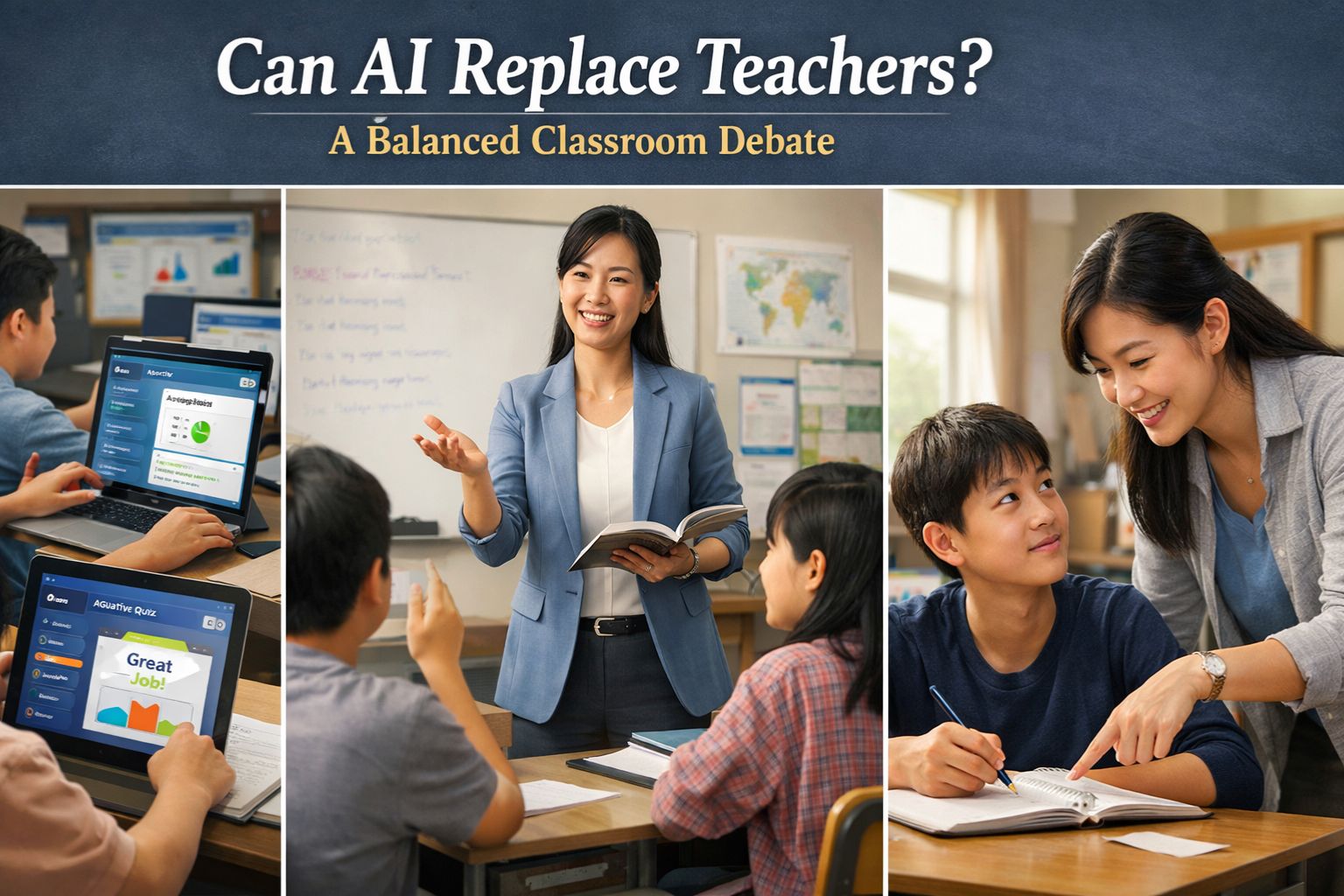
Schools, students, parents, and education leaders are asking a question that sounds simple but carries several separate issues: can AI replace teachers? A useful answer starts by narrowing the claim. Teaching is not only content delivery. It also includes lesson planning, explanation, guided practice, assessment, classroom culture, motivation, and responsibility for student welfare. When the debate is framed that way, the real issue is not whether software can copy every part of teaching. It is whether software can take over selected teaching tasks without weakening learning, fairness, or trust.
The question matters now because AI tools are already present in education systems. UNESCO says the world is projected to need 44 million more primary and secondary teachers by 2030. Gallup reports that six in ten U.S. teachers used an AI tool for work during the 2024–25 school year, with common uses tied to preparation, worksheets, and adapting materials. OECD’s 2026 outlook adds a second warning: AI can aid learning when guided by sound pedagogy, yet outsourcing tasks to AI without that guidance can raise visible performance without real learning gains.
Research gives the debate a more measured shape. A 2025 Scientific Reports study found stronger learning, higher engagement, and higher motivation in a structured AI tutor condition than in an in-class active-learning comparison. At the same time, a 2025 systematic review on teacher-student relationships links positive relationships with stronger academic outcomes and links negative relationships with disengagement and lower results. Put together, the evidence suggests a split answer: AI can replace some teaching work, but the case for full professional replacement remains weak in most school settings.
Summary
AI can replace selected teaching tasks such as drill practice, first-pass feedback, translation help, and some forms of structured tutoring. It does not replace the full role of teachers in most schools. Teaching also depends on judgment, trust, social context, and accountable decisions about students. The strongest evidence supports bounded AI use under teacher or tutor oversight, not full professional substitution.
Table of Content
- What does “replace teachers” mean?
- What can AI already do well in education?
- Where does AI fall short?
- What is the strongest case for AI replacing some teaching work?
- What is the strongest case against full replacement?
- Which parts of teaching are more replaceable, and which are not?
- How should schools, students, and families judge AI use?
- What does a balanced model look like?
- Conclusion
- Sources Used
Key Takeaways
-
AI is strongest on narrow, reviewable tasks.
-
Teaching is broader than content delivery.
-
Better task performance does not always mean better learning.
-
Positive teacher-student relationships still matter for engagement and academic outcomes.
-
Privacy, fairness, and accountability are central school issues.
-
The clearest path is teacher-led or tutor-led AI use, not full replacement.
What does “replace teachers” mean?
Replacement is better understood as task substitution rather than full professional removal. UNESCO’s AI competency framework for teachers defines knowledge, skills, and values that teachers need in the age of AI, which points toward role change and professional adaptation rather than disappearance of the profession.
A teacher’s role includes planning, explanation, guided practice, assessment, behavior management, relationship work, and protection of fair treatment. Some of those functions are narrow and repeatable. Others depend on context, memory of past interactions, and responsibility for decisions that shape a student’s learning path. That is why “replace teachers” is often too blunt. A better question is which parts of teaching can be handed to software while a teacher still remains accountable for the learning environment.
What can AI already do well in education?
AI already performs best in education when the task is structured, repeatable, and open to review. The clearest examples are practice systems, routine feedback, draft materials, adaptation of reading level, translation support, and bounded tutoring.
Personalized practice and quick feedback
AI can support personalized practice and rapid feedback at a scale that one teacher alone may not always reach. The Scientific Reports study on a custom AI tutor found that students learned more in less time than peers in the in-class comparison and also reported stronger engagement and motivation in that setting. Earlier review work on intelligent tutoring systems also found positive effects across many evaluations. These findings do not prove that AI tutors beat teachers across all subjects and ages. They do support the narrower claim that well-designed tutoring systems can replace some direct instruction and practice work in structured settings.
Teacher workload support
AI can also take over selected background tasks that consume teacher time. Gallup reports that teachers most often use AI for preparing to teach, making worksheets or activities, and modifying materials to meet student needs. Teachers who use AI weekly estimate average time savings of 5.9 hours per week, and many report better quality in routine work. That does not amount to replacement of the full teacher role, though it does show clear substitution of some teacher labor.
Access support in shortage settings
AI has a stronger case where access is thin. UNESCO’s 44-million-teacher shortage figure explains why systems are looking for ways to expand explanations, language support, and tutoring. In places where qualified staff are scarce, some software-based support may be better than no support for selected tasks. This point strengthens the case for bounded classroom use, though it does not settle the question of full replacement.
Where does AI fall short?
AI falls short where teaching depends on trust, relationship, ethical judgment, and public accountability. Those parts of schooling are not side issues. They are part of the job itself.
Relationships, trust, and motivation
Positive teacher-student relationships are linked with academic engagement and stronger outcomes. The 2025 systematic review in Frontiers was built around that point and examined ties between teacher-student relationships, disengagement, achievement, and early school leaving. A system that can explain algebra well is not automatically able to notice withdrawal, rebuild trust after failure, or judge when a student needs a different form of support. Those relational parts of teaching remain central in classrooms.
Brookings adds a related caution. Its 2025 article on AI chatbots and human connection describes support benefits reported by some users, yet also points to emotional dependency and the risk of replacing human relationships with easier machine interaction. In school settings, that warning matters because children and adolescents are still building social judgment and self-regulation.
Social and emotional learning
Teachers also shape social and emotional learning through routines, group work, feedback tone, and conflict handling. OECD’s work on social and emotional skills ties those skills to academic and life outcomes and states that many such skills are teachable through education. A classroom with little human guidance may still deliver information, yet it loses part of the setting where students learn how to cooperate, persist, and respond to challenge.
Privacy, fairness, and accountability
AI in schools also raises privacy and fairness questions. UNESCO’s ethics recommendation places privacy, data protection, transparency, fairness, and human oversight at the center of responsible AI use. UNESCO’s ethical impact assessment work adds auditability and public information about systems as major concerns, especially in sensitive public domains. In education, those concerns become sharper when AI is used for grading, behavior analysis, or decisions that affect student records.
A 2025 study on fairness perceptions in AI grading adds evidence from student views. The study examined 228 college students in South Korea and found reluctance toward AI grading compared with human professors, with fairness perceptions shaped by dissatisfaction with the existing system and by outcome favorability. The point is not that human grading is flawless. It is that schools need reasons for trust, transparency, and appeal when AI enters assessment.
Performance gains vs real learning
OECD’s 2026 outlook makes one of the most useful distinctions in this debate. It states that outsourcing tasks to AI without pedagogical guidance can enhance performance without real learning gains. That warning explains why polished output is not a sufficient test. Students may submit stronger answers with AI assistance and still learn less if the tool is doing too much of the reasoning work.
What is the strongest case for AI replacing some teaching work?
The strongest case for replacement is narrow and practical. AI can take over selected instructional functions where the learning goal is clear, the task is structured, and the output is easy to check.
One strong example is practice-heavy learning in areas such as arithmetic, vocabulary, grammar, or introductory science. In those areas, AI can provide immediate response loops, adapt difficulty, and keep students active without waiting for teacher attention. The Scientific Reports trial on AI tutoring offers one of the clearest current pieces of evidence for this use case.
A second example is after-hours support. Students often need help outside class time, and software can answer routine questions at any hour. A third example is first-pass feedback: grammar suggestions, likely rubric-aligned comments, or flagged gaps for a teacher to review. Gallup’s teacher survey shows that classroom staff are already using AI on these kinds of tasks rather than on the full role of teaching.
What is the strongest case against full replacement?
The strongest case against full replacement is that teaching is a public-trust profession, not only a delivery channel for content. UNESCO’s teacher framework is built around human agency, ethics, pedagogy, and professional learning. That framing fits schools, where adults remain responsible for decisions that affect students’ rights, records, and learning conditions.
The anti-replacement case gets stronger as the stakes rise. Drafting a worksheet and assigning a grade are not equivalent. UNESCO’s ethics standard and related impact-assessment material call for privacy protection, transparency, accountability, robustness, and human oversight. In education, that means humans remain responsible when an AI system is involved in decisions with academic or personal consequences.
There is also a developmental argument. School is one of the main places where students learn discussion habits, patience, cooperation, and recovery after mistakes. OECD’s social and emotional skills work and the teacher-student relationship review both point toward outcomes that are tied to human interaction, not only information delivery. That is a major reason the current evidence supports task support more strongly than full teacher substitution.
Which parts of teaching are more replaceable, and which are not?
Some teaching tasks are more replaceable because they are narrow, predictable, and reviewable. Other tasks are less replaceable because they rely on context, trust, and accountable judgment.
More replaceable tasks
More replaceable tasks include drill practice, short-answer feedback, worksheet drafting, reading-level adaptation, translation support, routine content explanation, quiz generation, and after-hours question handling. These align with the areas where Gallup reports teacher use and where bounded tutoring evidence is strongest.
Less replaceable tasks
Less replaceable tasks include building classroom trust, resolving conflict, reading student mood or withdrawal, making high-stakes assessment judgments, supporting social and emotional growth, and holding responsibility for fair treatment. These functions sit close to the relationship and ethics evidence rather than the practice-system evidence.
How should schools, students, and families judge AI use?
A sound judgment framework starts with fit rather than novelty. Low-risk support work can move first. Higher-risk uses need strong human review, clear privacy rules, and trained staff.
A five-part school decision framework
Learning goal
Ask whether the tool is strengthening learning or only producing cleaner output. OECD’s 2026 outlook makes this distinction central.
Risk level
Ask how much harm a mistake could cause. A worksheet draft and a grading decision do not carry the same risk. UNESCO’s ethics framework supports stronger oversight as stakes rise.
Data and privacy
Ask what student data the tool collects, stores, or shares. UNESCO places privacy and data protection across the full AI lifecycle, which makes school procurement and policy review essential.
Human review
Ask who checks the output, who can override it, and how students can challenge a decision. Accountability is part of responsible school use, not an afterthought.
Staff training
Ask whether teachers and leaders know how to use the system, spot weak outputs, and set boundaries. RAND reports that if district plans held, about three-quarters of districts would have provided teacher training on AI use by fall 2025, which shows both movement and uneven readiness. (
A student and family self-check
Students and families can use a shorter version of the same framework. What is the tool doing for you? Is it supporting practice, or is it doing the reasoning for you? Can you explain the answer without the tool? Are you sharing data that affects privacy? Is a teacher still involved in the parts that shape grades, placement, or well-being? Those checks fit both UNESCO’s ethics guidance and OECD’s warning about output without learning.
What does a balanced model look like?
The current evidence supports teacher-led or tutor-led AI use more strongly than teacher removal. UNESCO’s competency framework focuses on the capabilities teachers need in the AI era, and Tutor CoPilot points toward a hybrid pattern where AI strengthens human instruction rather than replacing it.
In practical terms, that means teachers using AI for drafts, differentiation, extra practice, translation help, and low-stakes feedback while retaining control over goals, explanation, assessment, and classroom culture. It also means schools choosing tools that are built around learning design and checking them through evidence rather than broad claims. OECD’s 2026 outlook supports that direction by tying successful AI use to pedagogy rather than to automation for its own sake.
Conclusion
AI can replace selected teaching tasks. It can support drill practice, routine explanation, first-pass feedback, material adaptation, and some forms of tutoring with useful results. That is the strongest point on the pro side, and current research supports it in bounded settings.
AI does not replace the full teacher role in most schools. Teaching also includes judgment, trust, classroom culture, fairness, privacy-sensitive decisions, and responsibility for student welfare. The evidence on teacher-student relationships, social and emotional learning, and ethical oversight keeps that boundary clear.
A balanced next step is to judge AI use task by task. Use it first where the work is narrow and reviewable. Keep strong human control where the stakes are high or the relationship work is central. That approach turns the debate into a practical framework for schools, students, and families.
Sources Used
-
UNESCO, Guidance for GenAI in Education and Research, 2023, UNESCO.
-
UNESCO, AI Competency Framework for Teachers, 2024 framework, UNESCO article updated 2026.
-
UNESCO, Global Report on Teachers: Addressing Teacher Shortages and Transforming the Profession, 2024 report, UNESCO article updated 2026.
-
UNESCO, Recommendation on the Ethics of Artificial Intelligence, global standard adopted in 2021, UNESCO pages updated through 2024.
-
OECD, OECD Digital Education Outlook 2026, 2026, OECD Publishing.
-
OECD, Social and Emotional Skills: Latest Evidence on Teachability and Impact on Life Outcomes, 2023, OECD Education Working Papers.
-
Gallup and Walton Family Foundation, Three in 10 Teachers Use AI Weekly, Saving Six Weeks a Year, 2025, Gallup.
-
RAND, More Districts Are Training Teachers on Artificial Intelligence, 2025, RAND. (
-
Kestin, Greg, et al., AI Tutoring Outperforms In-Class Active Learning, 2025, Scientific Reports.
-
Kulik, James A., and J. D. Fletcher, Effectiveness of Intelligent Tutoring Systems, 2016, Review of Educational Research.
-
Wang, Rose E., et al., Tutor CoPilot: A Human-AI Approach for Scaling Real-Time Expertise, 2024/2025, EdWorkingPapers.
-
Di Lisio, Giulia, et al., Nurturing Bonds That Empower Learning: A Systematic Review of the Significance of Teacher-Student Relationship in Education, 2025, Frontiers in Education.
-
Jones-Jang, S. Mo, et al., Fairness Perceptions of AI in Grading Systems, 2025, Computers and Education: Artificial Intelligence.
-
Brookings Institution, What Happens When AI Chatbots Replace Real Human Connection, 2025, Brookings.





Comments 0
No comments yet. Be the first to start the conversation.