



The Role of AI in Chartered Accountancy Today
AI is changing chartered accountancy by shifting part of the workload from manual processing toward review, control, interpretation, and communication. In practice, the role of AI in CA work is strongest in bounded tasks such as document handling, classification support, anomaly spotting, and draft preparation, while responsibility for material judgments and final sign-off stays with people.
This matters now because professional bodies, regulators, and educators are already responding. Chartered Accountants Worldwide and Ipsos reported broad willingness among surveyed chartered accountants to use AI, the FRC issued audit guidance in 2025, the IAASB opened a technology quality-management initiative in June 2025, and ICAI is running AI-focused courses and member tools.
This article takes a global view and adds India-relevant examples because “CA” is widely used to mean chartered accountant in South Asia. The goal is to help readers assess where AI fits, what it cannot do well, which skills remain central, and which controls matter before adoption. This article is for information only and is not legal, financial, or professional advice.
Summary
AI already has a working role in chartered accountancy, but that role is narrower than many headlines suggest. It supports repetitive and document-heavy tasks, while chartered accountants remain responsible for evidence, ethics, confidentiality, skepticism, and client communication. Current evidence points to task change and new skill demands more than a clean replacement of the profession.
Table of Content
- The Role of AI in Chartered Accountancy Today
- What does AI mean in chartered accountancy?
- Where is AI already changing CA work?
- What skills do chartered accountants need now?
- What risks and governance issues matter most?
- Will AI replace chartered accountants?
- What should students, firms, and finance teams do next?
- Conclusion
Key Takeaways
-
AI is strongest today in bounded, reviewable accounting tasks.
-
Chartered accountants still own judgment, documentation, and sign-off.
-
Audit bodies now frame AI as a quality-management issue.
-
Confidentiality and data use are central adoption risks.
-
Students and practitioners need accounting depth plus AI review skills.
-
Entry-level work may change first because routine work is easier to automate.
What does AI mean in chartered accountancy?
In this context, AI means systems that infer from input data and produce outputs such as classifications, summaries, recommendations, draft text, or flagged exceptions that influence accounting work. That matches the OECD definition of an AI system and fits how regulators and professional bodies are describing present use inside finance and audit workflows.
For chartered accountants, this usually appears inside accounting platforms, document-search tools, review tools, and drafting assistants. It does not remove the need for accounting standards knowledge, evidence checks, or ethical judgment. The tool may produce an output, but the CA still has to decide whether that output is fit for use.
Where is AI already changing CA work?
AI is already changing CA work in finance operations, audit support, document-heavy review, and parts of compliance work. The common pattern is not full automation of the profession. It is a redistribution of time away from repetitive handling and toward review, exceptions, and communication.
Finance operations and reporting
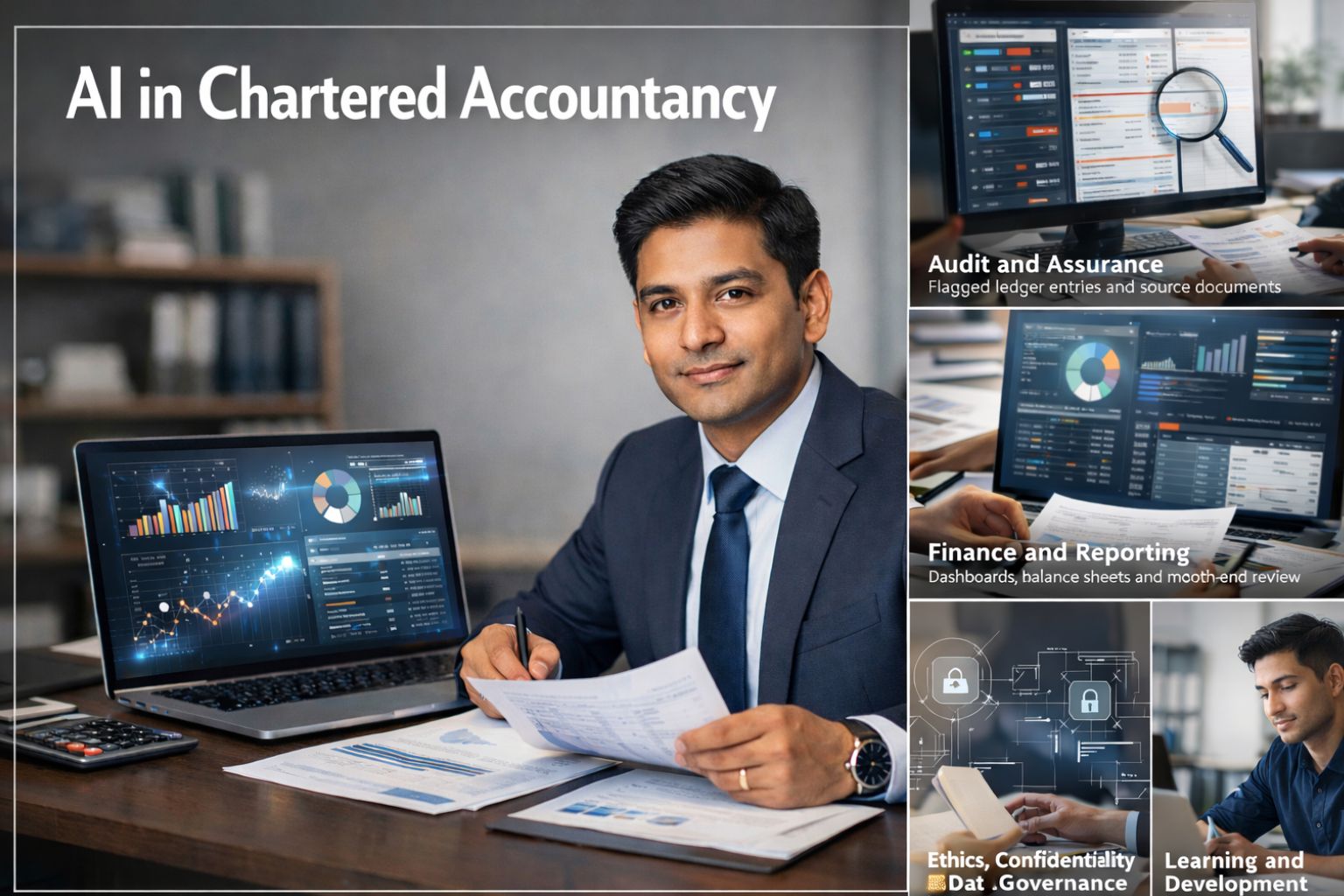
In finance operations, AI is being used for transaction classification support, reconciliation support, contract summarization, draft reporting, and close-process assistance. Early field evidence from a 2025 accounting study found a reallocation of about 9% of accountant time from routine data entry toward higher-value tasks, along with a 12% increase in ledger granularity and a 7.5-day reduction in monthly close time in the studied setting. Those figures come from a specific research context, so they should be read as early evidence rather than a universal outcome for every firm.
Audit and assurance
In audit, AI is being treated more cautiously. The FRC’s 2025 guidance uses journal testing as an example of where AI may help extend procedures and identify unusual transactions, while also stressing documentation of the tool and its role in the engagement. The IAASB’s technology initiative also frames emerging tools as something that has to be managed within existing quality-management standards.
Tax, compliance, and client service
In tax and compliance work, AI is often entering as research support, draft preparation, workflow assistance, and document handling rather than stand-alone decision-making. ICAI’s official AI pages show both institute-backed courses and a member-and-student CA GPT beta, which signals active institutional interest in AI-enabled professional workflows.
What skills do chartered accountants need now?
The skill profile for chartered accountants is shifting toward a mix of accounting depth, AI literacy, review discipline, and communication. The strongest position is not tool use alone. It is the ability to judge whether a tool’s output is reliable, relevant, and properly documented.
Technical literacy
Technical literacy for CAs means understanding what the tool does, what data it uses, how it can fail, and what checks are needed before relying on the output. It does not mean every accountant must become a software developer. It means they need enough system understanding to challenge weak output and spot misuse.
Judgment, skepticism, and communication
Professional judgment remains central. ACCA’s 2025 work states that professional judgment and critical thinking are fundamental when dealing with AI-supported insights and that decisions need to be documented to support transparency and accountability. That is especially important in audit, reporting, and client-facing work where a polished output may still be incomplete or wrong.
Training pathways for students and working professionals
Training needs are becoming more visible across the profession. Chartered Accountants Worldwide and Ipsos found strong willingness to use AI among surveyed chartered accountants and also identified skills and training gaps. IFAC’s education standards continue to frame competence as a structured development issue, while the World Economic Forum reported that employers expect 39% of workers’ core skills to change by 2030. For CA students, that means accounting fundamentals still come first, followed by careful use of AI for reading, draft support, and comparison tasks. For working professionals, the better starting point is task mapping, control design, and error tracking in a small number of bounded use cases.
What risks and governance issues matter most?
The main risks are client confidentiality, poor documentation, over-reliance on output, weak explainability, and unclear accountability. These are not side issues. They determine whether AI use fits professional standards and whether the resulting work can be trusted.
Client confidentiality and data handling
IESBA’s technology-related ethics and independence material places confidentiality, competence, and due care at the center of technology use. Its phase 2 work also highlights issues such as informed consent, anonymization, and whether client or customer data may be used for internal purposes such as model training. For CA firms, that means vendor review, internal policy, and data-handling rules need to be settled before staff begin placing client material into tools.
Explainability, documentation, and evidence
Explainability matters because a CA has to justify why a conclusion was accepted. The FRC’s audit guidance links AI use with documentation of the tool and its use in the engagement, and its newer 2026 guidance continues to discuss audit-quality risks and professional judgment when firms use advanced AI tools. In simple terms, if the team cannot explain why the output is relevant and reliable, it is harder to defend as professional evidence.
Low-risk adoption path
A lower-risk path starts with internal summarization, classification suggestions that remain reviewable, internal knowledge search, and draft support for non-final documents. Higher-risk uses include unsupervised tax conclusions, external-facing advice without review, and audit judgments where the team cannot describe the tool’s role or limitations. Early accounting research also found cases where users over-relied on inaccurate AI-suggested classifications, which is a useful warning for practice.
Will AI replace chartered accountants?
The present evidence does not support a clean claim that AI will replace chartered accountants as a profession. It supports a narrower claim: AI is changing the mix of tasks inside the profession, with routine work moving first and judgment-heavy work staying more resistant.
This distinction matters for career planning. Chartered Accountants Worldwide and Ipsos reported that 85% of surveyed chartered accountants were at least fairly willing to use AI if given the opportunity, and 79% agreed that accountants’ role as “data guardians” would become more important as AI spreads in business. The same report also describes expectations that the role will shift toward strategic advice and away from repeated manual tasks.
Entry-level work is likely to feel the change early because classification, document handling, and repetitive checking are easier to automate than client communication or high-stakes judgment. The World Economic Forum reported in 2025 that employers expect 39% of workers’ core skills to change by 2030 and that job disruption will affect 22% of jobs by 2030. For the CA profession, that points to retraining pressure rather than a single end point.
What should students, firms, and finance teams do next?
The next step depends on role and risk level. Students need strong accounting basics and review habits. Small firms need careful task selection and stricter data rules. Finance teams need control points, error tracking, and named reviewers before wider rollout.
Student checklist
-
Learn accounting, audit, tax, and ethics before leaning on AI output.
-
Use AI first for reading support, draft structure, and comparison work.
-
Check every important number, conclusion, and reference against source material.
-
Follow institute-led training where available.
Small practice checklist
-
Start with one or two bounded use cases.
-
Review vendor terms on data retention, confidentiality, and model-training use.
-
Keep a rule that no external-facing output leaves without human review.
-
Record common errors and update review notes for staff.
Finance team checklist
-
Sort tasks by risk: low-risk drafting, medium-risk classification, high-risk judgment.
-
Keep sign-off rules for close, reporting, and exceptions.
-
Track whether output quality and rework improve after adoption.
-
Review training needs often because skill gaps can become a control issue.
Conclusion
AI has a growing role in chartered accountancy, but the evidence points to a controlled and uneven change rather than a profession-wide handover to software. The strongest near-term use cases sit in repetitive, reviewable, and document-heavy work. The strongest human contribution stays in ethics, skepticism, evidence, communication, and accountability. For students and practitioners, the sound next step is careful adoption, stronger review habits, and continuous skill development grounded in accounting fundamentals.
Sources Used
-
OECD: “What is AI? Can you make a clear distinction between AI and non-AI systems?” 2024, OECD.AI.
-
Chartered Accountants Worldwide / Ipsos: “AI and the Future of the Global Chartered Accountancy Profession.” 2025, hosted by ICAEW.
-
ACCA: “AI Monitor” series page. 2025, ACCA Global.
-
ACCA: Article on professional judgment, transparency, and accountability in AI use. 2025, ACCA Global.
-
Financial Reporting Council: “AI in audit: Illustrative example and documentation guidance.” 2025, FRC.
-
IAASB: Technology focus area and technology quality-management initiative. 2025, IAASB.
-
IESBA: Technology ethics and independence focus area. 2024, Ethics Board.
-
IESBA: Technology Working Group Phase 2 report page. Ethics Board.
-
IFAC: International Education Standards pages and 2026 handbook update. 2026, IFAC.
-
World Economic Forum: Future of Jobs Report 2025 and skills outlook pages. 2025, WEF.
-
Jung Ho Choi and Chloe Xie: “Human + AI in Accounting: Early Evidence from the Field.” 2025, SSRN.
-
ICAI: AI course page for chartered accountants. 2026, AI in ICAI.
-
ICAI: CA GPT member and student access page. 2026, AI in ICAI.







Comments 0
No comments yet. Be the first to start the conversation.