



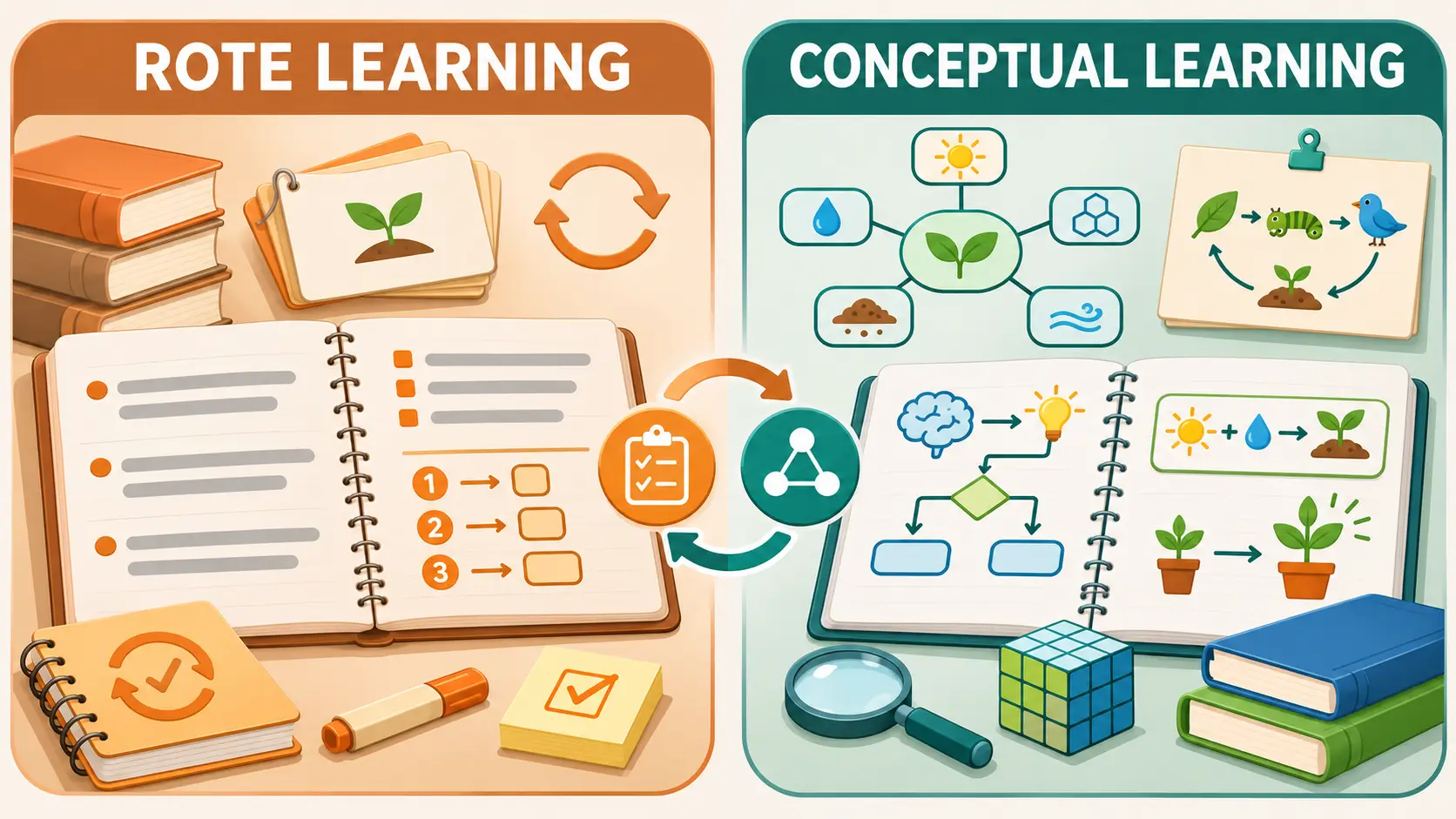
Rote learning focuses on remembering information through repetition, often without developing a clear understanding of its meaning. Conceptual learning focuses on understanding relationships, principles, and the conditions under which knowledge applies.
The difference becomes important when students encounter unfamiliar questions. Memorizing a formula may help someone reproduce it accurately, but choosing that formula for an unfamiliar problem requires understanding what it represents and when it applies.
Yet treating rote learning and conceptual learning as competing approaches creates another problem. Students need factual knowledge to reason effectively, while conceptual understanding does not automatically ensure that information remains accessible from memory.
The National Research Council's How People Learn (2000) identifies factual knowledge, conceptual organization, prior understanding, and transfer as interconnected aspects of effective learning.
For students preparing for examinations, the practical challenge is deciding what requires precise recall, what requires explanation, and what requires flexible application.
Answer Summary: Rote learning and conceptual learning serve different but complementary purposes. Rote repetition can support accurate reproduction of information, while conceptual understanding helps learners explain relationships and recognize when knowledge applies. Neither approach independently demonstrates complete learning. An effective study process combines factual knowledge, meaningful explanation, retrieval practice, feedback, and application. The appropriate balance depends on the subject, the learner's existing knowledge, and the intended learning outcome.
What Are Rote Learning and Conceptual Learning?
Rote and conceptual learning describe different ways of acquiring and organizing knowledge. They are not fixed categories of students or mutually exclusive learning methods.
What is rote learning?
Rote learning involves acquiring or remembering information through repetition with limited attention to its underlying relationships or meaning.
A student might repeatedly recite a scientific definition, memorize a mathematical procedure, or rehearse a sequence of terms until it can be reproduced accurately.
Such repetition can serve a legitimate purpose. Some academic tasks require exact terminology, symbols, vocabulary, or conventions.
The limitation appears when successful reproduction is mistaken for broader understanding. Remembering the wording of a definition does not independently establish that the learner can explain its significance or apply it appropriately.
Rote learning also differs from memorization generally. Information can be remembered through meaningful associations, explanations, and connections with existing knowledge.
Memorization is not necessarily rote.
What is conceptual learning?
Conceptual learning involves developing an understanding of how ideas relate, why principles work, and under which conditions they apply.
Instead of memorizing an equation-solving procedure without explanation, a conceptually oriented learner examines why particular operations preserve equality and how those principles apply to different equations.
The aim extends beyond reproducing correct responses. Learners develop knowledge that supports explanation, reasoning, and appropriate application.
Educational researchers also use the terms conceptual knowledge and meaningful learning. These concepts are related, although their definitions and measurements differ across research traditions.
Grove and Bretz (2012) examined learning approaches among organic chemistry students and described rote memorization and meaningful learning as endpoints of a continuum rather than rigidly separate categories.
Their qualitative analysis included 12 participants and identified intermediate approaches. The study illustrates why rigid learning labels are misleading, although its small sample does not establish how common those approaches are among students generally.
Conceptual learning is not a particular teaching style
A learner can develop conceptual understanding through teacher explanations, guided problem-solving, reading, discussion, or practical investigation.
Similarly, participating in experiments or classroom activities does not automatically establish meaningful understanding.
The important distinction is between the instructional activity and what the student learns from it.
Students need opportunities to identify relationships, examine explanations, and check whether their understanding is accurate.
Rote Learning vs Conceptual Learning: Key Differences
The clearest difference concerns what students can demonstrate after studying.
| Comparison | Rote-oriented learning | Conceptually oriented learning |
|---|---|---|
| Primary emphasis | Reproducing information or familiar procedures | Understanding relationships and principles |
| Main activity | Rehearsing information with limited explanation | Explaining, connecting, and interpreting ideas |
| Evidence of learning | Accurate recall or repeated performance | Accurate explanation and appropriate application |
| Unfamiliar questions | May be difficult when familiar patterns change | Supports identifying relevant principles |
| Existing knowledge | Information may be learned separately | New information connects with prior understanding |
| Main limitation | Reasoning and flexible application may remain untested | Exact recall and retention may remain untested |
| Suitable goals | Terms, symbols, conventions, and precise information | Explanations, relationships, reasoning, and method selection |
These differences describe learning emphases, not guaranteed outcomes.
Rote repetition does not necessarily produce short-lived memory. Likewise, conceptual understanding does not guarantee permanent retention or successful performance on every unfamiliar problem.
Three forms of knowledge help explain why:
-
Factual knowledge concerns information such as definitions, terminology, and mathematical symbols.
-
Procedural knowledge concerns how to perform operations or follow procedures.
-
Conceptual knowledge concerns the relationships and principles that make those operations meaningful.
These forms of knowledge interact.
A research review by Rittle-Johnson, Schneider, and Star (2015) concluded that conceptual and procedural knowledge support one another in mathematics. Understanding can support procedural development, while learning procedures can contribute to conceptual understanding.
This relationship makes a strict choice between memorizing procedures and understanding principles educationally incomplete.
When Rote Memorization Helps—and When It Falls Short
Rote memorization is useful when the immediate learning goal requires accurate reproduction of specific information.
Vocabulary, mathematical symbols, scientific terminology, and established conventions often need to become readily accessible.
Students cannot spend time reconstructing every foundational fact whenever they encounter a demanding problem.
For example, remembering the meaning of mathematical symbols supports interpreting equations. However, remembering symbols alone does not establish the ability to solve equations correctly.
The National Research Council emphasizes that effective knowledge involves more than familiarity with facts. Learners benefit from organizing factual information within conceptual structures that support reasoning and transfer.
The limitations of rote learning become apparent when questions change their presentation or require explanations.
A learner who has memorized a procedure may perform familiar exercises accurately but struggle to identify whether that procedure is appropriate for a different problem.
The distinction also matters in language learning.
Remembering vocabulary helps learners recognize and retrieve words. Using those words appropriately requires additional knowledge of meaning, grammar, and context.
The mistake is not memorizing vocabulary. It is assuming that vocabulary recall alone demonstrates the ability to communicate appropriately.
For tasks involving unfamiliar applications, factual recall provides a foundation rather than sufficient evidence of understanding.
What Conceptual Understanding Adds
Conceptual understanding helps learners recognize underlying principles rather than relying exclusively on familiar question patterns.
Its practical value becomes clearer when students must compare methods, interpret unfamiliar problems, or explain why a procedure works.
Understanding principles rather than copying procedures
Consider a mathematical illustration:
2(x + 3) = 14
A learner can solve this equation by dividing both sides by 2 and then subtracting 3.
Another valid method is to expand the brackets first.
A student who has memorized one procedure may solve the equation correctly. Conceptual understanding adds the ability to explain why both approaches preserve equality and recognize when either method is suitable.
The distinction is not between getting the correct answer and understanding mathematics. Accurate procedural performance and conceptual explanation are different, interacting achievements.
What mathematics research shows
Rittle-Johnson and Star (2007) randomly assigned 70 seventh-grade students to study algebra equation-solving methods under two conditions.
One group compared alternative solution methods, while the other considered the same methods individually.
Students who compared methods demonstrated greater gains in procedural knowledge and flexibility. However, both groups showed comparable gains in conceptual knowledge.
The experiment demonstrates that comparing mathematical methods can support certain learning outcomes. It does not establish superior improvement across every aspect of conceptual understanding or every educational setting.
Understanding and transfer of learning
Transfer occurs when previously acquired knowledge is applied appropriately in a different situation.
For example, solving an unfamiliar mathematics problem requires recognizing relevant relationships and selecting a suitable method.
Understanding principles can support this process, but transfer is not automatic.
Prior knowledge, initial learning, task similarities, and practice conditions influence whether knowledge can be applied elsewhere.
A learner may understand one explanation accurately yet require further guidance before applying the same principle to a substantially different problem.
How to Combine Recall and Understanding When Studying
An evidence-informed study process can combine factual recall with explanation, independent retrieval, feedback, and varied application.
These activities address different learning requirements rather than assuming that one method provides every necessary outcome.
Identify what the learning task requires
Begin by examining the expected outcome.
Does the task require reproducing a definition, explaining a relationship, performing a familiar procedure, or choosing a method for an unfamiliar problem?
These goals require different evidence of readiness.
A student who remembers a formula but cannot explain its relevance needs to examine the underlying concept.
A student who explains the concept accurately but repeatedly forgets the formula needs additional recall practice.
The difficulty should guide the next study activity.
Connect explanations with existing knowledge
Before repeatedly rehearsing an unfamiliar concept, examine a reliable explanation or worked example.
Identify what each important step means, which principle supports it, and how it connects with material already learned.
For mathematics, this may involve comparing why two solution methods are valid.
For science, it may involve connecting a definition with the relationship or process it describes.
The US Institute of Education Sciences recommends integrating abstract and concrete representations, combining worked examples with problem-solving exercises, and asking explanatory questions.
Its 2007 practice guide assigns different evidence strengths to individual recommendations, so these activities should not be treated as equally established interventions.
When an explanation remains unclear, additional guided examples or instruction may be more useful than repeated unsuccessful attempts.
Practise retrieval without viewing the answer
Retrieval practice means attempting to recall learned information without consulting the original material.
Unlike passive rereading, retrieval requires learners to produce information independently.
It can involve remembering terminology, reconstructing an explanation, or solving a problem without a visible worked solution.
Dunlosky and colleagues (2013) reviewed ten learning techniques and identified practice testing and distributed practice as having high general utility across the evidence examined.
Retrieval practice should not be confused with rote learning.
A retrieval question can assess conceptual understanding when it asks students to reconstruct relationships or explain why a conclusion follows.
For further clarification, see Collegenp's guide to active recall versus rereading.
Check accuracy and correct misunderstandings
Independent recall becomes more informative when responses are checked.
Students should compare their answers with reliable course material, worked solutions, or appropriate teacher feedback.
An incorrect explanation repeated confidently does not become accurate through repetition.
A 2025 systematic and meta-analytic review by Gonçalves, Muniz, and Jaeger examined 44 studies containing 142 comparisons between retrieval practice and elaborative learning activities.
The review found a small average advantage for retrieval practice, reported as g = 0.14, but the results depended on factors including feedback and activity type.
Retrieval practice showed stronger benefits when corrective feedback was available. In comparisons without corrective feedback, elaborative activities performed better on average.
The findings caution against treating practice quizzes, explanations, concept mapping, or discussion as universally superior alternatives.
The practical lesson is to attempt an answer, examine its accuracy, and correct misunderstandings before repeating the material.
Revisit knowledge and practise changed questions
Return to the material after an interval instead of assessing learning solely during the original study session.
Attempt to recall the main facts, reconstruct the explanation, and solve a related problem without immediately consulting the solution.
When appropriate, change the question's presentation or compare alternative methods.
Spaced review supports retention, while varied practice provides opportunities to assess whether knowledge applies beyond familiar examples.
Students seeking more detail on scheduling revision can consult Collegenp's guide to spaced repetition.
This combination is an evidence-informed recommendation based on related research. It should not be mistaken for a single instructional package proven superior for every learner.
How to Check What You Have Actually Learned
Learning should be assessed through accurate recall, explanation, application, and performance after a delay.
Each check answers a different question.
Can you remember the information accurately?
Close the study material and reproduce the required facts, definitions, formulas, or steps.
Compare the response with an authoritative answer.
Errors indicate which information needs further attention.
Accurate reproduction demonstrates recall, but does not independently confirm conceptual understanding.
Can you explain why the answer works?
Attempt to explain the relationship or principle without repeating the textbook wording.
Identify the reason behind an important step and the conditions under which it applies.
Check the explanation for correctness. An explanation expressed in different words is not necessarily accurate.
Can you select a method when the question changes?
Attempt a related problem with a different presentation or an unfamiliar combination of previously learned ideas.
Before solving it, identify the relevant principle and explain why the selected method fits.
Difficulty selecting a method may indicate that procedural familiarity has developed further than flexible application.
Can you perform these tasks later?
Revisit the topic after a delay and repeat the recall, explanation, and application checks.
Immediate familiarity is not equivalent to retained learning.
A systematic review by Agarwal, Nunes, and Blunt (2021) examined 50 classroom experiments involving 5,374 learners and found substantial benefits from retrieval practice across multiple studied settings.
However, only 6% of those experiments were conducted in countries outside the researchers' Western, Educated, Industrialized, Rich, and Democratic grouping. This limits assumptions about identical effects across all educational contexts.
These checks help identify learning gaps. They are not definitive measurements of complete mastery.
Common Mistakes When Comparing Learning Approaches
Several misunderstandings can lead students to select unsuitable study activities.
Treating memorization as the opposite of understanding
Knowledge can be remembered through meaningful connections.
Students may accurately recall information and understand its significance.
The relevant concern is whether repetition occurs without examining the relationships needed for the learning task.
Assuming understanding removes the need for revision
Understanding an explanation during a lesson does not establish that the information will remain accessible later.
Conceptual learning and memory retention should be checked separately.
Equating conceptual learning with independent discovery
Learning through discovery is not synonymous with understanding.
Clear instruction, guided explanation, and appropriately chosen examples can support conceptual development.
Students encountering unfamiliar material may need substantial guidance before independently applying it.
Assuming every practice question measures the same ability
A question asking for a definition primarily assesses recall.
A question requiring justification assesses a different aspect of knowledge.
Assessment tasks should match what students are expected to learn.
Teachers can examine conceptual understanding through concise explanations, comparisons, and appropriately varied problems without requiring lengthy written responses to every question.
Which Approach Should You Use?
The appropriate balance depends on the knowledge required and the performance expected.
When the goal is exact recall, focused memorization and retrieval practice are relevant.
When the goal is explaining relationships, students need opportunities to examine and verify conceptual connections.
When the goal involves unfamiliar applications, accurate foundational knowledge should be combined with method comparison and varied problem-solving.
Students preparing for examinations can examine their course requirements and practise the forms of performance those assessments demand.
Teachers and parents can support this process by identifying specific difficulties rather than describing learners as permanently belonging to one learning category.
Conclusion
Rote learning and conceptual learning address related but distinct educational needs.
Repetition can support accurate recall, while conceptual understanding helps learners explain relationships and apply knowledge appropriately.
Neither eliminates the need for the other.
A useful study decision begins with identifying what is missing: accurate information, a clear explanation, appropriate method selection, or reliable recall after time has passed.
The aim is knowledge that students can remember accurately, understand meaningfully, and use when the task requires it.






Comments 0
No comments yet. Be the first to start the conversation.