




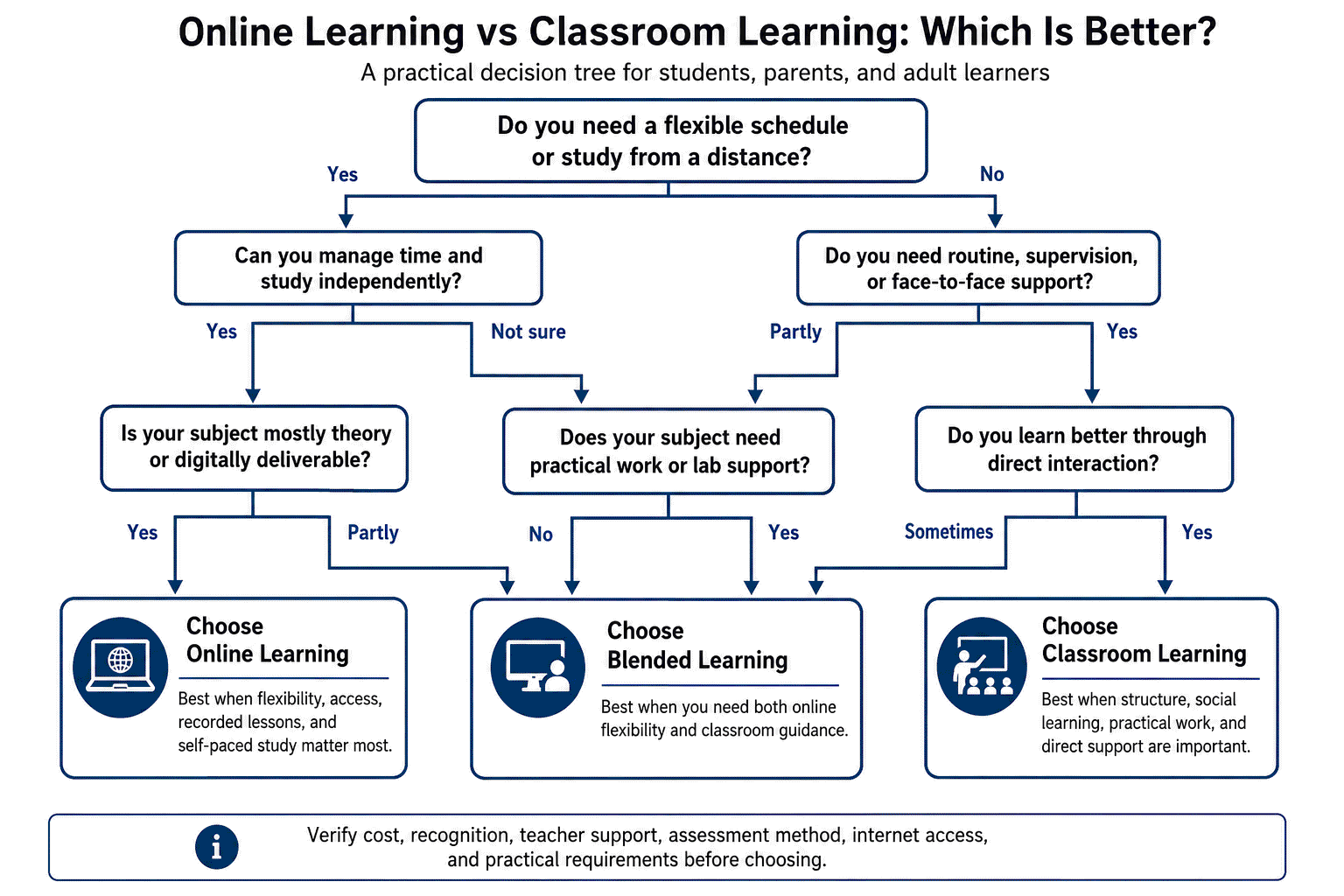
Students, parents, and adult learners are usually not asking whether online learning is modern or classroom learning is traditional. The real question is more practical: which learning format will help the student understand lessons, stay consistent, ask questions, complete assignments, prepare for exams, and manage time and cost without losing necessary support?
Online learning and classroom learning can both work well. They can also both fail when the course is poorly designed, the teacher support is weak, or the student’s situation does not match the learning format. A strong online course can be more useful than a poorly managed classroom. A strong classroom can be more effective than a weak online program.
The better choice depends on the learner’s age, subject, schedule, internet access, self-discipline, budget, teacher support, and need for practical or social learning. This comparison explains online learning vs classroom learning through practical criteria, not broad claims.
Quick Answer:
Online learning is usually more suitable for independent learners, working students, remote learners, and students who need flexible schedules or recorded materials for revision. Classroom learning is usually more suitable for younger students, practical subjects, structured routines, face-to-face interaction, and learners who need direct supervision.
For many students, blended learning is often a practical middle option because it combines online resources with classroom guidance. However, blended learning works only when both parts are planned properly. The best choice is not the format that sounds more advanced; it is the format that gives the student the right level of access, structure, feedback, and support.
Table of Content
- Anatomy of the Issue: What Are Students Really Deciding?
- Comparison Methodology
- Evidence Snapshot
- Online Learning vs Classroom Learning: Comparison Table
- Reader-Specific Recommendation
- Who Should Avoid Each Option?
- What Would Change the Verdict?
- Common Mistakes Students Make
- Decision Checklist Before Choosing
- Final Verdict: Online Learning vs Classroom Learning
- Source Notes
Anatomy of the Issue: What Are Students Really Deciding?
The debate around online learning vs classroom learning often becomes too simple. Many people reduce it to “online is flexible” or “classroom is better,” but those statements do not answer the real decision.
A student is actually deciding:
-
Can I learn consistently in this format?
-
Can I ask questions and get useful feedback?
-
Can I afford the visible and hidden costs?
-
Does the subject need lab work, equipment, fieldwork, or supervised practice?
-
Will this format help me stay disciplined?
-
Is the course recognized, reliable, and properly assessed?
-
Will I get enough academic and emotional support?
-
Does the learning mode fit my home, work, family, and location situation?
The confusing part is that surface-level claims can be misleading. Online learning is not automatically cheaper because students may still need a device, internet connection, software, and a quiet study space. Classroom learning is not automatically higher quality because quality depends on the teacher, class size, resources, curriculum, and institution.
Students should not decide based only on popularity, advertisements, peer pressure, low fees, convenience, or the idea that one format is always superior. The better decision comes from testing the learning mode against the student’s actual needs.
 Comparison Methodology
This comparison uses practical criteria that affect student learning and decision-making:
| Criteria | Why It Matters |
|---|---|
| Access and flexibility | Determines whether the student can attend regularly and continue learning despite distance, work, health, or schedule limits. |
| Structure and discipline | Affects consistency, deadline management, attendance, and study habits. |
| Teacher interaction | Influences doubt-solving, feedback, confidence, and academic support. |
| Peer interaction | Supports communication, teamwork, confidence, and social development. |
| Cost and hidden expenses | Helps students and families understand the full financial burden, not just tuition. |
| Learning pace | Determines whether students can revise, replay, accelerate, or slow down. |
| Practical learning | Matters for labs, workshops, clinical practice, fieldwork, performance, and hands-on skills. |
| Assessment and credibility | Affects exam reliability, academic integrity, and recognition of the course or program. |
| Learning outcomes | Depends on design quality, learner motivation, feedback, technology, and support. |
| Student suitability | Connects the choice to age, learning style, family situation, career goal, and available support. |
This article does not assign fixed scores because the result can change by institution, teacher quality, student discipline, subject type, location, technology access, and support system.
Evidence Snapshot
What is verified
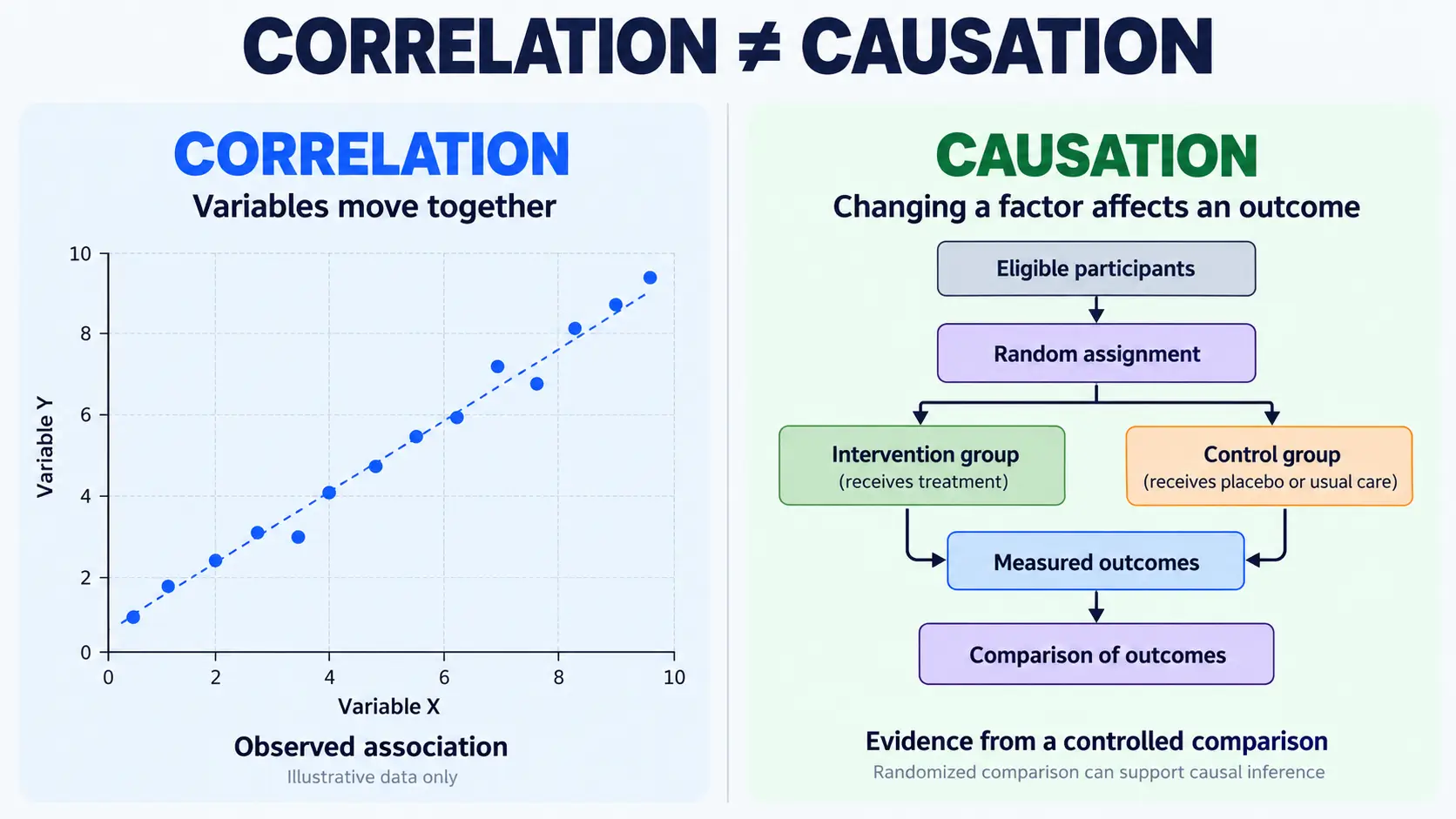
Online learning can support student learning when courses are well designed, interaction is active, feedback is regular, technology is reliable, and students are motivated. Research does not prove that online learning is always better or worse than classroom learning.
Classroom learning remains important for direct interaction, social learning, routine, practical activities, and immediate teacher support. It is especially useful when students need close supervision or the subject requires physical practice.
Available U.S. postsecondary data also shows that distance education is no longer a small side format. In fall 2023, 25.6% of U.S. postsecondary students were enrolled exclusively in distance education courses, and 27.5% were enrolled in some, but not all, distance education courses. This is useful context, but it should not be treated as global proof.
What needs verification
Before choosing any course, students should verify:
-
Latest fee structure
-
Accreditation or approval status
-
Assessment method
-
Teacher availability
-
Class size
-
Device and internet requirements
-
Attendance rules
-
Practical or lab requirements
-
Recognition by schools, universities, employers, or regulators
-
Refund, transfer, or support policies
What depends on context
The better choice depends on the student’s subject, age, learning habits, home environment, access to internet, family support, location, teacher quality, and long-term goal.
What should not be assumed
Do not assume that online learning is always cheaper, easier, or more flexible in practice. Do not assume that classroom learning is always more effective, more serious, or more respected. Do not assume that blended learning is automatically better unless both the online and classroom parts are properly connected.
Online Learning vs Classroom Learning: Comparison Table
| Criteria | Online Learning | Classroom Learning | Editorial Judgment |
|---|---|---|---|
| Learning environment | Delivered through internet, video classes, learning platforms, recorded lessons, digital assignments, and online discussions. | Delivered in a physical classroom, school, college, coaching center, lab, library, or campus setting. | Online has the advantage for location flexibility; classroom has the advantage for physical presence and direct supervision. |
| Schedule | Can be live, recorded, self-paced, or partly flexible. | Usually follows a fixed timetable and attendance system. | Online suits busy or remote learners; classroom suits students who need routine. |
| Teacher interaction | Happens through video calls, chat, email, forums, comments, or virtual office hours. | Happens face-to-face during class, discussion, doubt sessions, or practical work. | Classroom usually offers quicker natural interaction; online can work well if feedback systems are strong. |
| Peer interaction | Possible through discussion boards, group chats, shared documents, and virtual projects. | Happens daily through class discussion, group work, campus life, and informal conversation. | Classroom usually supports social learning more naturally. |
| Cost | May reduce travel, accommodation, uniform, and campus-related costs, but requires device, internet, and study space. | May include transport, hostel, meals, uniform, printed materials, and campus fees. | Cost depends on the program and location. Online is not automatically cheaper. |
| Learning pace | Often allows replay, pause, revision, and self-paced learning. | Usually follows the pace of the class and teacher. | Online helps revision and independent learning; classroom helps shared progress and accountability. |
| Discipline | Requires strong self-management, time planning, and focus. | Provides external structure through timetable, teacher presence, attendance, and peer routine. | Classroom is usually more suitable for students who struggle with self-discipline. |
| Practical learning | Works well for theory, software skills, language learning, digital tasks, and professional development. | Better suited for labs, workshops, clinical practice, fieldwork, arts, sports, and hands-on training. | Practical subjects often need classroom or blended delivery. |
| Assessment | Can use quizzes, assignments, projects, online exams, proctoring, and digital submissions. | Uses written exams, oral work, practical assessment, presentations, projects, and supervised tests. | Both can assess learning, but credibility depends on design, supervision, and recognition. |
| Best fit | Independent learners, working adults, remote learners, theory-heavy subjects, and students needing flexibility. | Younger students, practical learners, students needing supervision, and those who benefit from social interaction. | The best choice depends on learner fit, not format alone. |
1. Learning Environment and Access
Online learning takes place through digital systems such as video platforms, learning management systems, recorded lessons, online assignments, discussion boards, and digital study materials. It can help students who live far from schools, colleges, or training centers. It can also help learners who need to study from home because of work, health, travel, family duties, or location barriers.
Classroom learning takes place in a physical setting. Students attend lessons at a fixed place and time. This gives them access to teachers, classmates, classrooms, labs, libraries, campus activities, and in-person academic support.
Online learning has the advantage when distance and schedule are major problems. Classroom learning has the advantage when the student needs physical resources, direct observation, or regular in-person guidance. The conclusion changes if the student has poor internet access, no quiet study space, or limited digital skills. In that case, online learning may become difficult even if the course content is good.
2. Flexibility and Routine
Flexibility is one of the strongest reasons students choose online learning. Recorded lessons allow students to pause, replay, and revise. Live online classes can reduce travel time. Self-paced courses can help working adults or students with irregular schedules.
However, flexibility can become a weakness when students lack discipline. A student may delay lessons, skip assignments, or lose focus without a fixed routine.
Classroom learning provides a stronger external structure. Timetables, attendance, teachers, classmates, and school rules create accountability. This can help students who are still building study habits.
Online learning has the advantage on flexibility. Classroom learning has the advantage on routine. Students should choose based on how honestly they can manage time without direct supervision.
3. Teacher Interaction and Feedback
Classroom learning usually offers faster and more natural teacher interaction. A student can ask a question immediately, read the teacher’s expression, and get clarification during the lesson. Teachers can also notice confusion, low participation, or distraction more easily.
Online learning can still provide strong interaction if the course is well designed. Live classes, breakout rooms, chat support, discussion forums, feedback on assignments, and virtual office hours can make online learning active. The problem is that not all online courses provide this level of support.
If an online course is mainly recorded videos with little teacher feedback, students may struggle when they face difficult topics. If a classroom has too many students and weak teacher availability, face-to-face learning may also fail to provide meaningful support.
The key question is not only “online or classroom?” It is: how quickly and clearly does the student receive feedback?
4. Peer Interaction and Social Development
Classroom learning usually supports peer interaction more naturally. Students meet classmates regularly, take part in discussion, work in groups, present ideas, and learn communication through daily contact. This matters for school students and for learners who need confidence, teamwork, and social development.
Online learning can support peer interaction, but it needs deliberate planning. Group projects, forums, shared documents, live discussions, and peer review can help. Without these systems, students may feel isolated or disconnected.
For students who already have strong communication skills and independent study habits, online learning may be enough. For younger students or students who need confidence-building, classroom or blended learning is usually more suitable.
5. Cost and Hidden Expenses
Online learning may reduce travel, accommodation, meals, uniforms, printed materials, and campus-related expenses. This can make it useful for remote learners or students who cannot relocate.
But online learning is not automatically low-cost. Students may need a laptop or smartphone, stable internet, electricity backup, software, headphones, webcam, and a quiet place to study. In some homes, these hidden costs are serious.
Classroom learning may involve transport, hostel, food, uniforms, stationery, printed books, and institutional fees. However, it may also provide labs, libraries, counseling, sports, classroom supervision, and direct academic support.
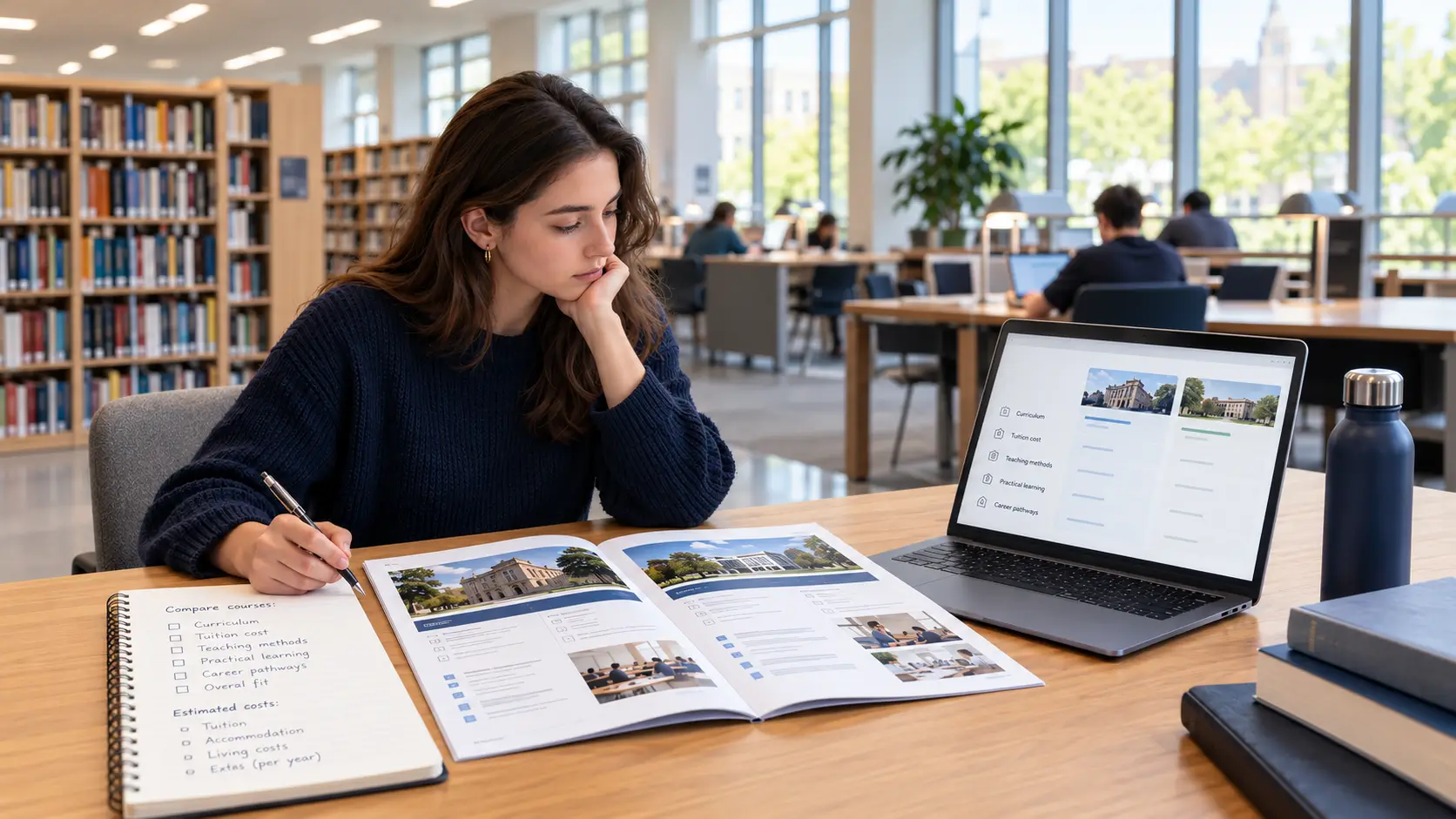
The practical decision is to compare total cost, not only tuition. Students should calculate both visible and hidden expenses before choosing.
6. Learning Pace and Self-Discipline
Online learning often supports flexible learning pace. Students can replay lessons, revise difficult topics, move ahead in familiar areas, and use digital resources repeatedly. This can help students who need more time and students who want faster progress.
The weakness is self-discipline. Online learners must manage deadlines, avoid distractions, attend sessions, complete assignments, and ask for help when needed. Without planning, online learning can become passive.
Classroom learning usually moves at the pace of the group. This can be limiting for fast learners and challenging for students who need extra time. However, the shared pace creates routine and accountability.
Online learning is stronger for self-paced study. Classroom learning is stronger for guided consistency. The better choice depends on how much structure the student needs.
7. Practical Learning and Assessment
Classroom learning is usually more suitable for subjects that require hands-on work. Science labs, medical and health training, engineering workshops, fieldwork, sports, performance, fine arts, and technical skills often need equipment, supervision, and direct demonstration.
Online learning works well for theory-based subjects, software skills, language learning, digital communication, professional development, test preparation, and courses where recorded demonstrations or simulations are enough.
Assessment also differs. Online courses may use quizzes, assignments, projects, presentations, discussion participation, and proctored exams. Classroom learning may use written exams, oral tests, lab work, field reports, supervised practical tasks, and class participation.
Students should verify how assessment is conducted and whether the certificate, credit, or result is recognized by the relevant school, university, employer, or authority.
8. Quality, Recognition, and Support
A good learning format cannot compensate for poor course quality. Students should judge the provider, teacher, curriculum, support system, and assessment process.
For online learning, check:
-
Is the platform reliable?
-
Are classes live, recorded, or both?
-
Is teacher feedback available?
-
Are assignments reviewed properly?
-
Is technical support available?
-
Is the course recognized by the relevant institution or authority?
For classroom learning, check:
-
Are teachers available and qualified?
-
Is class size manageable?
-
Are labs, library, and facilities actually usable?
-
Is academic support available outside class?
-
Is the institution recognized?
-
Are attendance and assessment rules clear?
Recognition is especially important for formal education, professional training, entrance preparation, licensing, credit transfer, or employment-related programs. If recognition affects the student’s future, verify it from official sources before enrollment.
9. What Research Says About Effectiveness
Research does not support a simple claim that online learning is always better or classroom learning is always better. The effect of online learning depends on course design, teacher feedback, interaction, internet access, digital tools, learner motivation, and the type of subject.
A 2024 systematic review in Discover Education reported varied effects of online learning on student performance and engagement. Some studies found benefits connected to flexibility and accessibility, while others reported problems such as weaker engagement, isolation, and reduced interaction.
An older U.S. Department of Education/SRI review found that online and blended learning conditions showed modestly stronger average outcomes than purely face-to-face instruction in the studies reviewed. However, that finding should be read carefully because the benefit may reflect differences in time, content, teaching method, and blended design rather than the online medium alone.
UNESCO’s Global Education Monitoring Report also warns that technology in education should be judged by evidence, equity, and learning value, not by enthusiasm for digital tools alone. Unequal access to devices and internet can widen education gaps when technology is used without proper support.
The safest conclusion is this: learning outcomes depend less on the label “online” or “classroom” and more on instructional quality, student support, feedback, engagement, and learner fit.
10. Personal and Social Factors
Learning decisions are not only academic. Students and families also deal with social expectations, confidence, cost pressure, location, safety, and support.
Some families may trust classroom learning more because it feels visible and structured. Some students may prefer online learning because it saves travel time or allows them to balance study with work. Some learners may feel more confident asking questions online, while others may participate better in person.
Peer pressure can also affect the decision. Students may choose online learning because friends are joining a popular platform, or they may choose classroom learning because it seems more socially accepted. Neither is a reliable basis for decision-making.
Financial pressure matters too. If classroom learning requires daily travel, hostel expenses, or relocation, online learning may reduce the burden. If online learning requires expensive devices, high-speed internet, or paid tools, classroom learning may be more practical.
Students should also consider their support system. A student studying online from a noisy home with no guidance may struggle. A student attending a crowded classroom with weak teaching may also struggle. The better choice is the one that gives the student a realistic chance to stay consistent and supported.
Reader-Specific Recommendation
Choose online learning if:
-
You need flexible timing.
-
You live far from the institution.
-
You can manage your study schedule independently.
-
You have reliable internet and a suitable device.
-
Your subject is theory-based or digitally deliverable.
-
You want recorded lessons for revision.
-
You are a working student or adult learner.
-
You are comfortable asking questions through digital tools.
Choose classroom learning if:
-
You need a fixed routine.
-
You learn better through face-to-face explanation.
-
You need immediate teacher feedback.
-
Your subject requires labs, equipment, fieldwork, or supervised practice.
-
You benefit from classmates, group work, and daily interaction.
-
You are a younger student or need stronger guidance.
-
You struggle with distractions at home.
-
You need campus facilities or in-person academic support.
Choose blended learning if:
-
You want recorded materials but still need classroom guidance.
-
Your subject has both theory and practical parts.
-
You need flexibility but do not want to lose teacher interaction.
-
The institution clearly connects online lessons, classroom work, assignments, and assessment.
Be careful if:
-
The course makes broad claims without evidence.
-
The provider does not explain teacher support.
-
Fees are unclear.
-
Accreditation or recognition is not confirmed.
-
Online classes are mostly videos with no feedback.
-
Classroom learning has large classes but limited teacher access.
-
Blended learning is only a label, not a properly planned model.
Who Should Avoid Each Option?
Fully online learning may not suit students who:
-
Do not have reliable internet or a suitable device.
-
Need close supervision to stay consistent.
-
Are easily distracted at home.
-
Need daily social interaction for confidence and communication.
-
Are studying practical subjects that require labs, workshops, or direct supervision.
-
Cannot get timely help from teachers or mentors.
Classroom-only learning may not suit students who:
-
Live far from the institution and cannot travel regularly.
-
Have work or family responsibilities that conflict with fixed schedules.
-
Need recorded lessons for repeated revision.
-
Face high transport, hostel, or relocation costs.
-
Learn better at their own pace.
-
Have health, mobility, or personal constraints that make daily attendance difficult.
Blended learning may not suit students if:
-
The online and classroom parts are not coordinated.
-
Teachers are not trained to manage both formats.
-
Students are given extra workload without clear planning.
-
Technology access is assumed but not supported.
-
Assessment rules are unclear.
What Would Change the Verdict?
The final recommendation can change under these conditions:
| Factor | How It Can Change the Decision |
|---|---|
| Student age | Younger students often need more structure and social interaction; adult learners may value flexibility more. |
| Subject type | Practical subjects often need classroom or blended learning; theory-heavy subjects may work online. |
| Internet access | Weak internet can make online learning unreliable. |
| Teacher quality | A strong teacher can make either format effective. |
| Feedback system | Online learning becomes weaker without timely feedback. Classroom learning also suffers if teachers are inaccessible. |
| Cost | Hidden costs can change which option is affordable. |
| Recognition | If the course affects formal credit, licensing, or employment, official recognition becomes essential. |
| Student discipline | Independent learners may do well online; students needing accountability may do better in classroom or blended formats. |
| Home environment | A quiet and supportive home can help online learning; a noisy or unsupportive environment can make it difficult. |
| Class size | A small interactive classroom may be better than a large passive one. A well-supported online class may be better than a crowded classroom. |
Common Mistakes Students Make
-
Choosing only by price
Low fees do not guarantee value. High fees do not guarantee quality. Compare total cost, support, recognition, teacher access, and learning outcomes.
-
Assuming online learning is easier
Online learning may be flexible, but it often requires more self-discipline. Students must manage time, deadlines, distractions, and communication.
-
Assuming classroom learning is always better
Classroom learning is useful, but quality still depends on teacher skill, class size, facilities, curriculum, and student support.
-
Ignoring hidden costs
Online learning may require devices, internet, and software. Classroom learning may require transport, food, uniform, accommodation, and printed materials.
-
Not checking recognition
For formal education or career-related training, recognition matters. Students should verify accreditation, approval, credit transfer, or certificate value from official sources.
-
Following trends
A learning format should match the student’s goal and situation. Popularity does not prove suitability.
-
Ignoring personal learning habits
Students should honestly assess whether they can study independently or need direct supervision.
-
Confusing access with quality
Online access to many courses is useful, but access alone does not mean the course is effective. Quality depends on design, feedback, assessment, and support.
Decision Checklist Before Choosing
Before enrolling in online, classroom, or blended learning, check:
-
What is the total cost, including hidden expenses?
-
Is the course or institution officially recognized where recognition matters?
-
Are teachers available for questions and feedback?
-
Is the class live, recorded, self-paced, or mixed?
-
Is there a clear timetable and assignment system?
-
What device, internet, or software is required?
-
Does the subject need practical work, lab access, or supervised training?
-
How are exams and assessments conducted?
-
Is student support available?
-
What is the class size?
-
Are refund, transfer, and attendance rules clear?
-
Can the student realistically stay consistent in this format?
-
Does the format match the student’s goal, learning style, family situation, and location?
Final Verdict: Online Learning vs Classroom Learning
Online learning vs classroom learning does not have one universal winner. Online learning is usually better when flexibility, location freedom, recorded revision, and self-paced study matter most. Classroom learning is usually better when students need structure, immediate interaction, practical facilities, social development, and direct supervision.
For many students, blended learning is often the most practical option when it combines online flexibility with meaningful classroom support. But blended learning should not be chosen only because it sounds balanced. It must be properly designed, with clear links between online lessons, classroom activities, assignments, feedback, and assessment.
The strongest point of online learning is access and flexibility. Its weakest point is that it can become passive or isolating without discipline, interaction, and feedback. The strongest point of classroom learning is structure and human interaction. Its weakest point is limited flexibility and possible extra cost from travel, time, and location.
The most practical takeaway is simple: choose the learning format that gives the student the best combination of access, quality, feedback, discipline, recognition, and support. Do not choose online learning only because it is convenient. Do not choose classroom learning only because it is traditional. Choose the format that helps the student learn consistently and complete the course successfully.
Source Notes
This article uses evidence from peer-reviewed research, official education data, and global education reporting. The evidence supports a cautious conclusion: learning format matters, but student fit, course design, teacher support, interaction, access, assessment, and recognition matter more.
Students should verify current fees, admission rules, recognition, course requirements, and institutional policies from the latest official source before enrolling.




Comments 0
No comments yet. Be the first to start the conversation.