



The question “AI tutor vs human teacher: which is better?” is not only about technology. It is about how learners receive support, how they build understanding, and when access, feedback, motivation, safety, and human judgment matter most.
An AI tutor can provide quick explanations, practice questions, quiz support, and feedback outside class time. A skilled human teacher can guide learning with judgment, emotional awareness, accountability, classroom experience, and a deeper understanding of the learner’s situation. The better choice depends on the learner’s age, subject, learning goal, budget, access to support, and the quality of the AI tool or teacher.
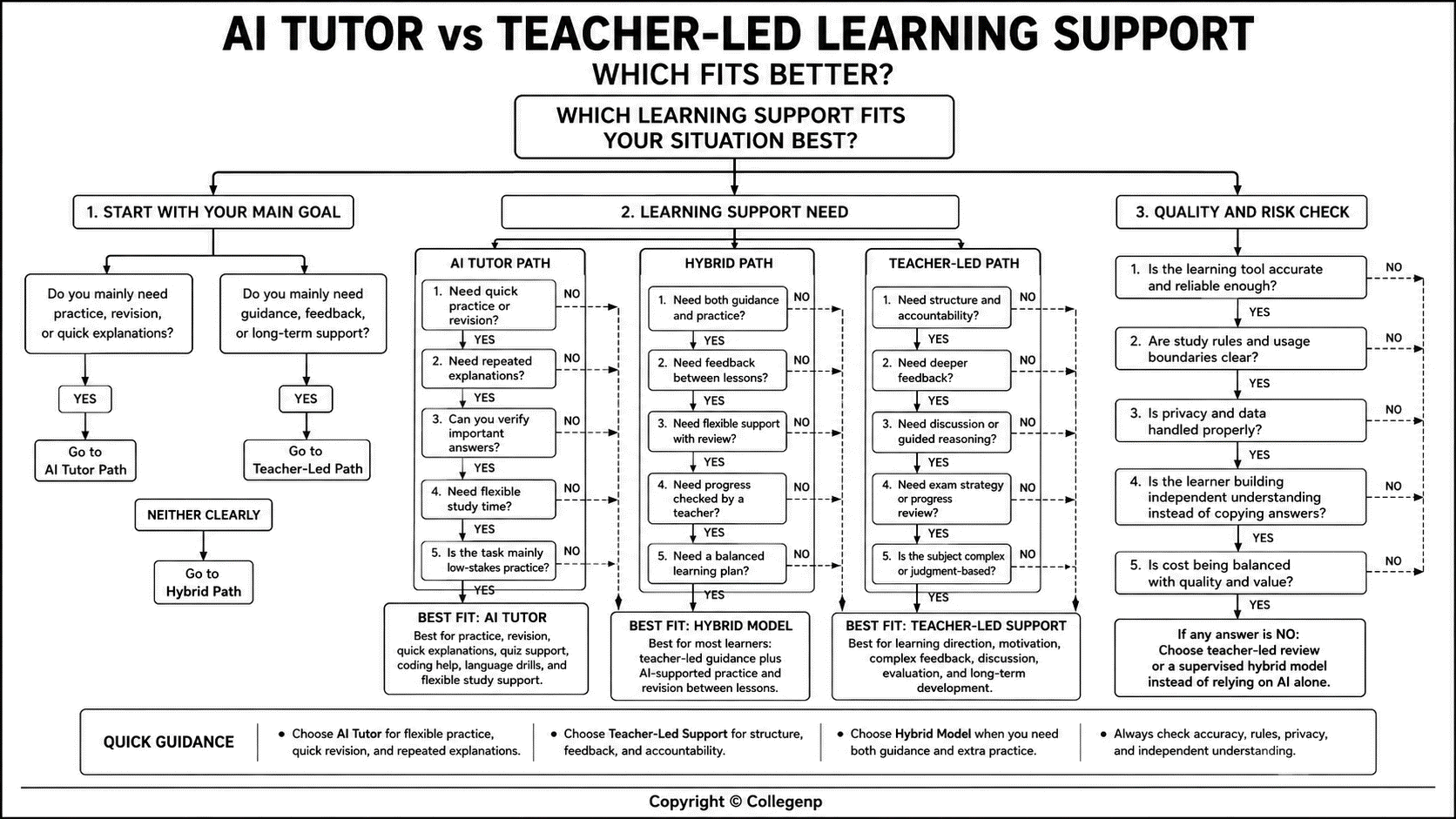
For most learners, the strongest answer is not AI alone or human teaching alone. A supervised hybrid model is usually more practical: a human teacher sets direction and evaluates progress, while an AI tutor supports practice, revision, and low-stakes feedback between lessons.
Table of Content
- Quick Answer
- Anatomy of the Issue: What Are Readers Really Deciding?
- Comparison Methodology
- Evidence Snapshot
- AI Tutor vs Human Teacher: Comparison Table
- What Is an AI Tutor?
- What Does a Human Teacher Do That AI Cannot Fully Replace?
- Access and Availability
- Feedback Quality
- Personalization
- Motivation and Accountability
- Learning Depth and Critical Thinking
- Safety, Privacy, and Academic Integrity
- Cost and Scalability
- When an AI Tutor Is Better
- When a Human Teacher Is Better
- Best Hybrid Model: Human Teacher + AI Tutor
- Decision Guide by Learner Type
- Personal and Social Factors
- Who Should Avoid Relying Mainly on AI Tutors?
- Who Can Use AI as First-Level Support?
- What Would Change the Verdict?
- Common Mistakes Readers Should Avoid
- Decision Checklist
- Reader-Specific Recommendation
- How Teachers Can Use AI Tutors Responsibly
- Final Verdict
Quick Answer
AI tutors are usually stronger for instant practice, self-paced revision, repeated explanations, quiz support, and affordable access outside class. Human teachers are usually stronger for motivation, emotional support, ethical judgment, deeper feedback, classroom discussion, and long-term learning development.
For many students, the best choice is both. Use a human teacher for structure, guidance, and accountability. Use an AI tutor for practice, review, and extra support after class.
AI should not be treated as a full replacement for human teaching. It works best when it helps learners think, not when it simply gives final answers.
Anatomy of the Issue: What Are Readers Really Deciding?
The real decision is not whether AI is “smarter” than a teacher. The real decision is whether a learner can get safer, more useful, and more consistent learning support from an AI tutor, a human teacher, or a combination of both.
This comparison becomes confusing because many discussions focus on surface-level claims:
-
AI is available anytime.
-
Teachers understand students better.
-
AI is cheaper.
-
Human teachers are more reliable.
-
AI can personalize learning.
-
Teachers provide real motivation.
These points can be true in some situations, but none of them alone decides the issue. An AI tutor that gives fast but incorrect answers can weaken learning. A human teacher with limited time may not provide enough individual feedback. A low-cost AI tool may help with practice, but it may not be safe or suitable for younger students. A skilled teacher may cost more, but the added structure and accountability can be worth it for complex learning goals.
Readers should not decide based only on cost, trend, convenience, fear of AI, or belief that technology automatically improves learning. The better choice depends on learning design, supervision, feedback quality, learner maturity, subject difficulty, and the purpose of support.
Comparison Methodology
This article compares AI tutors and human teachers using decision-focused criteria, not popularity or hype.
The main criteria are:
-
Access and availability: Can the learner get help when needed?
-
Feedback quality: Is the feedback fast, accurate, and useful?
-
Personalization: Can the support adapt to the learner’s level and gaps?
-
Motivation and accountability: Does the learner stay engaged and responsible?
-
Learning depth: Does the support improve understanding, not just task completion?
-
Safety and ethics: Are privacy, age suitability, academic integrity, and emotional context handled responsibly?
-
Cost and scalability: Can the support reach more learners affordably?
-
Suitability by learner type: Which option fits children, exam candidates, adult learners, language learners, and advanced learners?
No numeric score is used because performance depends heavily on tool design, teacher quality, subject, school policy, learner age, and supervision. The judgment is editorial and evidence-aware, not a universal ranking.
Evidence Snapshot
What is verified:
AI can support practice, feedback, and personalized learning when it is well-designed and supervised. Research on intelligent tutoring systems shows positive potential, but results vary by context, subject, age group, design, and study quality.
What depends on context:
The better option depends on learner age, subject, teacher quality, tool quality, internet access, family support, school rules, exam pressure, and learner discipline.
What should not be assumed:
AI tutors should not be assumed to be accurate, safe, or educationally effective in every case. Human teachers should not be assumed to provide strong individual support in every setting. Both options can be effective or weak depending on implementation.
Editorial judgment:
AI is strongest as a practice and feedback assistant. Human teachers remain stronger as learning designers, mentors, evaluators, and responsible guides.
AI Tutor vs Human Teacher: Comparison Table
| Criteria | AI Tutor | Human Teacher | Editorial Judgment |
|---|---|---|---|
| Availability | Often available anytime if device, internet, and service access exist | Limited by schedule, class time, location, and cost | AI has a clear advantage for quick access and after-class practice |
| Feedback speed | Can respond immediately | May take longer, especially with many students | AI is stronger for speed, but speed does not guarantee accuracy or depth |
| Personalization | Can adapt examples, difficulty, and practice if designed well | Can adapt using observation, experience, and human judgment | Both can personalize, but in different ways |
| Motivation | Can remind or encourage, but does not truly understand the learner | Can build trust, confidence, discipline, and accountability | Human teachers are stronger for motivation and emotional support |
| Accuracy | May produce confident but incorrect answers | Can also make mistakes, but can be questioned and held accountable | Human oversight is important, especially for high-stakes learning |
| Critical thinking | Can support questions and hints if properly designed | Can challenge reasoning through discussion, debate, and feedback | Human teachers are stronger for deeper reasoning and judgment |
| Cost and scale | Often cheaper and easier to scale | Usually more expensive for one-to-one support | AI can expand access, but quality and safety must be checked |
| Safety and ethics | Requires privacy checks, age-appropriate design, and guardrails | Can apply professional responsibility and contextual judgment | Human teachers are stronger for duty of care and ethical supervision |
| Best use | Practice, revision, drills, quick explanations, low-stakes feedback | Teaching strategy, mentorship, evaluation, motivation, complex feedback | The best model combines both |
What Is an AI Tutor?
An AI tutor is a software-based learning assistant that uses artificial intelligence to explain concepts, ask questions, generate examples, provide feedback, adjust difficulty, or simulate a tutoring conversation.
Some AI tutors are structured intelligent tutoring systems built for a specific curriculum or subject. Others are general AI chatbots that students use for homework help, writing support, coding practice, language learning, or exam revision.
The strongest use of an AI tutor is not answer delivery. It is guided practice. A good AI tutor should ask questions, give hints, check understanding, encourage recall, explain mistakes, and help the learner solve problems step by step.
An AI tutor becomes risky when it gives final answers too easily, sounds confident when wrong, collects sensitive data without clear safeguards, or helps students avoid thinking.
What Does a Human Teacher Do That AI Cannot Fully Replace?
A human teacher does more than explain information. A teacher observes confusion, adjusts classroom pace, reads social cues, motivates students, builds discipline, manages group learning, evaluates complex work, and understands when a learner needs support beyond the lesson.
Teaching is also relational. Many students learn better when someone notices their effort, expects progress, corrects weak habits, and gives feedback that fits their personality, background, and current confidence level. AI can simulate encouragement, but it does not have real responsibility for the learner.
A teacher also works inside a broader learning system: curriculum, assessment, ethics, school rules, parental communication, classroom safety, and long-term development. AI can support this system, but it should not become the only authority.
Access and Availability
AI tutors are stronger for access. A learner can use an AI tutor during revision, after missing class, outside school hours, or when a human tutor is unavailable. This matters for students who cannot afford regular private tutoring, live far from quality support, or need repeated practice beyond classroom time.
Human teachers are limited by time and availability. A teacher may have many students, fixed class periods, and limited ability to provide one-to-one feedback. In some contexts, the problem is not teacher quality but teacher workload.
However, access alone does not equal quality. A poorly designed AI tutor may give quick but shallow help. A human teacher with limited time may still provide more useful direction than an always-available tool.
Judgment: AI tutors are better for immediate access and repeated practice. Human teachers are better when access must include responsibility, diagnosis, and structured guidance.
Feedback Quality
AI tutors can provide instant feedback. This is useful for math drills, grammar practice, coding errors, flashcard review, language exercises, and quick concept checks. A student can make mistakes and correct them immediately instead of waiting days for feedback.
The weakness is reliability. AI can produce incorrect explanations, miss context, or give answers that appear polished but are wrong. This is especially risky when learners do not yet know enough to identify mistakes.
Human teachers may be slower, but they can judge the quality of thinking behind an answer. A teacher can ask why a student used a method, identify a pattern of misunderstanding, and decide whether the student needs reteaching, practice, or a different explanation.
Judgment: AI is stronger for fast feedback on low-stakes practice. Human teachers are stronger for feedback that requires judgment, context, and accountability.
Personalization
AI tutors can personalize quickly by changing examples, adjusting difficulty, simplifying explanations, or generating new practice questions. This can help students who feel embarrassed asking repeated questions in class.
Human teachers personalize differently. They observe behavior, confidence, effort, classroom participation, writing habits, and social context. They may know when a student needs encouragement, stricter deadlines, peer discussion, or a completely different approach.
The limitation is that both forms of personalization can fail. AI personalization depends on tool design and data quality. Human personalization depends on teacher skill, time, class size, and institutional support.
Judgment: AI is useful for content-level personalization. Human teachers are stronger for whole-learner personalization.
Motivation and Accountability
Many learners do not struggle because they lack information. They struggle because they lack routine, confidence, discipline, feedback, or support. In these cases, a human teacher is usually stronger.
A teacher can notice declining effort, ask follow-up questions, set expectations, communicate with parents or guardians when appropriate, encourage persistence, and help students build learning habits. A teacher can also create social accountability through class participation, assignments, presentations, and discussion.
AI tutors can remind, encourage, and track practice, but they do not hold real social responsibility. A student can ignore AI, misuse it, or use it mainly for shortcuts.
Judgment: Human teachers are better for motivation, accountability, and learning behavior. AI can support routine practice, but it should not be the main source of discipline for learners who need structure.
Learning Depth and Critical Thinking
AI tutors can help learners understand basic concepts, review weak areas, and practice step by step. When designed with guardrails, AI can support deeper learning by asking questions instead of giving final answers.
The risk is overreliance. If students use AI mainly to complete assignments, they may perform well during assisted practice but fail to build independent understanding. This is one of the most important weaknesses of AI tutoring.
Human teachers are stronger for discussion, debate, reasoning, originality, writing development, ethical questions, and long-term intellectual growth. A teacher can challenge assumptions, compare different answers, and help students explain their thinking in their own words.
Judgment: AI can support learning depth if it is designed for active thinking. Human teachers are stronger when the goal is judgment, reasoning, communication, and independent mastery.
Safety, Privacy, and Academic Integrity
Safety matters more for younger learners. Parents and schools should check whether an AI tutor is age-appropriate, what data it collects, how it stores conversations, whether it uses student data for model improvement, and whether it follows school policy.
Academic integrity is another issue. Students may use AI to complete work instead of learning. This does not mean AI should be banned in every case, but it does mean learners need clear rules: use AI for hints, practice, explanation, and revision, not for dishonest submission.
Human teachers are not perfect, but they usually operate within professional and institutional responsibilities. They can set boundaries, explain acceptable AI use, and evaluate whether a student actually understands the work.
Judgment: AI tutoring needs guardrails. Human oversight is necessary, especially for children, high-stakes exams, graded assignments, and sensitive student data.
Cost and Scalability
AI tutors can be cheaper and more scalable than one-to-one human tutoring. This makes them attractive for students who need frequent support but cannot afford private lessons. AI may also help teachers manage workload by supporting practice, quiz generation, and formative review.
Human teaching is more expensive to scale because it requires trained professionals, time, institutions, and ongoing support. However, lower cost should not be confused with better education. A low-cost tool that encourages shortcuts may be poor value. A skilled teacher may cost more but provide stronger long-term learning direction.
Judgment: AI is stronger for affordability and scale. Human teaching is stronger for high-value guidance and complex development.
When an AI Tutor Is Better
An AI tutor may be the better option when the learner needs:
-
Repeated practice after class
-
Quick explanations of basic concepts
-
Revision before a test
-
Extra examples in math, science, grammar, coding, or language learning
-
Low-stakes quiz support
-
Flexible study outside school hours
-
Help when no tutor is available
-
A non-judgmental space to ask repeated questions
AI is especially useful for learners who are self-disciplined and know how to verify important answers. It is also useful when a human teacher has already taught the main concept and the student needs more practice.
When a Human Teacher Is Better
A human teacher is usually better when the learner needs:
-
Motivation and accountability
-
Emotional support or confidence-building
-
Deep feedback on writing, projects, presentations, or reasoning
-
Exam strategy and readiness evaluation
-
Support for younger students
-
Classroom discussion and peer learning
-
Help with confusion that goes beyond one topic
-
Ethical guidance and academic integrity support
Human teachers are also better when the learner lacks discipline or tends to use AI for shortcuts. In those cases, AI may make learning easier in the short term but weaker in the long term.
Best Hybrid Model: Human Teacher + AI Tutor
The strongest learning model combines the strengths of both.
A practical hybrid workflow looks like this:
-
The human teacher introduces the concept and learning goal.
-
The student uses an AI tutor for practice, examples, hints, and quizzes.
-
The student records confusing points, repeated mistakes, and questions.
-
The teacher reviews those patterns and gives deeper feedback.
-
The AI tutor is used again for targeted revision.
This keeps the human teacher in charge of learning design while using AI for extra practice and feedback. It also reduces the risk of AI becoming an answer machine.
The best hybrid model follows one rule: AI supports learning; it does not replace thinking.
Decision Guide by Learner Type
| Learner Type | Better Option | Practical Reason |
|---|---|---|
| Young student | Human teacher first, supervised AI second | Children need adult guidance, privacy protection, and structured learning |
| Exam candidate | Both | AI can drill weak areas; a teacher should guide strategy and evaluate readiness |
| Adult self-learner | AI tutor or both | AI supports flexible learning; human feedback helps with advanced goals |
| Language learner | Both | AI helps daily practice; humans are stronger for natural conversation and cultural nuance |
| Coding learner | AI tutor with human review | AI can help debug and explain; humans should review logic and best practices |
| Student with low motivation | Human teacher | Accountability and routine matter more than instant answers |
| Student without access to tutoring | AI tutor, used carefully | AI may be better than no support, but important answers need verification |
| Advanced learner | Human teacher with AI support | Advanced work needs judgment, originality, and expert feedback |
Personal and Social Factors
Learning decisions are not purely technical. Students and families often compare AI tutors and human teachers under financial pressure, academic expectations, social perception, and fear of choosing the wrong support.
Some students may feel more comfortable asking an AI tutor repeated questions because they do not fear embarrassment. That can help with confidence during early practice. But if a student avoids human feedback entirely, weak habits may go unnoticed.
Parents may prefer human teachers because they trust visible supervision. Others may prefer AI because it is affordable and available. Neither choice should be based on prestige or trend alone.
The practical question is: What support will the learner actually use responsibly and consistently?
A student who needs structure may benefit more from a teacher. A student who already has discipline but needs more practice may benefit strongly from AI. A family with limited budget may use AI as support, but should still seek human guidance for major learning decisions when possible.
Who Should Avoid Relying Mainly on AI Tutors?
Be careful with AI-first learning if the student:
-
Is very young and lacks supervision
-
Uses AI mainly to get final answers
-
Cannot verify whether explanations are correct
-
Is preparing for high-stakes exams without teacher guidance
-
Needs motivation, routine, or emotional support
-
Is working on complex writing, ethics, research, or original projects
-
Is using a tool with unclear privacy or age policies
This does not mean AI tutors should be avoided completely. It means they should be used with supervision, clear rules, and verification.
Who Can Use AI as First-Level Support?
AI can work as first-level support if the learner:
-
Is an adult self-learner with strong discipline
-
Needs only low-stakes practice or revision
-
Already has classroom instruction and wants extra support
-
Cannot access or afford regular tutoring
-
Uses AI carefully for hints, examples, and self-testing
-
Can verify answers through textbooks, official materials, teachers, or reliable sources
This does not mean human teachers are unnecessary. It means the level of human support needed depends on the learner’s goal and risk level.
What Would Change the Verdict?
The verdict may change depending on:
-
Tool quality: A structured AI tutor with guardrails is safer than a general chatbot used without limits.
-
Teacher quality: A skilled teacher can outperform AI for deep learning; weak teaching can reduce the human advantage.
-
Learner age: Younger students need more human supervision.
-
Subject: AI may work well for drills and coding practice, while human judgment is stronger for writing, ethics, communication, and advanced reasoning.
-
Cost: AI may be more practical where tutoring is unaffordable.
-
Access: In areas with limited teachers or tutors, AI can provide useful support.
-
School policy: Some schools restrict or define AI use in assignments.
-
Assessment type: High-stakes exams require independent mastery, not AI-assisted performance.
-
Privacy rules: Tools with unclear data practices should not be used for children or sensitive learning data.
Common Mistakes Readers Should Avoid
-
Choosing AI only because it is cheaper
-
Choosing a teacher only because it feels traditional
-
Assuming AI explanations are always correct
-
Assuming human teachers always provide individual attention
-
Using AI to finish homework instead of learning
-
Ignoring privacy, age rules, and school policy
-
Treating AI as a replacement for exam preparation strategy
-
Confusing instant feedback with deep understanding
-
Following trends instead of checking learner needs
-
Not verifying important answers from textbooks, teachers, or official sources
Decision Checklist
Before choosing an AI tutor, human teacher, or hybrid model, check:
-
What is the learner’s main goal: practice, motivation, exam preparation, or deep understanding?
-
Is the learner mature enough to use AI responsibly?
-
Does the AI tool give hints and explanations, or only final answers?
-
Are privacy policy, age rules, and data practices clear?
-
Does the school allow AI use for this type of work?
-
Is the learner able to verify important answers?
-
Does the learner need emotional support, discipline, or accountability?
-
Is the subject low-stakes practice or high-stakes evaluation?
-
Is the cost realistic for the family or learner?
-
Can AI practice be reviewed by a teacher, parent, tutor, or mentor?
Reader-Specific Recommendation
Choose an AI Tutor If
Choose an AI tutor if you need affordable, flexible, repeated practice and you can use it responsibly. It is a good fit for revision, drills, language practice, coding support, quick explanations, and self-paced learning.
Choose a Human Teacher If
Choose a human teacher if you need structure, motivation, accountability, emotional support, expert feedback, exam guidance, or help with complex thinking. This is especially important for children and students preparing for serious assessments.
Choose Both If
Choose both if the learner needs regular teaching plus extra practice. This is the strongest option for many students: the teacher provides direction, and AI provides practice between lessons.
Be Careful If
Be careful if the AI tutor is being used mainly to complete assignments. Be careful if the human teacher provides only lectures without feedback or individual support. In both cases, the learner may appear busy without improving deeply.
Verify Before Deciding
Verify tool privacy rules, school policy, age suitability, cost, subject coverage, teacher qualification, tutoring quality, and whether the learner can explain answers independently.
How Teachers Can Use AI Tutors Responsibly
Teachers do not need to use every AI tool. They need tools that support clear learning goals. AI tutors may help with formative practice, differentiated review, quiz generation, language drills, coding exercises, and feedback drafts. However, teachers need guidance, training, and school-level rules before relying on AI in classrooms.
Implementation is still uneven. A U.S.-based Gallup/Walton report summarized by Axios found that many public K-12 teachers had received little or no formal guidance on AI use. That finding should not be treated as a global statistic, but it shows a practical risk: AI tools can enter classrooms faster than policies, training, and safeguards.
The responsible approach is to use AI as a support tool. Teachers should decide the learning goal, set acceptable-use rules, review student work, and make sure AI practice leads to independent understanding.
Final Verdict
AI tutors are usually better for practice, access, speed, repetition, and flexible revision. Skilled human teachers are usually better for motivation, emotional support, ethical judgment, complex feedback, and education as a whole.
The strongest point of AI is scalable support. It can give learners more chances to practice and receive feedback outside class. Its weakest point is risk: it can give wrong answers, encourage shortcuts, and weaken learning if used without guardrails.
The strongest point of a human teacher is judgment. A teacher can understand the learner, guide long-term growth, and create accountability. The weakest point is limited availability, especially when class sizes are large or tutoring costs are high.
For most learners, the best answer to “AI tutor vs human teacher” is not one or the other. Use human teaching for direction, care, and evaluation. Use AI tutoring for practice, revision, and feedback. The practical winner is a supervised hybrid model.




Comments 0
No comments yet. Be the first to start the conversation.