



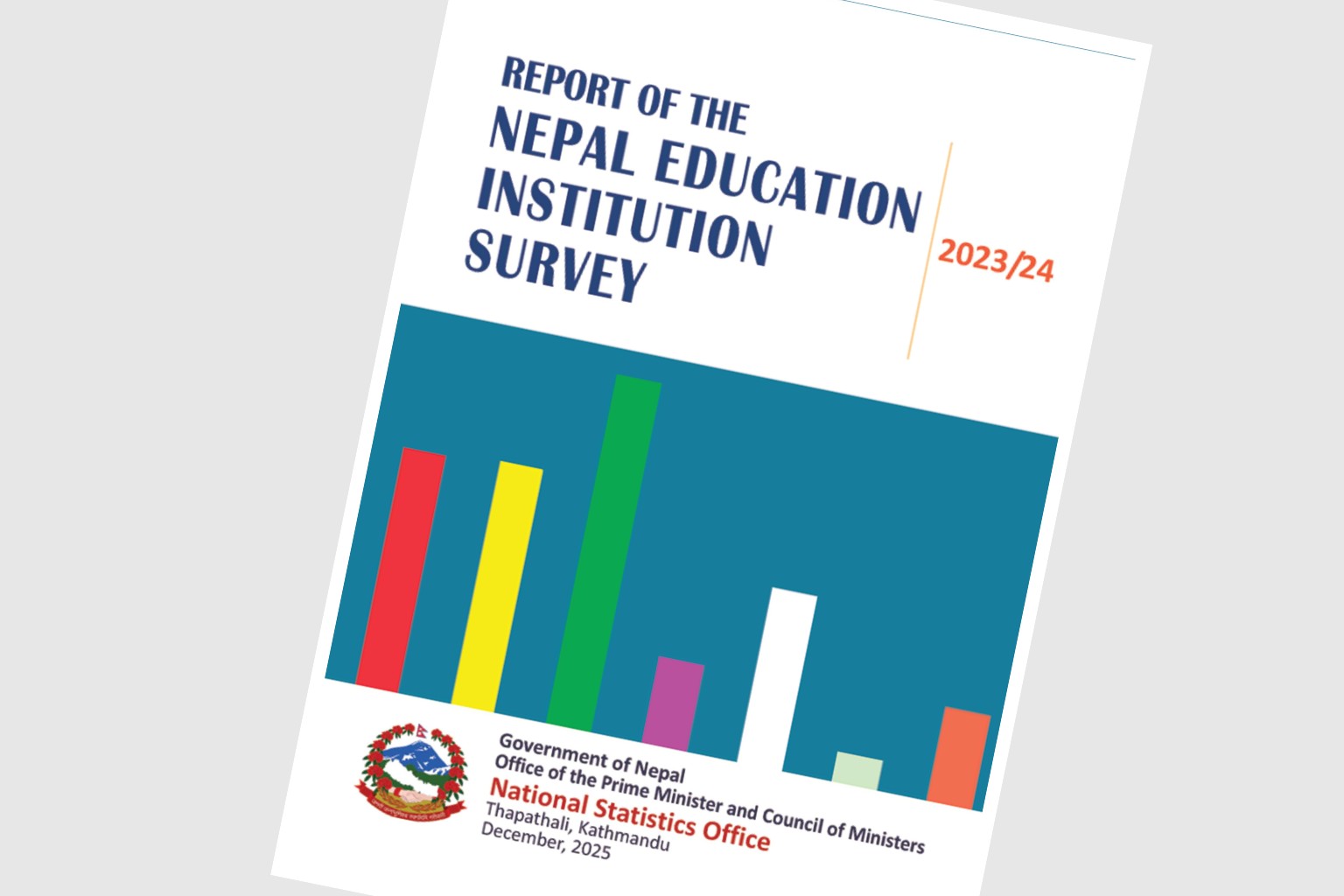
Nepal Education Institution Survey 2023/24
The education sector has made an important contribution to the country’s long-term development, prosperity, and social transformation. After the Government of Nepal made legal provisions allowing investment in the education sector not only from the government sector but also from the private and community sectors, the presence of schools, campuses, and technical-vocational training centers operated by private, community, trust, and other sectors other than government ownership has become notable in recent years.
With the expansion of such educational institutions, the economic activities, employment creation, infrastructure development, and investment generated by these institutions have made an important contribution to the national economy. Although these institutions have made an important contribution to the national economy through the development of human resources, employment creation, educational infrastructure development, and investment of private capital in teaching activities, timely and detailed educational statistics related to private, community, trust, and other sectors other than government ownership have not been available.
To address this lack of data, the National Statistics Office, as the official statistical agency of Nepal, conducted the Nepal Education Institution Survey, 2081, focusing on educational institutions other than those under government ownership that fall under Section “P – Education” of the Nepal Standard Industrial Classification of All Economic Activities (NSIC): pre-primary and primary education, from pre-primary to Grade 8 (Code 8510), secondary education (Code 8521), technical and vocational secondary education (Code 8522), and higher education (Code 8530).
The survey covered various subjects, including the structural status of educational institutions, type of ownership, human resources involved and employment status, number of students and tuition fees, salary and wages, recurrent expenditure for institutional operation, fixed assets, available services and facilities, among others. The survey was conducted in a way that would allow results to be obtained from the national level down to the provincial level.
The objective of the survey is to provide information on the actual status of important issues such as the contribution made by educational institutions other than those under government ownership to gross domestic product, employment creation, institutional infrastructure development, and investment in this sector. The results obtained from the survey have provided the details necessary for policy formulation, plan implementation, monitoring, and evaluation of this sector, as well as for measuring the contribution of the education sector to gross domestic product. These detailed statistics related to the education sector have also provided basic details for changing the base year of national accounts.
For the purpose of data collection in the survey, Fiscal Year 2080/81 BS was taken as the reference year. Therefore, the details presented in the results report of this survey depict the situation of Fiscal Year 2080/81 BS.
Major Results of the Survey
According to the survey results, 10,411 non-government educational institutions were found to be operating across the country during the reference year. By province, among the total non-government educational institutions in the country, the largest number, nearly one-third, or 3,903 institutions, were found to be operating in Bagmati Province.
Koshi and Madhesh provinces had almost similar numbers of educational institutions, with 1,913 and 1,821 institutions respectively. Similarly, 1,556 educational institutions were operating in Lumbini Province, 906 in Sudurpashchim Province, 862 in Gandaki Province, and the lowest number, 379, in Karnali Province.
According to the Nepal Standard Industrial Classification, the number of pre-primary and basic-level schools appears higher. Among educational institutions other than those under government ownership, pre-primary and basic-level educational institutions accounted for 43 percent, or 4,422 institutions; secondary-level institutions accounted for 41 percent, or 4,319 institutions; and institutions providing higher education in Nepal accounted for 12 percent, or 1,288 institutions. Similarly, educational institutions providing technical and vocational education were the lowest in number, with only about 3 percent, or 301 institutions, in operation.
During the reference period, a total of 151,516 persons were found to be involved in the 10,411 educational institutions in operation, while 121,516 persons were found to be working as salaried/wage-paid teachers and employees.
Educational institutions within the scope of the survey generated gross output of around Rs. 195 billion during the reference year, and intermediate consumption (IC) worth Rs. 35.4 billion was used to produce that output. Similarly, the total input of these educational institutions during the reference year was found to be around Rs. 120 billion.
During the reference period, educational institutions other than those under government ownership were found to have contributed gross value added of Rs. 120 billion to Nepal’s economy. During the same period, educational institutions spent around Rs. 75 billion under salaries/wages and other benefits, and by the reference year, fixed capital investment in educational institutions was found to be around Rs. 309 billion.
Institutional Details
On the basis of operational ownership, the number of educational institutions operating as private limited companies was found to be 5,421; the number operating under individual ownership was 2,163; the number operating as partnerships was 1,529; the number operating as private and public trusts was 746; and the number of community educational institutions providing higher education was 545.
Viewed this way, private-sector investment appears higher in the non-government education sector, while investment from the community and trust sectors was found to be comparatively lower.
When individual ownership of educational institutions is viewed on a gender basis, only 20 percent, or 436 institutions, were found to be owned by women, while only 17.8 percent, or 385 institutions, had women in managerial leadership. By province, women’s participation in ownership and management in Bagmati and Gandaki provinces stood at 21.3 percent, while women’s participation was found to be comparatively lower in Madhesh, Karnali, and Sudurpashchim provinces.
Among individually owned educational institutions, only about 15.6 percent in Madhesh Province were owned by women, while women were found to be in managerial roles in only 8.3 percent.
According to the physical structure of non-government educational institutions in Nepal, more than 50 percent of institutions were found to be operating in their own buildings, about 35 percent in rented buildings, and about 12 percent under lease arrangements. In Madhesh and Bagmati provinces, the share of institutions using rented buildings was 46 percent and 38 percent respectively, while the share of educational institutions operating from their own buildings in Gandaki, Karnali, and Sudurpashchim provinces stood at 72.5 percent, 66.5 percent, and 60.5 percent respectively.
Human Resources Involved and Employment
A total of 211,516 persons were engaged in educational institutions other than those under government ownership, and 211,516 persons were found to be working as paid employees receiving salaries/wages. Among the total paid employees, 221,504 persons, or 74 percent, were engaged in teaching work, while 78,517 persons, or 26 percent, were non-teaching employees.
Among the human resources involved in teaching work, 91 percent were full-time and 19 percent were part-time. Similarly, among the human resources involved in non-teaching work, about 96 percent were working full-time and only 4 percent part-time. Among all teaching and non-teaching employees, 145,610 men and 154,211 women were found to be employed.
By province, the highest number of employees was found in Bagmati Province, with 117,221 persons employed, which is more than one-third, or about 39 percent, of total employment in this sector. Similarly, 48,710 persons were employed in Koshi Province, 43,129 in Lumbini Province, 40,233 in Madhesh Province, 24,558 in Gandaki Province, and 18,758 in Sudurpashchim Province, while the lowest number, 7,312, was found in Karnali Province.
From the perspective of gender composition, the number of female employees was found to be higher than that of male employees in all provinces except Madhesh Province.
Number of Students
According to the survey results, the main share of students in educational institutions other than those under government ownership was found at the school level, including pre-primary, basic, and secondary levels. In the academic session 2080/81 BS, a total of 3.641 million students were found to be studying from pre-primary level to higher education.
At the pre-primary level alone, about 932,000 students were studying. In basic education, Grades 1–8, 1.564 million students were studying. At the secondary level, Grades 9–12, about 491,000 students were studying. At the higher education level, bachelor’s degree and above, about 221,000 students were studying in community educational institutions and about 245,000 in private educational institutions, making a total of about 466,000 students. Similarly, a total of 35,488 students were found at the pre-diploma and diploma levels of technical and vocational education.
Among the 466,604 students studying higher education, 214,917 students, or about 46 percent, were found to be studying in Bagmati Province. By faculty, 236,581 students, or about 51 percent, were studying under the management and commerce faculty; 112,776 students, or about 24 percent, under the education faculty; 41,009 students, or about 9 percent, under the humanities and social sciences faculty; 36,619 students, or about 7 percent, under the science and technology faculty; 21,739 students, or about 5 percent, under the engineering faculty; and 18,572 students, or about 3 percent, under other faculties.
By province, the number of students studying in the management and commerce faculty was higher in all provinces except Karnali Province. In Karnali Province, however, among the total 16,726 students studying higher education, 10,962 students, or about 70 percent, were found to be studying under the education faculty.
Physical Infrastructure, Tuition Fees, and Recurrent Operating Expenditure
Across 10,411 educational institutions in the country, there were 28,235 buildings and 183,846 classrooms. The average number of buildings per educational institution was 2.7, and the average number of classrooms was 17.7. There were 9,152 disability-friendly classrooms, about 5 percent, and 8,766 classrooms with air conditioning, about 4 percent.
The number of vehicles used for students in educational institutions was about 16,379. The highest number was in Bagmati Province, with 6,948 vehicles, followed by Koshi Province with 3,031 and Lumbini Province with 2,531.
In all types of educational institutions other than those under government ownership, the average annual expenditure per institution on salaries, allowances, and other costs required for running educational institutions was about Rs. 9.122 million. Compared with the national average, institutions in Bagmati Province had the highest average annual expenditure per institution, at about Rs. 21.2 million. Similarly, the average annual expenditure was about Rs. 13 million in Gandaki Province, about Rs. 10.4 million in Lumbini Province, about Rs. 8.9 million in Koshi Province, about Rs. 7 million in Madhesh Province, about Rs. 6.5 million in Karnali Province, and the lowest, about Rs. 6.3 million, in Sudurpashchim Province.
According to the Nepal Standard Industrial Classification, educational institutions in higher education had the highest average annual expenditure, at about Rs. 20 million. In secondary education from Grade 9 to Grade 12, the average annual expenditure was about Rs. 18.8 million, and in technical and vocational education, it was about Rs. 11.7 million. The survey results show that institutions providing pre-primary and primary education had the lowest average annual expenditure, at about Rs. 2.877 million.
The national average monthly tuition fee of educational institutions other than those under government ownership was found to be about Rs. 2,335. By province, the average monthly tuition fee of educational institutions in Bagmati Province was the highest, at Rs. 5,155, while the lowest average monthly fee was found in Sudurpashchim Province, at about Rs. 2,155.
According to the Nepal Standard Industrial Classification, monthly tuition fees also varied by level. Under the school level, the average monthly fees of pre-primary and basic-level institutions were relatively lower than those of the secondary level, while the fee level was found to increase gradually at the higher secondary level. Institutions operating higher education programs, bachelor’s degree or above, and institutions providing technical and vocational education had average monthly tuition fees higher than those at the school level.
In non-government educational institutions, the average monthly salary/allowance paid to teachers and other employees was about Rs. 16,327. By province, the highest average monthly salary/allowance was in Bagmati Province, at Rs. 19,657, while the lowest was in Sudurpashchim Province, at Rs. 12,447.
According to the Nepal Standard Industrial Classification, the average monthly salary/benefits of teachers and employees in institutions operating higher education and technical/vocational programs were higher than those in school-level institutions, including pre-primary, basic, and secondary levels. The average monthly salary/allowance of educational institutions conducting higher education-related activities was Rs. 21,631, while the lowest average monthly salary/allowance was found in pre-primary and primary-level educational institutions, at only Rs. 11,954.
Across the country, about 1.08 million students were found to be using school transport services. About 46,247 students were found to be living residentially in school hostels, while about 47,900 students were found to be studying while staying in day hostels, or day boarding.
Miscellaneous
Among educational institutions other than those under government ownership, 34.8 percent were found to have made contributions/support under corporate social responsibility (CSR).
Regarding thematic questions related to the major problems faced by educational institutions, only 1,642 institutions responded. Among them, the highest number of educational institutions identified governance, education-related laws, regulation, and unstable policies as the main problem, at about 71 percent. They also responded that economic problems, inability to collect fees on time, and financial problems in operating educational institutions were problems, at about 42 percent.
Problems related to physical infrastructure and basic services were found at 24 percent, problems related to human resources and internal management at 18 percent, and problems related to student enrollment, dropout, and awareness among parents/community at 28 percent.
Higher education and technical educational institutions were found to have identified issues such as declining student enrollment and the increasing number of students going abroad as major causes.






Comments 0
No comments yet. Be the first to start the conversation.