



Table of Content
- Higher Education in Nepal: Yesterday, Today, and Tomorrow
- Yesterday: Historical Background of Higher Education in Nepal
- Today: Structural Expansion, but a Crisis of Quality and Credibility
- Tomorrow: A Clear Roadmap to Reform Higher Education
- Conclusion
Higher Education in Nepal: Yesterday, Today, and Tomorrow
The main engine of any nation’s economic, social, and intellectual transformation is its higher education system. Universities and higher educational institutions are regarded as the places that produce knowledge, encourage innovation, and prepare a competitive workforce for the global market.
In Nepal’s context, the journey of higher education has already crossed nearly a century. Even so, in its current state, this sector has neither been able to address the expectations of ordinary young people in a satisfactory way nor produce the workforce required by the country’s economic and technological needs.
Today, the harsh reality before us is that hundreds of Nepali youths who have completed secondary education (SEE or Grade 12) stand in line every day at Tribhuvan International Airport holding No Objection Letters (NOC) in order to secure their future.
So, has Nepal’s higher education system completely failed? To find an objective answer to that question, it is necessary to conduct a hard and deep analysis of the path Nepali higher education has traveled in the “yesterday,” the condition it faces “today,” and the road it must take “tomorrow.” This article explores the multidimensional reality of higher education in Nepal on the basis of facts and evidence.
Yesterday: Historical Background of Higher Education in Nepal
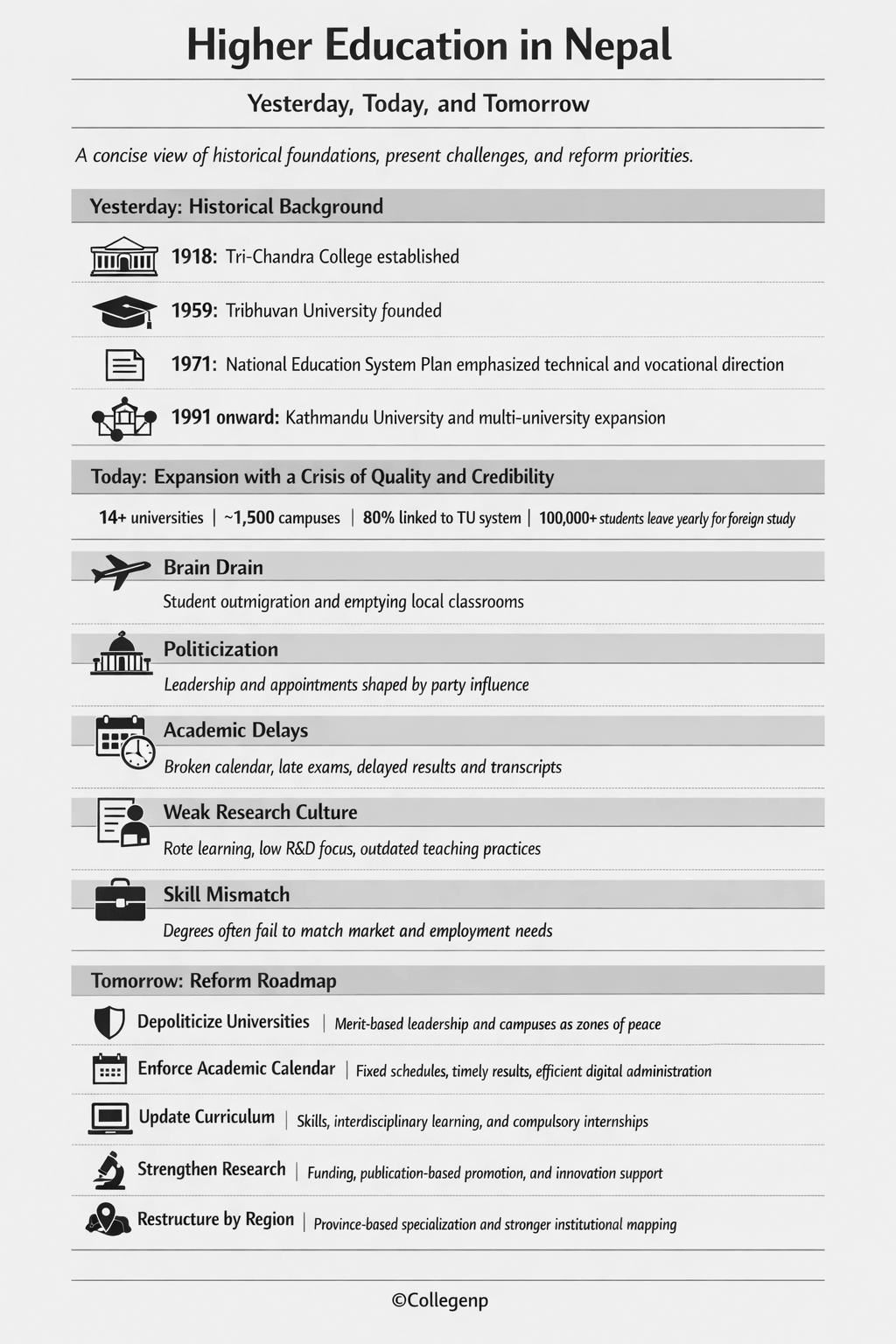
The ancient history of Nepal’s education system begins with informal structures such as gurukuls, viharas, gumbas, and madrasas. From the perspective of modern higher education, Tri-Chandra College, established in B.S. 1975 (A.D. 1918) by Rana Prime Minister Chandra Shamsher, was Nepal’s first formal institution of higher learning.
However, at that time education was not accessible to the general public, and most students from elite families used to travel to Banaras or Patna for study.
The institutional revolution in higher education in Nepal began when Tribhuvan University (TU) was established in B.S. 2016 (A.D. 1959). For decades, Tribhuvan University alone carried the entire burden of Nepal’s higher education system. The administrators, technicians, doctors, engineers, and teachers needed by the country were produced there.
In its early years, graduating from TU was a matter of deep social prestige, and its academic environment was considered disciplined and qualitatively strong.
Later, the National Education System Plan (NESP), implemented in B.S. 2028, attempted to place greater emphasis on technical and vocational education. However, it was unable to deliver a major systemic leap.
After the restoration of democracy in B.S. 2046, the concept of a multi-university system and liberalization entered higher education as well.
The establishment of Kathmandu University (KU) in 1991 presented a successful example that higher education could be run in an autonomous and different way, breaking the government monopoly. After that, universities such as Purbanchal University and Pokhara University began to open, creating the multidimensional landscape we see today.
Today: Structural Expansion, but a Crisis of Quality and Credibility
At present, Nepal has more than 14 universities in operation, along with several specialized medical and technical academies. This figure may also include provincial universities that are currently in the process of being established.
According to statistics and annual reports of the University Grants Commission (UGC), there are around 1,500 campuses in the country, of which more than 80 percent are either constituent or affiliated campuses of Tribhuvan University.
In numerical terms, higher education colleges have now spread across villages, neighborhoods, and municipalities throughout the country. From the standpoint of access, this is a positive and major achievement.
The earlier compulsion of having to come to Kathmandu even for bachelor’s or master’s level education has, to a large extent, ended. But ironically, while the number of institutions grew rapidly, quality declined at an equally alarming rate.
The current situation can be understood and evaluated through the following key dimensions:
1. Youth Despair and Widespread Foreign Outmigration (Brain Drain)
The most frightening reality faced by Nepal’s education sector today is brain drain, or student outmigration. Every year, more than 100,000 students leave the country with approval letters (NOC) from the Ministry of Education under the name of “study visas” to countries such as Australia, the United States, Canada, the United Kingdom, and Japan.
On the one hand, this is sending billions of rupees of capital out of the country, which can be described as capital flight. On the other hand, campuses in villages and towns are starting to see empty classrooms because there are no students left to enroll.
Even some established affiliated colleges have already reached a point where they are forced to close or merge due to a shortage of students. Students are not leaving only because of the perception of better-quality education abroad. A major reason is the deep uncertainty and distrust about the future after completing higher education within Nepal.
2. Politicization of Leadership and the Culture of Patronage-Based Appointments
The most serious illness of Nepal’s public universities is extreme partisan politicization at the institutional level. Appointments ranging from vice chancellors, rectors, and registrars to campus chiefs are often made through open political division of positions among parties.
When the leaders who run universities reach those positions not through academic excellence and administrative capability but through party recommendation, they serve their parties and unions more than the universities themselves.
Continuous lockouts, protests, and acts of vandalism by teachers’ associations and student unions have transformed public universities from academic and research centers into recruiting grounds for political parties.
3. A Broken Academic Calendar and Delays in Results
Another technical but serious reason why many young students in Nepal are frustrated with higher education is the failure to complete courses and examinations on time.
Any established university in the world publishes in advance the full four-year calendar, including the dates of exams and graduation ceremonies, and treats it as a binding commitment. But in institutions such as Tribhuvan University, students often need 5 to 6 years to complete a four-year bachelor’s degree and receive their transcripts.
In many cases, students do not receive their results even 10 to 15 months after sitting for exams. For young people who must apply for jobs within a month or two, this level of administrative delay and disorder has become unbearable. These weaknesses have long fueled criticism of the Tribhuvan University examination system.
4. The Miserable State of Research and the Culture of Rote Learning
The essence of higher education is not mere memorization. It is research, the habit of asking questions, and the discovery of new facts.
Unfortunately, most of our colleges still rely on a school-like rote learning model in which teachers explain textbooks, dictate notes, and award marks based on what students write in a three-hour exam hall.
There are statistics showing that only a very small share of university budgets, less than 1 percent, is spent on research and development (R&D) and publication. Most professors continue to teach from the same old notes for years instead of publishing research papers.
At a time when the market demand for new technologies such as artificial intelligence (AI), machine learning, and data analysis is rising sharply, the curricula of our universities remain trapped in traditional theory.
5. Degree on One Side, the Job Market on the Other (Skill Mismatch)
Millions of students earn degrees from the faculties of management, humanities, and science, but they do not possess the skills the market is actually looking for, such as IT competence, problem-solving ability, and corporate communication.
Because of this skills mismatch, degree-holding youths on one side are becoming victims of depression for lack of work, while banks, industries, factories, and corporate institutions on the other side keep complaining that they cannot find qualified and skilled people. The real meaning of education is to connect knowledge with employment or entrepreneurship, and the current education system is failing completely in this regard.
Even so, the present picture is not entirely hopeless. Amid this severe crisis, rays of hope are still alive in Nepal. TU’s Institute of Medicine (IOM) and Institute of Engineering (IOE) are still counted among the best, and gaining admission there is tied to the struggle and dreams of hundreds of thousands of students.
There are also examples before us of Kathmandu University and some autonomous and private institutions providing excellent medical and technical education within Nepal and even attracting foreign students.
The steps taken by the University Grants Commission (UGC) in recent years through the Quality Assurance and Accreditation (QAA) system to upgrade colleges to international standards are also a positive sign of reform.
Tomorrow: A Clear Roadmap to Reform Higher Education
No matter how deteriorated the present may be, structural, policy-level, and administrative surgery in Nepali higher education has become unavoidable if future generations are to have a secure future.
Minor patchwork reforms can no longer restore our academic foundation. If the state, political parties, and society are able to adopt the following measures, tomorrow’s higher education can become a tool for transforming the national economy. Much of this debate also aligns with the broader discussion on higher education reform in Nepal.
1. Complete Liberation of Universities from Partisan Politics
As long as university leadership does not emerge through open and global competition, reform will not be possible. A practice has recently begun in some universities of inviting applications for vice chancellor positions on a competitive basis. That method must now be established in law.
Universities should be declared Zones of Peace, and strict restrictions must be imposed on direct activities, strikes, and lockouts by any party-affiliated sister organizations.
To return universities to the domain of knowledge and debate, strict provisions should be enforced preventing teachers and professors from holding party membership.
2. Mandatory Academic Calendar and Efficient Administration
Rather than going abroad, our students will stay in Nepal if they know in advance what they will study, when they will sit for exams, and on what date they will receive their transcripts.
The admission period, days allocated for teaching and learning, and the maximum deadline for publishing results should be legally fixed, and the academic calendar must be implemented strictly.
There should be no further delay in making maximum use of information technology: allowing all administrative forms to be completed online, checking answer sheets through automated systems such as barcode scanning, and publishing results digitally within one month.
3. Updated Curriculum Focused on Skills and the Market
The compartmentalized structures of our universities must now be broken. An interdisciplinary approach should be adopted. This means science students should be able to take some required credits in economics and the humanities, and soft skills such as digital literacy, coding, professional communication, and project management should be made integral parts of all degree programs.
If a minimum six-month internship or apprenticeship in industry, companies, or institutions is made compulsory at the end of every course, students will graduate with concrete work experience in their hands.
4. Strengthening Research Funding and Inquiry
Professor promotions should be measured not only by years of service but also by the research they have published in international peer-reviewed journals.
A Higher Education Research Fund should be created in the national budget so that investment can be made through universities in startups, agricultural research, technology, and innovative project work aimed at solving the problems of local communities.
Only research-oriented universities can connect local social problems with global knowledge.
5. Geographic Restructuring of Universities (Mapping and Decentralization)
There is now a major challenge of merging the mushrooming colleges spread across the country that have no resources and strengthening them.
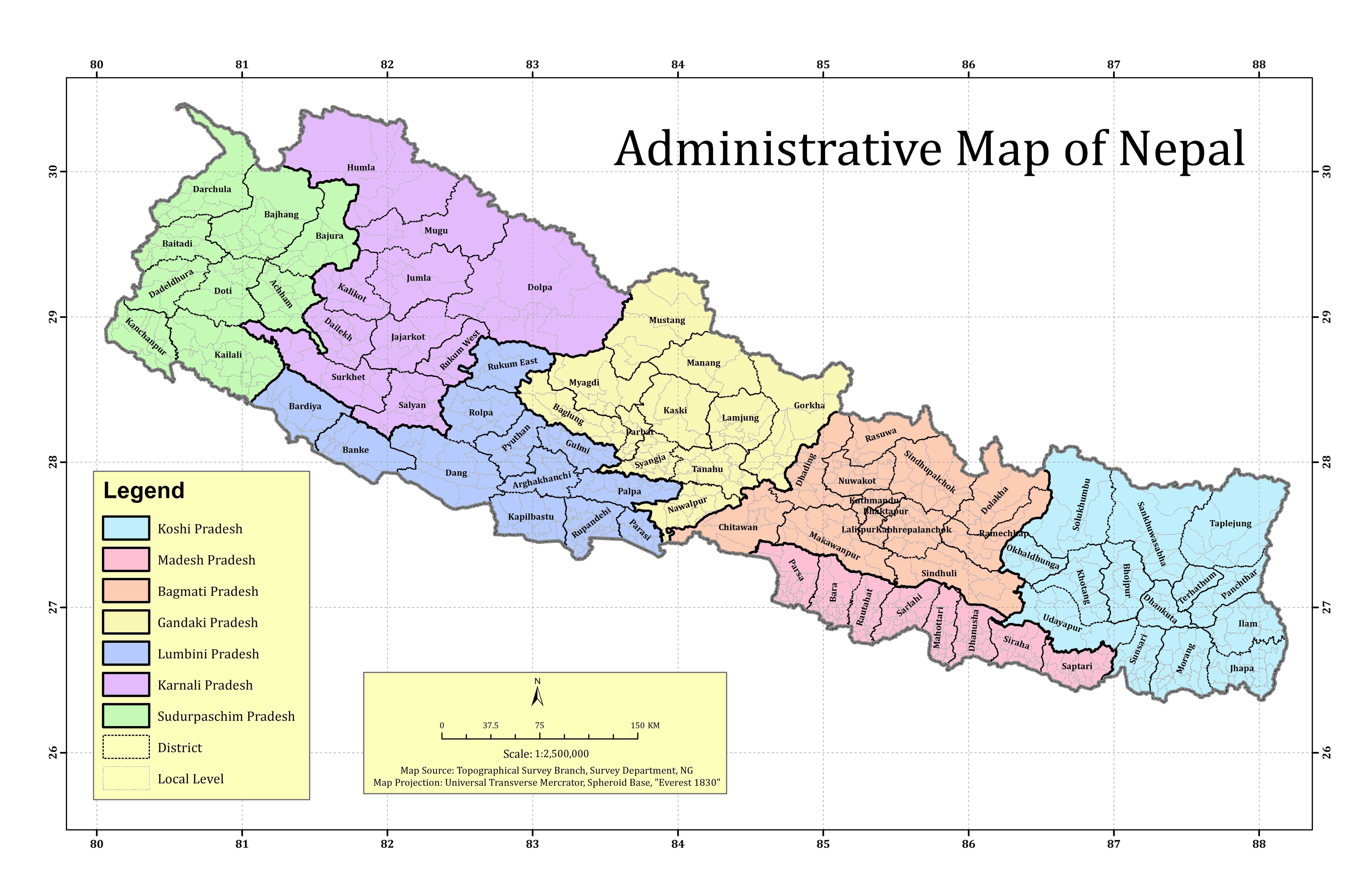
Nepal must now develop institutions based on the distinct needs of each province. For example, colleges in Madhesh or Lumbini should focus on agricultural science, colleges in Gandaki should emphasize hospitality and tourism, and institutions in Karnali and Sudurpashchim should prioritize herbal and environmental studies. Promoting such specialization would be a scientific approach.
Instead of every institution trying to teach everything, a national understanding should be established about which institution excels in what field.
Conclusion
In the end, Nepal’s higher education has transformed from the prestigious and elite structure of the past into today’s landscape of broad access and uncontrolled disorder. We now stand in a situation where we must escape this trap of expansion as quickly as possible.
The country’s economic future cannot continue to rest forever on the shoulders of unskilled youths who labor abroad and send remittances home. If we fail to produce intellectual power that creates jobs within the country and instead keep mistaking the artificial stability provided by foreign currency reserves for development, the nation will become hollow.
At this moment, the frustration widespread among young students is not merely an emotional reaction. It is a sharp response to the services the state system has failed to provide and to its broader inaction.
Therefore, the path ahead, the education of tomorrow, must be research-driven, technology-integrated, entrepreneurship-oriented, and administratively efficient.
Only if full meritocracy in leadership selection, academic freedom, and accountable administrative reform are implemented will we be able to restore a sense of pride in our universities, institutions that deliver not only certificates but also capable citizens who carry dreams into society.







Comments 0
No comments yet. Be the first to start the conversation.