




Nepal Higher Education: History and Future Roadmap
Among today’s young generation, one serious question is common: “Can Nepal’s higher education compete in the global market?”
Every year, hundreds of thousands of students leaving the country (brain drain) is not only a matter of personal choice. It is also the result of growing distrust in our education system. However, this situation was not created overnight. Its roots are hidden in the pages of history.
To understand the present condition of any country, it is essential to examine its past. In Nepal, the development of higher education has not moved forward in a steady and consistent way. At times, political restrictions; at times, lack of resources; and at times, policy instability have held it back.
The main objective of this article is to provide an impartial and evidence-based analysis of how higher education began in Nepal, what turning points it passed through, and where it stands today. This article will not praise any political party or individual. Instead, it will discuss policy and its impact.
Table of Content
- Nepal Higher Education: History and Future Roadmap
- Traditional Roots of Higher Education in Nepal
- Beginning of Modern Higher Education
- Rise of Democracy and Expansion of Education
- Establishment of Tribhuvan University
- New Education System Plan (NESP - 2028 B.S.)
- Multi-University Concept and Liberalization
- Current Situation: Problems, Challenges, and Reality
- The Way Forward
- Conclusion
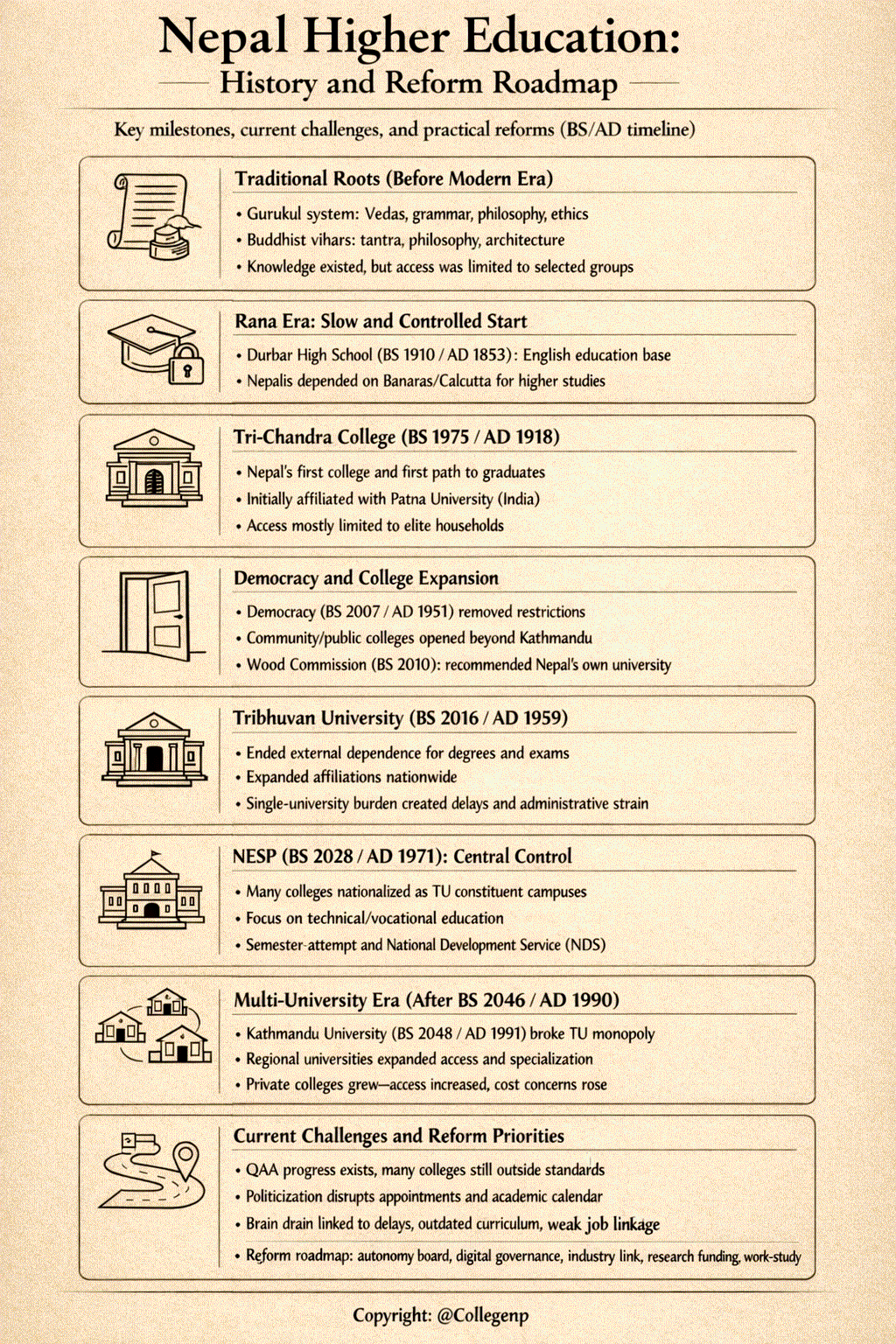
Traditional Roots of Higher Education in Nepal
Long before the establishment of modern colleges or universities, Nepal had its own original tradition of higher learning. Even if it did not match today’s modern structures, it was highly developed in terms of knowledge production and knowledge sharing.
Gurukul and the Vedic Education System
The foundation of Nepal’s education history is the Gurukul system. In ancient times, the ashrams of sages were centers of higher learning. Deep study of the Vedas, grammar, astrology, philosophy, and ethics was conducted there.
During the time of King Janak in Videha (Janakpur), it was a major center of scholars, where philosophers such as Yajnavalkya, Gargi, and Maitreyi engaged in scholarly debates. This represents the earliest form of higher education in Nepal.
Buddhist Monasteries and Gumba-Based Learning
Lumbini and the Kathmandu Valley were important centers of Buddhist education. Especially during the Licchavi and Malla periods, Nepal’s monasteries offered advanced learning in tantra, philosophy, and architecture.
Nepal also had academic links with Nalanda and Vikramashila universities in India. Historical records show that even Chinese travelers praised Nepal’s scholarship and manuscripts.
However, the key problem was this: the education system was limited to certain castes, classes, or communities. Higher education was not open to the general public.
Beginning of Modern Higher Education
The start of modern (Western-model) higher education in Nepal took place during the Rana era, but it progressed slowly and under strict control.
Durbar High School and the Foundation
In B.S. 1910 (A.D. 1853), after his visit to the United Kingdom, Jung Bahadur Rana established Durbar High School. Although it was a school-level institution, it laid the foundation for English education and modern subjects.
For higher education, Nepalis were still forced to go to Banaras or Calcutta in India.
Tri-Chandra College: Nepal’s First College (1918 A.D.)
The most important milestone in Nepal’s higher education history was the establishment of Tri-Chandra College on B.S. 1975 Bhadra 27 (A.D. 1918). It was established by then Prime Minister Chandra Shumsher.
Interesting fact and analysis: while inaugurating Tri-Chandra College, Chandra Shumsher reportedly said, “Today I struck an axe at my own feet.” This clearly shows that the rulers understood higher education would create public awareness, and that awareness could challenge authoritarian rule.
Affiliation: In the beginning, the college was affiliated with Patna University (India). The curriculum and examination system followed Patna University. First, I.A. (Intermediate of Arts) and later B.A. (Bachelor of Arts) programs began.
Tri-Chandra College opened the path for Nepal to produce its first graduates. However, the opportunity to study there was mostly limited to the Rana family and elite households.
Rise of Democracy and Expansion of Education
After the establishment of democracy in B.S. 2007 (A.D. 1951), higher education in Nepal expanded rapidly. With the fall of the Rana regime, restrictions on education were lifted.
Expansion of Colleges
Until B.S. 2007, Nepal had only one college (Tri-Chandra). But between B.S. 2007 and B.S. 2016, community (public) colleges began opening across different parts of the country.
Colleges were established through public efforts in Biratnagar, Birgunj, Patan, and various places in Kathmandu.
National Education Planning Commission (2010 B.S.): Formed under the leadership of Dr. Hugh B. Wood, this commission recommended that Nepal should have its own university. It is also known as the “Wood Commission.”
It played a major role in preventing higher education from remaining India-dependent and helped shape a national system.
Establishment of Tribhuvan University
The biggest event in Nepal’s higher education history was the establishment of Tribhuvan University (TU) in B.S. 2016 (A.D. 1959).
Why TU Was Necessary
Before TU was established, all colleges in Nepal were linked to Patna University. Without a national curriculum, a national examination system, and nationally issued degrees, Nepal lacked academic sovereignty.
The establishment of TU made Nepal academically independent.
Structure and Challenges
TU began from a small office at Tripureshwar and later moved to Kirtipur. It started granting affiliation to colleges across the country.
Problem: For a long time (more than 30 years), Nepal had only one university. This created a monopoly. When one university had to handle millions of students, problems such as delayed exams, late results, and administrative disorder began from this point.
New Education System Plan (NESP - 2028 B.S.)
During the time of King Mahendra, the New Education System Plan (NESP) was implemented in B.S. 2028 (A.D. 1971). It was a controversial but ambitious turning point in Nepal’s higher education history.
Key Features
Nationalization of private colleges: Most public colleges opened before B.S. 2028 were converted into constituent campuses of TU. The state took full responsibility for education.
Focus on vocational education: This plan attempted to link higher education with manpower production. Technical and vocational education was prioritized.
Semester system: For the first time, the semester system was practiced in B.S. 2028 (later discontinued due to failure, and now implemented again).
National Development Service (NDS): Postgraduate students were required to serve in rural areas for 10 months. This was highly effective in helping students understand the country’s realities.
Criticism and Impact
This plan made education highly controlled and centralized. The state treasury could not sustain the full cost of running all campuses.
As a result, after student movements and political changes around B.S. 2036/37, even some positive elements of the plan (such as NDS) were discontinued.
Multi-University Concept and Liberalization
Following the political change of B.S. 2046 (A.D. 1990), Nepal adopted open-market economic policies and liberalization. This directly affected higher education.
Emergence of Kathmandu University (KU)
Breaking TU’s monopoly, Kathmandu University (KU) was established in B.S. 2048 (A.D. 1991). KU demonstrated that quality education could be delivered through a private-sector or community-based (not-for-profit) model.
It brought a major shift in Nepal’s medical and engineering education.
Other Regional Universities
To promote balanced development, the government introduced region-based universities, including:
-
Purbanchal University (1995): Focused on eastern Nepal
-
Pokhara University (1997): For western Nepal and tourism/management education
-
Lumbini Buddhist University: For specialized studies
-
Agriculture and Forestry University (AFU): For agriculture education in Rampur
-
Mid-Western and Far-Western Universities: For geographical balance (in the 2010s)
Rapid Growth of Private Colleges
After 2046 B.S., a wave of private investment in colleges began. Private institutions expanded from +2 (Plus Two) to bachelor’s and master’s levels.
This increased access, but also faced accusations of commercialization. Education became expensive, and the educational gap between the wealthy and the less privileged widened.
Current Situation: Problems, Challenges, and Reality
After this long historical journey, Nepal’s higher education now stands at a crossroads. From a researcher’s perspective, the major challenges today include the following:
Quality Assurance and Accreditation (QAA)
After the establishment of the University Grants Commission (UGC) in 1993, quality improvement efforts have been made.
The QAA (Quality Assurance and Accreditation) system has been implemented, but many colleges still have not been able to meet these standards.
Politicization
This is the “cancer” of Nepal’s higher education. Appointments—from Vice-Chancellor (VC) to campus chiefs—are often based on political power-sharing.
When professors’ and student organizations focus more on party interests than academic issues, problems such as disrupted academic calendars, lockouts, and weakened learning environments continue to exist.
Brain Drain
Why are students today not attracted to Nepal’s higher education?
-
Exams do not happen on time
-
Results do not come on time
-
Curricula are outdated
-
Education is not linked to employment
Because of these reasons, students rush to Australia, the USA, or Europe immediately after passing Grade 12. This has become the biggest challenge of this era.
Lack of Research
A university is not only a place to distribute knowledge; it is also a place to create knowledge. However, Nepal’s universities lack sufficient research budgets.
Most teaching remains based on rote learning.
This section presents practical and structural solutions to the problems seen in Nepal’s higher education. It has been prepared with the depth of a policy paper and from a senior editorial perspective.
The Way Forward
By reviewing Nepal’s higher education history, we have seen many ups and downs. The pile of problems is large, but they are not impossible to solve.
Ad-hoc reforms are no longer enough. What is needed is systemic surgery. As a responsible analyst, based on 20 years of experience and international practices, the following practical solutions are presented in detail.
Board of Trustees and Real Autonomy
The biggest disease in Nepal’s higher education is political interference, and its roots lie within the structure of the universities.
Core problem: Currently, the Prime Minister serves as Chancellor and the Education Minister serves as Pro-Chancellor. As soon as the government changes, the process of replacing university leadership (VC, Rector, Registrar) begins.
Solution: Through a future Higher Education Act, the traditional provision of the Prime Minister as Chancellor should be removed. Instead, a Board of Trustees model should be introduced.
This board should include respected academics, industrialists, donors, and alumni. Full authority to select university leadership should belong to this board, not to Baluwatar or Singha Durbar.
Kathmandu University (KU) is a clear example where partial practice of this model has created stability.
Academic Calendar: Digital Governance and Decentralization
In TU, it has become normal for students to spend 3–4 years without timely exams or results. A paper calendar alone cannot solve this.
Technology-based system (ERP system): From admission to transcript, the entire process must be fully digitized. Exam control should be tracked by software, not only by people.
There must be real-time monitoring of where answer sheets are and which instructors did not check copies on time.
Decentralization: Managing TU with millions of students from the center alone is not practical. It should be divided regionally or academically (for example: separate autonomous units for science, management, and humanities), and authority must be delegated.
Regional offices should be given the power to conduct exams and publish results.
Industry-Academia Interface in Curriculum
There is a contradiction: graduates remain unemployed with degrees in hand, while employers claim they cannot find job-ready people.
Private sector involvement in curriculum design: Curriculum development bodies should include not only professors but also employers and industry representatives.
Curricula should be updated every 3 to 5 years based on the workforce the market needs.
Internship and credit hours: The burden of theory should be reduced and practical learning and internships should be made mandatory for credit.
A dual mode education system can be adopted to connect classroom learning with workplace experience.
Research-Driven Universities
Most of Nepal’s universities have become teaching centers only. The core responsibility of higher education is producing new knowledge.
Budget allocation: According to international standards, at least 10–15% of a university’s total budget should be spent on research and innovation (R&D).
The state should establish a National Research Fund and provide grants based on competitive proposals.
Faculty evaluation: Promotions should not be based only on years of teaching experience. They should be based on publications in quality research outlets (impact factor journals).
Separate tracks can be designed for teaching-focused and research-focused faculty.
Transforming the Role of Student Unions
History proves that student organizations can be guardians of democracy. However, today there are widespread complaints that these organizations focus more on party interests and contract-related activities than educational reform.
Constructive politics: Student movements should shift from lockouts and destruction toward academic debate, policy pressure, and library improvement.
FSU elections should be fought on agenda and merit rather than party panels.
University premises should be declared “peace zones,” and bandhs and strikes should be discouraged.
Learning with Earning to Reduce Brain Drain
A major reason young people leave the country is economic. Abroad, students can earn while studying, but Nepal lacks this culture.
Campus-based employment: Universities should adopt work-study programs by offering part-time jobs to their own students in libraries, labs, canteens, and administrative work, instead of hiring outside staff.
This provides financial relief and teaches dignity of labour.
Credit transfer: Credit transfer agreements should be expanded so students can complete part of their studies in Nepal and finish the remaining part at reputable foreign universities.
This increases the credibility of Nepal’s degree system.
Sustainable Financing Model
Higher education cannot run only on government grants.
Alumni networks: Top universities worldwide (such as Harvard and IITs) are supported through alumni endowment funds.
Nepal’s universities should also establish development funds by connecting alumni who are in high positions worldwide.
Consultancy services: University experts should provide consulting services to government and the private sector to increase income sources.
The solutions are not impossible. What is required is willpower. If Nepal aims to become an education hub, it must leave behind outdated mindsets and build a technology-friendly, research-based system that matches the global market.
This reform must start from the policy table and reach the classroom.
Conclusion
Nepal’s higher education has traveled a long journey—from the Gurukul huts to modern digital classrooms. From the establishment of Tri-Chandra College to today’s universities, Nepal has made a major leap in access.
In a country where higher education once served only a small number of students, today millions are enrolled. However, even if quantity has increased, serious questions remain about quality and trust.
History teaches that whenever politics and control dominated education, the system weakened. The future path is an education system that produces skilled, ethical manpower that can compete in the global market.
Young students must understand this history so they do not only complain, but also learn to ask the right questions for system reform. Nepal’s higher education history is meaningful, but improving the present and building a stronger future now lies on the shoulders of the next generation and policymakers.
(This article is based on in-depth research, study of historical documents, and a realistic analysis of the current situation. The facts used here have been drawn from authoritative sources of Nepal’s education history.)







Comments 0
No comments yet. Be the first to start the conversation.