



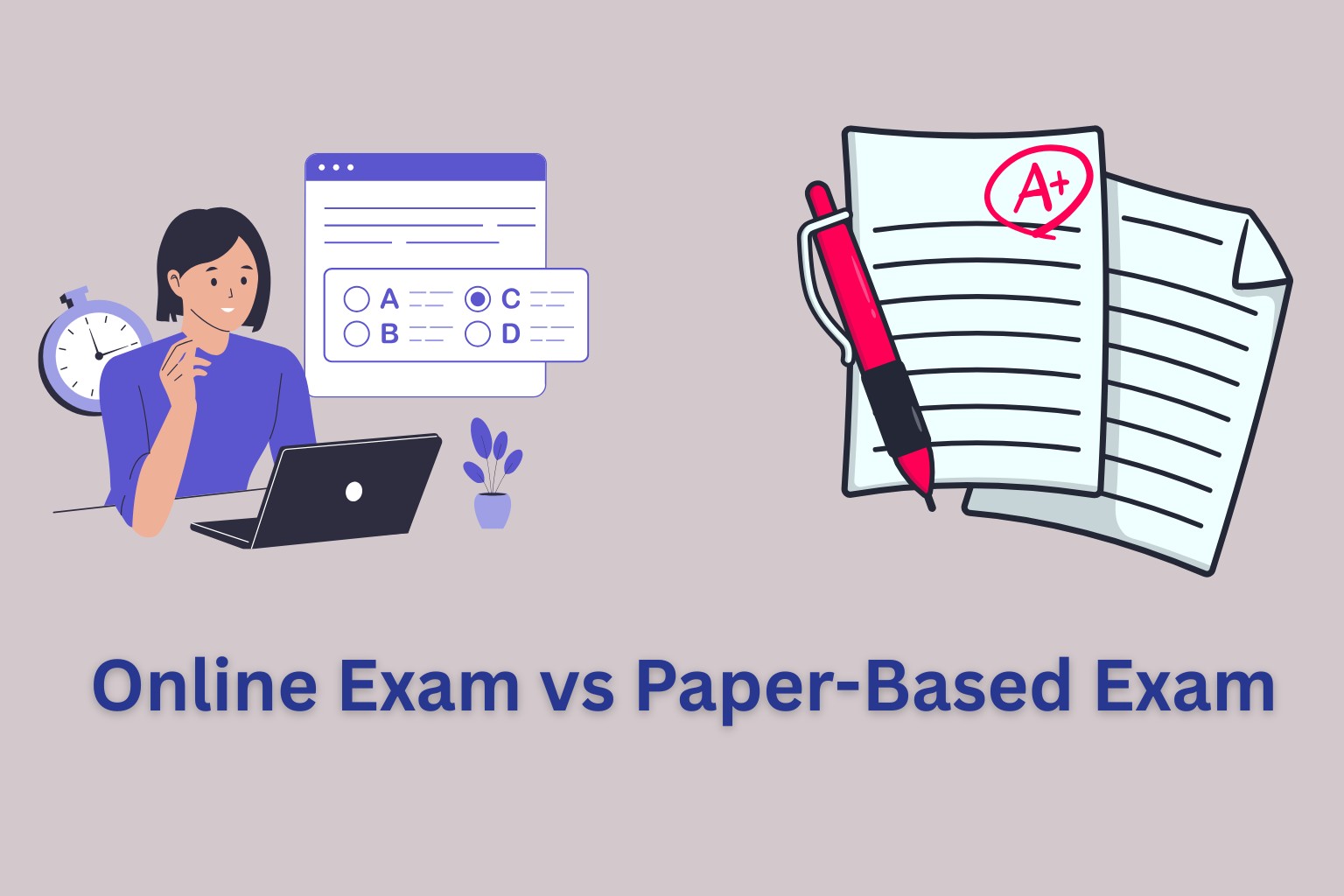
Choosing between an online exam and a paper-based exam is not only a technology decision. It is an assessment quality decision.
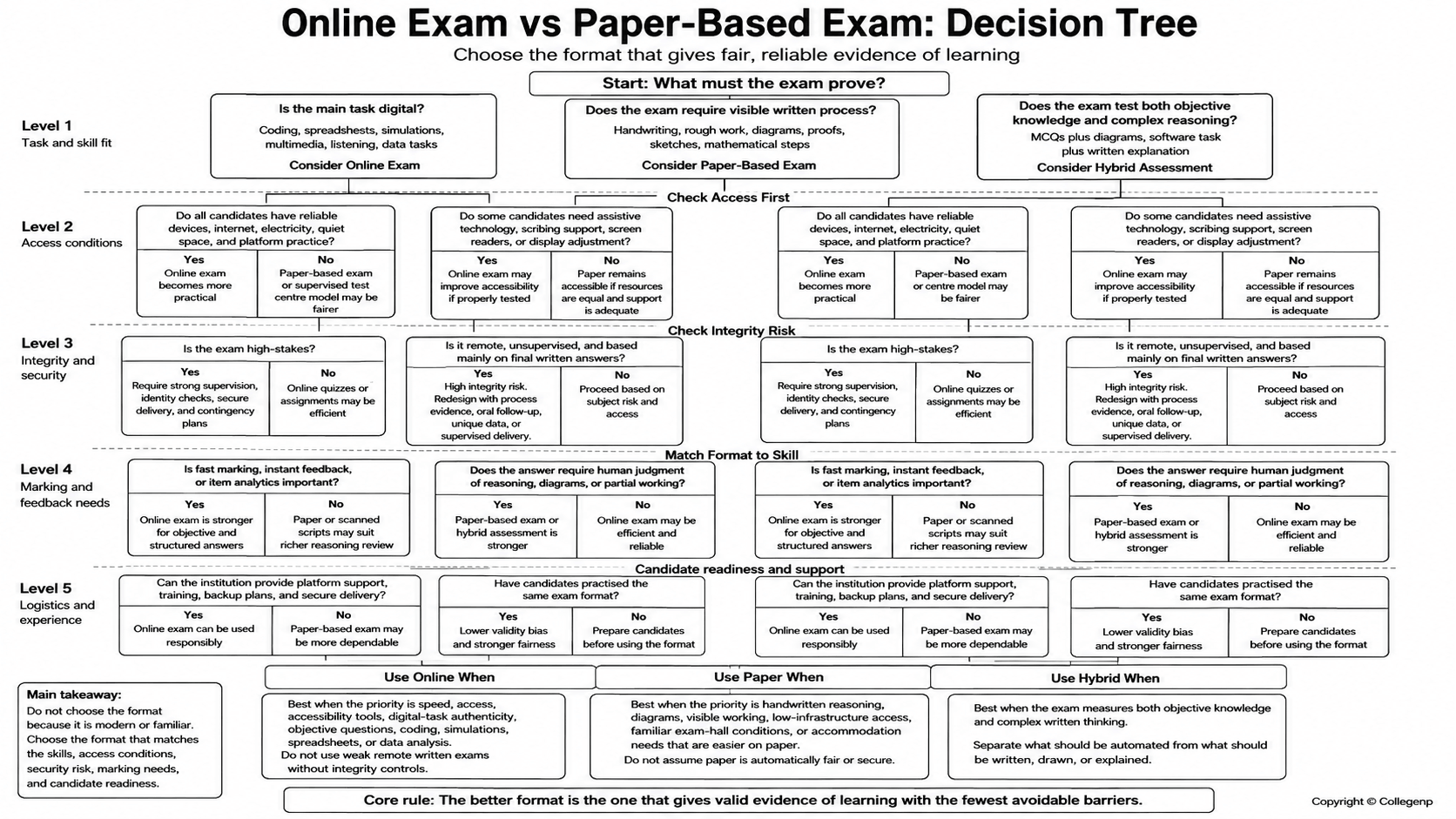
The better format is the one that measures the intended skill fairly, gives candidates reasonable access, protects exam integrity, supports reliable marking, and fits the subject being tested. A digital exam is not automatically better because it is newer. A paper exam is not automatically better because it is familiar.
In many student and school search contexts, this question is also phrased as online exam vs offline exam, where “offline exam” usually refers to a paper-based exam or a physically supervised exam.
Online exams can work well for fast marking, large-scale delivery, item analysis, remote access, accessibility settings, coding, spreadsheets, multimedia tasks, and regular diagnostic testing. Paper-based exams can work better where candidates need to show handwritten reasoning, diagrams, mathematical working, sketches, or where reliable devices and internet access cannot be guaranteed.
The strongest answer is often not online or paper. For many schools, colleges, universities, training providers, and exam teams, a hybrid assessment model is more defensible: online for objective, digital, and fast-feedback tasks; paper for handwritten reasoning, drawings, and process-based answers.
Quick Answer
Online exams are usually better when the assessment needs scale, speed, automated marking, analytics, software-based tasks, or controlled digital delivery.
Paper-based exams are usually better when candidates need to write, draw, annotate, show working, or take the exam in a setting where reliable digital access is not available for everyone.
For high-stakes assessment, neither format should be chosen only for convenience. The decision should be based on validity, access, security, reliability, subject fit, and available support. If one format cannot assess all required skills fairly, a hybrid model is often the safest choice.
Table of Content
- The Real Issue Behind Online Exam vs Paper-Based Exam
- Comparison Methodology
- Evidence Snapshot
- Online Exam vs Paper-Based Exam: Comparison Table
- What Is an Online Exam?
- What Is a Paper-Based Exam?
- Fairness and Validity
- Access and Equity
- Security and Academic Integrity
- Marking Reliability
- Feedback and Analytics
- Cost and Logistics
- Candidate Experience
- Subject Fit
- Mini Case Studies
- Personal and Social Factors
- Reader-Specific Recommendation
- What Would Change the Verdict?
- Who Should Avoid Each Option?
- Common Mistakes to Avoid
- Decision Checklist
- Final Verdict
The Real Issue Behind Online Exam vs Paper-Based Exam
The common debate asks, “Which is better: online exam or paper-based exam?” That question is too broad.
The real question is: Which format gives fair and reliable evidence of what the candidate has learned?
An exam should not reward or punish students for reasons unrelated to the learning outcome. If an online mathematics exam becomes difficult because equation entry is awkward, the test may measure platform familiarity instead of mathematical ability. If a paper-based exam disadvantages a student who needs assistive technology, the format may reduce fairness. If a remote written exam allows outside help or AI-generated answers without meaningful checks, the result may not represent the candidate’s own work.
Several assumptions create confusion:
-
Online exams are sometimes treated as automatically efficient and secure.
-
Paper exams are sometimes treated as automatically rigorous and fair.
-
Remote online exams are often confused with supervised computer-based exams.
-
Printing cost is compared with software cost, while training, devices, support, invigilation, moderation, scanning, and contingency planning are ignored.
-
Student comfort is sometimes treated as the same as assessment validity.
A fair decision must go deeper than format preference. It must test whether the exam mode supports the skill, the candidates, the institution, and the risk level.
Comparison Methodology
This comparison uses seven criteria.
| Criteria | Why It Matters |
|---|---|
| Validity | The exam must measure the intended skill, not the candidate’s comfort with the format. |
| Access and equity | Candidates need a fair opportunity to perform, regardless of device access, internet quality, disability needs, or location. |
| Security and integrity | The format should reduce avoidable risks such as leakage, impersonation, copying, unauthorised help, or AI misuse. |
| Marking reliability | Scores should be consistent, transparent, and defensible. |
| Feedback and analytics | Institutions may need fast results, item analysis, and learning feedback. |
| Cost and logistics | The full cost includes platform, printing, training, support, invigilation, marking, storage, and contingency planning. |
| Subject fit | Some subjects need digital tools; others need handwriting, diagrams, and visible working. |
No fixed score is used because the better format changes by context. A coding test, a school mathematics exam, a licensing exam, and a weekly quiz do not have the same assessment needs.
Evidence Snapshot
Research and institutional guidance do not support a simple claim that online and paper exams are always equivalent or that one format is always superior.
A 2024 Frontiers in Education study on student perceptions of online and paper-based exams found that students often viewed online exams positively for practicality, accessibility, and feedback, but this evidence is subject-specific and should not be treated as proof for every subject or institution.
The practical evidence is more balanced:
-
Some exam items may perform similarly across digital and paper formats.
-
Some items can become easier or harder depending on the delivery mode.
-
Student experience varies by access, preparation, subject, confidence, and exam design.
-
Online delivery can improve speed and analytics, but it can also introduce access and integrity risks.
-
Paper delivery can support visible reasoning and low-infrastructure access, but it can be slower and harder to analyse.
-
Unsupervised online written assessment has become more vulnerable because generative AI can produce plausible answers.
-
Hybrid and print-and-scan models can reduce the weakness of a strict online-versus-paper choice.
The strongest editorial judgment is this: exam quality depends less on the label and more on design, delivery, supervision, accessibility, marking, and review.
Online Exam vs Paper-Based Exam: Comparison Table
| Criteria | Online Exam | Paper-Based Exam | Editorial Judgment |
|---|---|---|---|
| Validity | Strong when the task itself is digital, such as coding, spreadsheets, simulations, data handling, or multimedia. | Strong when the task requires handwriting, diagrams, proofs, rough work, maps, or sketches. | Match the format to the skill being measured. |
| Access | Can support screen readers, adjustable display, typing, assistive tools, and remote participation. | More practical where devices, internet, electricity, or quiet digital spaces are unreliable. | Equity must be checked with the actual candidate group. |
| Security | Stronger in supervised labs or test centres with locked-down systems; weaker in unsupervised remote settings. | Strong under physical invigilation, but still exposed to leaks, impersonation, copying, and script handling risks. | Neither format is cheating-proof. Risk depends on delivery model. |
| Marking | Fast and consistent for objective, structured, numerical, and some coding tasks. | Better for reviewing handwritten reasoning, diagrams, and partial working. | Use automation only where the answer type supports it. |
| Feedback | Supports quick scores, item analysis, and diagnostic feedback. | Slower unless scripts are scanned and marked digitally. | Online is stronger for speed; paper may show richer reasoning evidence. |
| Cost | Efficient at scale after systems mature, but needs platforms, devices, training, support, security, and backup plans. | Predictable for small or low-frequency exams, but printing, storage, transport, marking, and moderation add cost. | Compare full operating cost, not only visible cost. |
| Candidate experience | Useful for typing, accessibility tools, digital tasks, and faster results. | Familiar for rough work, page overview, annotation, and diagrams. | Students should practise in the same format before the actual exam. |
| Best use | Objective tests, diagnostics, coding, ICT, simulations, recruitment screening, and large repeated exams. | Handwritten reasoning, drawing-heavy subjects, low-infrastructure contexts, and controlled exam halls. | Hybrid is often strongest for mixed-skill assessment. |
What Is an Online Exam?
An online exam is an assessment delivered through a computer, tablet, or another digital device. It may be taken in a supervised computer lab, at a test centre, in a classroom, or remotely from home.
Online exams may include multiple-choice questions, short answers, essays, numerical responses, drag-and-drop tasks, coding exercises, spreadsheet work, simulations, audio questions, video prompts, or adaptive testing.
The term needs careful use. A supervised computer-based test in a lab is not the same as an unsupervised take-home online exam. The University of Manchester, for example, describes in-cluster online exams as exams taken in designated IT suites under exam conditions and invigilation.
This distinction matters. Many weak claims about online exams come from treating all online formats as the same.
What Is a Paper-Based Exam?
A paper-based exam is delivered through printed question papers and handwritten or marked responses. It is usually taken in a physical exam hall under human invigilation.
Paper-based exams may use answer booklets, long-form written answers, diagrams, mathematical working, maps, sketches, optical mark sheets, or structured response forms.
Paper does not always mean fully manual. Some institutions use print-and-scan workflows. Candidates write on paper, then scripts are scanned and marked or reviewed digitally. This can preserve handwriting while improving tracking, moderation, and data handling.
Paper remains useful where infrastructure is limited or where the exam needs visible working. But paper also has weaknesses: slower marking, physical storage, transport risks, manual result entry, and delayed feedback.
Fairness and Validity
Validity is the first test. An exam is valid only when it measures what it claims to measure.
Online exams are stronger when the assessed skill is digital. A coding test should usually happen on a computer. A spreadsheet test is more authentic when candidates use spreadsheet software. A listening exam may work better with controlled digital audio. A simulation-based assessment may not be possible on paper.
Paper-based exams are stronger when the assessed skill depends on handwriting, layout, construction, sketching, or visible working. Mathematics, geometry, chemistry structures, design diagrams, maps, and extended written reasoning may be clearer on paper unless the digital tools are carefully tested and familiar to students.
The problem is mode effect. This means the delivery format itself may affect performance. Scrolling, screen size, typing speed, equation tools, navigation, handwriting fatigue, and page layout can all influence results.
The practical conclusion is simple: do not move a paper exam to screen without piloting the interface. Do not keep an exam on paper if paper prevents candidates from showing the real skill.
Access and Equity
Online exams can improve access for some candidates. They may support larger text, screen readers, contrast settings, typing, assistive technology, flexible scheduling, and remote participation. These features can help students with certain visual, motor, mobility, or writing-related needs.
But online exams can also create serious barriers. Candidates may lack a reliable device, stable internet, electricity backup, a quiet space, platform familiarity, keyboard confidence, or technical support. These are not small inconveniences. They can directly affect fairness.
Paper-based exams may be more equitable where the institution can provide the same venue, timing, printed materials, seating arrangement, and invigilation to all candidates. This is especially relevant where personal technology access is unequal.
Still, paper can disadvantage students who need typing support, enlarged text, assistive technology, or alternative response formats.
The editorial judgment is balanced: online is not automatically more accessible, and paper is not automatically more equal. Access must be tested with the actual student population.
Security and Academic Integrity
Both formats have integrity risks.
Paper-based exams may face question leakage, impersonation, copying in exam halls, unauthorised notes, weak invigilation, lost scripts, or inconsistent script handling.
Online exams may face impersonation, screen sharing, external help, device misuse, AI-assisted answers, platform tampering, login problems, or weak remote supervision.
The rise of generative AI has made one format especially vulnerable: unsupervised online written exams that rely mainly on final answers. A 2024 PLOS ONE study on AI-generated exam submissions found that most AI submissions in its real-world university test were not detected. This does not prove that all online exams are unsafe, but it does show why unsupervised written assessment needs stronger design.
Paper exams do not solve all integrity problems. Paper can be leaked, copied, mishandled, or marked inconsistently. A supervised computer-based test in a secure centre may be stronger than a poorly managed paper exam.
The better security strategy is assessment design:
-
Use supervised test centres for high-stakes exams when needed.
-
Verify candidate identity.
-
Use secure browsers or locked-down devices where appropriate.
-
Randomise question order and answer options.
-
Use large question banks.
-
Require process evidence for complex work.
-
Add oral follow-up or viva-style checks where suitable.
-
Use personalised or applied tasks.
-
Define clear AI-use rules.
-
Review unusual answer patterns.
No exam team should claim that online or paper exams are cheating-proof.
Marking Reliability
Reliability means that scores should be consistent and defensible.
Online exams are strong for objective and structured answers. Multiple-choice, matching, numerical response, short factual answers, and some coding questions can be marked quickly and consistently. This reduces manual scoring variation and helps large exam providers process results faster.
But automated marking has limits. It works best when the answer is predictable. It can be weaker for essays, reasoning, partial working, creative responses, diagrams, and explanations unless the marking design is carefully moderated.
Paper-based exams allow human markers to review reasoning, diagrams, working steps, structure, and written argument. This matters when the process is part of the skill. However, paper marking can vary if rubrics, marker training, moderation, and rechecking are weak.
The format alone does not guarantee reliability. A well-designed online exam can be reliable. A well-moderated paper exam can also be reliable. A poorly designed exam in either format can produce weak results.
Feedback and Analytics
Online exams have a clear advantage when fast feedback matters. Scores can be processed quickly, and exam teams can analyse item difficulty, completion time, topic-level errors, grade distribution, and candidate performance patterns.
This is useful for weekly quizzes, formative assessment, entrance screening, recruitment tests, compliance training, diagnostic exams, and large objective tests.
Paper-based exams are slower when scripts must be collected, transported, marked, moderated, and entered into a system. However, scanned scripts and digital marking can reduce some delays.
Still, speed should not be confused with quality. An instant score without explanation may be less useful than slower feedback that explains reasoning errors. Online exams are stronger for speed and analytics. Paper-based exams may still be stronger where feedback depends on handwritten process, structure, or explanation.
Cost and Logistics
Online exams can reduce printing, transport, storage, manual entry, and some marking workload. They become attractive when exams are large, repeated, geographically distributed, or mostly objective.
But online exams are not cost-free. Institutions may need exam platforms, computer labs or device access, internet capacity, server reliability, question-bank management, technical support, staff training, data security, accessibility testing, proctoring, and backup plans.
Paper-based exams are familiar and predictable. They require printing, secure storage, invigilators, venues, stationery, script handling, marking time, moderation, and result entry. For small cohorts or low-frequency exams, paper may be more practical.
The cost question should not be reduced to “printing cost vs software cost.” The correct comparison is full operating cost, including risk management and support.
Candidate Experience
Candidate experience affects performance, especially when students are unfamiliar with the format.
Online exams may feel easier for students who type comfortably, use digital tools regularly, or need accessibility features. They may also reduce travel in remote models and provide quicker results.
But online exams can create stress through login problems, internet disruption, fear of losing work, screen fatigue, proctoring discomfort, and unfamiliar tools.
Paper-based exams feel familiar to many students. They allow rough work, annotation, underlining, page overview, diagrams, and easier movement across pages. Some candidates think better on paper, especially in subjects requiring spatial layout or step-by-step working.
Paper can also create stress through long handwriting, physical fatigue, slower results, and strict exam-hall conditions.
The best way to reduce avoidable stress is preparation. Students should practise in the format they will use in the actual exam.
Subject Fit
Subject fit is one of the most practical decision points.
Online exams fit better for:
-
Multiple-choice questions
-
Matching and ordering questions
-
Numerical response
-
Coding
-
ICT skills
-
Spreadsheet tasks
-
Simulations
-
Listening tests
-
Multimedia tasks
-
Adaptive testing
-
Large diagnostic exams
-
Recruitment screening
Paper-based exams fit better for:
-
Long handwritten answers
-
Mathematical derivations
-
Geometry construction
-
Scientific diagrams
-
Chemical structures
-
Maps
-
Design sketches
-
Proofs
-
Rough working
-
Essay planning
-
Handwritten annotations
Hybrid exams fit better when a subject has mixed requirements. A science exam may use online objective questions for concept coverage and paper for labelled diagrams. A business course may use an online spreadsheet task and a written justification. A language exam may combine digital listening with handwritten composition if both skills matter.
The format should follow the task, not the other way around.
Mini Case Studies
Cambridge International: Format Effects Should Be Checked at Item Level
Cambridge International’s digital-versus-paper analysis found that only a minority of questions showed a difference in difficulty between formats, and those differences were not all in one direction. The useful lesson from digital versus paper assessments is not that format never matters. The lesson is that exam teams should review item-level evidence before assuming equivalence.
University of Manchester: Online Exams Still Require Operational Planning
Supervised online exams still need rooms, devices, secure access, support, scheduling, and capacity planning. Online does not always mean remote or logistically simple. This matters for institutions that assume digital delivery will automatically reduce all physical exam requirements.
University of Reading AI Exam Study: Take-Home Written Exams Need Redesign
The PLOS ONE study on AI-generated exam submissions shows why unsupervised written exams based only on final answers are now harder to defend. The lesson is not that all online exams are unsafe. The lesson is that assessment design must change when external answer-generation tools are widely available.
Print-and-Scan Assessment: A Practical Hybrid Option
Professional assessment guidance increasingly treats digital and paper as a continuum. The e-Assessment Association argues that the choice between digital or paper assessment is not always black and white. Print-and-scan models allow candidates to write on paper while scripts are scanned and processed digitally. This can preserve handwritten working while improving tracking, moderation, and marking workflow.
Personal and Social Factors
Exam format affects students, families, teachers, and institutions.
Students may feel disadvantaged if the format does not match their preparation, access, or learning style. A student with weak internet access may be anxious in an online exam. A student who uses assistive technology may struggle in a paper-only model. A student who needs rough work and diagrams may prefer paper. A student who types better than they write may prefer online assessment.
Families may value online exams because they reduce travel, but remote exams can create pressure if the household lacks a quiet space, stable electricity, or a reliable device.
Teachers may value online exams for quick marking, but they also need platform training, question-bank preparation, and technical backup. Paper exams may feel familiar, but manual marking and moderation require time.
Institutions must consider trust. A poorly implemented online exam can damage confidence. A poorly managed paper exam can do the same.
The decision should not be based on trend, prestige, or resistance to change. It should be based on fairness, reliability, and assessment purpose.
Reader-Specific Recommendation
Choose Online Exams If
Choose online exams if the assessment needs fast results, automated marking, analytics, remote reach, question randomisation, multimedia, coding, spreadsheets, simulations, or regular diagnostic feedback.
Online exams are also suitable when candidates have reliable access to devices and internet, and when the institution can provide technical support, accessibility testing, identity checks, and clear integrity rules.
Choose Paper-Based Exams If
Choose paper-based exams if candidates need to show handwritten reasoning, diagrams, rough work, sketches, long-form writing, or step-by-step calculations.
Paper is also suitable when the institution cannot guarantee reliable devices, electricity, internet, or platform familiarity for all candidates.
Choose Hybrid Exams If
Choose hybrid exams when one format cannot fairly assess all required skills.
Hybrid is often the most practical option for schools and universities because it separates what should be automated from what should be written, drawn, or explained.
Be Careful If
Be careful if the exam is high-stakes, remote, unsupervised, and based mainly on written final answers. That combination creates serious integrity risk, especially where AI tools can generate plausible responses.
Also be careful if students have not practised in the exam format. A format that is valid in theory can become unfair in practice if candidates are unfamiliar with it.
What Would Change the Verdict?
The recommendation changes when the context changes.
Online exams become stronger if candidates have reliable devices, stable internet, platform practice, technical support, and a secure delivery model.
Paper-based exams become stronger if infrastructure is weak, candidates need to write or draw extensively, or the subject depends on visible working.
Hybrid exams become stronger when the exam measures both objective knowledge and complex reasoning.
For low-stakes quizzes, online testing may be efficient. For high-stakes subjective exams, stronger supervision, paper delivery, oral follow-up, or hybrid assessment may be necessary.
Institutions should review results after each exam cycle. Technical incidents, student feedback, item performance, marking consistency, accessibility issues, and integrity cases should all inform the next decision.
Who Should Avoid Each Option?
Who Should Avoid Online Exams?
Online exams may not suit institutions that cannot provide reliable platforms, device access, technical support, accessibility checks, identity verification, or contingency planning.
They may also be unsuitable for exams that require extensive handwritten work, diagrams, or visible reasoning unless the digital tools are well tested.
Who Should Avoid Paper-Based Exams?
Paper-based exams may not suit assessments that require coding, software use, multimedia, adaptive testing, fast diagnostics, or large-scale automated scoring.
They may also be unsuitable when candidates need assistive technology that paper cannot properly support.
Common Mistakes to Avoid
Avoid these mistakes:
-
Choosing online only because it sounds modern
-
Choosing paper only because it feels traditional
-
Assuming online exams eliminate cheating
-
Assuming paper exams are automatically fair
-
Ignoring device, internet, and electricity access
-
Ignoring accessibility needs
-
Moving paper questions to screen without piloting
-
Using remote exams without clear AI-use rules
-
Comparing only printing cost and platform cost
-
Ignoring staff training and technical support
-
Auto-marking answers that require human judgment
-
Not preparing students in the final exam format
-
Treating low-stakes quizzes and high-stakes final exams as the same problem
Decision Checklist
Before choosing an exam format, ask:
-
What skill is the exam supposed to measure?
-
Does the format support or distort that skill?
-
Do all candidates have fair access to the required tools?
-
Is the exam low-stakes, medium-stakes, or high-stakes?
-
Can the exam be supervised properly?
-
What are the main cheating risks?
-
How will AI-assisted answers be handled?
-
Does the format support accessibility needs?
-
Have candidates practised in the same format?
-
Is the marking method reliable and defensible?
-
Can technical problems be handled quickly?
-
What is the full operating cost?
-
Would a hybrid model assess the skills more fairly?
Final Verdict
Online exams are better when the priority is speed, scale, analytics, automated marking, remote reach, accessibility tools, and digital-task authenticity. They are strongest for objective questions, coding, spreadsheets, simulations, diagnostics, and repeated large-scale testing.
Paper-based exams are better when the priority is low-infrastructure access, handwritten reasoning, diagrams, rough work, familiar exam-hall control, and visible process evidence. They remain important where digital access is unequal or where the subject requires written working.
Neither format is universally superior.
The most practical conclusion is this: use online exams where digital delivery improves validity or efficiency, use paper-based exams where paper protects access or reasoning evidence, and use hybrid assessment when the exam measures both objective knowledge and complex written thinking.





Comments 0
No comments yet. Be the first to start the conversation.