



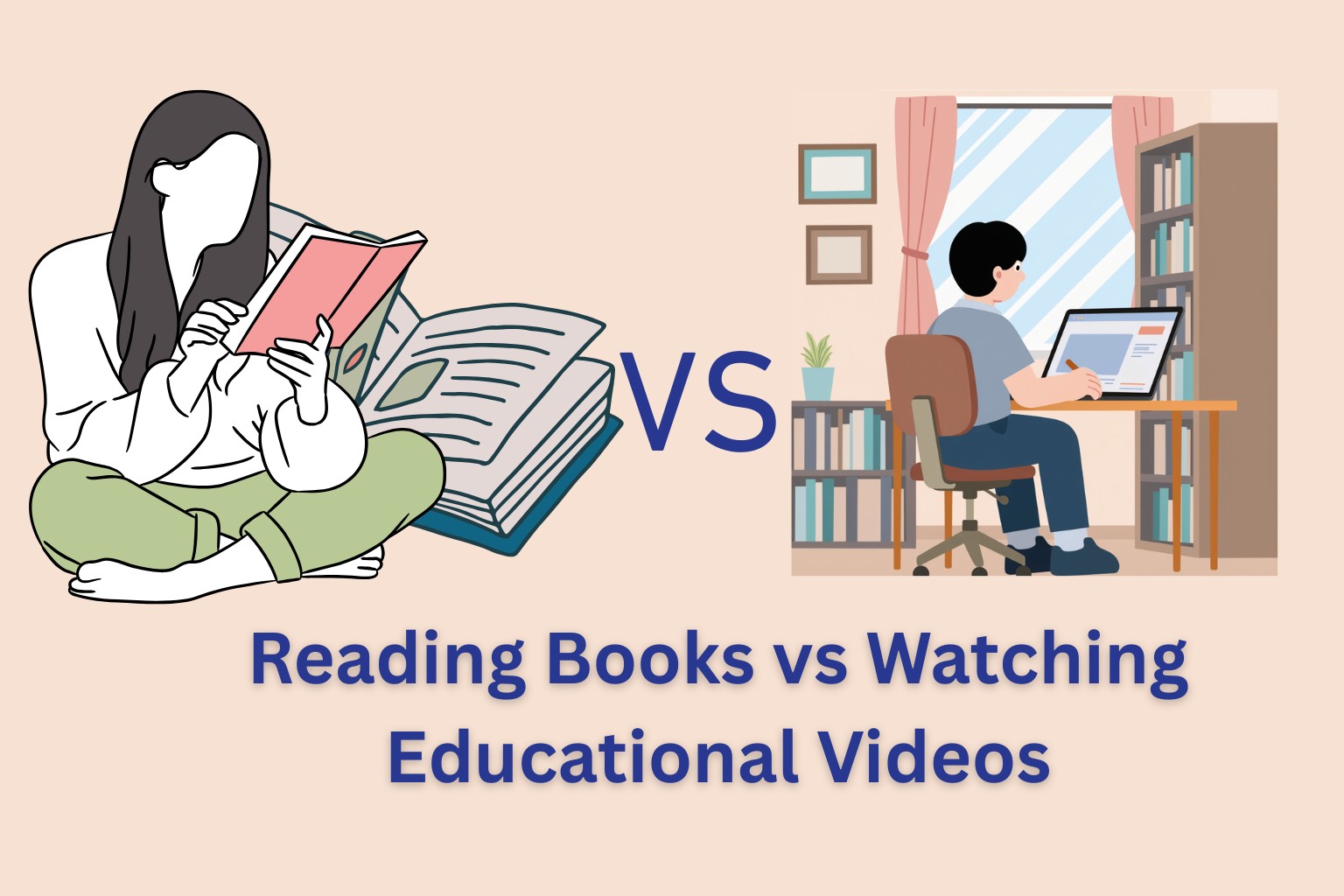
The comparison between reading books and watching educational videos is often treated as a simple contest. That is the wrong starting point. The better method depends on what the learner is trying to understand, remember, practice, or apply.
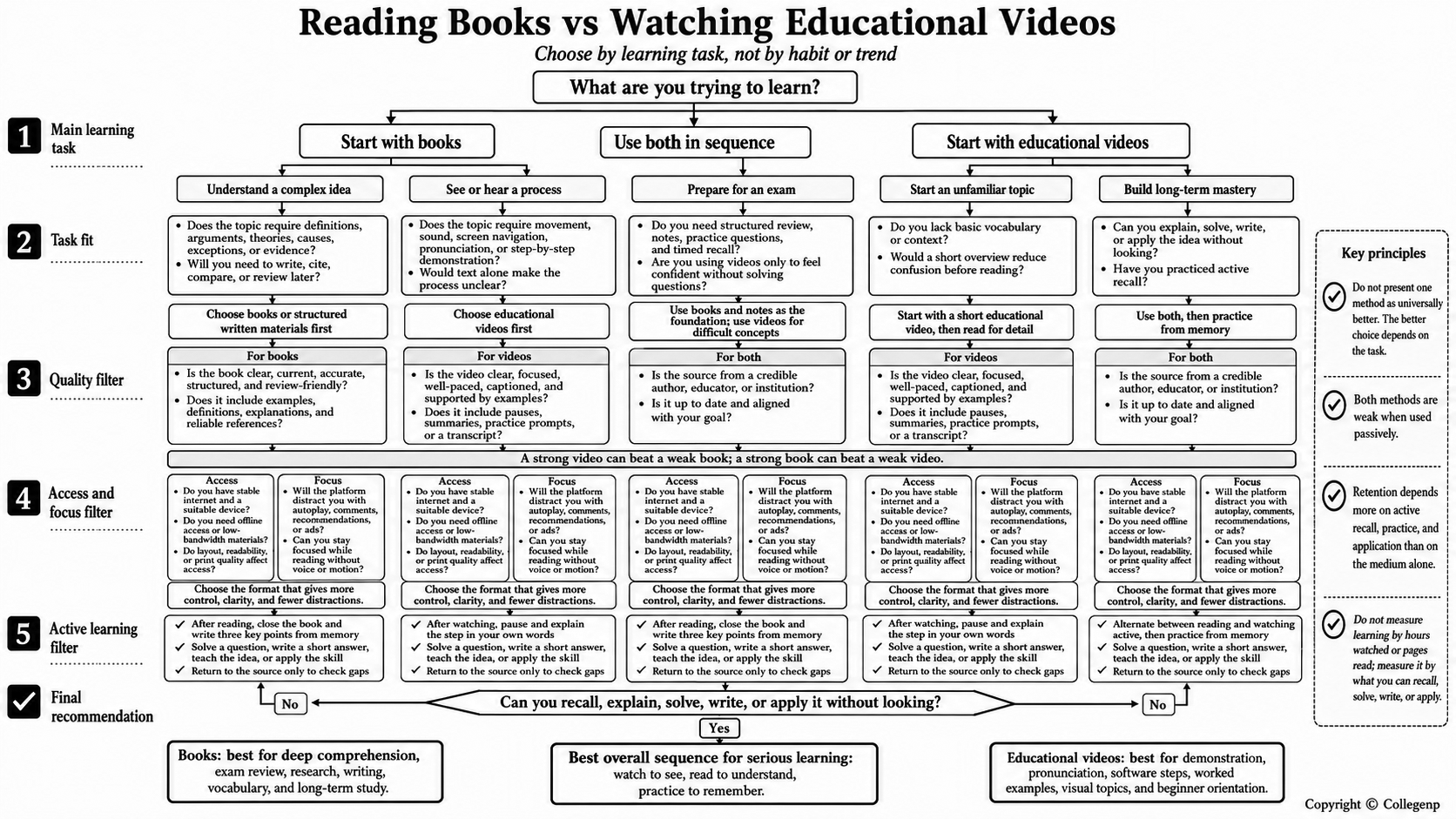
Books usually work better when the goal is deep comprehension, exam review, academic writing, research, vocabulary growth, and careful thinking. Educational videos are often stronger when the learner needs to see a process, hear pronunciation, follow movement, watch a worked example, or get a quick overview before deeper study.
This makes the real question more practical: does the learning method match the task? A student preparing for an exam may need textbooks, notes, and practice questions. A beginner learning software may first need a screen demonstration. A learner studying history, literature, philosophy, or law may need the structure and depth of a written source.
So, reading books vs watching educational videos should not be decided by trend, habit, or personal preference alone. Both can help. Both can also fail when used passively.
Quick Answer
Reading books is usually the better foundation for deep understanding, exam preparation, research, writing, and long-term review. Watching educational videos is usually better for demonstration, visual explanation, pronunciation, software steps, practical skills, and beginner orientation.
For most serious learning, the strongest method is not books versus videos. It is a sequence: watch to see the idea, read to understand it properly, and practice to remember it.
Table of Content
- Anatomy of the Issue
- Comparison Methodology
- Evidence Snapshot
- Quick Comparison Table
- What Reading Books Do Better
- What Educational Videos Do Better
- Retention: Which Helps You Remember More?
- Focus and Distraction
- Motivation and Accessibility
- Personal and Social Factors
- Reader-Specific Recommendation
- What Would Change the Verdict?
- Who Should Avoid Each Option?
- Common Mistakes
- Decision Checklist
- Final Verdict
Anatomy of the Issue
The real problem behind this comparison is passive learning.
A learner can read several pages and still remember very little. Another learner can watch a clear video and still fail to solve a question independently. In both cases, the weakness is not only the format. The weakness is the lack of recall, practice, and application.
Videos often feel easier because the teacher, narrator, animation, or screen recording carries the explanation forward. This can reduce confusion, especially for beginners. But it can also create a false feeling of mastery. The learner may recognize the answer while watching but struggle when asked to produce the answer alone.
Books create a different challenge. Reading requires sustained attention. The learner has to slow down, connect ideas, infer meaning, and stay focused without voice, motion, or visual prompts. That effort can feel difficult, but it often supports deeper processing when the topic is complex.
The reader should not decide based only on convenience, popularity, or the idea that one medium is automatically smarter. The correct decision depends on the topic, goal, material quality, access, and study behaviour.
Comparison Methodology
This comparison uses practical learning criteria rather than personal preference alone.
| Criteria | Why It Matters |
|---|---|
| Depth of understanding | Complex subjects need definitions, context, sequence, and careful explanation. |
| Demonstration value | Some skills are easier to learn when the process is shown. |
| Retention | The method should help learners remember and use information later. |
| Exam preparation | Students need review, self-testing, and structured practice. |
| Focus | The format should support attention, not passive consumption. |
| Accessibility | Learners differ in internet access, reading comfort, captions, layout, and device quality. |
| Verification | Academic work needs sources that can be checked and cited. |
| Motivation | A useful method should be realistic enough for the learner to continue. |
No fixed score is used because the result changes by subject, learner level, resource quality, and study method.
Evidence Snapshot
Educational video research supports a cautious view. Effective videos are not just attractive or easy to watch. They need good instructional design, including attention to cognitive load, student engagement, and active learning.
A small MIT Integrated Learning Initiative experiment compared learners who watched a video with learners who read a transcript with diagrams. In that setting, post-test results were not statistically different. This does not prove that reading and video are always equal. It shows that the medium alone may not decide the learning outcome.
Research on paper versus screen reading is useful but adjacent evidence. It does not directly compare books with educational videos. Its value here is narrower: it shows that digital design, distraction, and learning support can affect comprehension.
A study on digital texts and videos also supports caution against broad claims. Students spent longer watching videos than reading digital texts, but most measured outcomes did not show a broad medium-only advantage in that setup.
The common claim “I am a visual learner, so videos are best for me” also needs care. Research summaries on learning styles do not support matching instruction to fixed learner categories as a reliable way to improve outcomes. Preference matters, but the task matters more.
Quick Comparison Table
| Criteria | Reading Books | Educational Videos | Editorial Judgment |
|---|---|---|---|
| Deep comprehension | Strong | Moderate to strong if well designed | Books usually give more control for complex ideas. |
| Practical demonstration | Limited | Strong | Videos are better when seeing the process matters. |
| Exam preparation | Strong | Useful as support | Books, notes, and practice questions should usually lead. |
| Beginner overview | Moderate | Strong | A short video can reduce confusion before reading. |
| Long-term retention | Strong when active | Strong when active | Recall and practice matter more than format alone. |
| Focus | Requires sustained attention | Easier to start but easier to consume passively | Both need clear study rules. |
| Research and citation | Strong | Limited unless sources or transcripts are available | Written sources are easier to verify and cite. |
| Motivation | Depends on reader | Often strong for beginners | Videos can make difficult topics more approachable. |
What Reading Books Do Better
Books are usually stronger for depth, precision, and review. A well-structured book lets the learner slow down, reread difficult lines, compare sections, mark important points, and return to the same explanation later. This control is useful for subjects that depend on definitions, arguments, theories, causes, exceptions, and evidence.
For example, a student learning the causes of World War I may watch a short video to understand the timeline. But a serious written source is usually better for explaining alliances, nationalism, imperialism, militarism, and the relationship between events. The video may give the map. The book usually gives the argument.
Books also support academic writing. A student preparing an essay, report, or research answer can check exact wording, compare sources, and cite information more reliably. This matters when accuracy is important.
Books are also useful for exam preparation because they are easier to review. Students can scan headings, revisit marked pages, compare definitions, and connect notes with practice questions.
However, books are not automatically better. A confusing, outdated, poorly edited, or badly structured book can slow learning. A strong book should have clear organization, accurate content, relevant examples, and review-friendly sections.
What Educational Videos Do Better
Educational videos are strongest when the learner needs to see or hear something. A video can show how a math problem is solved step by step, how a chemical reaction changes, how a software menu works, how a word is pronounced, or how a physical technique is performed.
Videos are also useful at the beginning of a difficult topic. A dense textbook chapter can feel intimidating before the learner understands the basic vocabulary. A short, clear video can provide orientation and make later reading easier.
The limitation is quality. A video may be fast, attractive, and popular but still weak for learning if it lacks structure, examples, pauses, captions, a summary, or practice prompts. Smooth explanation is not the same as mastery.
Videos work best when they are treated as a learning tool, not background content. The learner should pause, write notes, answer questions, and attempt the task without watching.
Retention: Which Helps You Remember More?
Neither books nor videos guarantee retention. Memory improves when learners retrieve information, practice it, and use it after first exposure.
Books can support retention because they are easier to review. Learners can revisit headings, underline key points, annotate margins, summarize paragraphs, and compare definitions. This is especially useful for exam preparation and writing-based subjects.
Videos can also support retention when they are short, segmented, replayable, captioned, and connected to practice. A learner can pause after each section and write the idea from memory. The weakness comes when watching replaces doing.
The test is simple: after reading or watching, close the source and explain the idea without help. Then solve a question, write a short answer, teach someone else, or apply the step. If you cannot do that, the material has not become usable knowledge yet.
Focus and Distraction
Books and videos create different attention problems.
Reading demands concentration. There is no autoplay, voice, or animation to keep the learner moving. This can be difficult for tired students or beginners. But the slower pace can be useful because the learner has more control over attention.
Videos are easier to begin, but they come with more platform-level distractions. Recommendations, comments, notifications, ads, and entertainment-style editing can turn study time into passive browsing. A learner may watch several videos and still be unable to answer one question independently.
A practical rule for reading is: read a short section, then write three key points and one question.
A practical rule for videos is: pause every few minutes and write what was explained in your own words.
Focus improves when the learner has a task, not just content.
Motivation and Accessibility
Videos often help motivation. Voice, visuals, and examples can make a difficult subject feel less intimidating. This is useful for beginners, language learners, practical skills, and students who feel stuck.
Books support independence. They do not require stable internet, streaming quality, or platform access. A learner can move quickly through familiar sections and slow down where needed. Printed books and downloadable materials can also be more reliable in low-bandwidth settings.
Accessibility depends on design. A video without captions may be difficult for some learners. A book with dense formatting, poor layout, or unclear language may also be difficult. The better resource is the one that gives the learner control, clarity, and support.
Personal and Social Factors
Students often choose learning methods under pressure. Friends may recommend video channels. Parents may prefer textbooks. Teachers may assign books but explain through videos. None of these influences should decide the method alone.
A learner who lacks confidence may benefit from a video first because it reduces the fear of starting. A learner preparing for a high-stakes exam should not depend only on videos because exam performance usually requires reading, writing, recall, and timed practice. A learner with limited internet access may need printed notes or textbooks as the main resource. A learner studying a practical skill may waste time with text-only explanation when a demonstration would be clearer.
The decision should respect motivation, access, time, exam needs, and the learner’s ability to study independently.
Reader-Specific Recommendation
Choose books or written materials if you need:
-
Deep comprehension
-
Exam preparation
-
Essay writing
-
Research and citation
-
Vocabulary growth
-
Careful review
-
Long-form arguments
-
Reliable revision notes
Choose educational videos if you need:
-
Demonstration
-
Pronunciation
-
Software steps
-
Lab or practical methods
-
Visual explanation
-
Worked examples
-
Quick overview before reading
-
Help when you feel stuck
Be careful if you are using videos as your only exam preparation method. Watching is not the same as solving.
Be careful if you are only rereading books without recall. Rereading can feel productive even when memory is weak.
What Would Change the Verdict?
The verdict changes when the task changes.
If the topic is abstract, writing-heavy, research-based, or exam-focused, books and structured written materials should usually lead. If the topic is procedural, visual, or practical, videos may be the better starting point.
The verdict also changes with resource quality. A strong video with clear examples, captions, pauses, and practice can teach better than a weak textbook. A well-written book can teach better than a long, unfocused video.
Access also changes the answer. Poor internet, limited devices, or distracting platforms make books more practical. Complex demonstrations, pronunciation, and screen-based learning make videos more practical.
Who Should Avoid Each Option?
Avoid relying mainly on books if the topic requires movement, sound, screen navigation, or physical demonstration. Text alone may make the process harder than necessary.
Avoid relying mainly on videos if you are preparing for exams, writing academic answers, researching a topic, or trying to build long-term mastery. Videos can support those goals, but they should not replace reading, notes, and practice.
Avoid both methods when they are passive. Passive reading and passive watching are both weak.
Common Mistakes
| Mistake | Better Approach |
|---|---|
| Watching many videos without practice | Watch one useful video, then solve or explain something yourself. |
| Rereading chapters without testing memory | Close the book and write the idea from recall. |
| Choosing videos only because they feel easier | Use videos for overview and demonstration, then practice. |
| Choosing books only because they look serious | Check whether the book is clear, current, and relevant. |
| Ignoring captions and transcripts | Use them to slow down and review video content. |
| Measuring learning by hours | Measure learning by what you can recall, solve, write, or apply. |
Decision Checklist
Before choosing books, videos, or both, ask:
-
What am I learning: concept, process, skill, pronunciation, exam content, or research?
-
Do I need depth, demonstration, or both?
-
Is the material accurate and suitable for my level?
-
Can I review it easily later?
-
Does the video have captions, examples, pauses, or a transcript?
-
Does the book have clear structure, examples, and updated content?
-
Have I practiced without looking at the source?
-
Can I explain the topic in my own words?
-
For exams, have I solved practice questions?
-
Am I choosing the method because it works, or because it feels easier?
Final Verdict
Reading books vs watching educational videos is not a contest with one permanent winner. Books are usually stronger for depth, precision, reflection, exam preparation, and research. Educational videos are usually stronger for demonstration, motivation, visual explanation, and beginner orientation.
For students preparing for exams or writing academic work, books and structured written materials should usually be the foundation. Videos should be used to clarify difficult ideas, see worked examples, and reduce confusion.
For learners studying practical skills, software tools, pronunciation, movement, or visual processes, educational videos may be the better starting point. Written guides can then support review, accuracy, and practice.
The most practical takeaway is clear: watch to see, read to understand, and practice to remember. The medium matters, but active learning decides the result.


Comments 0
No comments yet. Be the first to start the conversation.