



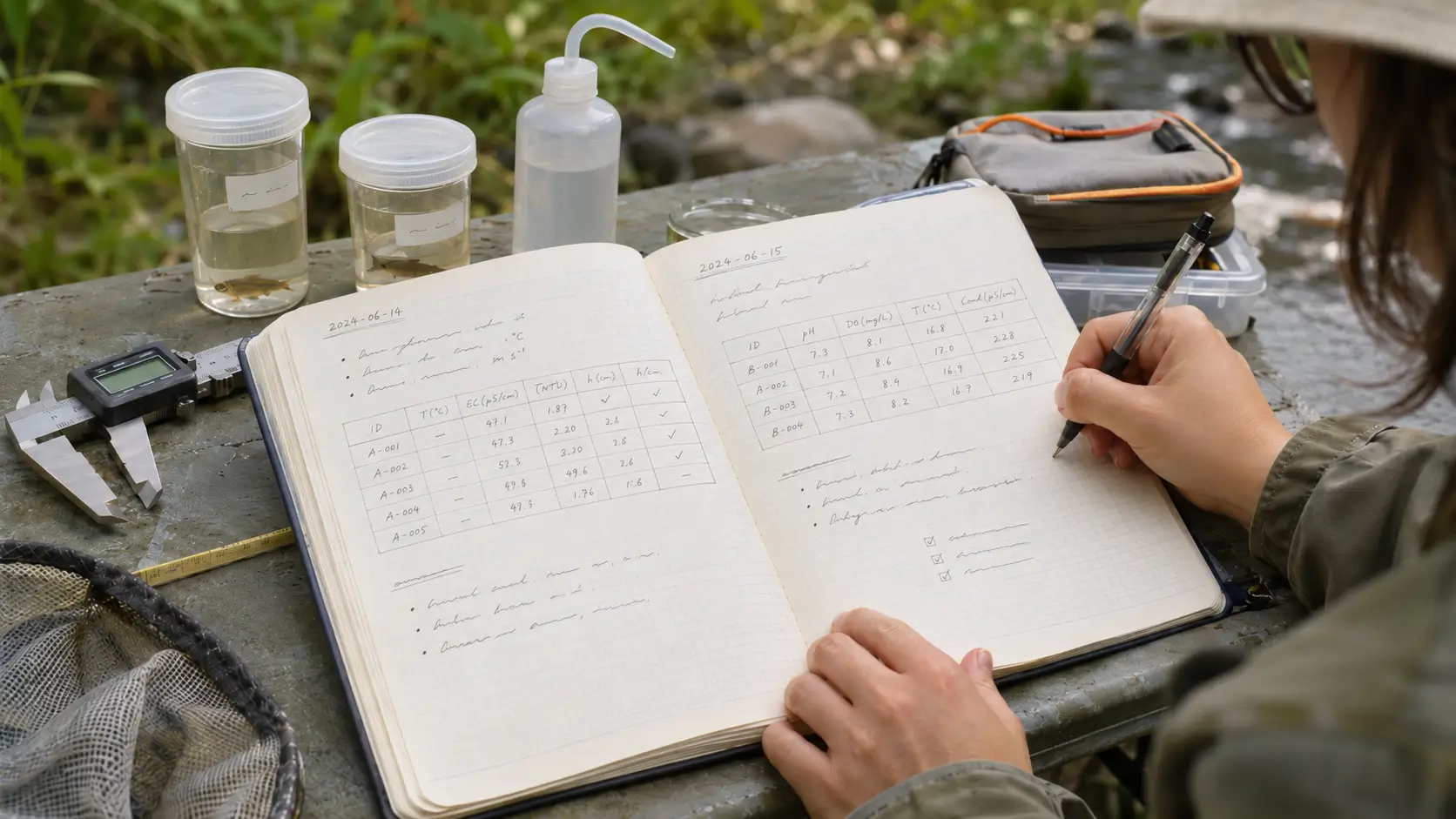
A reliable laboratory or fieldwork record documents what you did, observed, and measured while the activity was taking place. It preserves enough information for another person to understand the method, examine the original observations, identify changes, and trace how the findings were produced.
Whether you are completing a school science practical, conducting a university investigation, observing an ecosystem, or collecting research data, accurate record-keeping is part of the work itself.
A measurement without its unit, a field observation without its location, or a laboratory result without its experimental conditions can be difficult to interpret later.
The purpose of a laboratory notebook or field book is not to produce a polished account of an investigation. It is to preserve an accurate account of what happened, including unexpected observations, unsuccessful attempts, interruptions, and corrections.
The University of Colorado Boulder's laboratory notebook guidance emphasizes documenting actual activities, analysis, and interpretation so another researcher can follow the investigation.The principles are straightforward, although the required format depends on the activity, academic institution, and applicable research procedures.
Answer Summary: To create a reliable laboratory or fieldwork record, prepare a dated entry identifying the activity, recorder, purpose, and method. Document observations and measurements as they occur, preserving original values, units, and relevant conditions. Include equipment details for laboratory activities and location, time, and environmental context for fieldwork. Keep corrections traceable, link supporting files to their entries, and follow any institutional requirements governing documentation and storage.
Key Takeaways:
-
Record activities and observations as they happen rather than reconstructing them later.
-
Identify the recorder, date, purpose, method, and relevant location.
-
Preserve original measurements, units, unexpected findings, and procedural changes.
-
Connect field samples, photographs, and instrument files to their collection records.
-
Keep observations, calculations, and interpretations distinguishable.
-
Correct mistakes transparently without concealing original entries.
-
Follow institutional requirements for record formats, storage, and confidentiality.
What Makes a Laboratory or Fieldwork Record Reliable?
A reliable record is an accurate, understandable, and traceable account of an investigation. It allows someone to establish what happened, what evidence was collected, and how the original observations relate to the reported findings.
Four questions help assess its reliability:
-
Who performed and recorded the activity?
-
When and where did the activity take place?
-
What methods were followed, and what was observed or measured?
-
Can the reported findings be traced to the original observations?
A record becomes difficult to evaluate when important information is missing, even if its presentation is neat.
Reliability also requires distinguishing observations from interpretations. A description of what was measured is different from an explanation of why the result occurred.
The University of Colorado Boulder identifies objective information, interpretive observations, analysis, and research planning as distinct forms of laboratory documentation.
Laboratory notebook versus laboratory report
A laboratory notebook is a working record maintained throughout an investigation. A laboratory report is a structured document prepared afterward to communicate the purpose, methods, results, and interpretation.
A notebook preserves details that may not appear in the final report, including repeated trials, unsuccessful attempts, equipment adjustments, and preliminary calculations.
The University of Minnesota Libraries distinguishes note-taking during experiments from the later preparation of laboratory reports.
The same distinction applies to field notes and fieldwork reports. Field notes preserve observations at particular places and times; the final report organizes the relevant evidence to answer the research question.
Students preparing technical assignments can consult Collegenp's guidance on writing an engineering report.
How to Prepare a Record Before Starting
Prepare the recording structure before beginning the activity, but leave observation and measurement fields blank until data are collected.
Review the assignment, research question, approved method, or practical instructions. Determine which information will be needed to identify individual trials, observations, samples, or locations.
For independent investigations, it helps to plan the research project before designing the record.
Establish the essential entry details
Include the following information where relevant:
-
Identification: Project title, activity number, entry date, recorder's name, and team members.
-
Purpose: The question, objective, or hypothesis being investigated.
-
Method reference: The practical instructions, research protocol, or documented procedure being followed.
-
Materials and equipment: Relevant apparatus, instruments, materials, or observation tools.
-
Recording structure: Tables, headings, trial identifiers, sample labels, and space for descriptive notes.
A hypothesis is appropriate for an investigation testing a prediction, but it is not necessary for every descriptive field observation.
For longer projects, consistent page numbers or digital entry identifiers help connect records from different sessions.
Prepare tables without recording expected findings
Arrange measurement tables beforehand, with clear column headings and units.
Leave sufficient space to document unexpected observations, changes in procedure, and additional trials.
The University of Southampton recommends preparing data tables in advance and completing them during the laboratory session. Its guidance also emphasizes recording observations accurately and correcting mistakes visibly.
Preformatted tables reduce the likelihood of overlooking routine information, but they should not restrict the recording of unexpected events.
If your teacher or research organization provides a mandatory format, follow that format instead of replacing it with a general template.
What to Record During Laboratory or Fieldwork
During the activity, document what happens in chronological order. The record should preserve the actual method, observations, relevant conditions, and changes that may affect interpretation.
Record the actual procedure and its changes
Identify the procedure being followed and record any meaningful departure from it.
When an approved protocol is available and accessible, reference it accurately rather than reproducing unnecessary instructions.
Document changes such as:
-
An adjusted instrument setting.
-
A repeated or interrupted trial.
-
A change in observation location.
-
A measurement attempted under different conditions.
-
A sample that could not be collected.
Record when the change occurred and why, if the reason is known.
The intended method and the actual method are not necessarily identical. If they differ, the working record should make that distinction clear.
Preserve raw observations and measurements
Raw data are the original observations or measurements collected before later calculation or interpretation.
They may include numerical readings, counts, written descriptions, sketches, photographs, and instrument outputs.
For numerical measurements, preserve the recorded value, unit, and relevant measurement conditions. Do not add unsupported precision or substitute an expected result.
For descriptive observations, state what was observed without silently adding an explanation.
Record unsuccessful attempts and unexpected findings alongside other observations. Their importance may become clearer during analysis.
The University of Alabama in Huntsville's laboratory notebook guidance addresses qualitative and quantitative observations, raw data, calculated data, measurement units, and references to supporting documentation. Its broader guidance is designed for intellectual-property documentation, so its formal requirements should not be treated as universal classroom rules.
Separate observations, calculations, and interpretations
An observation reports what was recorded. A calculation uses recorded values to derive another result. An interpretation explains what those results may mean.
Keep these stages distinguishable.
For calculations, retain the original measurements and record the equations, units, and relevant assumptions.
For interpretations, explain the reasoning and identify limitations. An unexpected reading does not establish that an instrument malfunctioned unless supporting evidence exists.
The same principle applies when excluding data from an analysis. Preserve the original entry and explain the reason for exclusion.
Further guidance on how to evaluate evidence and avoid overclaims is useful when drawing conclusions from recorded results.
Laboratory Records Versus Fieldwork Records
Laboratory and fieldwork records share the same requirements for accurate identification, documentation, and traceability. Their differences arise mainly from the conditions under which information is collected.
What belongs in a laboratory record?
A laboratory record emphasizes experimental conditions, apparatus, instrument settings, materials, and measurements.
Depending on the investigation, relevant details include:
-
Equipment or instrument identifiers.
-
Experimental settings and conditions.
-
Materials and sample identifiers.
-
Trial sequence and measurement times.
-
Calibration or equipment-check references.
-
Raw readings, calculations, and unexpected observations.
Sketches may help explain an equipment arrangement when a written description is insufficient.
Record calibration information when it is relevant to the measurement. Do not claim that equipment was correctly calibrated without an appropriate check or supporting record.
What belongs in a fieldwork record?
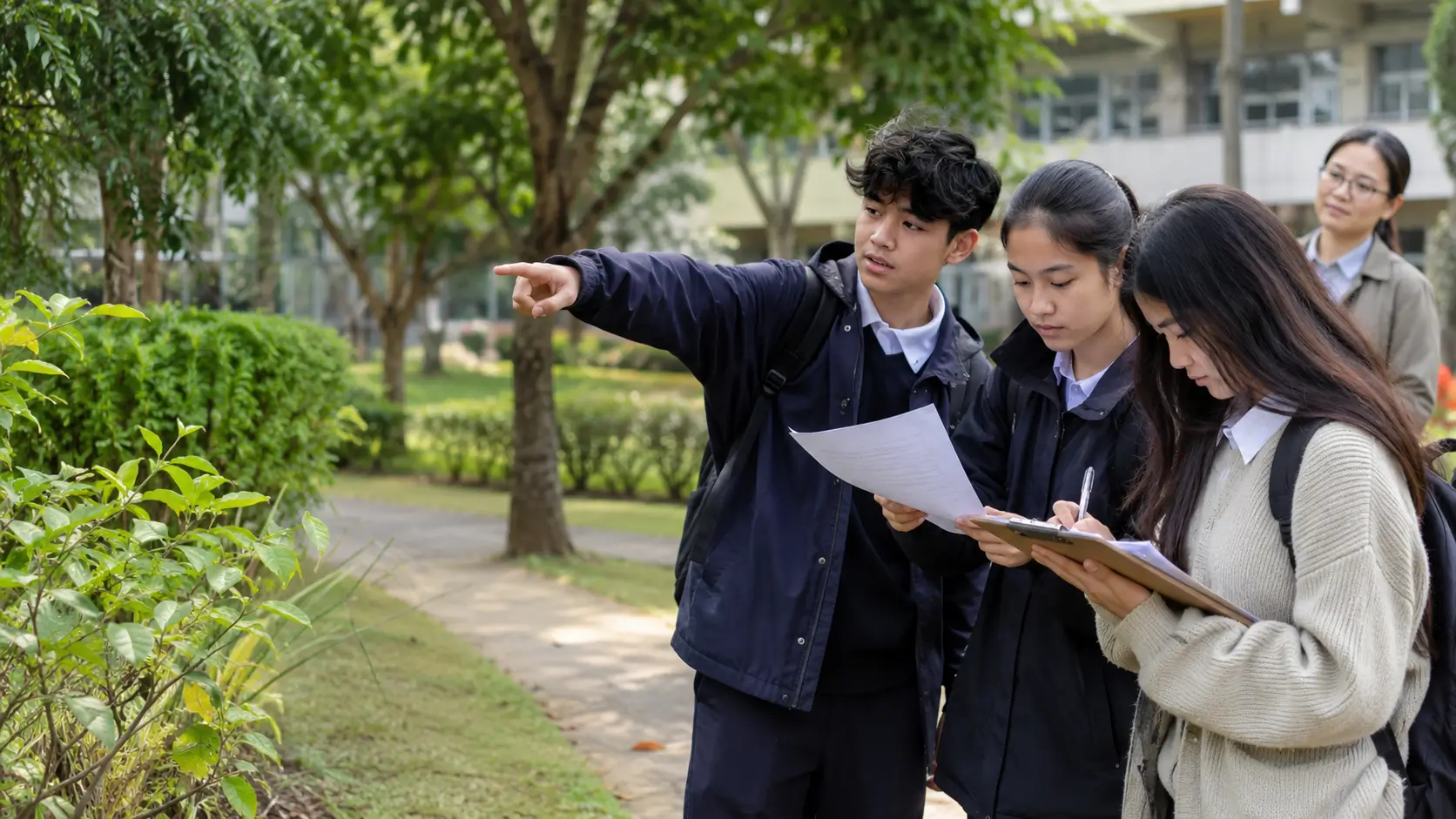
Fieldwork records emphasize the location, timing, surroundings, and collection context of observations.
The Smithsonian National Museum of Natural History identifies date, location, time, and observer information as important elements of field books. Its guidance also discusses environmental descriptions and labelled drawings.
Depending on the activity, additional details may include:
-
Site or observation-point identifiers.
-
Location descriptions or coordinates.
-
Relevant weather and environmental conditions.
-
Observation or sampling methods.
-
Collector information and sample identifiers.
-
Photographs, sketches, and map references.
Not every field activity involves physical samples. Natural-history observations, engineering site inspections, and geographical investigations may require different types of records.
|
Record detail |
Laboratory emphasis |
Fieldwork emphasis |
|---|---|---|
|
Location |
Laboratory or work area |
Site or observation point |
|
Equipment |
Apparatus and settings |
Field instruments and tools |
|
Conditions |
Experimental conditions |
Weather and site conditions |
|
Identification |
Trial and material labels |
Site, observation, and sample IDs |
|
Supporting material |
Instrument files and calculations |
Field notes, maps, and photographs |
|
Timing |
Experiment and measurement times |
Observation and collection times |
How should field samples be identified?
When collecting samples for later examination, use consistent identifiers connecting the physical material to the original collection entry.
Record the collection date, location, method, collector, and other information required by the project.
The Interstate Technology & Regulatory Council (ITRC) explains how sample identifiers, collection information, and associated metadata support environmental field-data management. Metadata are descriptive details explaining who collected information, where and when it was collected, and how it was obtained.
Some projects also require chain-of-custody documentation to track sample transfers and handling. This requirement depends on the project and receiving laboratory; it does not apply universally to student fieldwork.
How to Correct Errors and Handle Missing Data
Correct mistakes without concealing the original information. A reliable record should allow another reader to recognize what was changed and understand the correction.
Correcting paper notebook entries
For paper records, a common method is to draw a single line through an incorrect entry while leaving the original readable.
Add the correction and provide a date, initials, or explanation according to the applicable recording procedure.
Avoid erasing, covering, or removing original entries.
The University of Southampton and the University of Alabama in Huntsville describe visible corrections as appropriate laboratory notebook practices.
Correcting electronic records
Electronic corrections should preserve an appropriate edit history or other traceable documentation.
Where an approved research system is used, follow its requirements for amendments, author identification, and version history.
Do not silently replace original instrument data with corrected or processed values.
Distinguishing errors from missing observations
Different recording problems require different responses:
-
Incorrect entry: Preserve the original and document the correction.
-
Missing measurement: Identify the value as missing rather than entering an invented number.
-
Unsuccessful trial: Record what was attempted and what occurred.
-
Unexpected reading: Retain the observation and document any suspected problem separately.
-
Later addition: Clearly identify when the information was added and where it came from.
A recorded zero and a missing measurement are not equivalent.
If an observation was not documented during the activity, reconstructing it from memory without disclosure can misrepresent the original evidence.
How to Organize Paper and Electronic Records
Both paper notebooks and electronic systems can support reliable documentation. The appropriate format depends on the activity, recording conditions, institutional requirements, and long-term access needs.
Paper notebooks
Paper records can accommodate handwritten observations, diagrams, and field sketches without depending on a device.
Their limitations include physical deterioration, loss, difficulty searching large collections, and challenges connecting entries to electronic data.
Use clear dates, page references, headings, and consistent identifiers. Follow any institutional instructions concerning permanent ink, notebook format, signatures, or storage.
Electronic notebooks and supporting files
Electronic systems can organize measurements, photographs, calculations, and searchable notes.
However, a shared document is not automatically equivalent to an approved electronic laboratory notebook. Projects requiring controlled records may have specific expectations for access, changes, and preservation.
To maintain traceability:
-
Preserve original instrument outputs separately from processed files.
-
Use consistent identifiers in notebook entries and filenames.
-
Record the storage location of supporting files.
-
Explain relevant variables, units, and abbreviations.
-
Maintain approved backups and access arrangements.
-
Keep confidential information within authorized storage systems.
Cornell University Library recommends meaningful dataset organization, descriptive filenames, and documentation that explains file contents and how information should be interpreted.
When original data are transcribed into another format, check that the transferred information matches the source.
Protect confidential fieldwork information
Some fieldwork involves identifiable individuals, including interviews and observations of people.
The UK Data Service cautions that removing names from field notes does not necessarily prevent identification. Specific locations, occupations, and contextual descriptions may still reveal someone's identity.
Follow applicable consent, research ethics, privacy, and access requirements. Do not publicly distribute identifiable field notes without appropriate authorization.
Laboratory and Fieldwork Record Template
A consistent template helps establish what information should be recorded during an activity.
The following blank format can be adapted for classroom practicals, introductory research, environmental observations, and suitable field assignments.
It is a general educational template, not an officially prescribed institutional form.
|
Record field |
Information to enter |
|---|---|
|
Project or activity ID |
__________________ |
|
Entry title |
__________________ |
|
Date and time |
__________________ |
|
Recorder and team |
__________________ |
|
Aim or research question |
__________________ |
|
Method or protocol reference |
__________________ |
|
Actual procedure and changes |
__________________ |
|
Location or laboratory setting |
__________________ |
|
Equipment and relevant checks |
__________________ |
|
Trial, observation, or sample ID |
__________________ |
|
Raw observations and measurements |
__________________ |
|
Measurement units |
__________________ |
|
Photographs, sketches, or original files |
__________________ |
|
Missing data or unexpected observations |
__________________ |
|
Calculations and analysis |
__________________ |
|
Interpretation and limitations |
__________________ |
|
Corrections and review details |
__________________ |
|
Entry completed by and date |
__________________ |
For longer investigations, expand the raw-data section into a separate table with columns for observation identifiers, recorded values, units, times, and explanatory notes.
Use separate entries for distinct sessions when this makes the chronology easier to follow.
The template should remain proportional to the task. A brief classroom observation does not require the documentation structure of a regulated research laboratory.
Common Record-Keeping Mistakes
Record quality often suffers when important context is missing, even though the observations themselves were collected carefully.
Common mistakes include:
-
Writing after the session: Reconstructing an activity later may omit changes, interruptions, or unusual observations.
-
Entering expected results: Predictions should not replace measured or observed findings.
-
Omitting units: Numerical values may become difficult to interpret.
-
Using unclear identifiers: Measurements and samples may lose their connection to the relevant trial or site.
-
Ignoring unsuccessful attempts: The record becomes an incomplete account of the investigation.
-
Replacing raw values with calculations: The original evidence becomes harder to examine.
-
Leaving photographs unlinked: Images without contextual information may be difficult to associate with the correct observation.
-
Concealing corrections: Unexplained changes reduce transparency.
-
Overstating conclusions: Recorded observations may not support every proposed explanation.
The appropriate response is to correct the documentation process while preserving earlier records. Missing information should be disclosed rather than filled with unsupported details.
Final Record Review Checklist
Before submitting or archiving a laboratory or fieldwork record, check whether another person can understand and trace the investigation.
Completing this checklist supports consistent documentation. It does not guarantee scientific validity, reproducibility, compliance with specialized regulations, or a particular assessment outcome.
Conclusion
A reliable laboratory or fieldwork record preserves the connection between an activity and the evidence it produces.
Prepare the entry before starting, document actual observations during the work, retain original measurements, and make subsequent corrections and interpretations traceable.
For laboratory activities, include relevant equipment and experimental conditions. For fieldwork, preserve location, timing, environmental context, and sample information where applicable.
The central test is whether another reader can understand what happened and identify the original evidence supporting the reported findings.


Comments 0
No comments yet. Be the first to start the conversation.