



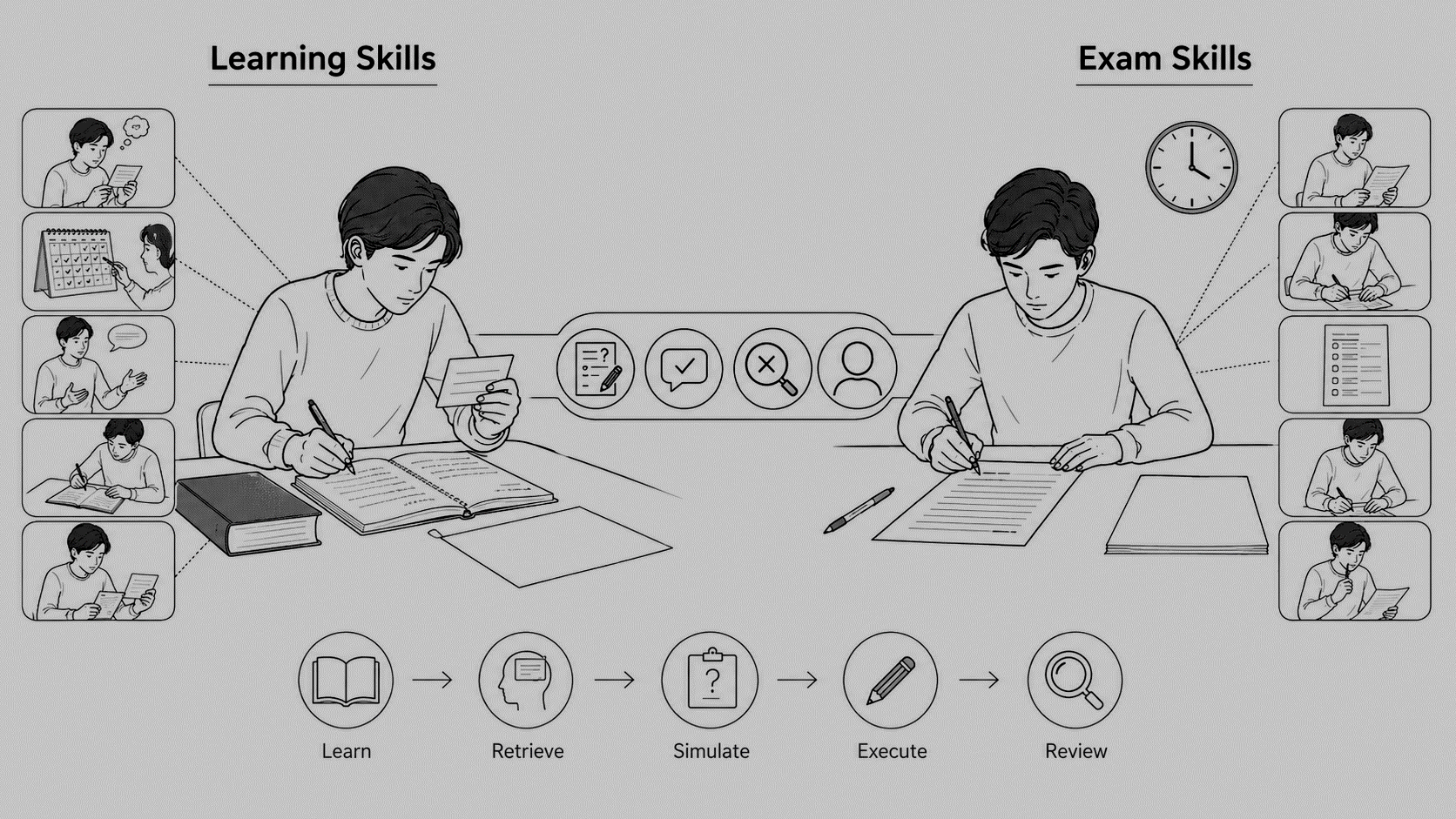
Learning skills and exam skills serve different purposes. Learning skills help students understand, retain, monitor, and apply knowledge. Exam skills help them demonstrate that knowledge within an assessment's format, instructions, time limits, and response requirements.
Students usually need both. The practical question is not whether learning matters more than exam technique in every situation, but which part of the process is currently limiting performance.
A student who cannot explain a concept without notes has a different problem from one who understands the concept but repeatedly runs out of time. Likewise, a student who performs well on familiar questions but struggles to remember the material later may need a different approach from someone whose knowledge is secure but whose response does not fit the assessment.
"Learning skills" and "exam skills" are useful practical categories rather than a universally standardized scientific classification. Research more often examines narrower concepts such as retrieval practice, spacing, metacognition, transfer, practice testing, and test-taking strategies.
Answer Summary: Learning skills build and maintain knowledge, while exam skills help students express that knowledge under assessment conditions. When understanding or recall is weak, learning deserves more attention. When knowledge is reasonably secure but timing, instructions, format, or execution causes difficulty, assessment-specific practice becomes more relevant. Retrieval practice, practice tests, feedback, metacognition, and error review connect the two.
Table of Content
- Learning Skills vs Exam Skills: The Core Difference
- Quick Comparison
- Where Learning Skills and Exam Skills Overlap
- What Happens When You Train Only One Side?
- How to Identify What Needs More Work
- A Balanced Five-Stage Study System
- Exam Skills Depend on the Assessment Format
- Common Myths About Learning and Exams
- Which Skills Should You Prioritize?
- Final Takeaway
Key Takeaways:
-
Learning skills focus on understanding, retention, monitoring, and transfer.
-
Exam skills focus on demonstrating knowledge within assessment constraints.
-
Retrieval and practice testing can contribute to both learning and exam preparation.
-
Familiarity with notes is not the same as independent retrieval.
-
Exam technique cannot substitute for knowledge that has not been learned.
-
Assessment-specific practice becomes more relevant when knowledge is secure but execution remains weak.
-
Error patterns can guide the next study activity, but they are not a formal diagnostic test.
Learning Skills vs Exam Skills: The Core Difference
The main difference is purpose. Learning skills help students acquire and maintain usable knowledge. Exam skills help students perform a particular assessment task under its conditions.
The categories overlap. A practice question can require retrieval from memory while also helping a student become familiar with how an assessment asks them to express that knowledge.
Learning skills focus on durable knowledge
Learning skills involve more than repeated exposure to information. They include activities that require learners to retrieve, organize, explain, monitor, and revisit what they are studying.
A major review by Dunlosky and colleagues examined ten commonly used learning techniques. Among the methods reviewed, practice testing and distributed practice received the review's highest utility assessments because evidence supported their use across a range of learning conditions and tasks.
A later Nature Reviews Psychology article examined spacing, retrieval practice, and metacognition, emphasizing their relevance across domains and ages while also discussing how learners monitor and regulate their study.
In practical study, learning skills can include:
-
retrieving an answer without first looking at notes;
-
spreading review across separate sessions;
-
explaining a concept in one's own words;
-
solving a problem before checking a worked solution;
-
comparing related ideas;
-
identifying gaps in understanding;
-
checking an attempted answer against feedback;
-
applying a learned principle to a different question.
An applied review by Agarwal, Nunes, and Blunt systematically coded 50 classroom experiments involving 5,374 learners. The review found benefits from retrieval practice across different educational levels, subjects, delays, formats, and feedback conditions. However, only 6% of the included experiments were conducted in non-WEIRD countries, which is an important limit for a globally framed article.
Students who want a broader introduction to these methods can use Collegenp's evidence-based study skills guide. For the distinction between looking at information and retrieving it independently, active recall vs passive review provides a more focused explanation. Both pages were available during the final publication check.
Students working specifically on review intervals can also refer to the guide to spaced repetition for long-term memory.
Exam skills focus on assessment performance
Exam skills concern how students demonstrate knowledge under particular assessment conditions. They can include interpreting instructions, recognizing the required response type, managing available time, organizing an answer, and reviewing completed work when the format permits.
These demands vary by assessment. Multiple-choice tests, essays, oral assessments, calculation-based papers, practical examinations, and extended problem-solving tasks do not require identical execution strategies.
Current university learning-support guidance reflects this distinction. Northwestern connects active preparation with self-quizzing, practice problems, and timed practice where appropriate. Caltech organizes test-taking guidance around preparation, engagement during the test, and reflection afterward. The University of Utah also treats understanding different assessment formats as part of test preparation.
These institutional resources help define practical exam preparation. They do not establish that every individual tactic improves performance for every student or every assessment.
Quick Comparison
Learning skills and exam skills become easier to distinguish when the same criteria are applied to both.
| Dimension | Learning skills | Exam skills |
|---|---|---|
| Main purpose | Build understanding, retention, monitoring, and transfer | Demonstrate knowledge under assessment constraints |
| Typical methods | Retrieval, spacing, explanation, feedback, self-monitoring | Format practice, instructions, pacing, response structure, review |
| Common warning sign | Material is familiar but difficult to retrieve or apply independently | Knowledge is available, but performance changes under assessment conditions |
The categories are not separate boxes. Practice questions, feedback, reflection, and error review can contribute to both learning and assessment preparation.
Where Learning Skills and Exam Skills Overlap
Practice testing is one of the clearest areas of overlap. It can act as a learning activity because students must retrieve information, while representative practice questions can also prepare them for the demands of an assessment.
A 2021 systematic and meta-analytic review of classroom quizzing concluded that testing can support classroom learning, while also finding that outcomes vary with study and implementation conditions. The evidence therefore supports practice testing as a learning tool without implying that every quiz design has the same effect.
Practice tests are more than score checks
A practice-test score tells a student what happened, but not necessarily why.
Several incorrect answers could reflect different problems:
-
the underlying concept was not understood;
-
the information could not be retrieved;
-
the question format was unfamiliar;
-
instructions were misunderstood;
-
limited time affected performance;
-
a correctable procedural error occurred.
This classification is a practical self-review framework rather than a validated educational diagnosis. Its purpose is to help students choose a more relevant next activity.
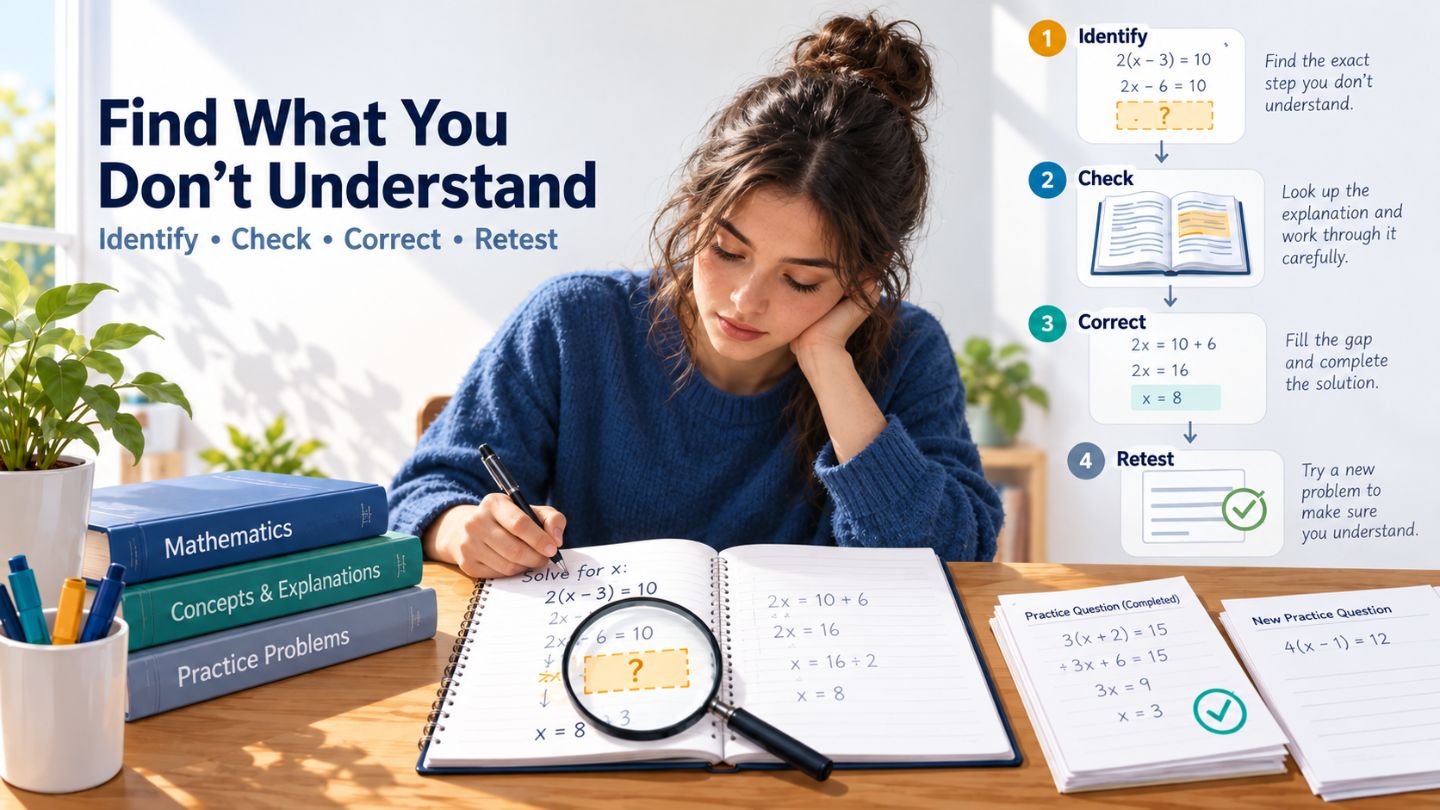
For example, a concept problem points back toward learning. A recall problem suggests more closed-book retrieval. A format problem suggests representative assessment practice. Repeated execution mistakes may be easier to notice by keeping an exam mistakes error log, which was verified as an active Collegenp resource during the final check.
Practice testing can support transfer
Retrieval practice is not limited to reproducing an identical question.
A meta-analysis of transfer of test-enhanced learning examined 192 transfer effect sizes from 122 experiments. It found evidence that testing can support transfer beyond the original material, but the results differed according to factors such as task relationship, retrieval success, elaboration, and final-test conditions.
The useful conclusion is therefore conditional: retrieval can contribute to flexible learning, but memorizing answers to a narrow set of practice questions should not be assumed to create broad understanding automatically.
What Happens When You Train Only One Side?
Focusing heavily on learning or heavily on test execution can leave a mismatch between what a student knows and what an assessment requires.
Strong learning, weaker exam execution
A student may explain material accurately during normal study but encounter problems during formal assessment.
Possible signs include:
-
leaving sections unfinished;
-
misinterpreting what a question requires;
-
giving relevant information in the wrong response form;
-
spending too much time on one part of the assessment;
-
noticing avoidable mistakes only after working time has ended.
These patterns do not prove that exam technique is the cause. They do suggest that assessment-specific factors deserve attention rather than automatically adding more content review.
Northwestern's current guidance recommends timed practice when pacing is a problem while also retaining untimed practice as part of preparation.
Students who find that planning rather than subject knowledge is interfering with preparation can also review time management skills for students. The linked page was active during the final review.
Strong exam familiarity, weaker durable learning
The reverse pattern is also possible. A student may become familiar with recurring question structures but still have difficulty retrieving or applying the underlying knowledge without support.
One useful distinction is recognition versus retrieval. Material may look familiar when notes or worked examples are visible, but independent recall asks whether the learner can produce or use the information once the support is removed. Research reviews on retrieval practice distinguish this active memory attempt from additional exposure or restudy. (DOI)
This does not mean that forgetting proves someone never learned the material. Memory performance varies with the learner, material, delay, and study conditions. The narrower point is that independent retrieval provides information that rereading alone does not.
How to Identify What Needs More Work
A final score cannot explain by itself why performance was strong or weak. Looking at when and how difficulties appear can provide a more useful starting point.
| Observed pattern | What it may indicate | Useful next check |
|---|---|---|
| Cannot explain or solve the material without time pressure | Understanding or knowledge gap | Relearn, retrieve, and check with feedback |
| Material seems familiar but cannot be produced closed-book | Retrieval weakness | Use retrieval practice and spaced review |
| Performs accurately untimed but struggles with the required question format | Format or execution issue | Practise representative tasks |
| Performs accurately with extra time but not under normal limits | Possible pacing issue | Use controlled timed practice and review |
This matrix is a self-check tool, not a formal psychological or educational assessment.
If an explanation remains inaccurate without time pressure, the underlying material needs more attention. If the concept becomes clear while notes are visible but cannot be produced after the notes are closed, retrieval practice directly tests that gap.
If untimed work is accurate but the assessment format creates difficulty, representative task practice becomes more relevant. University learning-support guidance also separates active learning from the specific demands of test preparation and timed execution.
A Balanced Five-Stage Study System
A practical study cycle is:
Learn → Retrieve → Simulate → Execute → Review
This is an editorial framework derived from the evidence and guidance used in this article. It is not a named or independently validated scientific model.
1. Learn
Build the initial understanding. Work through explanations, clarify difficult concepts, connect ideas, and check that the basic reasoning makes sense.
2. Retrieve
Remove the source and attempt to produce the knowledge. Answer a question, reconstruct an explanation, solve a problem, or write what you remember before checking.
Then compare the attempt with reliable feedback. Retrieval provides a learning opportunity, while feedback identifies missing or inaccurate information. Evidence from classroom retrieval research supports this combination across many studied settings.
3. Simulate
Introduce the conditions that matter for the assessment. This may involve representative question types, expected response formats, or realistic timing when timing is part of the difficulty.
4. Execute
During the assessment, follow its actual instructions and use the response methods appropriate to that format. Generic exam rules should not override what a particular test asks students to do.
5. Review
After practice, examine what went wrong and decide which stage needs more attention next. Caltech and Northwestern both include reflection, feedback, or review as part of their assessment-preparation guidance.
The value of the sequence is the feedback loop: review changes what the learner studies or practises next.
Exam Skills Depend on the Assessment Format
Exam technique is most useful when it reflects the actual assessment. Advice for an essay cannot automatically be transferred to an oral examination, multiple-choice paper, or mathematical problem set.
The University of Utah explicitly includes understanding different test formats in its current test-taking resources, while Northwestern discusses different approaches to multiple-choice and essay responses.
This is why universal rules such as "always answer questions in this order" should be treated cautiously.
Changing an answer is not automatically a mistake
One familiar multiple-choice rule says that an initial response should never be changed. Evidence does not support treating that as a universal principle.
A 2024 review of changing test answers found more wrong-to-right than right-to-wrong changes across the studies it reviewed. The evidence base includes substantial nursing and health-professions research, so the finding should not be converted into a rule that applies identically to every examination.
The narrower guidance is more defensible: do not keep an answer simply because it was your first choice, and do not change answers randomly. Reconsider it when you identify a reason, such as a misread question or an error in the original reasoning.
Common Myths About Learning and Exams
Myth: Exam technique can replace subject knowledge.
Exam preparation can improve familiarity with assessment demands, but it cannot supply knowledge or understanding that has not been learned.
Myth: Practice tests only measure learning.
Practice testing can also contribute to learning because retrieval itself can strengthen later memory.
Myth: Familiar material must be mastered.
Recognition during review and independent retrieval are different performances. Producing the material without support provides a stronger check of accessible knowledge.
Myth: Strong understanding makes exam practice unnecessary.
Understanding is foundational, but assessments can introduce timing, instructions, and response formats that require separate practice.
Myth: One exam trick works everywhere.
Assessment demands differ, so format-specific tactics should remain conditional rather than be presented as universal rules.
Which Skills Should You Prioritize?
Prioritize the part of the process that your practice suggests needs the most attention.
If you cannot explain or solve the material accurately without assistance, spend more time building understanding and practising retrieval.
If knowledge remains accurate during untimed work but performance changes substantially under the target assessment, add representative exam practice and examine timing, interpretation, response structure, and other execution demands.
If both areas are weak, work progressively: learn a manageable section, retrieve it, practise representative questions, review the errors, and then continue.
If you perform well on an exam but want to retain the material afterward, continued spaced retrieval is more closely aligned with that goal than ending all review on the test date. Research reviews support spacing and retrieval for longer-term learning, while also showing that outcomes depend on implementation and context.
Global conclusions should remain qualified. Applied classroom retrieval research is geographically uneven, and evidence about exam tactics often depends strongly on the assessment being studied.
Final Takeaway
Learning skills help students build, maintain, and retrieve usable knowledge. Exam skills help them express that knowledge within a particular assessment.
Neither replaces the other.
A useful practical rule is to identify where performance first breaks down. If understanding or retrieval fails before assessment pressure is introduced, strengthen learning. If knowledge remains available but performance changes under the exam's timing, instructions, or response format, add more assessment-specific practice.
Practice testing, feedback, metacognitive reflection, and error analysis connect the two. Together, they help students move from learning material to retrieving it, applying it, and demonstrating it under assessment conditions.




What a great read! I’ve always struggled with the balance between learning skills and exam tactics. I found that focusing on understanding concepts helped me more than cramming for tests. Thanks for highlighting this important distinction! [level devil](https://trollplatform.io/)