



Getting an answer wrong, missing an assessment criterion, or receiving a poor result tells you that your work did not meet an expected standard in some respect. It does not explain, by itself, why the gap occurred or what you should change next.
That distinction matters when learning from mistakes as a student. The same result may come from missing knowledge, an unsuitable method, misunderstood instructions, an execution error, difficult study conditions, or a wider need for academic support. Treating every setback as evidence of low ability—or assuming that more effort is always the solution—can lead you toward the wrong response.
Research gives a more useful interpretation. Janet Metcalfe’s review of learning from errors explains how errorful attempts followed by corrective feedback can support learning under appropriate conditions. Feedback research also shows that simply receiving comments or seeing the right answer is not enough. What matters is whether the information helps the learner identify a gap and change the next attempt.
Answer Summary: A mistake is a specific error, failure is an outcome that did not meet a goal or standard, and feedback is information that helps guide a change. Failure does not become feedback automatically. A student makes a mistake useful by identifying the gap, examining its likely cause, finding an accurate correction, explaining the correction, and trying another task to check whether the new understanding works.
Table of Content
- Mistake, Failure, and Feedback Are Different
- Why Can Mistakes Support Learning?
- A Practical Mistake-to-Feedback Process
- How Should Students Understand Teacher Feedback?
- Examples of Turning Mistakes Into Useful Feedback
- What Does Growth Mindset Add?
- What If You Keep Making the Same Mistake?
- How to Use an Error Log Without Creating Extra Work
- The Main Point: Turn the Result Into Information
Key Takeaways:
-
A poor result describes performance on a task; it does not explain the whole cause.
-
Failure and feedback are different concepts.
-
A mistake becomes more useful when correction and another attempt follow.
-
Different causes require different responses.
-
Specific feedback is easier to act on than a vague judgment.
-
A fresh task helps check whether a correction has transferred.
-
Repeated difficulty may require instruction or support rather than more effort alone.
Mistake, Failure, and Feedback Are Different
Mistake, failure, and feedback describe different parts of a learning event. Keeping them separate makes it easier to decide what should happen next.
| Term | What it means here | What it does not establish |
|---|---|---|
| Mistake or error | A particular answer, step, interpretation, or choice is incorrect. | Why the error happened or what it says about the entire task. |
| Failure | A goal, criterion, or required standard is not met. | Which gap caused the result or how it should be corrected. |
| Feedback | Information about performance that can guide a next action. | That the learner has already corrected the problem. |
These are practical working definitions. Different researchers, schools, and education systems may use related terms differently.
A mark can show that work did not reach a required threshold. A teacher comment can identify a missing criterion. A worked solution can reveal where a calculation first went wrong. Each gives different information.
This is why “failure is feedback” is better understood as a useful idea than as a literal definition. Failure is an outcome. It becomes informative when you examine what happened, identify the gap, and decide what to change.
Why Can Mistakes Support Learning?
Mistakes can contribute to learning when they are followed by accurate correction, attention to the error, and another opportunity to use the corrected understanding. The error alone is not the lesson.
Metcalfe’s research review found that making errors before receiving corrective feedback can support later learning in some settings, while also emphasizing that the effects depend on the learner, task, and context.
Feedback itself is similarly dependent on context. Hattie and Timperley’s research on the power of feedback explains feedback in relation to learning goals, current performance, and what needs to happen next. It also shows that feedback does not have the same effect in every situation.
A later meta-analysis of educational feedback research by Benedikt Wisniewski, Klaus Zierer, and John Hattie found considerable variation across feedback interventions. That matters because the word “feedback” covers many different practices, from a detailed explanation of an error to a mark with little guidance.
The Education Endowment Foundation’s guidance on teacher feedback similarly emphasizes the relationship between teaching, assessment, identifying learning gaps, and giving pupils an opportunity to use feedback. Its guidance focuses on school-age learners, so it should not be treated as a universal rule for every educational setting.
The practical point is simple: receiving a correction is only part of the process. You also need to understand what changed and apply that understanding again.
A Practical Mistake-to-Feedback Process
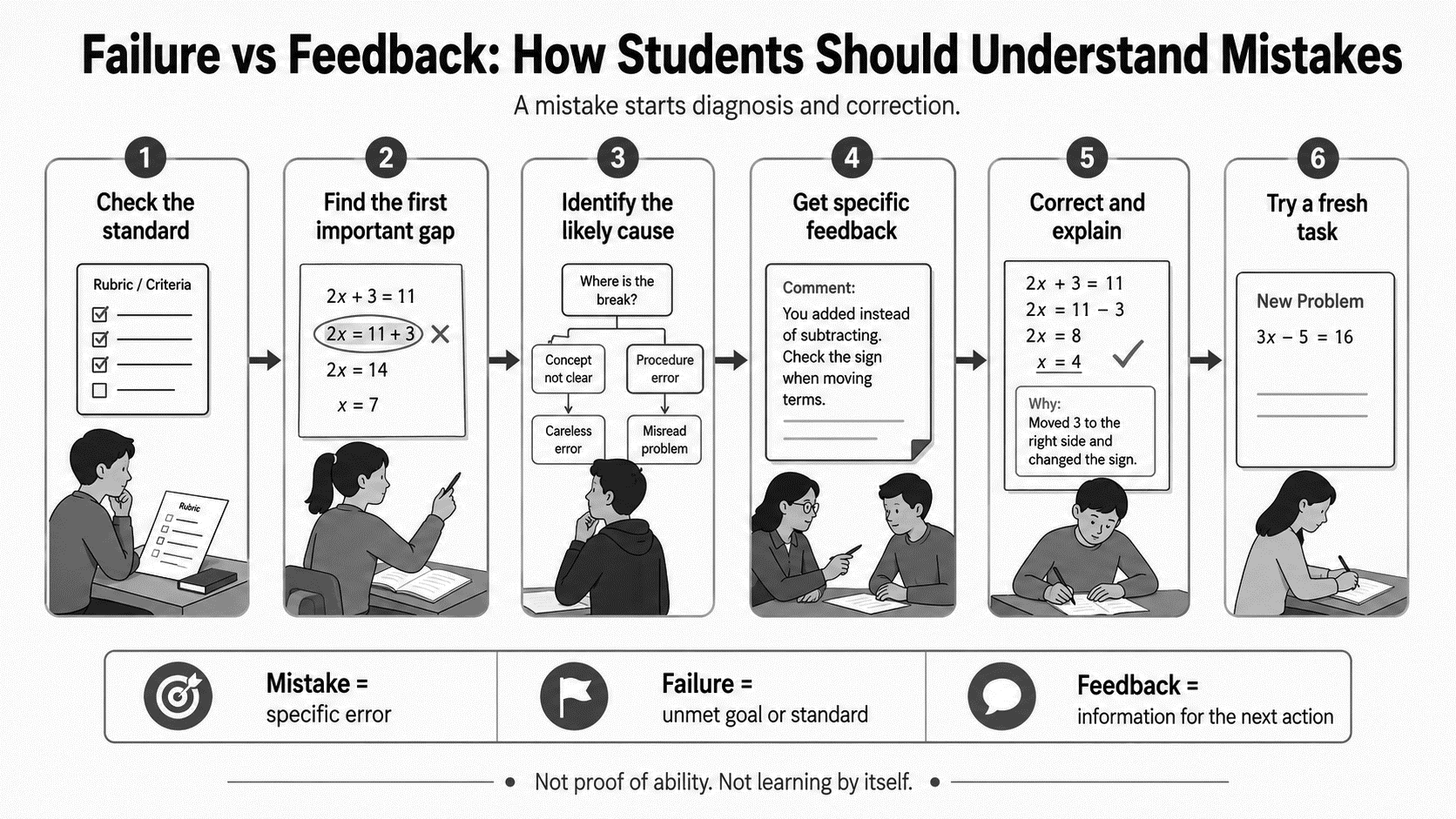
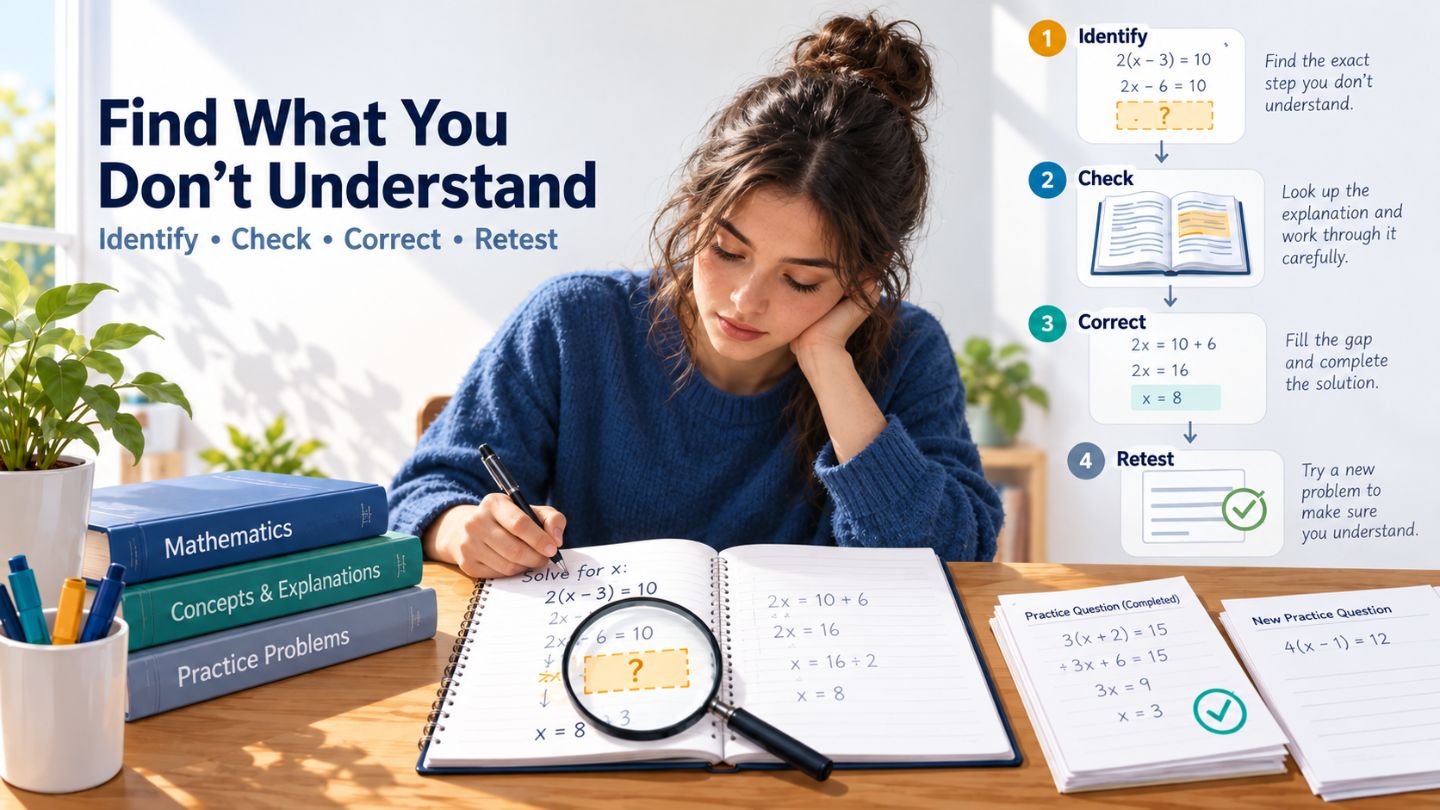
A useful response to a mistake follows six steps: check the standard, locate the gap, examine the likely cause, obtain specific feedback, correct the work, and try a fresh task.
This is a practical student framework drawn from the research principles above rather than a named learning intervention.
1. Recheck the Goal or Standard
First determine what the task required.
Read the question, instructions, learning objective, marking criterion, rubric, or worked example again. This helps separate a knowledge problem from a task-interpretation problem.
A student may understand a topic but answer a different question from the one assessed. Another may know the correct method but overlook a required step or format.
Before deciding how to study differently, make sure you know what successful performance was supposed to look like.
2. Find the First Important Gap
Locate the earliest meaningful point where your response stopped matching the expected answer, process, or criterion.
This matters because one early error can create several later ones. Choosing the wrong formula may affect every calculation that follows. An essay built around an unclear claim may produce several weak paragraphs.
Fixing the final visible mistake without finding the earlier cause may leave the real problem unchanged.
Ask: Where did my reasoning first move away from what the task required?
3. Examine the Likely Cause
Do not assume every error has the same cause.
A useful set of categories is:
-
knowledge gap: information or understanding needed for the task was missing;
-
method gap: you understood the topic but selected or applied an unsuitable process;
-
interpretation gap: you misunderstood the question, command word, instruction, or assessment criterion;
-
execution or conditions issue: you knew what to do but made a slip, rushed, lost track of a step, or worked under difficult conditions;
-
broader support issue: foundations, instruction, language, accessibility, workload, health, or another barrier may need attention.
These categories are prompts for analysis, not fixed labels. More than one may apply to the same piece of work.
4. Get Specific Feedback
Useful feedback should help you understand the gap or choose a next action.
It may come from a teacher, instructor, tutor, rubric, marking guide, worked solution, or reliable answer explanation.
If a teacher writes “needs more detail,” find out which part needs detail and what criterion is involved. If a calculation is marked wrong, compare the steps rather than copying the final number.
Students who want to use comments more systematically in their study process can also read Collegenp’s guide on feedback for improving study habits.
5. Correct the Work and Explain Why
Make the correction, then explain why the revised answer or method is more appropriate.
For a calculation, state why the corrected operation applies. For an essay, identify what the revised paragraph now demonstrates. For a factual error, write the correct idea and note what caused the confusion.
If you can copy the corrected answer but cannot explain the change, you may still need another example or clearer instruction.
6. Try a Fresh Task
After correcting the original work, try another task that requires the same knowledge or skill.
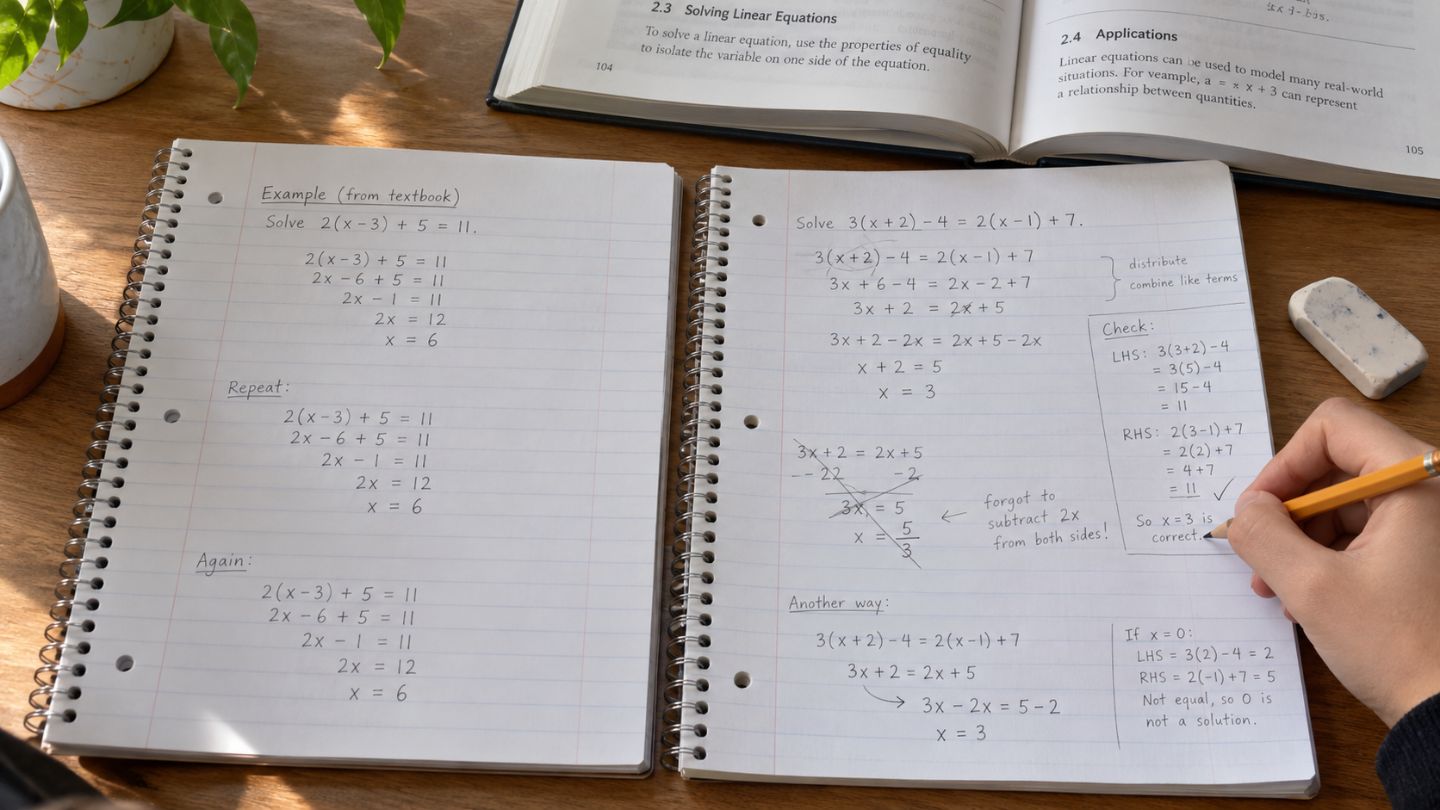
Redoing the original problem can be useful, but familiarity may make the answer easier to remember. A fresh item gives you a clearer check of whether you can apply the corrected understanding independently.
If the same gap appears again, return to the diagnosis. You may need a different explanation, more foundational practice, or academic support.
How Should Students Understand Teacher Feedback?
Teacher feedback is most useful when you read it as information about your work in relation to a standard, not as a judgment about who you are.
“The paragraph does not provide enough evidence for its main claim” identifies something that can be revised. “I am bad at writing” does not identify a criterion, cause, or next action.
When feedback is vague, turn it into a more specific question:
-
Which part of my work did not meet the criterion?
-
What would a stronger answer include?
-
Which mistake should I correct first?
-
Which example or rubric section should I compare with?
-
What kind of new task would show that I understand the correction?
The goal is not to collect more comments. It is to obtain enough information to decide what to change.
For the classroom and teacher perspective, Collegenp’s guide on how to help students learn from mistakes covers how educators can respond to errors without treating them as personal shortcomings.
Examples of Turning Mistakes Into Useful Feedback
The same process works across subjects, although the diagnosis may be different.
Calculation or Science Problem
Suppose the final answer is wrong.
If you selected an unsuitable formula, the issue may be conceptual or procedural. If you chose the correct formula but substituted the wrong value, the issue may be execution or checking.
Both produce an incorrect answer, but they should not lead to the same practice response.
Essay or Report
A weak paragraph may result from an unclear claim, insufficient evidence, incomplete explanation, poor organization, or misunderstanding of the assignment.
Correcting grammar will not solve missing evidence. Adding evidence will not fix a paragraph that answers the wrong question.
Compare the work with the relevant criterion before deciding what to revise.
Quiz or Examination
Several errors from the same topic should be compared before you decide what to study.
You may discover a missing foundation, confusion between similar concepts, repeated misreading of command words, or difficulty applying knowledge under test conditions.
For exam-specific patterns, an exam mistakes and error log can help organize recurring errors without treating every wrong answer as the same type of problem.
Group or Project Work
A project can miss a required standard even when the group understands the subject.
The problem may involve unclear responsibilities, missed criteria, incomplete checking, or communication. In that case, part of the correction belongs to the working process rather than the academic content.
What Does Growth Mindset Add?
Growth mindset can provide one useful framing: ability should not automatically be treated as fixed because of one poor performance. It does not mean that positive thinking alone improves grades.
Research on growth-mindset interventions is more mixed than simplified motivational claims often suggest. A 2023 systematic review and meta-analysis of growth mindset interventions by Brooke Macnamara and Alexander Burgoyne reported a small overall academic effect and found that conclusions became weaker under stricter methodological analyses.
For students, the useful interpretation is limited. Leave room for improvement, but then work on the actual academic problem.
A mindset statement cannot replace missing instruction, accurate feedback, suitable study strategies, practice, accessibility support, or other resources. If you misunderstand algebraic manipulation, for example, believing that improvement is possible may help you remain engaged, but you still need to learn and practise the missing mathematics.
What If You Keep Making the Same Mistake?
Repeated mistakes suggest that you should look for a pattern rather than simply repeating the same study response.
Compare several examples:
-
Is the same prerequisite knowledge missing?
-
Do you understand worked examples but struggle independently?
-
Are you repeatedly misreading the same type of instruction?
-
Does the mistake happen mainly when you rush?
-
Does the problem remain after correction and suitable practice?
Repeated difficulty can involve knowledge, method, instruction, workload, study conditions, accessibility, language, health, or several factors together. A general article cannot determine which explanation applies to one student.
If the problem continues, bring specific examples to a teacher, tutor, academic adviser, or learning-support service. Show the task, the repeated error, what you tried to correct, and where you remain unsure.
If a poor result has consequences involving reassessment, appeals, progression, or institutional rules, check the current policy of your school, university, course, or examination body. Those rules vary.
Students dealing with a broader setback may also find Collegenp’s guidance on how to recover from academic failure relevant to the next steps beyond individual error correction.
How to Use an Error Log Without Creating Extra Work
An error log can help you organize repeated mistakes when it stays short and leads to a specific study action. It should not become another task you maintain without using.
| Task and first gap | Likely cause and correction | Fresh check |
|---|---|---|
| Record the task and first important error. | Note the likely cause and corrected idea, method, or criterion. | Try another item and record whether the problem returns. |
You do not need to record every minor error. Focus on mistakes that are repeated, important, or difficult to explain.
After several entries, look for patterns. Repeated knowledge gaps may point to material that needs to be relearned. Repeated method errors may show that you need to practise choosing between procedures. Repeated interpretation errors may suggest more work on identifying command words or assessment criteria.
The log is useful only if it changes the next action.
The Main Point: Turn the Result Into Information
A mistake becomes useful when it tells you something specific about what to change.
Start with the standard. Find the first important gap. Examine the likely cause. Get an accurate correction. Explain why the correction works. Then try a fresh task.
Failure describes an outcome. Feedback provides information. Learning from a mistake depends on how you use that information on the next attempt.





Comments 0
No comments yet. Be the first to start the conversation.