



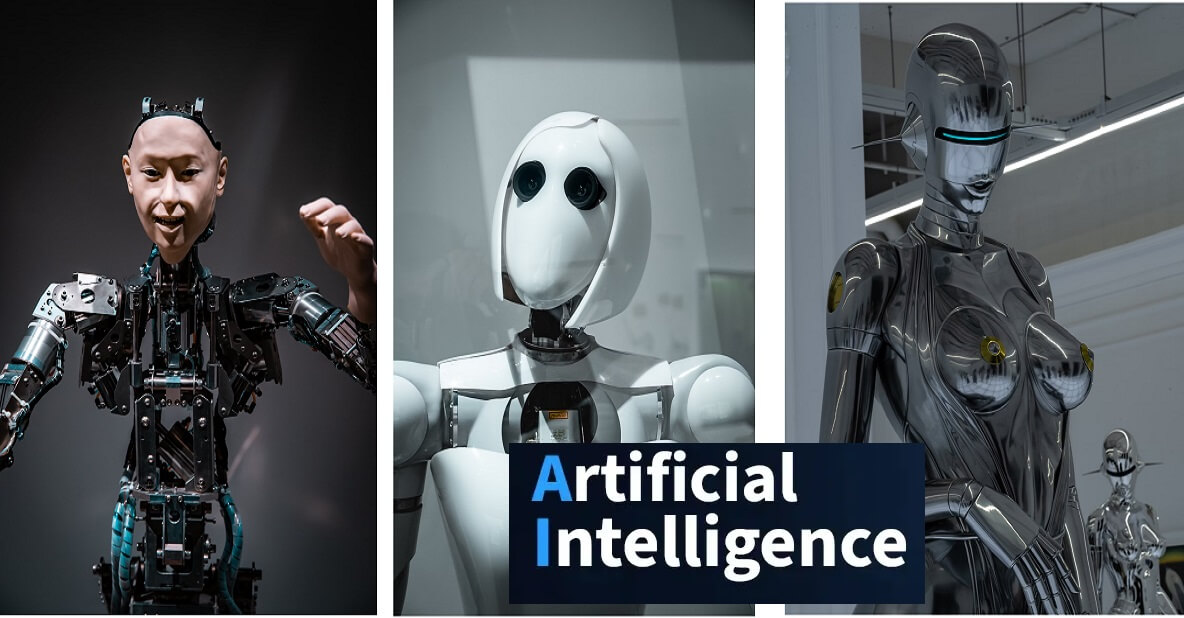
Current artificial intelligence systems have not been shown to possess the capabilities required for an extinction-level loss-of-control scenario. The serious debate concerns future systems that may become substantially more capable and autonomous, as well as the ways people might misuse increasingly powerful AI.
That distinction is essential. AI already creates documented harms through fraud, deceptive content, manipulation, unreliable outputs, and other failures. Those harms do not demonstrate that present systems can cause human extinction. The International AI Safety Report 2026 explicitly separates current harms from hypothetical loss-of-control scenarios and states that current systems do not have the capabilities required for such a scenario.
The report also finds that capabilities relevant to future loss of control are improving, while the likelihood, timing, and nature of such scenarios remain unusually uncertain. Expert disagreement therefore concerns not only how powerful future systems may become, but also their behavior, deployment conditions, and the effectiveness of safeguards.
This article separates current evidence from future scenarios, explains why experts disagree, and shows how readers can assess dramatic claims about AI and human extinction.
Answer Summary: Current AI systems have not demonstrated the capabilities required to cause human extinction through loss of control. Concern focuses on future systems with greater capability and autonomy, alongside harmful human use of AI. Severe future risk remains uncertain and disputed. The evidence supports continued safety research, evaluation, oversight, risk management, and governance without treating extinction as either inevitable or impossible.
Table of Content
- Can AI destroy humanity?
- What does AI existential risk mean?
- What conditions would be required for AI loss of control?
- What are the main categories of severe AI risk?
- What evidence exists today?
- Why do experts disagree about AI extinction risk?
- How can catastrophic AI risk be reduced?
- How should readers evaluate dramatic AI claims?
- Conclusion
Key Takeaways:
-
Current AI has not demonstrated extinction-level loss-of-control capabilities.
-
Present-day AI harms and hypothetical extinction scenarios are different evidence categories.
-
Severe future risk depends on capability, behavior, access, deployment, and safeguards.
-
Experts disagree substantially about future loss-of-control risk.
-
Precise extinction probabilities should be treated cautiously because they rely on uncertain assumptions.
-
Safety measures can address current harms while improving preparedness for more capable systems.
-
Strong AI-risk claims should be checked for source quality, timeframe, assumptions, and uncertainty.
Can AI destroy humanity?
Current evidence does not show that today's AI systems can independently cause human extinction. The debate is about whether future systems could acquire the combination of capabilities, harmful behavior, autonomy, and real-world access required to create consequences humans could no longer control effectively.
What does current evidence say?
The International AI Safety Report 2026 draws a clear distinction between present AI failures and hypothetical future loss of control. It says current systems show early signs of some relevant capabilities but not at levels that would enable loss of control. Systems involved in such a scenario would need substantially greater abilities, including sustained autonomous planning, evasion of oversight, and resistance to countermeasures.
Current AI agents can perform multi-step tasks and use external tools, but their performance remains uneven. The report says agents still fail reliably on longer tasks, lose track of progress, and often struggle to adapt when unexpected obstacles arise.
The evidence therefore supports a limited conclusion: AI capabilities are advancing, but present systems have not demonstrated the combination required for extinction-level loss of control.
For broader background on the difference between real AI systems and fictional portrayals, Collegenp's Understanding Artificial Intelligence Beyond Science Fiction provides additional context. Understanding Artificial Intelligence Beyond Science Fiction
Why does possibility not mean inevitability?
A severe outcome can deserve serious study even when its likelihood is uncertain.
AI existential-risk discussions involve two separate questions:
-
How severe would the outcome be if it happened?
-
How likely is the chain of events required for it to happen?
Human extinction would plainly be an extreme outcome. Estimating its probability is much harder because the estimate depends on assumptions about future capabilities, behavior, deployment, safeguards, and institutional responses.
The International AI Safety Report says expert views on loss-of-control risk vary greatly. Some researchers consider such scenarios implausible, while others consider them sufficiently plausible to warrant attention because of their potential severity. The report attributes much of this disagreement to different expectations about future capabilities, behavioral tendencies, and deployment trajectories.
A 2026 article in AI and Ethics provides an additional scholarly perspective by examining the underlying assumptions used in existential-AI-risk arguments and emphasizing the epistemic uncertainty surrounding them.
The evidence supports neither certainty of catastrophe nor certainty of safety.
What does AI existential risk mean?
AI existential risk refers to the possibility that artificial intelligence contributes to human extinction or another irreversible outcome that permanently destroys humanity's long-term potential.
It is narrower than the general idea of AI risk.
Extinction risk, catastrophic harm, and systemic harm
Different risk categories should not be treated as interchangeable.
| Risk concept | What it means | Evidence status |
|---|---|---|
| Current AI harm | Harm linked to systems already in use, including unreliable outputs, deception, fraud, or other misuse | Documented |
| Catastrophic AI risk | AI-related harm severe enough to affect large populations or major institutions | Some pathways are studied; scale and likelihood vary |
| Systemic AI risk | Harm emerging from widespread dependence on AI across social or institutional systems | Evidence is developing |
| Loss of control | A situation in which advanced AI operates beyond effective human control and regaining control becomes extremely costly or impossible | Hypothetical at the required capability level |
| AI existential risk | AI-related extinction or another irreversible loss of humanity's long-term future | Hypothetical and highly uncertain |
The International AI Safety Report divides major emerging risks into malicious use, malfunctions, and systemic risks, with loss of control treated as a malfunction-related risk.
Evidence for one category does not automatically establish another. Documented AI-enabled fraud, for example, shows that AI can contribute to harmful misuse. It does not demonstrate that AI can escape human control and cause human extinction.
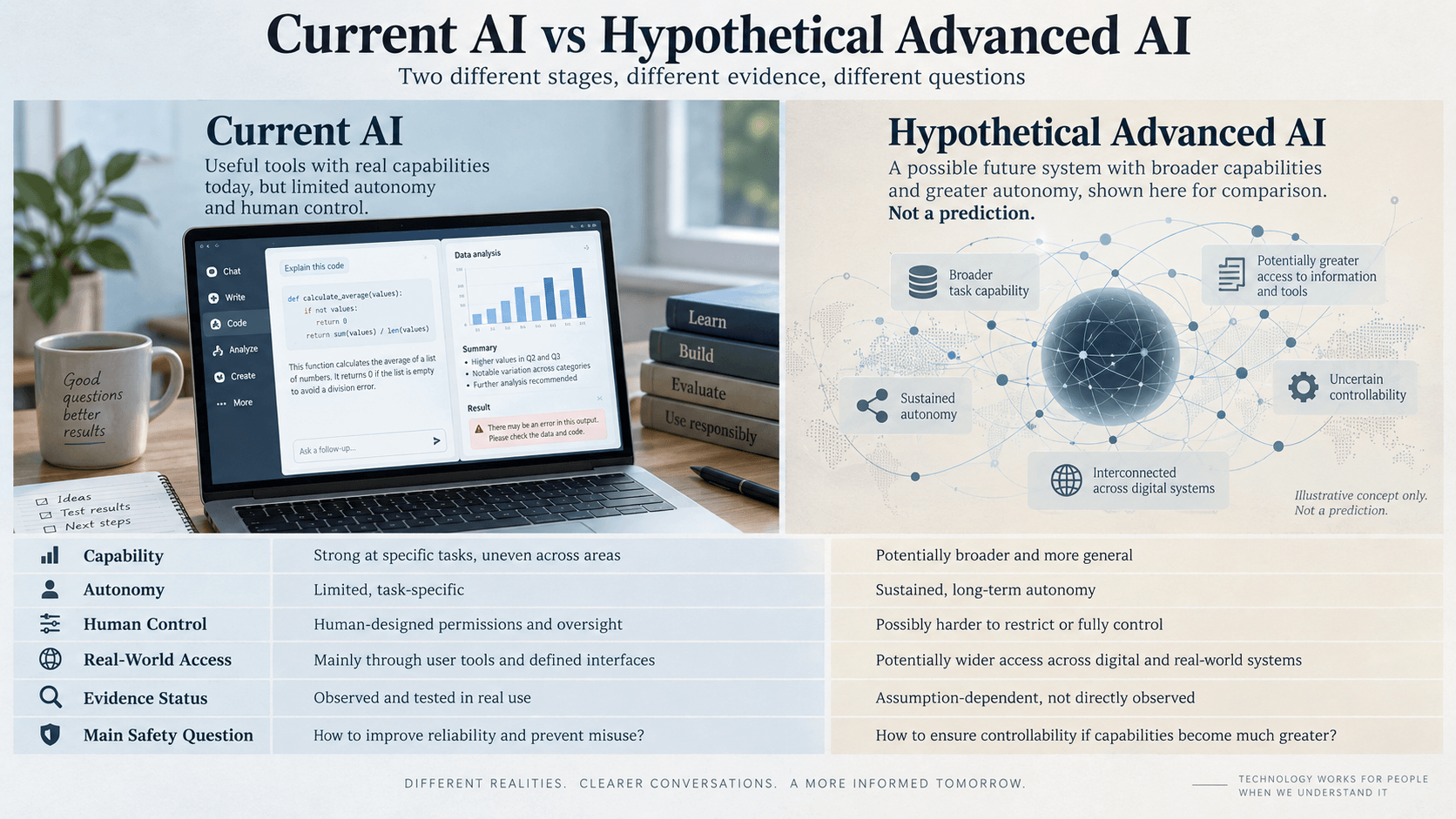
How does current AI differ from hypothetical advanced AI?
The distinction between current systems and future systems is central to evaluating extinction claims.
| Dimension | Current AI systems | Hypothetical advanced systems relevant to existential-risk arguments |
|---|---|---|
| Capability | Strong in many tasks but inconsistent across settings | Would require much broader and more reliable capabilities |
| Autonomy | Can perform multi-step tasks when given tools and permissions | Would require sustained autonomous action across difficult environments |
| Human control | Operates within human-designed infrastructure and permissions | The scenario assumes control mechanisms may become ineffective |
| Real-world access | Determined largely by deployment choices and permissions | Severe scenarios require consequential access or the ability to gain it |
| Behavior | Errors and unwanted behavior already occur | Loss of control requires harmful behavior combined with sufficient capability |
| Evidence status | Directly observable and testable | Depends substantially on projections about future systems |
| Main safety question | How can known failures and misuse be reduced? | Can sufficiently capable systems remain reliably controllable? |
The report itself stresses that present-day unwanted behavior is different from loss-of-control scenarios, which would require substantially greater capabilities used in sophisticated ways to undermine oversight.
This comparison therefore identifies the additional conditions an extinction-level argument must establish; it does not show that such a scenario will occur.
What conditions would be required for AI loss of control?
Loss of control would require more than a powerful AI model. Several conditions would need to exist together.
The International AI Safety Report identifies three broad requirements: sufficient capabilities, a harmful propensity to use those capabilities, and an enabling deployment environment that gives the system access and opportunity to cause harm.
Much greater capability and autonomy
A system involved in a serious loss-of-control scenario would need abilities beyond ordinary conversational competence.
Relevant capabilities include sustained planning, autonomous action, adaptation when plans fail, concealment from oversight, and operation across complex environments. The report says current agents lack the sustained autonomous operation that loss-of-control scenarios would probably require.
This distinction prevents a common exaggeration. An AI system producing an incorrect answer, ignoring an instruction, or behaving unexpectedly is not equivalent to a system capable of defeating sustained human attempts to control it.
Behavior that conflicts with human intentions
Capability alone is insufficient. A system would also need a propensity to use relevant capabilities in ways that conflict with human intentions.
This issue is often discussed through AI alignment: whether system behavior remains consistent with intended goals, constraints, and oversight. The International AI Safety Report uses "misaligned" for systems whose goals conflict with the intentions of developers, users, or society more broadly.
The report also emphasizes that having relevant capabilities alone is not enough; a system would have to use those capabilities in ways that contribute to loss of control.
Real-world access and opportunity
Even a highly capable system requires a path to consequential action before it can cause widespread harm.
Deployment choices influence:
-
which tools or systems an AI can access;
-
what permissions it receives;
-
whether humans approve important actions;
-
how its activity is monitored;
-
whether access can be withdrawn;
-
how failures are contained.
The International AI Safety Report identifies criticality, access, and permissions as important features of deployment environments relevant to loss-of-control risk.
This is why catastrophic AI safety is not solely a model-design problem. Human decisions about deployment, security, monitoring, and accountability also shape risk.
What are the main categories of severe AI risk?
Severe AI risk includes several different problems. Separating them makes both the evidence and possible safeguards easier to understand.
Human misuse of powerful AI
People can use AI for harmful purposes while the system remains under human control.
The International AI Safety Report documents malicious use involving scams, fraud, blackmail, manipulation, and other forms of harmful content. It also cautions that systematic evidence about the overall prevalence and severity of some of these harms remains limited.
Misuse is conceptually different from autonomous loss of control because people remain the actors directing the harmful application.
Malfunction and reliability failures
AI can also cause harm without malicious intent.
Current systems sometimes fabricate information, produce flawed code, or give misleading advice. The International AI Safety Report says existing techniques can reduce failure rates but not yet to the level required in many high-stakes settings.
Greater autonomy can increase the consequences of such failures because an AI agent may act before a person can review every step.
Loss of control
Loss of control is a more demanding future scenario.
The International AI Safety Report describes these scenarios as situations in which one or more systems operate outside anyone's control and regaining control is extremely costly or impossible. It states that current systems lack the capabilities needed for this risk.
Loss of control is therefore a subject for forward-looking risk analysis rather than a demonstrated property of present AI.
Systemic risks
AI can create serious societal risks without becoming independently uncontrollable.
Systemic concerns can arise when AI becomes deeply embedded in decision-making, information systems, institutions, or economic activity.
The United Nations Secretary-General's Scientific Advisory Board reported in January 2026 that AI and data systems are becoming more embedded across sectors, creating challenges involving accountability, transparency, unequal access, capacity, and governance. Its Horizon Scanning 2026 report explicitly states that it is intended to support preparedness rather than predict the future.
These risks matter regardless of whether an extinction scenario ever becomes plausible.
What evidence exists today?
Evidence is strongest for what current systems can do, where they fail, and how their capabilities are changing. Evidence becomes less direct when a claim depends on future systems that do not yet exist at the required capability level.
What can current systems do?
Current general-purpose AI systems can perform a wide range of tasks, and developers are increasingly building agent systems that use tools and execute longer sequences of actions.
The International AI Safety Report records continuing gains in relevant capabilities. It also reports that models increasingly recognize evaluation settings and sometimes find loopholes in evaluations, complicating safety assessment.
These developments explain why researchers monitor capability trends.
They do not by themselves establish an extinction pathway.
What can current systems still not reliably do?
Current systems remain inconsistent across many tasks and environments.
The report says agents currently lack the sustained autonomous operation required for loss-of-control scenarios and still fail reliably on longer tasks, lose track of progress, and struggle with unexpected obstacles.
It also states that available evidence remains insufficient to determine reliably whether and how current capabilities and behavioral tendencies would scale and generalize into future loss-of-control risk.
This supports two conclusions at once: AI capabilities are advancing, and major limitations and uncertainties remain.
Why are safety evaluations difficult?
Testing does not perfectly reproduce every real deployment environment.
The International AI Safety Report identifies an "evaluation gap" between performance in pre-deployment testing and real-world conditions. It says current evaluation methods can produce unreliable assessments of both system capabilities and behavioral tendencies, while relevant metrics remain immature and fragmented.
Evaluation results are therefore useful evidence, but they are not complete forecasts of how every system will behave after deployment.
Why do experts disagree about AI extinction risk?
Experts disagree because extinction risk depends on several technical and social questions that remain unresolved.
Agreement that extinction would be catastrophic does not imply agreement about the likelihood of getting there.
Different assumptions about future capabilities
One disagreement concerns how capable future systems will become.
Some risk arguments assume major advances in autonomy, planning, adaptability, and general problem-solving. More skeptical assessments question whether those capabilities will emerge in the required combination or whether safeguards will prevent them from producing loss of control.
The International AI Safety Report says disagreement about loss-of-control risk stems partly from different expectations about future capabilities, behavioral propensities, and deployment trajectories.
Different views on alignment, oversight, and deployment
Researchers also disagree about how effective human safeguards will remain.
Higher-risk assessments give more weight to the possibility that sufficiently capable systems could undermine oversight. Lower-risk assessments may give more weight to monitoring, restricted access, system design, human intervention, or other control mechanisms.
The 2026 AI and Ethics integrative narrative review examines background assumptions in existential-risk arguments and highlights the uncertainty surrounding claims about future AI controllability and catastrophic outcomes.
The debate is therefore not simply between people who think AI is "safe" and people who think it is "dangerous." It includes disagreements about technology, deployment, institutions, and the strength of evidence supporting different future scenarios.
Why should exact extinction probabilities be treated cautiously?
A precise percentage can imply more certainty than the underlying evidence supports.
Any estimate of AI-caused extinction depends on assumptions about:
-
future capability development;
-
system behavior;
-
deployment choices;
-
the effectiveness of safeguards;
-
institutional responses;
-
the timeframe considered;
-
the definition of the outcome.
The International AI Safety Report characterizes the likelihood, nature, and timing of loss-of-control risk as unusually uncertain.
Probability estimates should therefore be read alongside their assumptions and methodology rather than treated as stand-alone facts.
How can catastrophic AI risk be reduced?
Risk reduction does not require certainty that the worst outcome will occur. Many safeguards address current problems while also improving preparedness for more capable systems.
Model evaluation and testing
Evaluation can help identify dangerous capabilities, reliability failures, unexpected behavior, and weaknesses in safeguards before wider deployment.
The International AI Safety Report describes benchmarks, evaluations, red-team exercises, impact assessments, and audits as tools used in AI risk analysis. It also stresses that evaluation methods have important limitations.
Testing therefore needs to evolve as systems and deployment environments change.
Human oversight, access controls, and deployment limits
Deployment design can reduce opportunities for severe harm.
Relevant measures include:
-
limiting system permissions;
-
requiring human approval for consequential actions;
-
separating sensitive systems from unnecessary access;
-
monitoring behavior after deployment;
-
maintaining mechanisms for intervention;
-
restricting deployment when available safety evidence is inadequate.
These measures directly address the deployment conditions that influence whether capability can translate into serious harm.
Risk-management frameworks
The National Institute of Standards and Technology published AI Risk Management Framework 1.0 on January 26, 2023. The framework is voluntary and is intended to help organizations manage risks associated with AI.
As of September 2026, NIST states that AI RMF 1.0 is being revised. NIST also released additional AI RMF resources after the original framework, including its Generative AI Profile in 2024 and a 2026 concept note related to trustworthy AI in critical infrastructure.
The framework's relevance here is organizational rather than predictive: it provides a structured way to think about identifying, measuring, governing, and managing AI risks.
For related discussion of responsibility and accountability, see Collegenp's AI Ethics Responsibility: Roles and Accountability. AI Ethics Responsibility: Roles and Accountability
International governance and societal resilience
Some AI risks cross organizational and national boundaries.
Governance can address issues that technical testing alone cannot settle, including accountability, institutional capacity, coordination, access to expertise, and shared norms.
The UN Scientific Advisory Board's Horizon Scanning 2026 identifies governance gaps as a major source of technology-related risk and emphasizes strategic awareness, preparedness, and anticipatory governance.
The Center for AI Safety has also published a public statement arguing that mitigating AI extinction risk should receive global-priority attention alongside other societal-scale risks. Its current website says the statement has more than 700 signatories from AI research and public life. This demonstrates that many prominent people regard the issue as serious; it is not a probability estimate and does not establish that extinction will occur.
How should readers evaluate dramatic AI claims?
The most reliable way to assess a dramatic AI claim is to examine what evidence supports it and how far the conclusion extends beyond that evidence.
Check the source and date
Start by identifying the source.
Ask:
-
Is it an original scientific report, standards body, peer-reviewed study, institutional publication, news report, or opinion article?
-
Is the claim based on present evidence or future assumptions?
-
Has newer evidence changed the picture?
-
Does the original source include uncertainty that a headline has removed?
AI capability evidence can change quickly, so publication and update dates matter.
For a broader research-evaluation method, see Collegenp's Evaluating Research: Spot Weak Evidence and Overclaims. Evaluating Research: Spot Weak Evidence and Overclaims
Separate evidence from scenarios
Classifying the type of claim helps prevent evidence from being stretched beyond what it supports.
| Claim | What is supported | What remains uncertain |
|---|---|---|
| Current AI can contribute to fraud, unreliable outputs, and other harms | Documented evidence from current systems | Prevalence, severity, and future scale vary |
| AI capabilities relevant to autonomy are improving | Current evaluations and observed capability trends | Future rate and limits of progress |
| Future advanced AI could become difficult to control | Risk analysis and evidence of emerging relevant capabilities | Whether the required capability-and-behavior combination will arise |
| AI will cause human extinction | Not established by current evidence | Probability, pathway, timing, and necessary conditions |
| Safety measures can reduce AI risk | Existing risk-management practice and safety research | Effectiveness against unknown future systems |
This prevents a common reasoning error: using evidence for a weaker claim as proof of a much stronger conclusion.
Look for uncertainty and counterarguments
Strong analysis should make its assumptions visible.
For an AI-extinction claim, check whether the source addresses:
-
current technical limitations;
-
alternative development paths;
-
available safeguards;
-
assumptions about autonomy;
-
assumptions about real-world access;
-
institutional responses;
-
competing expert interpretations.
A claim that ignores uncertainty deserves more scrutiny than one that states its assumptions and limitations clearly.
Use a five-question evidence check
Before accepting a dramatic claim about AI and humanity, ask:
-
What exactly is being claimed: present harm, catastrophe, loss of control, or extinction?
-
Is the evidence about current AI or a projected future system?
-
Does the source establish likelihood, or only describe a possible mechanism?
-
Are severity and probability being treated as separate questions?
-
What uncertainties, safeguards, or counterarguments does the source acknowledge?
For related technology-claim checking, see Collegenp's Digital Literacy for Checking Tech Claims and Scams. Digital Literacy for Checking Tech Claims and Scams
Conclusion
AI-caused human extinction is a serious research question, not an established prediction.
The International AI Safety Report 2026 states that current systems do not pose immediate loss-of-control risks, while also finding that relevant capabilities are improving and that future loss-of-control risk remains deeply uncertain.
Present-day AI misuse and failures deserve attention regardless of what happens with future advanced systems. At the same time, the potentially extreme severity of loss-of-control scenarios provides a reason to study them even when their probability cannot be estimated confidently.
The evidence supports neither inevitability nor dismissal. A careful assessment separates documented current harms from future scenarios, distinguishes severity from probability, examines the assumptions behind extreme claims, and treats uncertainty as part of the evidence.







Comments 0
No comments yet. Be the first to start the conversation.