



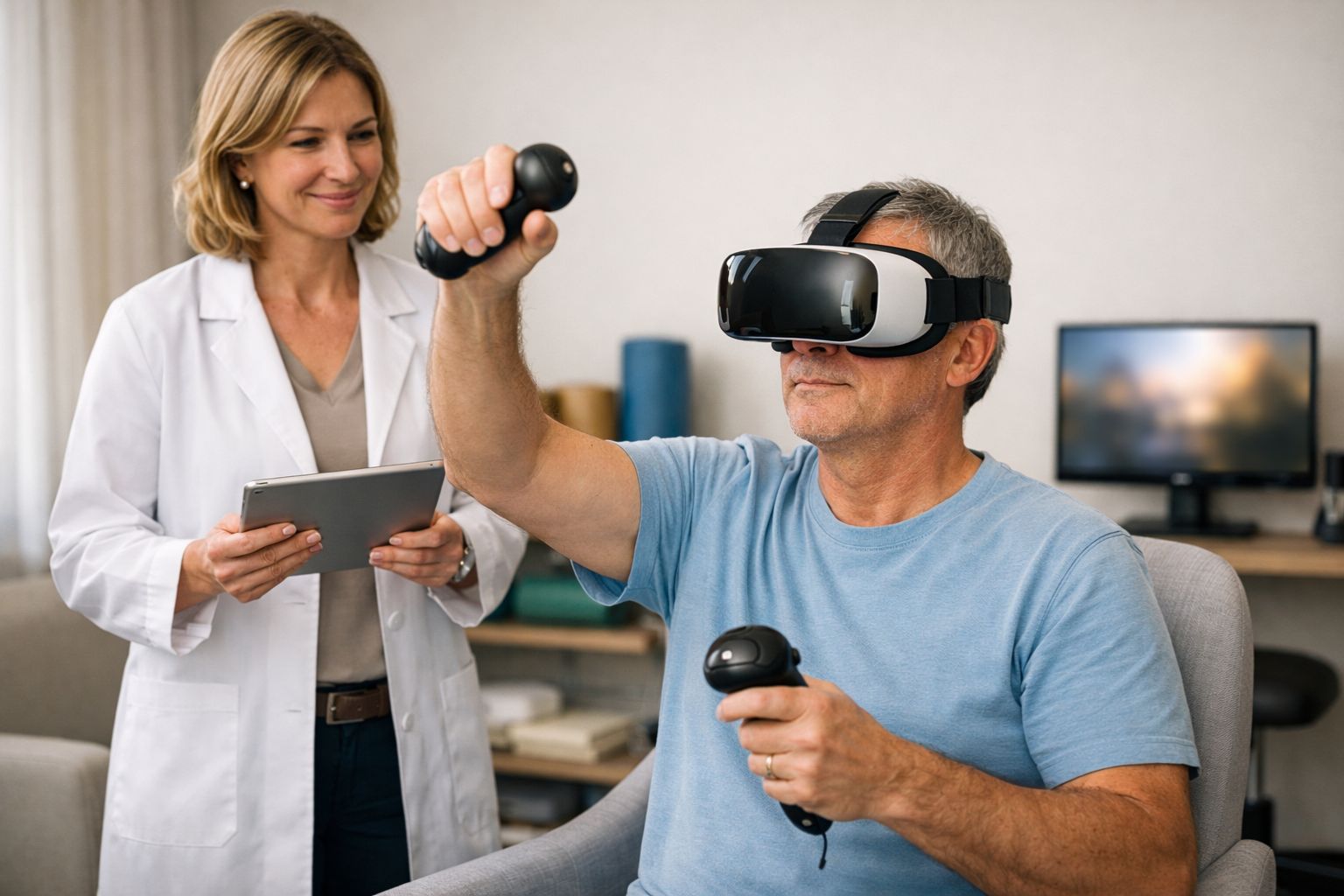
How VR Is Moving Beyond Gaming Into Therapy and Rehabilitation
Virtual reality used to be easy to place in one box: entertainment. Headsets were built for games, and most people’s first exposure was a roller-coaster demo or a quick sci-fi shooter. That picture is changing. VR is now showing up in places where the goal is not fun, but care: psychology clinics running exposure sessions, hospitals supporting painful procedures, and rehabilitation teams looking for more practice time and better feedback.
This shift is not just about newer hardware. It is also about a simple clinical fit. Many therapies depend on controlled practice in realistic situations. Exposure-based mental health care relies on repeated, graded contact with feared cues. Rehabilitation relies on repetition, feedback, and motivation across many sessions. Pain care often needs tools that work during short, intense moments like wound care or physical therapy. VR can create controlled environments where practice is repeatable, adjustable, and trackable—features that map closely to how many therapies are delivered.
This article is general educational information, not medical advice. If you are considering VR for a health condition, a qualified clinician can help assess fit, safety, and alternatives.
You will get four things here: a plain-language definition of virtual reality therapy, a map of where it is used today (mental health, pain, rehab, and skills support), a practical checklist for evaluating programs (safety, privacy, and evidence), and a realistic view of limits and training pathways.
Table of Content
- How VR Is Moving Beyond Gaming Into Therapy and Rehabilitation
- Explain: What virtual reality therapy is (and what it is not)
- Inform: Where VR is used in therapy today
- Practical Insight: How to evaluate a VR therapy program
- Practical Insight: Learning pathways and careers in VR therapy
- Outcomes and Limitations: What the evidence supports and where it is mixed
- Conclusion
- FAQs
- Reference
Explain: What virtual reality therapy is (and what it is not)
VR as a delivery format for established care
“Virtual reality therapy” can sound like a single, branded treatment. In healthcare, it is usually a format that delivers a known clinical approach. The most common example is exposure therapy for anxiety: VR provides the stimuli and setting, while the clinician applies the exposure protocol, pacing, and coaching. Reviews of virtual reality exposure therapy (VRET) describe VR as a tool that can support access to exposure-based treatment and may help standardize delivery and training, rather than replacing the underlying clinical method.
A similar logic applies in pain care. VR may be used to support attention and coping during painful procedures, or as part of a structured behavioral program for chronic pain. In rehabilitation, VR can support task practice by providing visual feedback, graded difficulty, and engaging repetition. The main point is the same: VR is often the “how,” not the “what,” of therapy.
Common mechanisms: exposure, attention, skills practice, motor learning
Across clinical settings, VR therapy commonly uses four mechanisms:
-
Controlled exposure: presenting feared cues in a graded way (VRET), with clinician-guided pacing and response prevention where appropriate.
-
Attention and distraction: shifting focus during painful care, often through interactive tasks that compete for attention. Systematic review and trial evidence in burn care contexts describes VR as an adjunct that can reduce pain intensity or unpleasantness during procedures for some patients.
-
Skills practice: rehearsing coping skills, relaxation strategies, or social interactions in scenarios that would be hard to recreate in real life.
-
Motor learning and repetition: encouraging high-repetition movement practice with feedback (for example, upper limb tasks after stroke), sometimes used to add more therapy time.
These mechanisms also explain why gaming and therapy can look similar at the surface. Both rely on interaction, feedback, and pacing. The difference is intent, supervision, measurement, and the limits on claims.
Inform: Where VR is used in therapy today
Mental health: VR exposure therapy for anxiety and PTSD
Exposure therapy is a well-established approach for anxiety-related conditions, and VR is often studied as a way to deliver exposure when real-world scenarios are difficult to arrange. Reviews describe VRET as a promising format that may improve access to exposure-based treatment and help clinicians deliver graded scenarios with more control over timing and intensity.
PTSD is a more complex case than many specific phobias because trauma-related cues and responses differ widely across individuals, and careful protocol choices matter. A meta-analysis of VRET for PTSD highlights that the evidence base includes controlled studies and that outcomes can depend on comparator conditions and study design.
What VR changes compared with real-world exposure
VR changes the logistics and the control:
-
Repeatability: the same scenario can be repeated with small adjustments in intensity, which supports graded exposure planning.
-
Accessibility: feared situations that are costly or hard to access (like flights or specific environments) can be simulated on demand. Clinician reporting describes this as a practical advantage when exposure settings are hard to schedule.
-
Measurement: systems can track session duration, progression steps, and user-reported distress, which can support structured treatment monitoring when done responsibly.
What VR does not change is the need for a clear clinical plan. Exposure therapy still depends on appropriate case formulation, a rationale the patient understands, safety screening, and careful pacing. VR can make those steps easier to deliver in some contexts, but it does not remove the need for clinical skill.
Why supervision and protocol still matter
VR can feel intense. For some people, the sense of “being there” increases emotional engagement, which is the point of exposure—up to a safe and planned level. That is also why clinician supervision and protocol adherence are central in many clinical uses discussed in the literature on adoption and training.
A practical way to think about it: VR can supply realistic cues; a clinician supplies the therapy method, safety checks, and interpretation of progress.
Pain care: procedural pain and chronic pain programs
Pain applications are one reason VR therapy moved from novelty to clinical workflow. In procedural settings, the goal is often immediate: help reduce pain intensity or distress during a difficult moment.
Burn wound care and painful rehab sessions
Burn wound care and burn rehabilitation are among the most studied procedural contexts. A systematic review and meta-analysis on VR-based interventions during burn wound care examines pain outcomes and reports benefits in many included studies, while also reflecting variation in methods and devices.
Randomized trial work in pediatric burn rehabilitation also reports VR as a nonpharmacologic adjunct during painful therapy sessions, with effects maintained across repeated sessions in the trial design.
These findings are not a claim that VR replaces analgesia or medical care. They are consistent with the way the studies frame VR: an adjunct that may help certain patients cope better during painful procedures.
FDA De Novo VR for chronic low back pain
Chronic pain is where claims can become confusing because “VR wellness” content and regulated medical devices can look similar to a casual observer.
A key reference point is the U.S. FDA De Novo decision summary for DEN210014 (EaseVRx). The decision summary describes a prescription-use immersive VR system intended to provide adjunctive treatment based on cognitive behavioral therapy skills and other evidence-based behavioral methods for adults (18 and older) with chronic low back pain. The FDA classification order letter also documents the De Novo classification process and indications language in official form.
Three practical implications follow from that wording:
-
“De Novo” and “Class II” relate to a specific device type and a specific intended use, not to VR apps in general.
-
“Adjunctive” signals add-on use alongside other care, not a replacement for evaluation or treatment planning.
-
The relevant comparison is between a program’s claims and its published evidence and indications, not between VR and “no care.”
Broader syntheses also underline the point that “VR for pain” is not a single intervention. An umbrella review covering many systematic reviews and meta-analyses reports benefits across perioperative, periprocedural, and chronic settings, while still reflecting heterogeneity in study designs and outcomes.
Rehabilitation: stroke and movement retraining
Rehabilitation is a natural setting for VR because recovery can require many repetitions, feedback, and sustained engagement over time.
A Cochrane review on VR for stroke rehabilitation suggests VR and interactive gaming can be slightly more beneficial than alternative therapy approaches for outcomes such as upper limb function, balance, and activity limitation, with larger benefits often seen when VR is used in addition to usual care to increase overall therapy time. The evidence summary also notes that a small number of people reported unwanted effects such as pain, headaches, or feeling faint or dizzy, with no serious unwanted effects reported in the summary.
Outcomes commonly studied and what evidence suggests
Stroke-related VR studies often track:
-
Upper limb function (reach, grasp, dexterity tasks)
-
Balance and gait measures
-
Activities of daily living or functional task performance
Headlines can be misleading because “VR rehabilitation” spans everything from simple screen-based systems to immersive headsets with motion tracking. That variation affects what patients do, how much therapy time is added, and which outcomes are measured—one reason evidence conclusions are usually careful and qualified in systematic reviews.
When VR adds value in real clinics
VR tends to be most defensible when it helps deliver more structured practice time, especially for repetitive tasks that would otherwise be difficult to sustain. It can also support feedback (visual cues, scores, progress markers) that helps patients persist. Implementation-focused reviews note that successful adoption still depends on planning, workflow fit, training, and the identification of barriers early in implementation.
Cognition and skills support: memory, social practice, engagement
Not all therapeutic uses of VR are about fear exposure or motor recovery. VR is also used as a structured environment for cognitive tasks and skills practice.
Autism-related social skills training
A 2025 systematic review in JMIR reports that VR technology interventions can positively affect social skills outcomes in children and adolescents with autism spectrum disorder, with variation by participant characteristics and the type of skills trained.
For families and students, the key is transfer: whether practice in VR maps onto real-world settings and relationships. That is often a study design question (follow-up, generalization measures), and it is a quality question when evaluating any program.
Practical Insight: How to evaluate a VR therapy program
If you are considering VR therapy, the useful question is not “Is VR good?” It is “Is this program appropriate for this goal, and does it have the right safeguards?”
Safety screening and comfort (cybersickness and other effects)
VR can cause side effects, especially in immersive head-mounted displays. A systematic literature review on cybersickness in therapeutic VR reports common symptoms captured in the reviewed studies (disorientation, nausea, and oculomotor disturbances) and notes that side effects were reported more frequently with head-mounted displays than desktop systems in that review’s included sample.
Cochrane’s stroke evidence summary also notes that some people reported headaches, pain, or feeling faint or dizzy.
Practical checks to ask a clinician or provider:
-
What side effects are expected, and what stop rules are used?
-
Are there comfort settings (reduced motion, shorter sessions, breaks)?
-
What screening is used for people prone to motion sensitivity, migraines, or balance issues?
-
How is safety handled in first sessions (supervision, seated use, safe space)?
Privacy and data handling questions
Therapy involves sensitive information, and VR systems can collect additional data types beyond a typical app (movement patterns, interaction behavior, and other usage signals). The European Commission’s guidance on privacy in virtual worlds highlights that personal data in these environments can relate to movements, interactions, and behavior, and stresses the relevance of data protection frameworks for virtual-world contexts.
Questions that help you assess risk:
-
What data is collected (movement, audio, device identifiers, usage logs)?
-
Who can access it (clinic staff, vendor, third parties)?
-
How long is it stored, and can it be deleted?
-
If used at home, what protections exist for shared devices and accounts?
Clinician-led vs self-guided use cases
VR therapy appears in three common models:
-
Clinician-led: common for exposure-based care and many rehabilitation uses, where pacing and response monitoring matter.
-
Hybrid: structured use with periodic oversight, sometimes used in pain programs or rehab support.
-
Self-guided wellness: may support relaxation or practice, but should not be treated as equivalent to a clinician-delivered protocol for a diagnosed condition.
When a program is a regulated medical device, intended use details should be stated plainly in official documentation.
Quality signals: evidence, measurement, accountability
Quality signals look similar to other healthcare tools:
-
Clear intended use and limits (what the program targets, for whom).
-
Evidence transparency: published studies and clear outcome measures, not only testimonials.
-
Monitoring and documentation: tracking outcomes that matter (symptoms, function, pain interference), not only “minutes used.”
-
Accountability: clinician oversight where clinically appropriate and a plan for follow-up.
Implementation research also suggests asking practical workflow questions: who sets up the system, who trains staff, and how barriers are handled early.
Practical Insight: Learning pathways and careers in VR therapy
VR therapy sits between healthcare and technology, so entry paths vary.
Degree vs certificate: what each can and cannot do
-
Degree: Clinical delivery of psychotherapy or rehabilitation is often regulated by licensing or professional registration frameworks. VR does not remove those requirements; it changes the tools used within a professional scope.
-
Certificate: A certificate is commonly an add-on focused on a method or tool (for example, exposure therapy training plus VR system training). Reviews discussing adoption note the role of clinician education and training in VRET integration.
For students, a practical lens is role-first: clinicians bring clinical responsibility and protocols; technologists bring design, safety engineering, evaluation, and implementation support.
Skill sets and portfolio signals across roles
Depending on the role, useful skill clusters include:
-
Clinical roles: exposure therapy principles, pain coping frameworks, rehab outcome measurement, safety screening, and ethical data handling.
-
Research and evaluation: study design literacy, outcome selection, bias and comparator awareness, and adverse-effect monitoring.
-
Design and engineering: usability testing, comfort design to reduce cybersickness risk, accessibility, and privacy-by-design practices.
-
Implementation: workflow mapping, training plans, barrier identification, and iterative rollout.
Outcomes and Limitations: What the evidence supports and where it is mixed
Evidence varies by condition, comparison, and outcomes
“VR therapy” is not a single evidence category.
-
Mental health: VRET research supports feasibility and symptom improvement in several anxiety contexts, with PTSD evidence synthesized in meta-analytic work that emphasizes comparator and design considerations.
-
Pain: procedural uses (burn wound care and painful rehab sessions) have systematic review and trial support for adjunct effects in many contexts; broader pain syntheses highlight heterogeneity across interventions and outcomes.
-
Rehabilitation: Cochrane’s stroke review suggests small benefits in some outcomes and highlights added-therapy-time effects, while also reporting some unwanted effects.
-
Skills support: autism-related social skills training has systematic review evidence with variation in participants and skill complexity, and the transfer question remains central.
A reader-friendly takeaway is program-level evaluation: judge evidence and fit for the specific condition, population, and outcome.
Implementation constraints and equity issues
Even with positive research findings, real-world use depends on:
-
Access to devices and clinical programs
-
Training time and workflow fit in busy clinical settings
-
Comfort and adverse effects that reduce tolerance or adherence
-
Privacy and data handling, especially for at-home use
Implementation reviews note that identifying barriers early and setting clear implementation objectives can shape whether VR becomes a consistent part of care or remains a one-off experiment.
Research gaps and what to watch next
Across the evidence base, common gaps include:
-
Longer-term follow-up and real-world transfer (do benefits hold outside the VR context?)
-
Standardization of outcomes to improve comparability across studies
-
Clear comparisons between VR formats (immersive vs non-immersive) and between “VR added time” vs “VR replacing time”
These gaps do not imply VR is ineffective; they explain why responsible summaries stay specific and cautious.
Conclusion
Virtual reality therapy is moving beyond gaming because its core strengths—controlled environments, repeatable practice, and interactive feedback—match how many therapies are delivered. Evidence is strongest when VR is used to deliver established methods: exposure-based protocols in mental health, adjunct support during painful procedures, and structured task practice in rehabilitation, often by increasing total therapy time.
At the same time, VR is not a single intervention with a single evidence level. Outcomes vary by condition, comparator, session structure, and the measures used. Safety screening (including cybersickness) and privacy assessment should be treated as core quality checks, not optional extras.
For readers evaluating options, a practical next step is to match a program to a specific goal, verify the evidence for that use case, and confirm what supervision and data protections are in place.
FAQs
Is virtual reality therapy the same as exposure therapy?
VR therapy is often a delivery format for exposure therapy (VRET), but VR is also used in pain support and rehabilitation. The clinical method (exposure protocol, pacing, coaching) still matters.
What does FDA De Novo mean for a VR therapy device?
De Novo classification applies to a specific device type and intended use. For DEN210014 (EaseVRx), the FDA decision summary describes a prescription-use VR system intended as adjunctive treatment for adults with chronic low back pain using CBT-based skills and related methods.
Is VR therapy safe?
Many people tolerate VR, but side effects can occur. A cybersickness review reports symptoms such as disorientation and nausea in therapeutic VR studies and notes differences by device type in reviewed research. Cochrane’s stroke summary also notes headaches or dizziness in a small number of users.
Does VR help with pain during medical procedures?
Systematic review and trial evidence in burn care contexts reports benefits for pain outcomes during wound care or painful rehabilitation sessions when VR is used as an adjunct for some patients.
Can VR improve rehabilitation after stroke?
A Cochrane review suggests VR and interactive gaming may offer small benefits for outcomes such as upper limb function and balance, especially when used to add therapy time, while noting some unwanted effects in a small number of people.
Reference
-
U.S. Food and Drug Administration. De Novo Decision Summary: DEN210014 (EaseVRx). 2021. Host: accessdata.fda.gov.
-
U.S. Food and Drug Administration. De Novo classification order letter: DEN210014. 2021. Host: accessdata.fda.gov.
-
Cochrane. Virtual reality for stroke rehabilitation (evidence summary, CD008349). 2025. Host: cochrane.org.
-
Laver KE et al. Virtual reality for stroke rehabilitation (CD008349, full review text). 2025. Hosts: Cochrane Library; PMC mirror.
-
Boeldt D et al. Using Virtual Reality Exposure Therapy to Enhance Treatment for Anxiety Disorders. 2019. Host: PMC.
-
Kothgassner OD et al. Virtual reality exposure therapy for PTSD: a meta-analysis. 2019. Hosts: PubMed; journal publisher.
-
Norouzkhani N et al. Effect of VR-based interventions on pain during wound care in burn patients: systematic review and meta-analysis. 2022. Host: PMC.
-
Schmitt YS et al. Randomized trial of immersive VR analgesia during physical therapy for pediatric burns. 2010/2011. Hosts: PMC; PubMed.
-
Viderman D et al. Virtual reality for pain management: an umbrella review. 2023. Hosts: PMC; PubMed.
-
Simón-Vicente L et al. Cybersickness: systematic literature review of adverse effects related to virtual reality. 2024. Hosts: PubMed; ScienceDirect.
-
American Psychological Association. Psychologists are finding more ways to use virtual reality in therapy. 2025. Host: apa.org.
-
European Commission. Data protection and privacy in virtual worlds. 2025. Host: digital-strategy.ec.europa.eu.
-
Kouijzer MMTE et al. Implementation of virtual reality in healthcare: a scoping review. 2023. Hosts: PubMed; Springer.
-
Yang X et al. VR interventions for social skills in children and adolescents with autism: systematic review. 2025. Hosts: JMIR; PubMed.
-
American Psychological Association. What Is Exposure Therapy? Host: apa.org.







Comments 0
No comments yet. Be the first to start the conversation.