



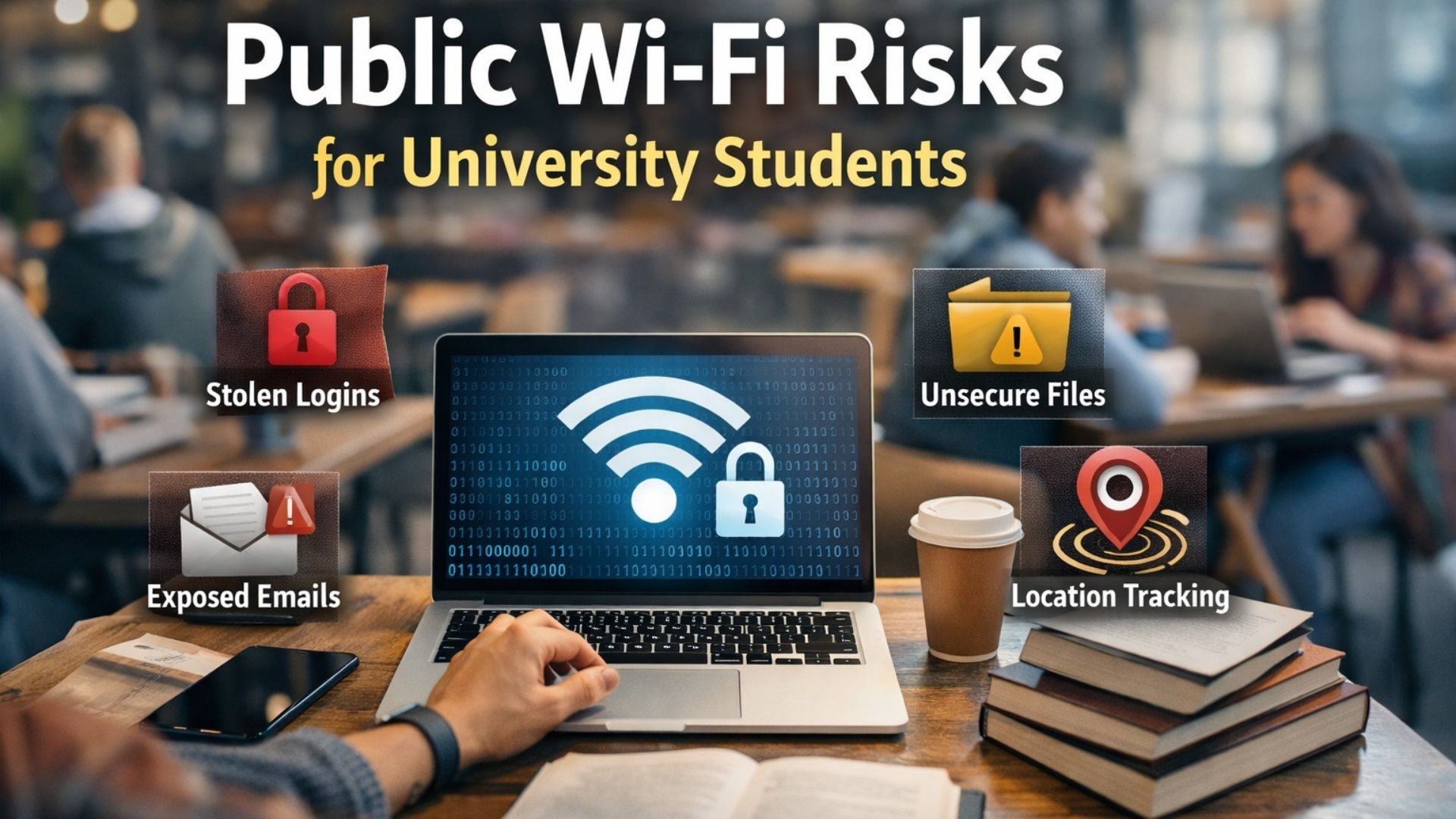
For university students, campuses, libraries, and cafés are not just social spaces. They are where most daily digital tasks happen. Lecture notes are downloaded there, assignments are uploaded, group work is coordinated, and job applications are sent.
Much of this activity runs through shared Wi-Fi networks. While these networks are convenient and usually free, that convenience is often mistaken for safety. Public Wi-Fi remains a real and often underestimated risk for students.
Why Shared Networks Still Create Issues
Public Wi-Fi networks are designed to handle many users at once, with little visibility into who is connected or what they are doing.
That lack of control makes it easier for activity on the network to be observed or interfered with. For students, the risks are usually quiet rather than dramatic. They tend to show up as small breaches that go unnoticed:
- Login sessions being intercepted
- University emails exposed
- Shared files accessed without permission
- IP-based tracking of location and usage patterns
These issues become more likely when students move between learning platforms, academic email accounts, and personal services on the same open network.
Digital Security Habits on Campus
Public Wi-Fi is often treated as a short-term fix. Many students assume that a brief connection is harmless, especially if they are only checking notes or sending a quick message. In reality, the duration of the connection matters less than the fact that the device is now part of a shared environment.
Because of this, some students take basic precautions when using Windows laptops in public spaces. One example is choosing to use CyberGhost on your Windows PC when connecting to open networks
This kind of setup does not remove all risk, but it can reduce how exposed network traffic is to others on the same connection. It is commonly used by students who study or work off campus and rely on public networks regularly.
What Institutions Say About Public Wi-Fi
Universities and regulators have long acknowledged these risks. The US National Institute of Standards and Technology highlights the privacy and data integrity concerns tied to open networks and stresses the importance of user awareness
The Federal Trade Commission also warns about how public networks can expose personal data and encourages users to reconsider how and where they connect
These positions make it clear that the issue is not hypothetical. The risks associated with public Wi-Fi are well documented and widely recognized.
Academic Life and the Digital Footprint
Beyond security, public Wi-Fi affects privacy. Over time, patterns emerge: when a student is online, which platforms they use, and how often they access certain services. On shared or campus networks, this information becomes easier to observe and log.
Collegenp has previously explored how a student’s digital footprint develops during university life and why it matters later on.
Rethinking Everyday Use
Public Wi-Fi is not going away. For students, it will remain part of daily academic life. But widespread use does not cancel out its risks. What matters is how consciously these networks are used.
Paying attention to where connections happen and what actions are taken on open networks can make a meaningful difference over the course of a student’s academic journey.
Disclaimer:
This content is provided for general informational purposes only. It does not constitute professional cybersecurity, legal, or technical advice. Any tools or examples mentioned are for contextual reference only and do not represent endorsements, recommendations, or brand preferences. Students should seek guidance from qualified IT or security professionals for their specific needs.





Comments 0
No comments yet. Be the first to start the conversation.