



Leeds Beckett University is a public higher-education institution in Leeds, West Yorkshire, England. Its legal identity as a higher education corporation dates from 1989, while its educational lineage reaches back to the Leeds Mechanics Institute, founded in 1824. The institution received taught and research degree-awarding powers in 1992, gained university status in 1993, and adopted the name Leeds Beckett University in 2014.
The university operates principally through City Campus and Headingley Campus and organises academic activity through nine Schools. Its subject base includes arts, architecture, engineering, computing, business, education, health, humanities and social sciences, events and tourism, law, and sport. Teaching ranges from classroom and seminar study to laboratories, studios, simulation, professional practice and work-based learning, depending on the discipline. Research is organised through the Schools, specialist centres, institutes and laboratories.
| Field | Detail |
|---|---|
| Official legal name | Leeds Beckett University |
| Location | Leeds, West Yorkshire, England |
| Institutional form | Higher education corporation |
| Legal establishment | 1 April 1989 under the Education Reform Act 1988 |
| Historical root | Leeds Mechanics Institute, founded in 1824 |
| Degree-awarding authority | Taught and research degree-awarding powers granted 4 June 1992 |
| University status | Granted 26 April 1993 |
| Previous university name | Leeds Metropolitan University |
| Leeds Beckett name adopted | 2014 |
| Main campus areas | City Campus and Headingley Campus |
| Academic organisation | Nine Schools |
| Governing body | Board of Governors |
| Principal academic authority | Academic Board |
| Charitable status | Exempt charity under the Charities Act 2011 |
Leeds Beckett’s historical roots and its legal establishment are separate parts of its institutional history. The 1824 date refers to the Leeds Mechanics Institute and the educational lineage that eventually contributed to the university. The present higher education corporation was established on 1 April 1989 under the Education Reform Act 1988.
The university was granted taught and research degree-awarding powers on 4 June 1992. This authority permits Leeds Beckett to award its own taught and research degrees rather than requiring another university to serve as the awarding body. Formal university status followed on 26 April 1993.
Leeds Beckett is an exempt charity for the purposes of the Charities Act 2011. Its Board of Governors is the governing body, and members of the Board act as charity trustees in law. The Office for Students is identified as the university’s principal regulator for higher education.
Institutional degree-awarding authority should not be confused with professional recognition attached to individual programmes. Some degrees are connected with professional, statutory or regulatory requirements, while others are not. Professional accreditation is consequently a programme-level matter rather than a blanket status covering every Leeds Beckett qualification.
The university’s history developed from several strands of education in Leeds rather than from a single organisation operating continuously under different names.
The earliest institutional root is the Leeds Mechanics Institute, founded in 1824. Its early provision included a library, classroom teaching, chemistry and other scientific subjects. During the nineteenth and twentieth centuries, additional specialist institutions in the city contributed to the educational lineage that later became associated with Leeds Beckett.
Teacher education developed through the City of Leeds Training College. Household and domestic education was represented by the Yorkshire Training College of Housecraft. Legal education developed through Leeds Law School, commercial education through Leeds College of Commerce, art education through Leeds College of Art, and physical education through Carnegie College of Physical Training.
These separate traditions help explain the university’s present subject mix. Leeds Beckett did not emerge from one narrow academic specialism; its later structure brought together professional, technical, creative, educational, business, health, social-science and sport-related disciplines.
A major organisational change took place in 1970 with the formation of Leeds Polytechnic. The institution became known as Leeds Metropolitan University in 1992. University status was formally granted in 1993, and the name Leeds Beckett University was adopted in 2014.
The Beckett name also has a connection with the Headingley site. The history of the estate includes ownership by the Beckett family before the land became associated with teacher training and higher education.
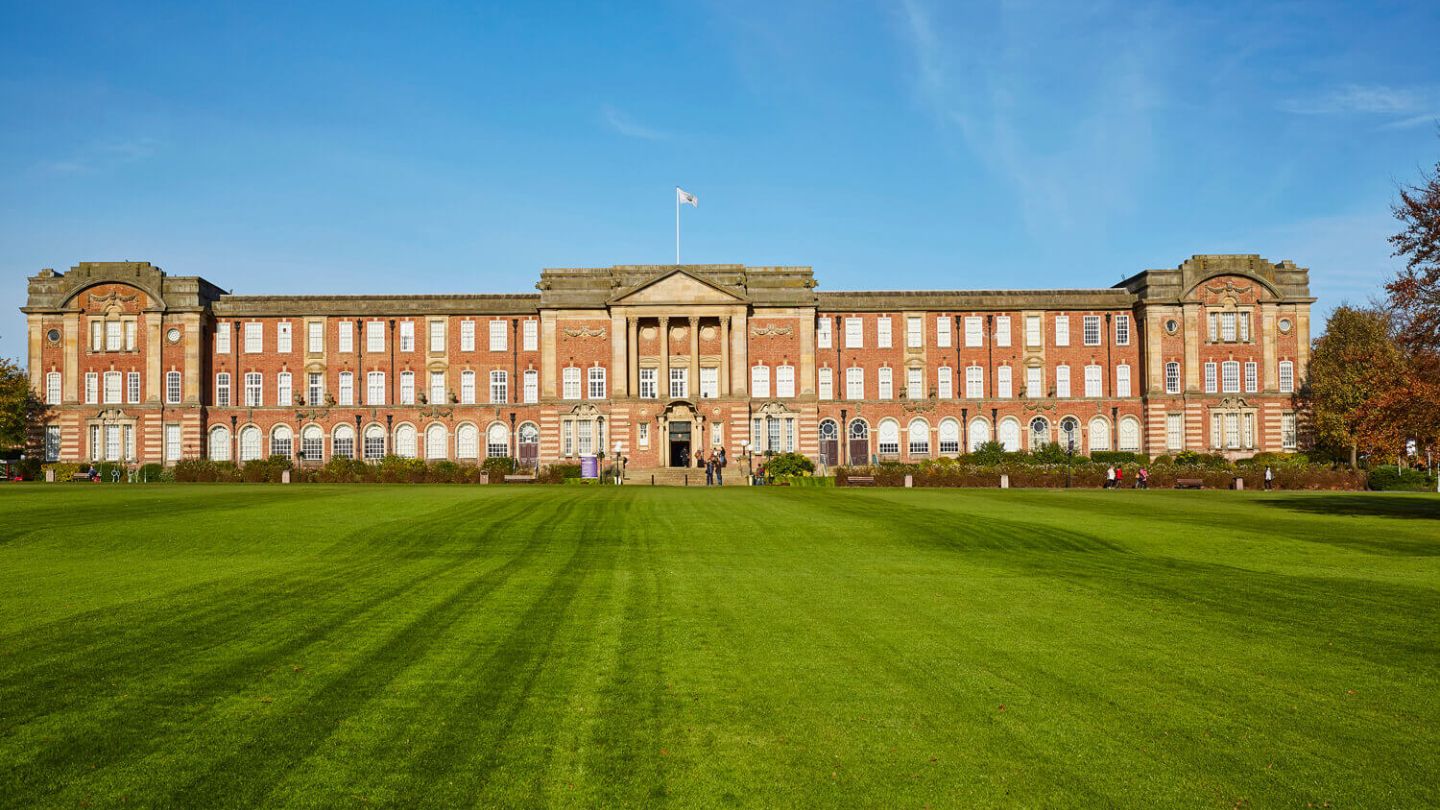
Leeds Beckett is organised around two main campus areas rather than one enclosed university site. City Campus occupies buildings in central Leeds, while Headingley Campus lies approximately three miles from the city centre and covers about 100 acres of parkland.
The location of teaching depends on School and programme. The two campus areas are not interchangeable, and some specialist facilities are closely connected with particular subjects.
The general City Campus address is Woodhouse Lane, Leeds, LS1 3HE. The Rose Bowl at City Campus, with the postcode LS1 3HB, is separately identified as the university corporation’s principal place of business and correspondence address.
Major buildings associated with City Campus include The Rose Bowl, Broadcasting Place, the Leslie Silver Building and the Leeds School of Arts building. Academic activity in this part of the university includes business, law, built environment, engineering, computing, arts and related subjects.
Broadcasting Place contains facilities used for architecture and design. The Leslie Silver Building houses the Sheila Silver Library. Creative teaching facilities connected with Leeds School of Arts are also concentrated within the city-centre group of buildings.
City Campus is integrated into central Leeds. University activity is therefore spread among several buildings rather than contained within a single gated site.
Headingley Campus combines academic buildings, sport facilities, open grounds and residential provision. The campus includes the James Graham Building, Headingley Library and facilities associated with Carnegie School of Sport.
Carnegie Village student accommodation is located on the Headingley site. The campus also contains spaces used for teaching, research, sport and student services.
Its approximately 100-acre site gives Headingley a different physical form from City Campus. This distinction is relevant to students because academic facilities, libraries, accommodation and specialist resources are distributed according to campus and School.
Leeds Beckett’s constitutional arrangements are set out through its Instrument and Articles of Government.
The Board of Governors is responsible for institutional governance and exercises the university’s powers within the relevant statutory and constitutional arrangements. It conducts defined areas of business through standing committees.
The Vice Chancellor is responsible for leadership and management, supported by executive groups. This executive role is distinct from the responsibilities of the Board of Governors.
Academic authority rests principally with the Academic Board. Its remit includes learning, teaching and assessment, academic quality assurance and enhancement, research and scholarly activity. School Academic Committees report through this academic structure on matters within their respective Schools.
University-wide professional services operate alongside the Schools. These include functions connected with estates, information technology, human resources, libraries and learning, international activity, sport, and campus and residential services.
Leeds Beckett organises subject teaching and much of its research through nine academic Schools. The School structure is more useful for understanding the university than a long programme list because individual courses can change while the disciplinary organisation remains comparatively stable.
| School | Main subject areas |
|---|---|
| Leeds School of Arts | Art and design, architecture and landscape, creative technologies, music and sound, film, performing arts |
| School of Built Environment, Engineering and Computing | Engineering, computing, surveying, construction and project management, geography, housing and planning |
| Leeds Business School | Accounting and finance, business, economics and analytics, enterprise, international business, leadership, marketing, public relations and journalism |
| Carnegie School of Education | Teacher education, education studies, childhood, professional development, education partnerships |
| School of Health | Biomedical sciences, counselling, dietetics and nutrition, nursing and healthcare, occupational therapy, physiotherapy, health promotion, environmental health and related areas |
| School of Humanities and Social Sciences | Psychology, criminology, sociology, history, media, politics and international relations, English, creative writing, speech and language sciences |
| School of Events, Tourism and Hospitality Management | Events, tourism, hospitality and related study |
| Leeds Law School | Law, legal practice and related professional study |
| Carnegie School of Sport | Sport and exercise sciences, physical education, coaching, sport management and related research |
The university supports undergraduate study, postgraduate taught study and postgraduate research alongside distance learning, degree apprenticeships, continuing professional development and short-course provision. Availability varies by discipline and award.
There is no single teaching method applied across Leeds Beckett. Teaching reflects the requirements of each discipline.
Arts and design subjects use studios, workshops and production spaces. Health education can include laboratories, clinical-skills teaching, simulation and practice learning. Sport combines academic study with laboratories and applied performance facilities. Engineering and computing use technical laboratories, while education programmes can include school-based placements and partnership activity.
Work-based learning also forms part of the university’s employer engagement. Activities identified within this area include employer-led consultancy projects, internships, vacation schemes, short-term employment, insight activities and traditional placements.
The form and extent of work-based learning depend on the course. The existence of placement and employer-engagement structures across the university does not mean that every degree includes a placement year or the same type of practical experience.
The School of Health operates a Practice Learning Hub associated with practice-based education. Carnegie School of Education works with placement and partnership arrangements connected with education programmes. In creative subjects, practice centres on making, production and performance, while sport, engineering and computing use specialist facilities linked to their disciplinary requirements.
Research at Leeds Beckett is conducted through academic Schools and a network of centres, institutes, specialist groups and laboratories. Areas represented include architecture, arts, business, computing, education, events and tourism, health, law, humanities and social sciences, and sport.
Named research units include the Leeds Sustainability Institute, Leeds Arts Research Centre, The Retail Institute, Centre for Biomedical Science Research, Centre for Human Performance, Centre for Justice, Law and Policy, Centre for Psychological Research, Cybercrime and Security Innovation Centre, Centre for Health Promotion and Centre for Applied Social Research.
These units illustrate the disciplinary spread of organised research activity rather than serving as a complete list of every research group associated with the university.
Postgraduate research provision includes MPhil and PhD routes together with other research and professional doctorate pathways in selected fields. Research students have access to supervision, researcher development, workshops, seminars and relevant specialist facilities.
Research facilities also connect academic investigation with advanced teaching. Art and design workshops support work with materials and three-dimensional fabrication. Built-environment facilities support testing and applied research. Health laboratories and simulation spaces serve clinical and biomedical work. Creative facilities support film, sound and production activity, while sport laboratories are used for human movement, physiology, biomechanics and performance analysis.
Research also connects with organisations outside the university through consultancy, knowledge exchange, employer collaboration, specialist expertise and Knowledge Transfer Partnerships. These are institutional mechanisms for collaborative work rather than evidence that every research project has an external partner.
Leeds Beckett’s principal libraries are the Sheila Silver Library at City Campus and Headingley Library in the James Graham Building.
Library provision includes printed and electronic books, journals, databases and subject-specific research resources. Academic librarians provide subject guidance, while Skills for Learning supports areas such as academic writing, critical thinking, information searching and referencing.
Library provision is complemented by Student IT Advice and other digital support. Academic library services and IT services have different functions: one centres on study and research resources, while the other supports access to university technology and systems.
The two-library structure reflects the university’s wider campus organisation, giving students access to study resources across City Campus and Headingley.
Leeds Beckett’s specialist facilities are distributed according to academic need rather than offered uniformly across every School.
Leeds School of Arts uses studios and workshops for art, design and architecture, together with music rehearsal and recording rooms, acoustics spaces, film studios, editing and sound-production facilities, theatre space and a cinema associated with the Northern Film School.
The School of Health has biomedical science laboratories, microbiology and cell-culture spaces, nutrition and food-inspection laboratories, clinical-skills areas and ward-style simulation facilities. These spaces support laboratory study and practice-based teaching in relevant health disciplines.
Carnegie School of Sport uses facilities that include indoor athletics provision, strength-and-conditioning space, human-movement research laboratories, environmental chambers, water-immersion facilities, a nutrition teaching kitchen and laboratories for physiology, biomechanics and performance work.
Built environment, engineering and computing subjects use technical and computing facilities linked to areas such as civil engineering, networking, data science and applied built-environment work.
These resources are School- and subject-specific. Their presence indicates the types of practical teaching and research supported within particular disciplines rather than a common set of facilities used by every student.
Student Advice acts as a central point for access to several university support functions. These include disability support, wellbeing, academic assistance, placements, accommodation, library and IT services, and other practical student matters.
Disability Advice supports students with disabilities, long-term conditions and specific learning differences. Its work includes identifying reasonable adjustments and coordinating relevant assessment and support arrangements.
The university also provides Student Wellbeing services and support connected with faith and belief, accommodation, study and international-student matters.
Academic support sits alongside personal and practical services. Students can therefore use specialist teams for different needs rather than relying on one general service for every issue.
Beckett Careers provides careers support through appointments, workshops and online resources.
Its areas of support include career planning, CVs, applications, placements, part-time employment, volunteering, study abroad and graduate job searches. Careers activity works alongside programme-based placement arrangements and employer engagement within individual Schools.
Career support also extends beyond completion of study through graduate services. This continued provision is separate from any claim about a particular employment outcome.
Employer engagement includes placements, internships, short-term work, employer-led projects and other forms of work-based learning. Organisations can also engage with university research, consultancy and knowledge-exchange activity.
Leeds Beckett has an International Office and dedicated services for international applicants and enrolled international students.
Academic entry conditions for international students depend on the qualification system in the applicant’s country and the requirements of the chosen programme. The university consequently uses country-specific information rather than one worldwide academic threshold.
English-language requirements can also differ between courses, particularly where professional or regulatory conditions apply. Programme requirements and country equivalencies are handled separately from the university’s institution-level status.
International support extends into enrolment through services dealing with student immigration and compliance matters. These functions provide specialist assistance within the university for international students whose study involves immigration requirements.
Leeds Beckett also participates in study-abroad and exchange activity through partnerships with institutions outside the United Kingdom. Some opportunities operate across multiple subjects, while others are connected with particular Schools or programmes.
Professional requirements can affect whether overseas study can form part of a degree. Exchange opportunities are consequently not identical across all programmes.
Student accommodation forms part of Leeds Beckett’s wider campus and student-support provision.
Carnegie Village is located at Headingley Campus, while other accommodation associated with university student housing is situated in Leeds. Residence options, room types and contract arrangements vary, so accommodation is separate from the permanent academic structure of the university.
Residence Life provides support connected with students living in university accommodation. Its work includes helping residents settle into halls, connecting students with activities and support services, and responding to practical or welfare matters associated with residential life.
The presence of residential support is particularly relevant to understanding Headingley Campus, where teaching, sport facilities and accommodation occupy the same wider university site.
Admissions at Leeds Beckett are organised according to course, level of study and applicant background rather than through one university-wide academic requirement.
Course pages establish the academic conditions for particular degrees. International applicants are also assessed through qualification guidance relevant to their country or education system. A qualification from one jurisdiction cannot be treated as automatically equivalent to the same qualification title used elsewhere.
Some programmes carry additional subject, professional or practice requirements. These conditions belong to the individual course and should not be generalised across the university.
Application arrangements also differ by study level and applicant category. For an institutional profile, the stable point is that undergraduate, postgraduate and international admissions are administered through separate routes and programme-specific requirements rather than one common admission formula.
The same distinction applies to professional recognition. Leeds Beckett has its own taught and research degree-awarding authority, but professional accreditation or licensing relevance depends on the specific degree and professional body concerned.
External engagement appears across teaching, research and professional activity.
The School of Health works with practice settings and health partners, while Carnegie School of Education maintains partnerships connected with school and education provision. Leeds Business School has activity in enterprise and knowledge exchange, and research units work with public, professional, commercial and community organisations.
At university level, mechanisms for external collaboration include consultancy, placements, employer-led projects, research partnerships, knowledge exchange and Knowledge Transfer Partnerships.
These relationships perform different functions. Some support student learning or professional practice, while others relate to applied research, consultancy or organisational collaboration.
Leeds Beckett’s institutional identity is shaped by the combination of a multi-strand educational history, its legal status as a degree-awarding university, a two-campus physical structure and a nine-School academic organisation.
Its roots in technical, commercial, creative, teacher, legal and physical education continue to be visible in its disciplinary range. City Campus concentrates a substantial part of its business, law, built-environment, computing and creative activity in central Leeds, while Headingley combines academic buildings with sport facilities, parkland and student accommodation.
The university’s academic provision also has a strong practical component across several Schools. Laboratories, studios, clinical simulation, workshops, performance facilities, placements, practice learning and employer-led activity are used where they match disciplinary needs. Research follows a similarly distributed model through Schools, research centres, institutes and specialist laboratories.
For global readers, the most important distinction is between university-wide facts and programme-specific conditions. Leeds Beckett’s legal status, governance, degree-awarding authority, campus structure and School organisation apply to the institution as a whole. Entry requirements, professional accreditation, placements, exchange opportunities and specialist conditions depend on the individual programme.
Leeds Beckett University is a public higher-education institution in Leeds, West Yorkshire, England. Its present legal form is a higher education corporation established on 1 April 1989 under the Education Reform Act 1988.
The university traces its educational lineage to the Leeds Mechanics Institute, founded in 1824. The present higher education corporation was established in 1989, received taught and research degree-awarding powers in 1992, and gained university status in 1993. The name Leeds Beckett University was adopted in 2014.
Leeds Beckett University is based in Leeds, England. Its buildings and facilities are organised principally across City Campus in central Leeds and Headingley Campus, located approximately three miles from the city centre.
The university operates through two main campus areas: City Campus and Headingley Campus. Teaching locations vary by School and programme, and specialist facilities are distributed between the two campus areas.
Academic teaching and much of the university’s research are organised through nine Schools. These cover arts, built environment, engineering and computing, business, education, health, humanities and social sciences, events, tourism and hospitality, law, and sport.
Yes. Leeds Beckett University was granted taught and research degree-awarding powers on 4 June 1992. This allows the university to award its own academic degrees. Professional accreditation or recognition, where applicable, is determined at programme level.
The university provides undergraduate and postgraduate taught study, research degrees, degree apprenticeships, distance learning, and professional-development provision. Available routes and study formats vary by subject and programme.
Research facilities are distributed across the university’s Schools, centres, institutes and specialist laboratories. These include facilities supporting biomedical science, health, sport and human performance, arts and creative production, architecture, built environment, engineering, computing and other research areas.
The university’s principal libraries are the Sheila Silver Library at City Campus and Headingley Library in the James Graham Building. Library provision includes printed and electronic resources, journals, databases, subject guidance and academic study support.
Student support includes Student Advice, Disability Advice, Student Wellbeing, library and IT support, careers services, accommodation support and services for international students. Specialist teams deal with different academic, practical and personal-support needs.
Beckett Careers provides support with career planning, applications, CVs, placements, part-time work, volunteering and graduate employment searches. Careers provision also operates alongside placement and employer-engagement activity within individual Schools.
Student accommodation is available in Leeds, including Carnegie Village at Headingley Campus. Residence Life provides support for students living in university accommodation, including help with settling into halls and access to relevant support services.
Yes. Leeds Beckett provides dedicated services and country-specific admissions information for international applicants. Academic entry requirements depend on the applicant’s qualifications, country and chosen programme, while English-language and professional requirements can also vary by course.
Professional accreditation applies to individual programmes where relevant rather than to the university as a whole. Applicants considering a professionally regulated field should check the recognition attached to the specific programme they intend to study.
City Campus consists of university buildings in central Leeds and includes facilities used for subjects such as business, law, arts, built environment, engineering and computing. Headingley Campus is set within approximately 100 acres of parkland and includes academic buildings, sport facilities, Headingley Library and Carnegie Village accommodation.
