



Rapti Academy of Health Sciences (RAHS), known in Nepali as राप्ती स्वास्थ्य विज्ञान प्रतिष्ठान, is a public, autonomous health sciences academy based in Ghorahi, Dang, Lumbini Province. Established under the Rapti Academy of Health Sciences Act, 2074, the academy has responsibilities in health sciences education, research and health-service delivery.
RAHS developed from the former Rapti Sub-regional Hospital and combines academic teaching with clinical services. Its institutional records document undergraduate medical and nursing education, postgraduate nursing and medical education, research oversight, and hospital-based training.
| Particular | Detail |
|---|---|
| Official name | Rapti Academy of Health Sciences |
| Abbreviation | RAHS |
| Nepali name | राप्ती स्वास्थ्य विज्ञान प्रतिष्ठान |
| Institution type | Public, autonomous health sciences academy |
| Established | 2074 BS / 2017 AD |
| Legal basis | Rapti Academy of Health Sciences Act, 2074 |
| Location | Ghorahi, Dang, Lumbini Province, Nepal |
| Academic areas | Medicine, nursing and postgraduate medical education |
| Documented programs | MBBS, BSc Nursing, Bachelor of Nursing Science, Master of Nursing and MD/MS |
| Teaching hospital | RAHS hospital, developed from Rapti Sub-regional Hospital |
| Official website | https://rahs.edu.np |
The academy's legal status, location, academic role and core institutional functions are supported by its governing Act and RAHS institutional records.
RAHS was established through legislation rather than as a college affiliated with another university. The Nepal Law Commission record identified in the verified institutional research lists the Rapti Academy of Health Sciences Act, 2074 as the legal basis for the academy. The Act assigns RAHS responsibilities for higher-level study, teaching and research in health sciences, together with health-service delivery.
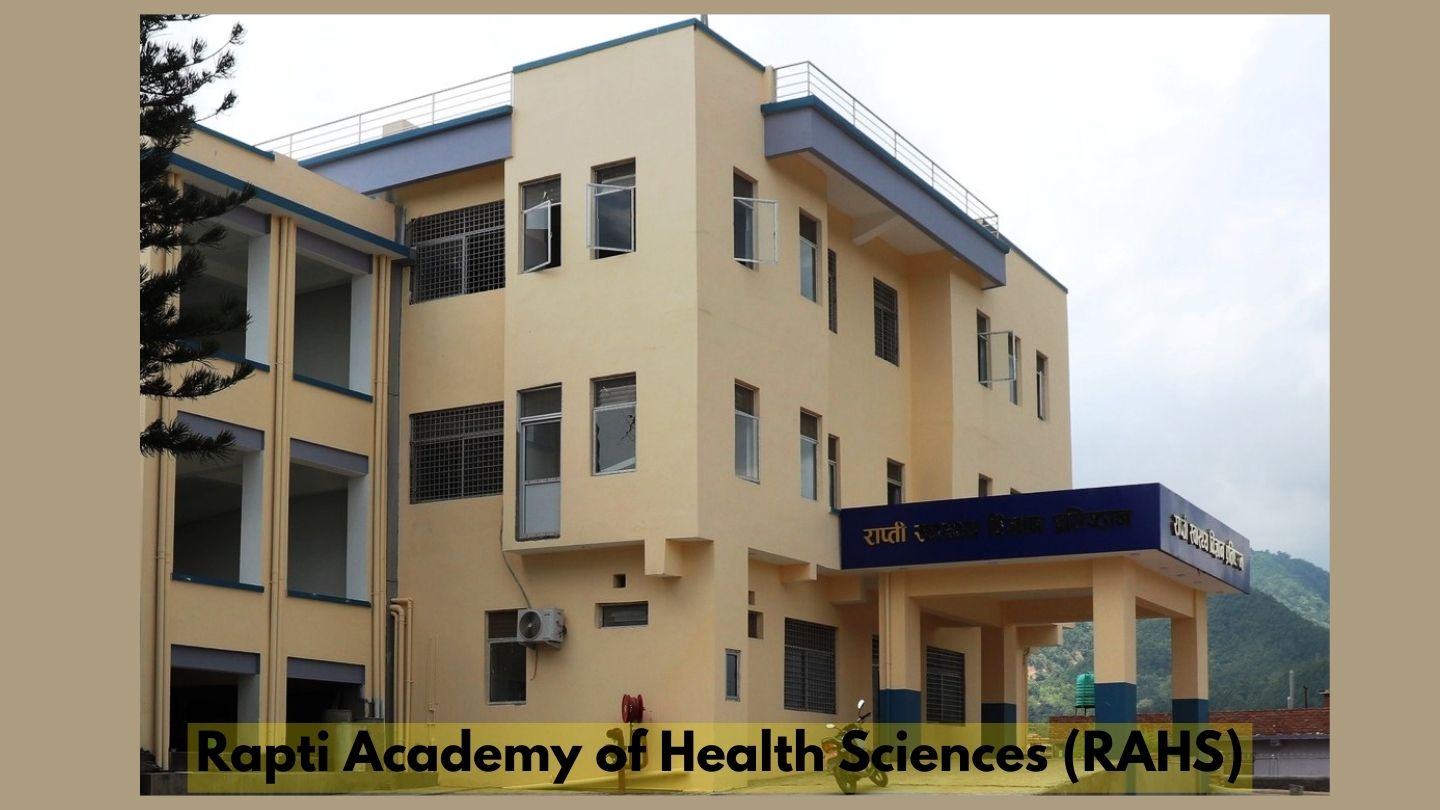
The academy's institutional history is connected to the development of health services in Dang. RAHS records trace its hospital background through Mahendra Health Center and Mahendra Hospital, followed by development into Rapti Sub-regional Hospital and its later incorporation into Rapti Academy of Health Sciences.
This history explains why hospital services and health sciences education operate within the same institutional structure.
RAHS has an academic, research and health-service mandate. Its governance structure includes a Senate, Executive Council, Academic Council and Hospital Management Committee. These bodies support the academy's academic and hospital responsibilities.
The institutional model connects classroom and laboratory education with clinical teaching. Medical and nursing education are supported by departments that also participate in patient care, while research is handled through institutional academic and ethics-review structures.
RAHS institutional records document programs at undergraduate and postgraduate levels. The principal programs identified in the verified academic record are MBBS, BSc Nursing, Bachelor of Nursing Science (BNS), Master of Nursing (MN) and MD/MS postgraduate medical education.
The Bachelor of Medicine and Bachelor of Surgery (MBBS) program forms the academy's undergraduate medical education stream. RAHS records identify MBBS teaching as part of the School of Medicine.
Medical teaching is supported by basic sciences, clinical departments and hospital-based learning. Students seeking general information about medical education pathways can also read MBBS in Nepal Eligibility, Fees and Admission. RAHS-specific admission conditions should be taken from the applicable official admission notice rather than from a general MBBS guide.
Bachelor of Science in Nursing is part of the academy's undergraduate nursing education. RAHS organizes nursing teaching through the School of Nursing and its subject departments.
The nursing structure includes Community Health Nursing, Medical-Surgical Nursing, Child Health Nursing, Women's Health/Maternal Health Nursing and Mental Health Nursing.
Bachelor of Nursing Science (BNS) is another undergraduate nursing program documented by RAHS. It operates within the academy's nursing education structure alongside BSc Nursing.
Program admission requirements and other intake-specific conditions are governed by the applicable official notices.
RAHS institutional records also document Master of Nursing (MN) education. The academic record identifies postgraduate nursing study within areas such as Community Health Nursing and Medical-Surgical Nursing.
The MN program adds postgraduate nursing education to an academic structure that already includes undergraduate nursing teaching and clinical departments.
RAHS provides postgraduate medical education through MD/MS programs. Institutional records identify postgraduate training in clinical fields such as medicine, surgery, orthopedics, obstetrics and gynecology, pediatrics, community medicine, and general practice and emergency medicine.
Exact degree titles and available disciplines should be read from the applicable academic and admission documents because postgraduate program designations can vary by specialty.
The School of Medicine includes basic science and clinical departments that support medical teaching and hospital care.
RAHS identifies clinical departments including:
Medicine and Geriatrics
General Surgery
Obstetrics and Gynecology
Pediatrics
Anesthesiology and Critical Care
Orthopedics
Ophthalmology
ENT-HNS
Forensic Medicine
Psychiatry
Dermatology
Radiology and Medical Imaging
General Practice and Emergency Medicine
Pathology
Dentistry
Urology
Neurosurgery
These departments form part of the academy's medical teaching and clinical-service structure.
RAHS also lists core basic and pre-clinical disciplines required for medical education:
Anatomy
Biochemistry
Community Medicine
Microbiology
Physiology
Pharmacology and Therapeutics
These subjects support the scientific foundation of medical study before and alongside clinical education.
The School of Nursing provides the institutional structure for undergraduate and postgraduate nursing education.
Its documented departments include:
Community Health Nursing
Medical-Surgical Nursing
Child Health Nursing
Women's Health/Maternal Health Nursing
Mental Health Nursing
The nursing structure connects academic instruction with clinical learning in relevant hospital departments.
Clinical services are part of the academy's teaching system. RAHS developed from Rapti Sub-regional Hospital, linking the institution's academic development to an established hospital-service base.
Institutional records describe outpatient, inpatient and emergency care together with diagnostic, surgical and specialty services. Documented service areas include:
outpatient and inpatient care;
emergency medicine;
general and specialty surgery;
dialysis;
radiology and medical imaging;
laboratory services;
pharmacy services;
physiotherapy and rehabilitation;
critical-care services;
echocardiography and endoscopy;
nutrition and dietetics;
maternal and neonatal care;
geriatric services; and
selected public-health and social-support services.
RAHS also documents services connected with safe motherhood, antiretroviral therapy, tuberculosis care through DOTS, nutritional rehabilitation, sickle-cell services and the One-Stop Crisis Management Center.
The hospital setting supports clinical exposure for medical and nursing education while serving the academy's statutory health-service function.
RAHS uses its academic departments and hospital services as connected parts of health-professional education.
Clinical departments provide settings for bedside teaching, supervised clinical learning and exposure to patient-care systems. Basic sciences provide the scientific foundation for medical education, while nursing departments connect classroom instruction with nursing practice.
The Medical Education Department supports the organization of medical teaching within the academy's academic structure.
Research is one of the functions assigned to RAHS under its institutional mandate. The academy maintains an Institutional Review Committee (IRC) for review of research proposals and publishes guidance related to proposal submission.
An institutional review committee helps provide ethical and procedural review for research involving the academy's academic and clinical environment.
RAHS also maintains the Journal of Rapti Academy of Health Sciences (JRAHS), providing an institutional channel for academic publication.
RAHS records identify infrastructure supporting teaching, research, administration and hospital services.
Documented resources include:
hospital buildings;
teaching buildings;
library facilities;
research laboratories;
basic-science teaching areas;
administrative facilities; and
laboratory and clinical-service spaces.
These resources support the academy's combination of health sciences education, research and clinical service.
Admission to regulated health-professional programs at RAHS is connected with the Medical Education Commission (MEC) process and the academy's institutional admission requirements.
Applicants should follow the applicable Medical Education Commission notice for the relevant program and then follow the RAHS enrollment instructions issued for that admission process.
Official notices should be used for:
eligibility requirements;
entrance and matching procedures;
available seats;
scholarship or paying categories;
fees;
required documents; and
enrollment deadlines.
These conditions belong to individual admission cycles and should not be treated as fixed institutional facts.
Rapti Academy of Health Sciences is based in Ghorahi, Dang, in Lumbini Province, Nepal. Ghorahi is the main institutional location identified in the academy's governing Act and official institutional records.
The academy's official website is https://rahs.edu.np.
RAHS combines three related functions within one statutory academy:
health sciences education at undergraduate and postgraduate levels;
research and institutional research review; and
hospital and clinical services.
This structure allows the School of Medicine, School of Nursing, clinical departments, research functions and hospital services to operate within the same academy.
For students, this means the institution is organized around both academic study and clinical training rather than functioning only as a classroom-based degree provider.
Rapti Academy of Health Sciences is a public, autonomous health sciences academy established under the Rapti Academy of Health Sciences Act, 2074.
RAHS is located in Ghorahi, Dang, Lumbini Province, Nepal.
RAHS institutional records document MBBS as part of its undergraduate medical education.
The documented nursing programs include BSc Nursing, Bachelor of Nursing Science and Master of Nursing.
Yes. RAHS institutional records document MD/MS postgraduate medical education across several clinical disciplines.
Yes. RAHS developed from Rapti Sub-regional Hospital and integrates hospital services with medical and nursing education.
Students should use the applicable Medical Education Commission notice and the corresponding RAHS admission instructions. Eligibility, seats, fees, documents and deadlines are determined through the relevant admission process.
