



The University of Northampton is a higher education institution based in Northampton, England, with its principal address at Waterside Campus, University Drive, Northampton, NN1 5PH, United Kingdom. Its institutional roots extend to Northampton Technical College, established in 1924, while the University of Northampton in its present status dates from 2005, when the institution received full university status and research degree-awarding powers.
The University is legally constituted as a Higher Education Corporation and operates as an exempt charity. The Office for Students is its principal regulator for charity-law purposes. Much of the University’s teaching, library provision, academic support and student services is concentrated at Waterside Campus, which opened in 2018.
Academic activity is organised through three faculties: the Faculty of Education, Arts, Science and Technology; the Faculty of Business and Law; and the Faculty of Health, Sport and Behavioural Sciences. The University provides undergraduate, postgraduate taught and postgraduate research study across these broad subject areas.
| Area | Institutional information |
|---|---|
| Official legal title | The University of Northampton (UON) |
| Location | Northampton, England, United Kingdom |
| Principal address | Waterside Campus, University Drive, Northampton, NN1 5PH |
| Institutional roots | Northampton Technical College, established in 1924 |
| Full university status | 2005 |
| Degree-awarding position | Research degree-awarding powers obtained with full university status in 2005 |
| Legal form | Higher Education Corporation and exempt charity |
| Principal charity regulator | Office for Students |
| Main academic campus | Waterside Campus |
| Waterside opening | 2018 |
| Academic organisation | Three faculties |
| Study levels | Undergraduate, postgraduate taught and postgraduate research |
| Teaching model | Active Blended Learning, with teaching predominantly face to face and supported by digital study resources |
| TEF 2023 | Silver overall, Silver for student experience and Silver for student outcomes |
| University accommodation | Halls at Waterside, St John’s and Scholars Green |
The University’s official legal title is The University of Northampton. Its status is more precisely described through its legal constitution than through broad labels such as “public university.”
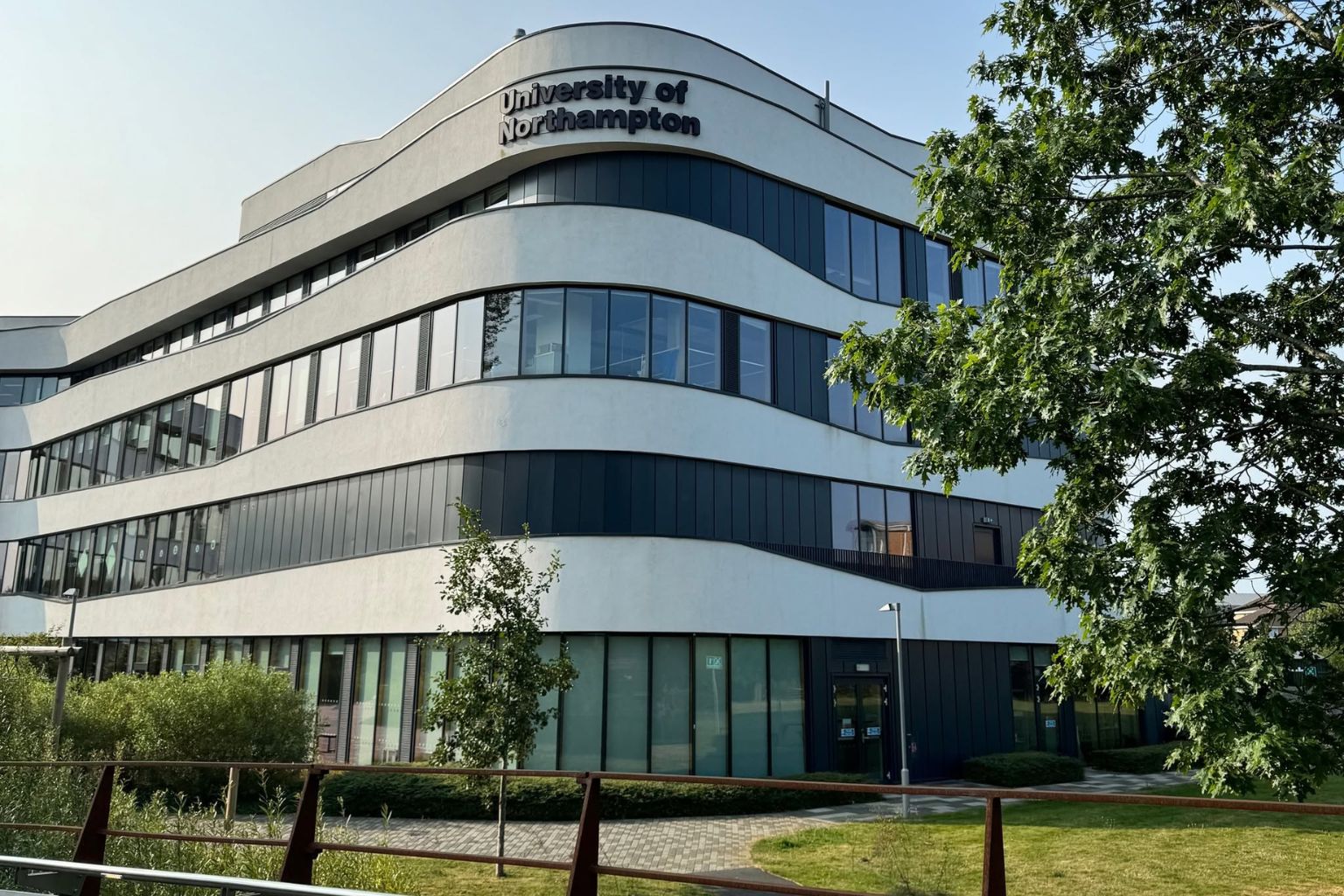
It is a Higher Education Corporation created under the Education Reform Act 1988 and is an exempt charity. An exempt charity has charitable status but is not registered and regulated in the same way as an ordinary registered charity. For the University of Northampton, the Office for Students acts as the principal regulator for charity-law purposes. The University’s charitable purpose is the advancement of education.
This institutional status should be distinguished from professional recognition attached to individual degrees. The University’s legal authority and institutional regulation apply across the organisation, whereas accreditation by a professional or statutory body may apply only to a particular programme. Recognition held by one course therefore cannot be extended automatically to another programme, faculty or the University as a whole.
The University’s degree-awarding position is also part of its institutional identity. It obtained full university status and research degree-awarding powers in 2005. This allows the institution to award qualifications within its approved academic provision, including postgraduate research degrees.
The Board of Governors is the University’s governing body. Governors are members of the Higher Education Corporation and serve as charity trustees, with independent members forming the majority.
The Board carries responsibility for the University’s institutional direction, stewardship and oversight. It also appoints the Vice-Chancellor. Its role is distinct from the academic responsibilities exercised through the University’s Senate.
The relationship between the Board of Governors, Vice-Chancellor and Senate is established through the University’s Instrument and Articles of Government. Academic governance then continues through Senate and associated committees.
These academic structures address matters including academic quality and standards, research and knowledge exchange, research degrees, student experience and faculty academic business. The arrangement separates corporate oversight from academic decision-making while connecting both to the University’s formal governance system.
For readers comparing UK institutions, this distinction is significant. The Board is responsible for institutional governance, while Senate and its related academic bodies deal with the academic standards and processes through which teaching, assessment, research and awards are administered.
The University’s history is best understood as a sequence of institutional developments rather than through a single founding date.
Its roots begin with Northampton Technical College, established in 1924. The institution later became part of a wider reorganisation of higher education in Northampton.
In 1975, Nene College was formed through the amalgamation of several local colleges. The institution became University College Northampton in 1999. In 2005, it received full university status and research degree-awarding powers and adopted the University of Northampton name.
The distinction between 1924 and 2005 is important. The earlier date represents the beginning of the institutional line from which the present University developed. It does not mean that the University of Northampton existed in its current legal and academic form from 1924.
A further major change occurred in 2018, when Waterside Campus opened and the University moved its main academic activity there. The relocation brought much of the institution’s teaching, library provision, student services and Students’ Union activity together around a central campus near Northampton town centre.
Waterside Campus is the University’s principal academic base. It is located beside the River Nene in Northampton and has shaped the physical organisation of the institution since opening in 2018.
The University is not based in London. Northampton is its home city. London and Birmingham are relevant as transport connections rather than as university locations. Rail services connect Northampton with both cities, while the town centre is accessible from Waterside by a pedestrian route across the river.
The campus is organised around several buildings with different teaching, study and support functions rather than around one large academic building. These include the Learning Hub, Creative Hub, Senate and Engine Shed, alongside other academic and support spaces.
This arrangement means students use different parts of the University according to their subject and the type of teaching required. A student using health-related specialist facilities may have a different daily pattern from a student working in creative studios or business teaching spaces.
The Learning Hub is one of the central academic buildings at Waterside. It accommodates general teaching, study areas, library provision and several student-facing services.
The University’s library is integrated into the Learning Hub rather than operating solely as a separate standalone building. Physical collections are located on upper floors, with areas for group work and quieter individual study.
The building also brings together services students may need during their studies. These include IT support, the Student Information Desk and Student Futures.
Specialist areas in the Learning Hub support subjects including nursing and other health disciplines, paramedic science, psychology and policing. The precise facilities a student uses depend on the programme rather than being common to every degree.
Combining teaching, study space, library resources and support services within the same building gives the Learning Hub a wider institutional role than that of a conventional library building.
Other Waterside buildings serve more specialised academic purposes.
The Creative Hub supports arts, media, design and related subjects. Its facilities include studios, computer spaces and areas used for production or rehearsal work. These spaces reflect the practical requirements of creative disciplines rather than a standard classroom-only model.
Senate provides further teaching and study space and includes business-related facilities such as the Bloomberg Finance Lab. Its academic use differs from that of the Creative Hub, illustrating how teaching space is distributed according to disciplinary requirements.
The Engine Shed is a converted nineteenth-century railway building used by the Students’ Union. The University also uses the Development Hub for parts of its creative and performing arts provision.
Together, these buildings show that Waterside is not a uniform teaching site. General academic space, specialist subject facilities, study resources and student services are distributed across buildings according to function.
The University organises its academic activity through three faculties:
Faculty of Education, Arts, Science and Technology
Faculty of Business and Law
Faculty of Health, Sport and Behavioural Sciences
The Faculty of Education, Arts, Science and Technology brings together education with arts, creative disciplines, science and technology.
The Faculty of Business and Law covers areas including business, management, accounting, finance, law and related subjects.
The Faculty of Health, Sport and Behavioural Sciences includes health and nursing disciplines, sport, psychology and related behavioural subjects.
These faculty names are important because older university profiles may use previous organisational arrangements. Schools, departments and subject groupings can also change more frequently than the main faculty structure.
The University offers study at undergraduate, postgraduate taught and postgraduate research levels. Selected programmes also include routes such as integrated foundation study, top-up provision or placement options.
Such features are course-specific. A foundation route available for one degree should not be assumed to exist across the University, and placement provision attached to one programme does not create a university-wide placement entitlement.
The same principle applies to professional accreditation, programme duration and entry requirements. These details belong to the individual course where they are formally specified.
The University describes its principal teaching approach as Active Blended Learning.
In this model, teaching is predominantly face to face, with digital resources used to prepare for, support and follow up academic activity. The approach includes interactive small-group work, teamwork and problem-solving alongside independent study using online materials.
The term “blended” should not be interpreted as meaning that the University is primarily an online institution. It also does not imply that every subject is taught in the same way.
The balance between lectures, seminars, workshops, laboratory work, clinical activity, professional practice and independent study depends on the programme. A nursing or health course may require forms of practical teaching that differ substantially from the teaching pattern used in business, arts or computing.
This subject-level variation is important when assessing the University’s teaching model. Active Blended Learning describes the broad approach, while individual programmes determine how that approach is applied within a discipline.
The University received Silver in the Teaching Excellence Framework 2023, with Silver ratings for the overall assessment, student experience and student outcomes.
The Teaching Excellence Framework is administered by the Office for Students and assesses undergraduate teaching and student outcomes in England. It should not be treated as the same type of measure as an international or domestic university league table.
The result is therefore most useful as a dated regulatory assessment of undergraduate teaching and outcomes rather than as a permanent institutional ranking.
Keeping that distinction clear avoids turning a specific national assessment into a broader claim about every aspect of the University.
Research is part of the University’s academic role alongside undergraduate and taught postgraduate education.
The University participated in the UK Research Excellence Framework 2021 and submitted work across 12 units of assessment. In its published REF 2021 summary, it reported that 79% of submitted research was rated at 2-star, 3-star or 4-star across the categories assessed.
That figure applies specifically to the University’s REF 2021 submission. It should not be interpreted as a score for every research output, faculty or research project at the institution.
Research activity is distributed across faculties, institutes and centres and includes work in areas connected with health, society, technology, the natural and built environment, business and culture.
Individual institute and centre names can change as research organisation develops. For an institutional profile, the broader scope of activity provides a more stable picture than a long inventory of organisational units.
The University provides postgraduate research routes including MPhil and PhD study, alongside professional or practice-based doctoral routes within its research-degree provision.
Research applicants may develop their own proposed project where suitable supervision is available. Other opportunities may be connected with identified research projects or defined subject areas.
Research-degree admission is separate from taught postgraduate admission. The availability of appropriate supervision, the quality and suitability of a research proposal and the academic requirements attached to the research route form part of the application process.
This distinction matters because admission requirements for a taught master’s programme cannot be assumed to apply to an MPhil, PhD or professional doctorate.
The University’s possession of research degree-awarding powers since 2005 provides the institutional authority for this area of its academic activity.
Student support at the University is delivered through a combination of central information services and specialist teams.
The Student Information Desk functions as a first point of contact for students who need guidance but may not know which service handles their issue. It can direct students towards relevant areas including academic advice, counselling and mental-health support, financial guidance, international support and disability or additional-needs services.
IT assistance and library-related support are closely associated with the Learning Hub. Student Futures provides careers-related support.
This service structure is more useful to prospective students than a broad statement that support exists, because it identifies how students can enter the support system and reach the appropriate specialist service.
The concentration of several of these functions at Waterside is also connected to the University’s move to the campus in 2018, which brought academic and student-facing services into a more consolidated physical arrangement.
The University operates halls of residence at three principal locations: Waterside, St John’s and Scholars Green.
Waterside accommodation is located at the main academic campus. St John’s is in Northampton town centre. Scholars Green is located farther from Waterside and is connected to the University by transport.
The University has reported more than 2,250 bed spaces across its accommodation provision. Room types and availability differ by location.
Accommodation should therefore be understood as a multi-site system rather than a single residence complex attached to Waterside. The location chosen can affect a student’s relationship with the main academic campus and Northampton town centre.
Detailed accommodation conditions can change between admission cycles, so room availability, contracts and allocation arrangements are matters for the relevant intake rather than permanent characteristics of the institution.
The Students’ Union occupies the Engine Shed at Waterside. The building is a converted nineteenth-century railway structure incorporated into the University campus.
Its location within the Waterside estate places student representation and Students’ Union activity near the main academic and support buildings.
The broader campus arrangement brings together teaching, study areas, support services, student representation and some accommodation within or close to the principal site. Other university-managed accommodation remains distributed elsewhere in Northampton.
Campus use nevertheless varies by academic discipline. Students whose teaching is concentrated in the Creative Hub, Development Hub, Learning Hub or Senate may experience the physical layout differently.
Careers support is delivered through Student Futures.
Its activities include career coaching, workshops, employer engagement, assistance connected with part-time work and enterprise-related support. These services operate separately from course-specific placement arrangements.
Placement opportunities are offered on selected programmes. They are not guaranteed across the University, and the conditions attached to a placement route depend on the individual course.
This distinction is necessary when considering employability information. Careers advice is an institution-level student service, while work placements form part of particular academic programmes where specified.
Graduate employment should likewise not be presented as guaranteed. Career outcomes depend on factors beyond the University and should not be inferred from the existence of careers services or placement options.
The University does not use one universal institutional entry standard for every applicant and programme.
Admission requirements vary according to academic level, chosen course and applicant circumstances. This is particularly important for programmes with professional, clinical or specialist requirements.
UK undergraduate applications are generally handled through the Universities and Colleges Admissions Service, commonly known as UCAS. Other applicant categories, including postgraduate study, may use University application routes where applicable.
International application arrangements can differ according to course and applicant circumstances, including country of residence. A route available to one applicant should therefore not be assumed to apply universally.
English-language requirements also differ according to study level and programme. General University requirements may apply to many courses, while professional or specialist degrees can set higher or differently structured requirements.
For this reason, a university profile can explain the admissions structure but should not reduce Northampton admissions to a single entry score, language threshold or acceptance percentage.
No official University-wide acceptance rate was identified in the verified research. Percentages published elsewhere may use different definitions, populations or calculations and should not be treated as an official institutional measure.
Professional recognition at the University must be understood at programme level.
Subjects such as health, psychology, law, engineering, accounting and other professionally oriented areas can involve accreditation or recognition by external bodies, but the presence of such recognition for one programme does not establish an institution-wide accreditation across related subjects.
The University’s status as a Higher Education Corporation, its regulation by the Office for Students and its degree-awarding powers are institutional matters. Professional-body recognition is separate.
Prospective students considering a regulated profession therefore need to distinguish between the University’s authority to award a degree and any additional professional recognition attached to the particular course.
This distinction is especially important for readers outside the United Kingdom because recognition for professional practice can depend on the course, regulator and jurisdiction involved.
The University’s academic activity extends beyond students studying physically at Waterside.
International applicants also form part of the University’s admissions activity, although application procedures and course requirements cannot be generalised across all countries or programmes.
For global readers, the important point is that international admission, professional recognition and entry requirements remain tied to individual applicant and course circumstances. The University’s UK institutional status does not by itself determine how a qualification will be treated by every professional regulator or education authority outside the United Kingdom.
The University of Northampton combines a century-long institutional lineage with a more recent legal status as a university.
Its roots reach back to Northampton Technical College in 1924. Nene College was formed in 1975, University College Northampton followed in 1999, and full university status with research degree-awarding powers was obtained in 2005.
The opening of Waterside Campus in 2018 marked another major change. Much of the University’s teaching, library provision, student support and Students’ Union activity is now concentrated there, with specialist spaces distributed across buildings such as the Learning Hub, Creative Hub, Senate and Development Hub.
Academically, the University operates through three faculties and provides undergraduate, postgraduate taught and postgraduate research education. Its Active Blended Learning approach combines predominantly face-to-face teaching with digital preparation and study, while the exact teaching pattern depends on the programme.
Research activity includes participation in REF 2021 and postgraduate research provision leading to qualifications including MPhil and PhD. Student services are organised through identifiable routes including the Student Information Desk, library and IT support, Student Futures and specialist wellbeing and disability services.
Several important distinctions define how the University should be understood. Its legal status is separate from programme accreditation. Its on-campus student population is different from the population studying through partnerships and distance arrangements. Careers support is not the same as a guaranteed placement. General admissions arrangements do not replace course-specific requirements.
These distinctions provide a clearer picture of the University than broad claims about reputation or quality. The institution is defined by its governance and degree-awarding authority, its development from earlier Northampton colleges, the concentration of academic activity at Waterside, its current three-faculty organisation, its teaching and research activity, and the student services connected with study at the University.
The University of Northampton is based in Northampton, England. Its principal address is Waterside Campus, University Drive, Northampton, NN1 5PH, United Kingdom. Waterside has been the University’s main academic base since 2018.
The University traces its institutional roots to Northampton Technical College, established in 1924. Nene College was formed in 1975, and the institution became University College Northampton in 1999. It received full university status and research degree-awarding powers in 2005 and adopted the University of Northampton name.
The University of Northampton is legally constituted as a Higher Education Corporation and is an exempt charity. The Office for Students acts as its principal regulator for charity-law purposes. Its institutional legal status is separate from professional accreditation that may apply to individual degree programmes.
Yes. The University received full university status and research degree-awarding powers in 2005. Its academic provision includes undergraduate, postgraduate taught and postgraduate research study.
The University operates through three faculties: the Faculty of Education, Arts, Science and Technology; the Faculty of Business and Law; and the Faculty of Health, Sport and Behavioural Sciences. These faculties cover the University’s principal academic areas, while individual schools, departments and programme arrangements may change over time.
Waterside Campus is the University’s principal academic campus in Northampton. It opened in 2018 after the University moved its main academic activity from earlier sites. Facilities at Waterside include the Learning Hub, Creative Hub, Senate, Engine Shed and other teaching, study and student-support spaces.
The University describes its principal teaching approach as Active Blended Learning. Teaching is predominantly face to face and is supported by digital learning resources. The balance of lectures, seminars, workshops, laboratory work, practical activity and independent study varies according to the programme.
Yes. Research forms part of the University’s academic activity, and the institution offers postgraduate research degrees including MPhil and PhD routes. The University participated in the Research Excellence Framework 2021 across multiple units of assessment. Research activity spans areas connected with health, society, technology, business, culture and the natural and built environment.
Yes. University-managed accommodation is available at Waterside, St John’s and Scholars Green. The University has reported more than 2,250 bed spaces across these locations. Accommodation arrangements, room availability and allocation conditions can vary by intake.
No. Admission requirements vary by course, study level and applicant circumstances. Undergraduate, postgraduate and research programmes can have different academic and English-language requirements, while professionally regulated courses may have additional conditions. International application routes can also differ according to the applicant’s country of residence.
An official University-wide acceptance rate was not identified in the verified institutional research. Published third-party percentages use different definitions and calculation methods, so they should not be presented as an official University of Northampton acceptance rate. Applicants are better served by reviewing the entry requirements and application process for their chosen programme.
No. Professional accreditation and recognition are programme-specific. Accreditation attached to one course should not be assumed to apply to other programmes within the same faculty or across the University. The University’s institutional status and degree-awarding authority are separate from recognition granted by professional or statutory bodies to individual programmes.
