



The University of the West of England, Bristol, commonly known as UWE Bristol, is a university based in Bristol, England. It gained university status in 1992 following the development of Bristol Polytechnic, while its educational lineage incorporates earlier technical, artistic, teacher-training and professional institutions.
UWE Bristol is constituted as a higher education corporation, operates as an exempt charity and awards its own degrees. Its academic activity is organised through three colleges and ten schools across Frenchay Campus, Glenside Campus and the multi-site City Campus. The university also supports postgraduate research, apprenticeships, professional study, online or distance provision and approved collaborative awards with partner institutions.
| Area | Institutional position |
|---|---|
| Official public name | University of the West of England, Bristol |
| Common name | UWE Bristol |
| Formal corporate name | University of the West of England Higher Education Corporation |
| University status | Granted in 1992 following Bristol Polytechnic |
| Main location | Bristol, England, United Kingdom |
| Legal form | Higher education corporation and exempt charity |
| Principal regulator | Office for Students |
| Degree-awarding position | Independent degree-awarding body |
| Campus structure | Frenchay Campus, Glenside Campus and City Campus |
| Academic organisation | Three colleges and ten schools |
| Study provision | Undergraduate, postgraduate taught, postgraduate research, apprenticeships, professional and short courses, online or distance study, and collaborative provision |
The university’s full public name is the University of the West of England, Bristol. UWE and UWE Bristol are established shortened forms, while its formal corporate designation is University of the West of England Higher Education Corporation.
UWE Bristol and the University of Bristol are separate universities. They have distinct legal identities, governance arrangements and degree-awarding responsibilities. The distinction is particularly important for readers outside the United Kingdom because both institutions are located in Bristol and their names can appear similar.
UWE Bristol is constituted as a higher education corporation. Its present legal arrangements developed from changes to UK higher education following the Education Reform Act 1988. Bristol Polytechnic was removed from local-authority control in 1989 and reconstituted with an independent Board of Governors. It gained university status in 1992 and became the University of the West of England.
A Privy Council Instrument of Government followed in February 1993. The 1992 and 1993 dates therefore refer to different stages: the transition from Bristol Polytechnic to university status occurred in 1992, while the formal Instrument of Government belongs to the subsequent corporate governance arrangements.
The university is also an exempt charity under Schedule 3 to the Charities Act 2011. Its governing body is the Board of Governors, whose members act as trustees of the exempt charity. The Office for Students serves as the principal regulator for charity-law purposes and regulates UWE Bristol within the English higher education system.
Governance is divided among bodies with different responsibilities. The Board of Governors deals with corporate governance, institutional strategy, financial sustainability and risk. The Academic Board is the principal academic governance body, with responsibilities that include academic standards and the quality of the student experience. It works through committees and related academic bodies covering areas such as learning and teaching, quality and standards, research degrees, research and knowledge exchange, and ethics.
The Vice-Chancellor’s Executive provides senior executive management and oversees institutional operations and strategic implementation. This separation distinguishes corporate oversight from academic decision-making and day-to-day executive management.
UWE Bristol’s history does not begin with a single institution carrying the present university name. Its development involved the consolidation of several strands of technical, artistic, teacher-training, health and professional education in and around Bristol.
One historical strand is traced to the Bristol Society of Merchant Venturers’ Navigation School, founded in 1595. Another began with the Bristol School of Practical Art in 1853. These predecessor dates form part of the university’s educational lineage, but they should not be interpreted as the legal foundation dates of the present University of the West of England.
The technical strand changed repeatedly during the nineteenth and twentieth centuries. The Merchant Venturers’ Navigation School became Merchant Venturers’ Technical College in 1894. Following transfer to Bristol City Education Authority, the institution was divided in 1949 into the Bristol College of Commerce and Bristol College of Technology.
Further reorganisation came in 1960, when the College of Technology was divided into Bristol College of Science and Technology and Bristol Technical College. The former later gained university status and moved to Bath, while technical and professional provision remaining in Bristol continued through subsequent institutional changes.
Bristol Polytechnic developed around the end of the 1960s. Its sites in 1969 included Unity Street, Bower Ashton and Ashley Down. In 1970, Bristol Technical College was divided so that Brunel Technical College handled lower-level study while Bristol Polytechnic concentrated on higher-level provision. The former West of England College of Art was incorporated into Bristol Polytechnic, strengthening the institution’s connection with art and design education.
Frenchay became a major part of the university’s later physical development and officially opened in 1975. Redland College and St Matthias College merged with Bristol Polytechnic in 1976, while St Matthias became part of the Polytechnic in 1978. These changes added further teacher education and humanities provision to an institution already associated with technical and artistic study.
The Education Reform Act 1988 altered the Polytechnic’s administrative position. In 1989 it became independent of local-authority control and was reconstituted as a higher education corporation. University status followed in 1992.
Development continued after the creation of UWE Bristol. Health education became more closely integrated into the university through developments involving the Bath and Swindon Colleges of Health and the Avon and Gloucester College of Health at Glenside in 1996. Glenside subsequently became one of UWE Bristol’s principal locations for health-related education.
The estate also changed as provision was consolidated. St Matthias Campus closed in 2014, with teaching transferred elsewhere. City Campus was introduced in 2016, connecting creative teaching at Bower Ashton with established cultural venues in Bristol. The present university consequently retains visible links to technical education, art and design, teacher education, health professions and other professional disciplines within one institution.
UWE Bristol does not operate from one central university precinct. Its academic and student facilities are distributed across Frenchay Campus, Glenside Campus and City Campus.
The three groupings are not interchangeable. Subject location influences the specialist facilities students use, the libraries available to them and the parts of Bristol in which much of their teaching takes place.
| Campus | Main institutional role | Selected academic features |
|---|---|---|
| Frenchay | Main university campus | Engineering, computing, architecture, business, law, central services and research facilities |
| Glenside | Health-focused campus | Nursing, midwifery, allied health, clinical and simulation facilities |
| City Campus | Multi-site creative campus | Arts, design and creative production centred on Bower Ashton and linked cultural venues |
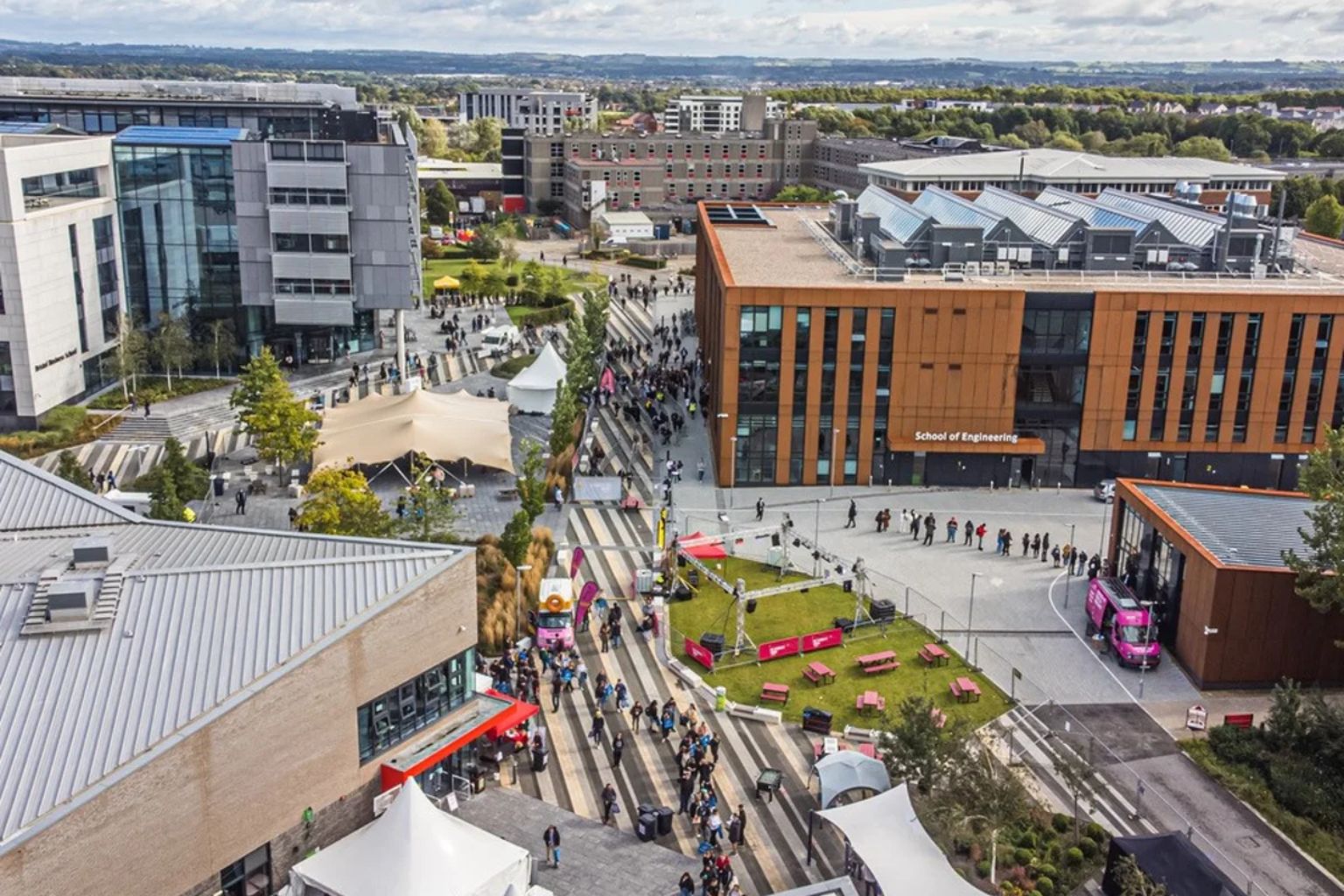
Frenchay is UWE Bristol’s main campus, situated north of central Bristol. It combines academic teaching, research facilities and central student services and serves subjects from more than one college.
Large parts of the College of Arts, Technology and Environment are based at Frenchay, particularly technical and built-environment disciplines. The College of Business and Law is also located there.
Subject facilities include engineering spaces, computing resources, architecture and built-environment facilities, business teaching spaces and law facilities. The campus also accommodates the Bristol Robotics Laboratory. The laboratory is a collaboration between UWE Bristol and the University of Bristol, so it should not be described as belonging exclusively to either institution.
Frenchay contains a major university library, central student services, sports provision and the main Students’ Union building. The library supports several academic disciplines through physical and digital collections, study areas, equipment loans, printing and scanning, and academic study support.
Glenside Campus is in Fishponds, northeast of central Bristol. Its role is more specialised than Frenchay’s and is closely associated with health and social care education, including allied health, nursing and midwifery.
Teaching facilities reflect the practical requirements of health-profession study. They include clinical and simulation spaces such as a replica hospital ward, diagnostic radiography facilities and an eye clinic. Use of individual facilities depends on the programme and teaching activity; their presence at Glenside does not mean every health student uses every specialist space.
Glenside has its own library, with collections and services directed particularly towards health and social care. Facilities include study areas, bookable rooms, assistive technology, loanable equipment, printing and scanning, and anatomical models.
City Campus differs from the other two campus groupings because it is not a single enclosed site. Bower Ashton acts as its academic hub, while Arnolfini, Spike Island and Watershed are also identified as City Campus locations.
Bower Ashton accommodates the School of Arts and provides specialist spaces for creative subjects. Its facilities include studios, workshops and production spaces used in areas such as art, design, film, animation, photography and fashion.
The Bower Ashton library serves creative disciplines and contains art and design resources as well as specialist material including artists’ books and zines.
Arnolfini, Spike Island and Watershed retain their own public and cultural functions while also hosting university activity. They should therefore be understood as locations within UWE Bristol’s distributed creative campus rather than as conventional university teaching buildings of the same type as those at Frenchay.
UWE Bristol organises its academic activity through three colleges. Together they contain ten schools.
The College of Arts, Technology and Environment contains:
School of Architecture and Environment
School of Computing and Creative Technologies
School of Engineering
School of Arts
Its disciplines include architecture, built-environment subjects, planning, computing, creative technologies, engineering and arts. Much of its technical provision is based at Frenchay, while the School of Arts is associated principally with City Campus.
The College of Health, Science and Society contains:
School of Applied Sciences
School of Education and Childhood
School of Health and Social Wellbeing
School of Social Sciences
Its teaching is divided between Frenchay and Glenside according to subject. Applied sciences, education, social sciences and health professions have different facility and teaching requirements. Clinical placements, external professional requirements and accreditation can apply to individual health-related programmes but should not be treated as college-wide conditions.
The College of Business and Law comprises:
Bristol Business School
Bristol Law School
Both are based at Frenchay. Business facilities include a trading room, while law provision includes mock courtrooms. The Business and Law Clinic is used for supervised practical activity connected with relevant study.
The university’s academic provision extends beyond conventional full-time bachelor’s and master’s degrees. It includes foundation study, undergraduate degrees, taught postgraduate courses, postgraduate research, higher and degree apprenticeships, professional and short courses, part-time study, online or distance learning and approved collaborative provision. Individual programme availability and study modes differ across subjects.
UWE Bristol is an independent degree-awarding body. Its degrees are awarded under its own academic authority rather than requiring validation by another university.
Taught awards operate through a modular, credit-based academic system. Programmes are constructed from modules at defined academic levels. Modules carry credit, specify learning outcomes and have assessment requirements.
This common academic structure does not make every programme identical. Programme requirements can vary where professional, statutory or regulatory bodies impose additional conditions. Approved variations may affect assessment, placements, professional practice or other elements of study.
Accreditation and professional recognition therefore apply at programme level. Recognition granted to a particular engineering, health, law or other professionally connected programme should not be presented as an accreditation of the university as a whole.
Teaching methods also vary substantially by discipline. Lectures and seminars form part of many programmes, while other subjects rely more heavily on laboratories, design studios, production spaces, clinical simulation, computing facilities or supervised practical activity.
Apprenticeships have an employment-based component alongside university-level study. Research degrees follow supervisory and examination arrangements distinct from taught courses. Professional and short courses have narrower academic or continuing-development purposes.
Research is organised across the three colleges through centres, groups and school-based activity.
Within the College of Arts, Technology and Environment, named research organisations include the Bristol Robotics Laboratory, Centre for Transport and Society, Computer Science Research Centre, Digital Cultures Research Centre and Science Communication Unit. Other research activity covers architecture, creative technologies, engineering, mathematics and related fields.
The Bristol Robotics Laboratory is institutionally distinctive because it is operated as a collaboration between UWE Bristol and the University of Bristol.
Research associated with the College of Health, Science and Society includes centres such as the Centre for Appearance Research, Centre for Biomedical Research, Centre for Health and Clinical Research, and Centre for Public Health and Wellbeing. Research also takes place through the schools responsible for applied sciences, education and childhood, health and social wellbeing, and social sciences.
Business and law research is organised through Bristol Business School, Bristol Law School and related research groups and centres.
Research governance extends beyond the colleges. Academic Board structures include responsibility for research and knowledge exchange, while the Research and Knowledge Exchange Committee deals with institutional research, knowledge-exchange and enterprise matters. Research ethics and integrity are also incorporated into academic governance.
Postgraduate research is coordinated through the Doctoral Academy. It provides central support for postgraduate research policy and administration and works with research candidates, supervisors, examiners and relevant university services.
Research-degree types identified by UWE Bristol include:
Doctor of Philosophy (PhD)
Master of Philosophy (MPhil)
Doctor of Philosophy by publication (DPhil)
Professional Doctorates
These routes have different academic structures. PhD and MPhil study is based around supervised research and examination. The DPhil route is based on published work. Professional Doctorates combine taught and research elements within defined professional fields.
The university operates dedicated libraries at Frenchay, Glenside and Bower Ashton. Their collections and services reflect the subjects taught at each location.
Frenchay provides multidisciplinary library resources. Glenside concentrates particularly on health and social care, while Bower Ashton supports arts, design and related creative subjects.
Across the library service, students can use physical and digital resources, borrowing services, study areas, printing and scanning, equipment loans and study-skills support. Academic support includes areas such as writing, referencing, research skills and study planning. Assistive technology and adapted study facilities are available in designated locations.
Specialist teaching resources are distributed by subject rather than duplicated across all campuses. Frenchay includes engineering, computing, architecture, built-environment, business and law facilities as well as robotics research infrastructure. Glenside contains clinical and simulation spaces for health education. Bower Ashton provides studios, workshops and production facilities for creative disciplines.
This distribution is important when assessing a programme because access to laboratories, studios, clinics, workshops or other specialist resources depends on the school, course and modules involved.
UWE Bristol provides university-level support alongside school and programme services.
Health and wellbeing services include access to medical, wellbeing, disability, faith and spirituality support. These services sit outside the academic schools and are available as part of the institution’s wider student-support provision.
The Disability Service works with applicants and enrolled students who require reasonable adjustments, assistive technology or other disability-related support. Adjustments are based on individual circumstances and evidence rather than applied uniformly.
Study support is also available through library services. Students can receive help with academic writing, referencing, research skills, study planning, time management and the use of information resources.
Formal university procedures cover matters including assessments, complaints and appeals. These procedures operate alongside support delivered through academic schools.
The Careers and Enterprise Development Team provides support with career exploration, applications, work experience, internships, placements, enterprise and further-study planning. This university-wide service is separate from placements that form a compulsory or optional component of individual programmes. The existence of the service should not be interpreted as a guarantee that every programme includes a placement.
The Students’ Union at UWE has its main building at Frenchay and serves students across the university. Its activities include representation, societies, sports, volunteering and social activities.
UWE Bristol provides student accommodation connected with its wider campus and city-based provision. Accommodation arrangements are separate from academic allocation: a student’s course location and place of residence are related practical considerations but are not the same thing.
The three-campus structure makes location particularly relevant. Frenchay students may spend most of their academic time north of central Bristol, Glenside students may study primarily in Fishponds, while many creative students are based at Bower Ashton or other City Campus locations.
Accommodation availability, property arrangements and eligibility conditions can change between entry periods, so they are not treated here as permanent institutional facts. The stable point for understanding UWE Bristol is that accommodation forms part of its student services while teaching itself remains distributed across distinct campus locations.
UWE Bristol’s international activity includes students studying in Bristol as well as academic relationships with institutions outside the university.
Collaborative provision allows approved partner institutions to participate in delivery leading to UWE Bristol awards. Other agreements provide progression routes in which students undertake earlier study elsewhere before continuing to a UWE programme.
These arrangements are not identical. A partner institution delivering provision that results in a UWE Bristol award has a different academic relationship with the university from an institution participating solely in a progression agreement.
The university also provides Global Student Support for students arriving from outside the United Kingdom. This includes assistance connected with arrival and transition to study in Bristol and access to specialist immigration advice alongside the services available to the wider student body.
Academic and English-language requirements for international applicants can vary by programme and country. Immigration conditions are externally regulated and are separate from the university’s academic degree-awarding responsibilities.
UWE Bristol uses different application routes according to level and type of study rather than one admission process for all applicants.
Full-time undergraduate applicants usually apply through the Universities and Colleges Admissions Service, commonly known as UCAS. Part-time routes can involve direct applications to UWE Bristol or a partner college depending on the programme.
Postgraduate applicants generally use the online application route associated with the relevant course. Research-degree applications follow the requirements of postgraduate research study, while apprenticeship applications operate within employment-linked arrangements.
International students use the relevant undergraduate or postgraduate route, with additional academic, English-language and immigration requirements where applicable.
Entry grades, portfolio requirements, professional experience, supporting documents and other admission conditions are programme-specific. Professionally regulated courses may also have requirements that do not apply to the wider university.
No. The University of the West of England, Bristol, commonly called UWE Bristol, and the University of Bristol are separate universities. Each has its own legal identity, governance arrangements and academic awards.
Bristol Polytechnic gained university status in 1992 and became the University of the West of England. Earlier dates associated with institutions such as the Merchant Venturers’ Navigation School refer to predecessor organisations rather than the legal establishment of the present university.
The university operates through Frenchay Campus, Glenside Campus and City Campus. City Campus is a multi-site grouping centred on Bower Ashton and also includes Arnolfini, Spike Island and Watershed.
UWE Bristol is organised into three colleges containing ten schools. The colleges are the College of Arts, Technology and Environment; College of Health, Science and Society; and College of Business and Law.
Yes. UWE Bristol is an independent degree-awarding body and operates its own academic regulations for its approved awards.
No. Professional, statutory and regulatory recognition applies to individual programmes where relevant. Accreditation attached to one course does not automatically apply to other programmes or to the university as a whole.
Glenside Campus is strongly associated with allied health, nursing and midwifery education and contains clinical and simulation facilities. Some health, science and related provision is based elsewhere, so Glenside should not be treated as the location of every programme within the College of Health, Science and Society.
Bower Ashton is the academic hub of City Campus and houses the School of Arts. City Campus also includes Arnolfini, Spike Island and Watershed as locations used for university activity.
Its provision includes foundation and undergraduate study, taught postgraduate degrees, postgraduate research, higher and degree apprenticeships, professional and short courses, part-time study, online or distance learning and approved collaborative provision.
No. The university provides careers, work-experience and placement support, but placement requirements and opportunities are specific to individual programmes.
